
MG Hector Tomahawk EV vs Mahindra XEV 9S: Flagship Electric 7-Seater SUVs' Top Models Shootout
The launch of the MG Tomahawk EV has caused the 7-Seater EV SUV segment to come alive with proper competition. How does it stack up against rivals like the XEV 9S which have already established themselves in this segment?


Category:
Tag:
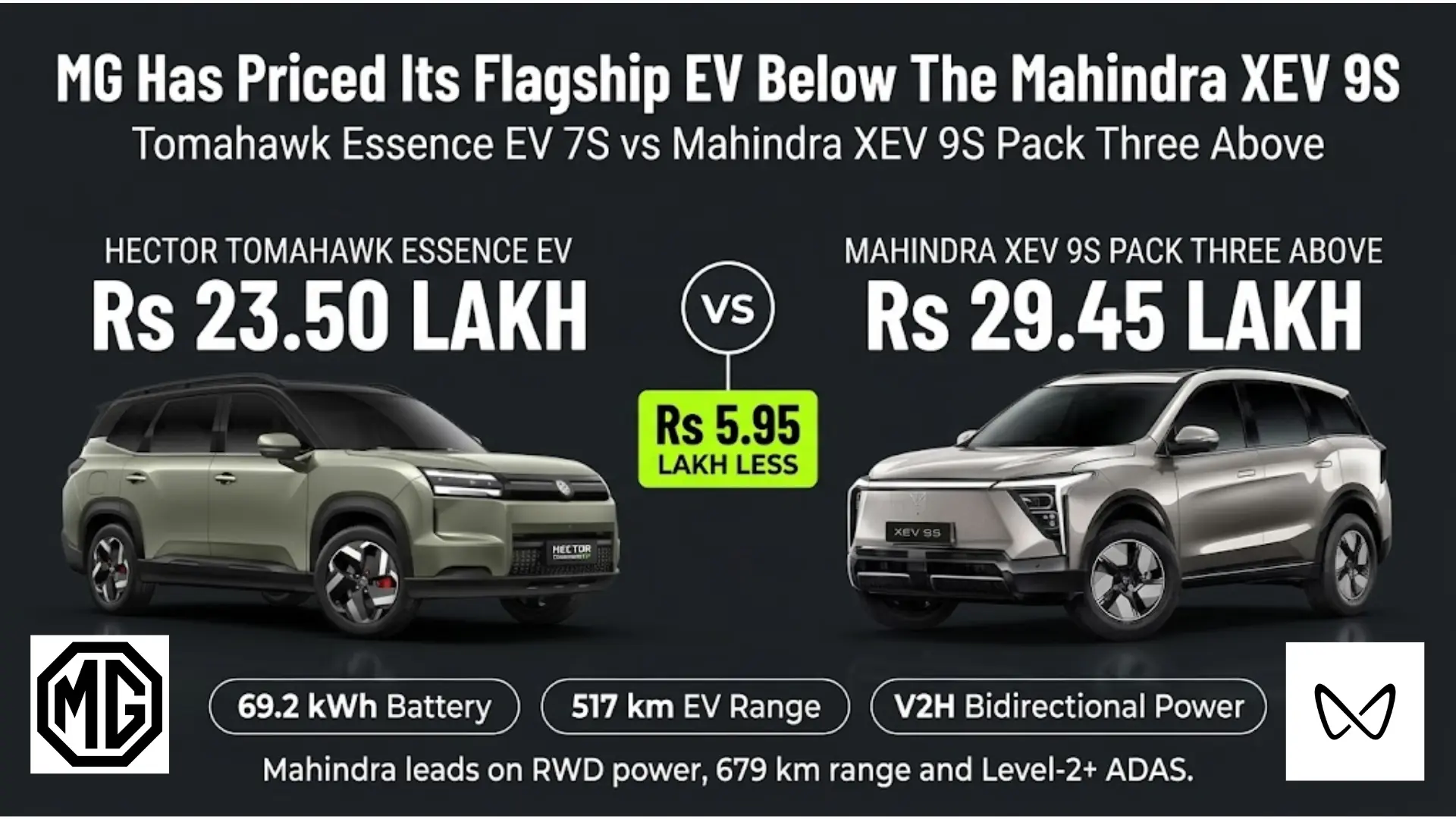
The full-size electric SUV space in India has just been kicked into high gear with the launch of the MG Hector Tomahawk EV. Positioned right at the center of this conversation is a head-to-head rivalry between the MG Hector Tomahawk EV (Essence 7-Seater) and the Mahindra XEV 9S (Pack Three Above 79kWh 7-Seater).
While both vehicles offer three rows of seating and competitive battery packs, their fundamental design philosophies differ significantly, from motor layout and driver-assistance sensor suites to pricing strategy and battery ownership programs.
Exterior Design
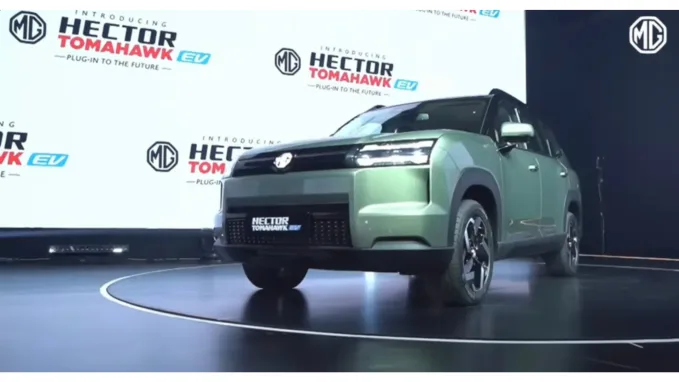
MG Hector Tomahawk EV: Features an upright, classic SUV stance defined by a closed-off body-coloured EV nose, wide-set Beacon LED Projector headlamps, and an illuminated central MG badge. Its boxy glasshouse packaging is complemented by 18-inch dual-tone alloy wheels and a more rugged looking 230 mm ground clearance.
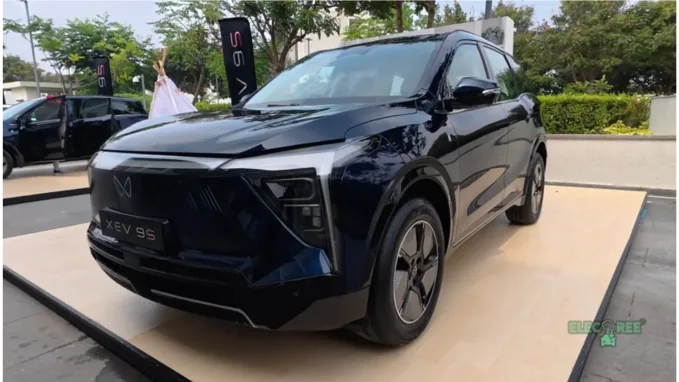
Mahindra XEV 9S: Adopts a sleeker, aerodynamic profile characterized by an illuminated copper-tinted emblem, flush electronic door handles, aerodynamic aero-blade wheels, and an integrated 150-litre front trunk (frunk) with a lower 201 mm ground clearance.
Flagship Variant Specs
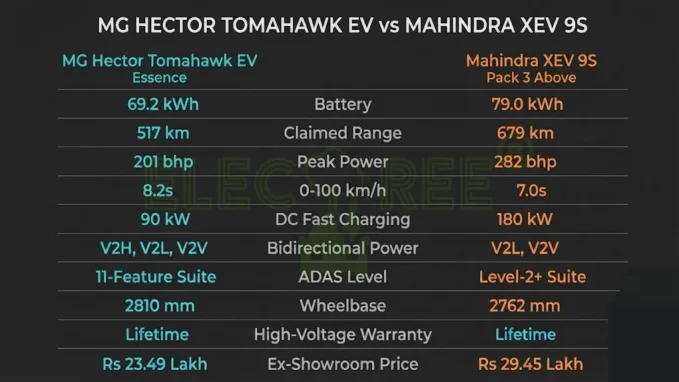
| Spec / Feature Parameter | MG Hector Tomahawk EV (Essence 7-Seater) | Mahindra XEV 9S (Pack Three Above 79 kWh) |
|---|---|---|
| Outright Ex-Showroom Price | ₹23,49,800 | ₹29,45,000 |
| BaaS (Battery-as-a-Service) Price | ₹17,49,000 (+ ₹4.90/km rental) | Not Offered (Outright Only) |
| Platform Architecture | MG ADAPT (Front-Wheel Drive) | INGLO Platform (Rear-Wheel Drive) |
| Battery Pack Capacity | 69.2 kWh LFP Battery | 79.0 kWh LFP Blade Battery |
| Certified Range (ARAI MIDC) | 517 km | 679 km |
| Peak Power Output | 150 kW (204 PS / 201 bhp) | 210 kW (286 PS / 282 bhp) |
| Peak Torque Output | 310 Nm | 380 Nm |
| 0–100 km/h Acceleration | 8.2 seconds | 7.0 seconds |
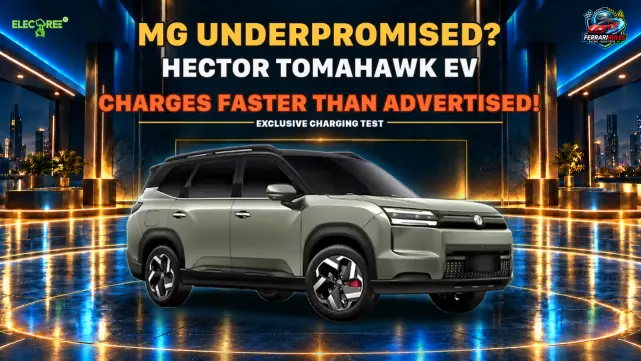
| DC Fast Charging Peak Rate | 90 kW (30–80% in ~35 mins) | 180 kW (20–80% in ~20 mins) |
| ADAS Level 2 Technology | Vision/Camera-Based ADAS Suite with Radar | Radar + Camera Sensor Fusion ADAS |
| Wheelbase & Length | 2,810 mm Wheelbase | 4,745 mm Length | 2,762 mm Wheelbase | 4,737 mm Length |
| Battery Warranty (First Owner) | Lifetime Warranty (15 years) | Lifetime Warranty (15 years) |
Powertrain Dynamics & Drivetrain Architecture
- Mahindra’s INGLO Rear-Drive characteristics: The Mahindra XEV 9S is engineered around a dedicated rear-wheel-drive architecture. Powered by an electric motor delivering 282 bhp (210 kW) and 380 Nm of torque, the XEV 9S moves its substantial footprint from 0 to 100 km/h in around 7 seconds. Its massive 79.0 kWh LFP blade battery yields an ARAI-certified range of 679 km, while support for peak 180 kW DC fast-charging allows a 20% to 80% charge time in roughly 20 minutes under ideal high-power grid conditions.
- MG’s FWD Efficiency and Urban Usability: The Hector Tomahawk EV Essence opts for a front-wheel-drive layout with a Motor producing 201 bhp (150 kW) and 310 Nm of torque. Hitting 0 to 100 km/h in 8.2 seconds, it focuses on progressive throttle calibration tailored for smooth multi-passenger transit. Its 69.2 kWh battery pack delivers a certified 517 km MIDC range, supporting 90 kW DC charging (30% to 80% in 35 minutes) alongside standard 7.4 kW home AC wall-box charging (10% to 100% in 12.5 hours).
ADAS Architecture
The consumer has gotten around to expect some sort of ADAS-adaptation in premium Vehicles over the past couple of years. Both the Hector Tomahawk EV and the Mahindra XEV 9S come equipped with Autonomous Level 2 Advanced Driver Assistance Systems (ADAS) designed to take the fatigue out of highway cruising and dense city traffic. However, the breadth of active features and semi-autonomous capabilities differs between the two flagships.
- MG Hector Tomahawk EV: MG equips the Tomahawk EV with a focused 11-feature Autonomous Level-2 ADAS suite:
- Adaptive Cruise Control (ACC) and Bend Cruise Assistance (BCA)
- Traffic Jam Assist (TJA) and Lane Keep Assist (LKA)
- Lane Departure Warning (LDW) and Lane Departure Prevention (LDP)
- Front Collision Warning (FCW)
- Automatic Emergency Braking (AEB) and AEB-Pedestrian (AEB-P)
- Intelligent Hydraulic Braking Assistance (IHBA)
- Intelligent Headlamp Control (IHC / Auto High Beam)
- Additional Parking Tech: MG integrates these driver-assist functions with an in-cabin 360° HD camera featuring a Transparent Chassis and Wheel View for effortless maneuvering in tight spaces.
- Mahindra XEV 9S (Extended Level-2+ ADAS Capabilities): Mahindra offers a wider array of Level-2+ active driver assistance features that extend beyond standard lane centering and emergency braking:
- Driver-Initiated Auto Lane Change: Tap the turn indicator on expressways, and the vehicle checks surrounding traffic before steering into the next lane automatically.
- Comprehensive Blind-Zone Coverage: Includes Blind Spot Detection (BSD), Rear Collision Warning (RCW), and Front & Rear Cross-Traffic Alert with Autonomous Braking.
- Autonomous Emergency Steering (AES) / Evasive Steering Assist: Automatically assists steering torque to steer around sudden obstacles when braking alone is insufficient.
- AutoPark Assist: Handles semi-autonomous hands-free parallel and perpendicular parking maneuvers.
- Traffic Sign Recognition (TSR): Actively reads and displays speed limits and road warnings on the digital cockpit.
- Augmented Reality Head-Up Display (AR-HUD) & Driver Monitoring: Integrates real-time blind-spot visual cues into the windshield display, paired with a Driver & Occupant Monitoring System (DOMS) to track drowsiness and distraction.
MG’s ADAS features cover the everyday essentials such as adaptive stop-and-go cruising, lane keeping, and emergency braking reliably for urban and highway driving. Mahindra, however, offers a notably more exhaustive feature list, packing premium semi-autonomous conveniences like Auto Lane Change, Rear Cross-Traffic Braking, Auto-Park, and Evasive Steering Assist.
In-Cabin Tech
Cockpit Tech & V2H: The Tomahawk EV features a 39.6 cm Grand View HD Display with GenAI Karaoke and a 10-speaker Infinity audio system. The XEV 9S counters with a pillar-to-pillar triple-screen setup and a 16-speaker Harman Kardon system.
Cabin Practicality: Despite near-identical lengths (4,745 mm vs 4,737 mm), the MG boasts a longer 2,810 mm wheelbase yielding an 85% usable floor area for third-row passengers.
It is also important to note that the Tomahawk EV is offered only in 5 and 7 seater configurations while the XEV 9S is offered in only 6 and 7 seater configurations.
Also, both the 9S and the Tomahawk's interiors bear family resemblance with other EV offering from their brands, such as the XEV 9S and the Windsor respectfully.
The Choice
The ultimate choice of what the consumer purchases will depend entirely on what they want. If they just want an EV to use generally with no extra tricks and trinkets and at a comparatively affordable price, the Tomahawk pulls ahead. But if the consumer wants a more tech driven, cutting edge feature loaded experience with more power and is fine with paying the premium for it, the XEV 9S is the clear choice.
To read more about the MG Hector Tomahawk EV read our article covering its launch.
To comment and participate in discussion Click Here
Trending Articles

Recent Articles
Top 5 Best Selling EVs This Year: Windsor Leads with Clear Margin

Renault Duster Hybrid vs Maruti Suzuki Grand Vitara Hybrid: Base, Mid, and Top Variant Comparison
Exclusive: MG Hector Tomahawk EV Charges Faster than MG Advertises

Renault Duster Hybrid Launched At ₹16,99,000 - See How It Compares With Its Rivals