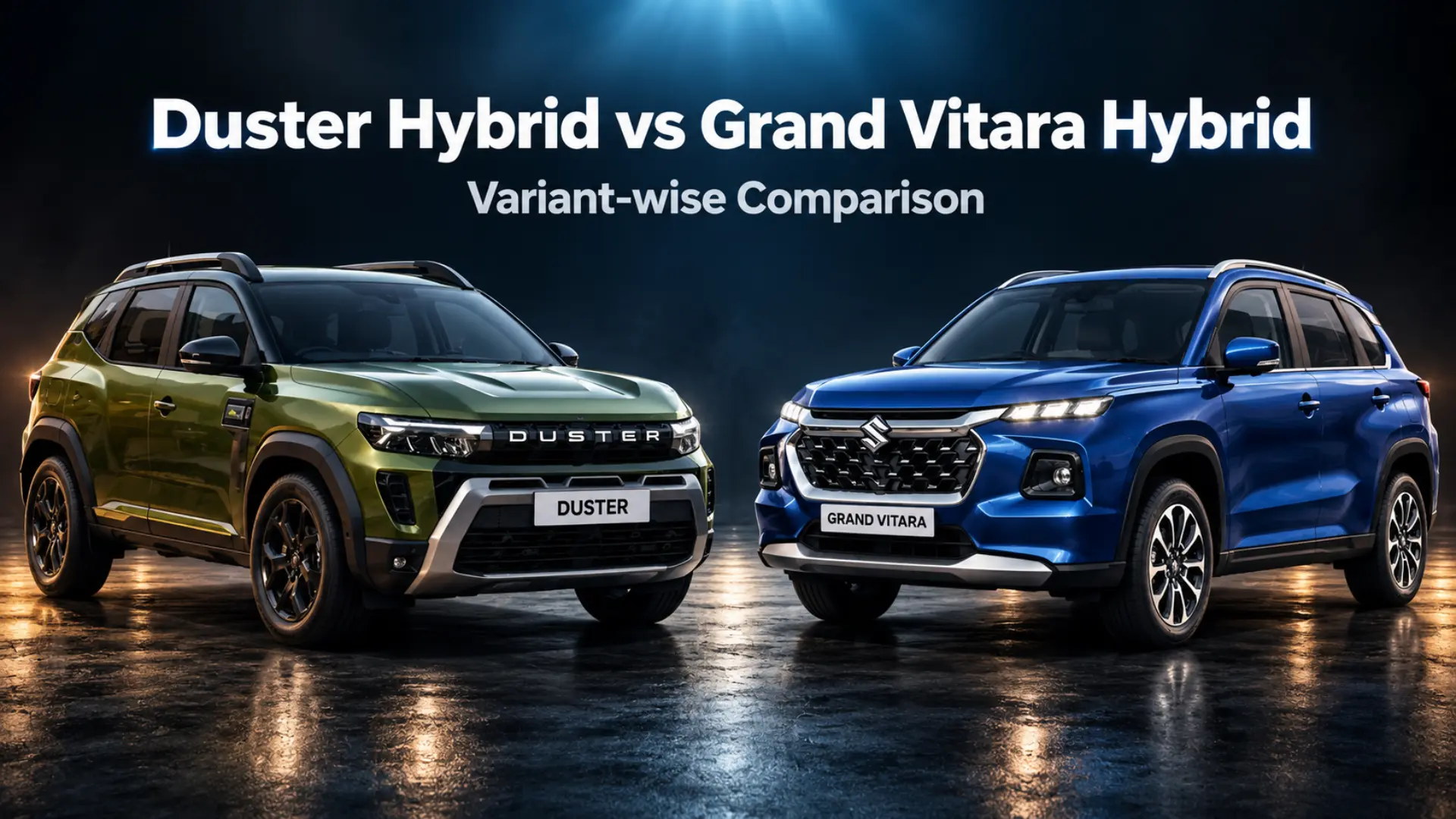
Renault Duster Hybrid vs Maruti Suzuki Grand Vitara Hybrid: Base, Mid, and Top Variant Comparison
The midsize hybrid SUV segment in India has witnessed an aggressive disruption. With the official market launch of the Renault Duster Strong Hybrid E-Tech 160 starting at ₹16.99 lakh, Maruti Suzuki’s established Grand Vitara Intelligent Electric Hybrid (eCVT) faces a direct, high-output petrol-electric adversary.


Category:
Tag:
- Renault Duster Hybrid
- Maruti Grand Vitara Hybrid
- Duster vs Grand Vitara
Both SUVs leverage true self-charging petrol-electric powertrains capable of running on electric energy during heavy city traffic while eliminating range anxiety on long highway hauls. However, their underlying mechanical philosophy, power output, battery cooling architectures, and pricing strategies differ significantly across their respective variant lineups.
E-Tech Multi-Mode vs Toyota-Sourced eCVT
Before comparing trim-by-trim feature lists, understanding the structural powertrain differences reveals why these two hybrid systems behave so differently on the road
Technical Benchmark | Renault Duster Strong Hybrid E-Tech 160 | Maruti Suzuki Grand Vitara Strong Hybrid |
|---|---|---|
Engine Architecture | 1.8-Litre 4-Cylinder Naturally Aspirated Petrol (109 hp) | 1.5-Litre 3-Cylinder Atkinson Cycle Petrol (92.5 hp) |
Electric Traction Motor | 49 hp / 208 Nm torque | 79 hp / 141 Nm torque |
Secondary Starter-Generator | 20 hp High-Voltage Starter Generator (HSG) | Integrated Starter Generator (ISG) |
Combined Output | 160 PS (158 bhp) / 208 Nm | 115.56 PS (114 bhp) / 141 Nm |
Battery Chemistry & Capacity | 1.4 kWh (247V NMC) with Direct Refrigerant Cooling | 0.76 kWh (177.6V Li-ion) Air-Cooled |
Transmission Tech | Clutchless Multi-Mode Gearbox (2 EV + 4 ICE ratio combinations) | Power-Split e-CVT Planetary Gearset |
0–100 km/h Acceleration | 9.6 seconds | ~12.2 seconds |
ARAI Fuel Efficiency | 29.0 km/l (Over 1,400 km range on 50L tank) | 27.97 km/l (Over 1,250 km range on 45L tank) |
Renault’s E-Tech system uses a larger 1.4 kWh battery operating at 247V with direct refrigerant cooling—enabling it to run up to 80% of city commutes in pure EV mode. The Grand Vitara utilizes Toyota's proven air-cooled 0.76 kWh battery paired with an e-CVT. While Maruti focuses on continuous smooth progression, Renault delivers a punchier 160 PS output and faster 0–100 km/h sprint times.
Base Variant Comparison: Duster Evolution vs Grand Vitara Delta Plus
Renault Duster Hybrid Evolution: ₹16,99,000 (Ex-showroom)
Maruti Suzuki Grand Vitara Delta Plus Hybrid: ₹16,99,000 (Ex-showroom)
Price & Commercial Positioning
Both manufacturers target aggressive entry-level hybrid conversion, pricing their base variants identically at ₹16.99 lakh ex-showroom.
Infotainment, Cluster, & Connectivity
The Duster Evolution comes fitted with a 10.1-inch central touchscreen running Built-in Google OS, wireless Android Auto/Apple CarPlay, and a 7-inch digital TFT instrument cluster. The Grand Vitara Delta Plus counters with a smaller 7-inch SmartPlay Pro screen with basic digital gauges.
Wheels, Exterior & Lighting
The Grand Vitara Delta Plus gets full LED projector headlamps and factory 17-inch alloy wheels. The Duster Evolution utilizes 17-inch styled steel wheels with basic LED DRLs, though its wheel arches are wide enough to house the 18-inch rims found on higher trims.
HVAC, Safety & Color Palette
The Duster Evolution includes Dual-Zone Automatic Climate Control at the base level, whereas the Grand Vitara offers a single-zone unit. Both cars provide 6 airbags, ESC, Hill Hold, and ISOFIX mounts. Color choices for the Duster Evolution are limited to Pearl White, Moonlight Silver, and Stealth Black.
Base Variant Verdict
At ₹16.99 lakh, the Duster Evolution offers significantly higher mechanical value: 160 PS vs 114 bhp, a larger battery, dual-zone AC, and a superior 10.1-inch infotainment unit. The Grand Vitara Delta Plus counters with factory alloy wheels, LED projectors, and Maruti's low-maintenance network footprint.
Mid Variant Comparison: Duster Techno vs Grand Vitara Zeta Plus (O)
Renault Duster Hybrid Techno: ₹18,99,000 (Ex-showroom)
Maruti Suzuki Grand Vitara Zeta Plus (O) Hybrid: ₹18,55,300 (Ex-showroom)
Ride Quality & Safety Architecture
The Duster Techno introduces Frequency-Dependent Dampers (FDD) specifically tuned to isolate harsh Indian road surfaces, alongside Blind Spot Detection and active Level-1 ADAS alerts managed via Renault’s "My Safety Switch". The Grand Vitara Zeta Plus (O) skips active driver assistance alerts.
Interior Tech & Ergonomic Convenience
The Grand Vitara Zeta Plus (O) includes a pop-up Head-Up Display (HUD), ambient footwell lighting, and a built-in wireless charging pad. The Duster Techno counters with Qi2 magnetic wireless charging, full-screen Google Maps mirroring directly within the driver's display, rain-sensing wipers, and auto-dimming rearview mirrors.
Glass Area & Color Options
Both mid-tier models feature a broad Electric Panoramic Sunroof. The Duster Techno expands color options to River Blue, Sunset Red, and Mountain Jade Green, along with optional dual-tone Stealth Black roof finishes.
Mid Variant Verdict
The Grand Vitara Zeta Plus (O) undercuts the Duster Techno by ~₹43,700, offering a HUD and ambient cabin lighting. However, the Duster Techno justifies its price gap by offering active safety alerts, frequency-dependent suspension damping, and full Google navigation integration directly in the driver's gauge cluster.
Top Variant Comparison: Duster Emotion vs Grand Vitara Alpha Plus (O)
Renault Duster Hybrid Emotion: ₹19,49,000 (Ex-showroom)
Maruti Suzuki Grand Vitara Alpha Plus (O) Hybrid: ₹19,77,400 – ₹19,92,000 (Ex-showroom)
Price-to-Value Positioning
The range-topping Duster Emotion undercuts the Grand Vitara Alpha Plus (O) by ₹28,400 to ₹43,000, reversing the base-variant dynamic and delivering aggressive top-end value.
Cabin Ergonomics & Power Seating
The Duster Emotion upgrades seating comfort with 6-way power-adjustable ventilated front seats for both the driver and passenger. The Grand Vitara Alpha Plus provides ventilated front seats, but limits them to manual slider/recline adjustments.
Tailgate Utility & Boot Packaging
The Duster Emotion features a hands-free Electric Powered Tailgate opening to a 372-litre trunk volume up to the parcel shelf (544 litres to the roof). The Grand Vitara Alpha Plus uses a manual liftgate and suffers from a slightly raised boot floor due to its air-cooled battery packaging.
Driver Displays & Parking Assist
The Duster Emotion gets a crisp 10.25-inch digital driver display and 18-inch diamond-cut alloy wheels. The Grand Vitara Alpha Plus relies on a 7-inch TFT cluster but retains a key feature advantage with its 360-degree surround-view camera system and TPMS, whereas the Duster Emotion relies on rear parking cameras and blind-spot sensors.
Top Variant Verdict
The Renault Duster Emotion stands out as the superior top-spec choice. Undercutting its Maruti rival by up to ₹43,000, it offers 6-way power-adjustable ventilated seats, a powered tailgate, 18-inch wheels, a 10.25-inch map display, and a punchier 160 PS powertrain. The Grand Vitara Alpha Plus remains attractive primarily for buyers prioritizing a 360-degree camera and Maruti's widespread service footprint.
Which one to pick
Choose the Renault Duster Strong Hybrid if: You want class-leading power (160 PS), high fuel efficiency (29 km/l), direct-refrigerant battery cooling, dual power-ventilated seats, and a powered tailgate—especially in the top-spec Emotion trim where it directly undercuts the competition.
Choose the Maruti Suzuki Grand Vitara Hybrid if: You prefer tech features like a 360-degree camera and Head-Up Display, along with maximum resale security and extensive dealer support across India.
Trending Articles