
Is India’s EV Market Maturing or Just Growing Up Too Fast?
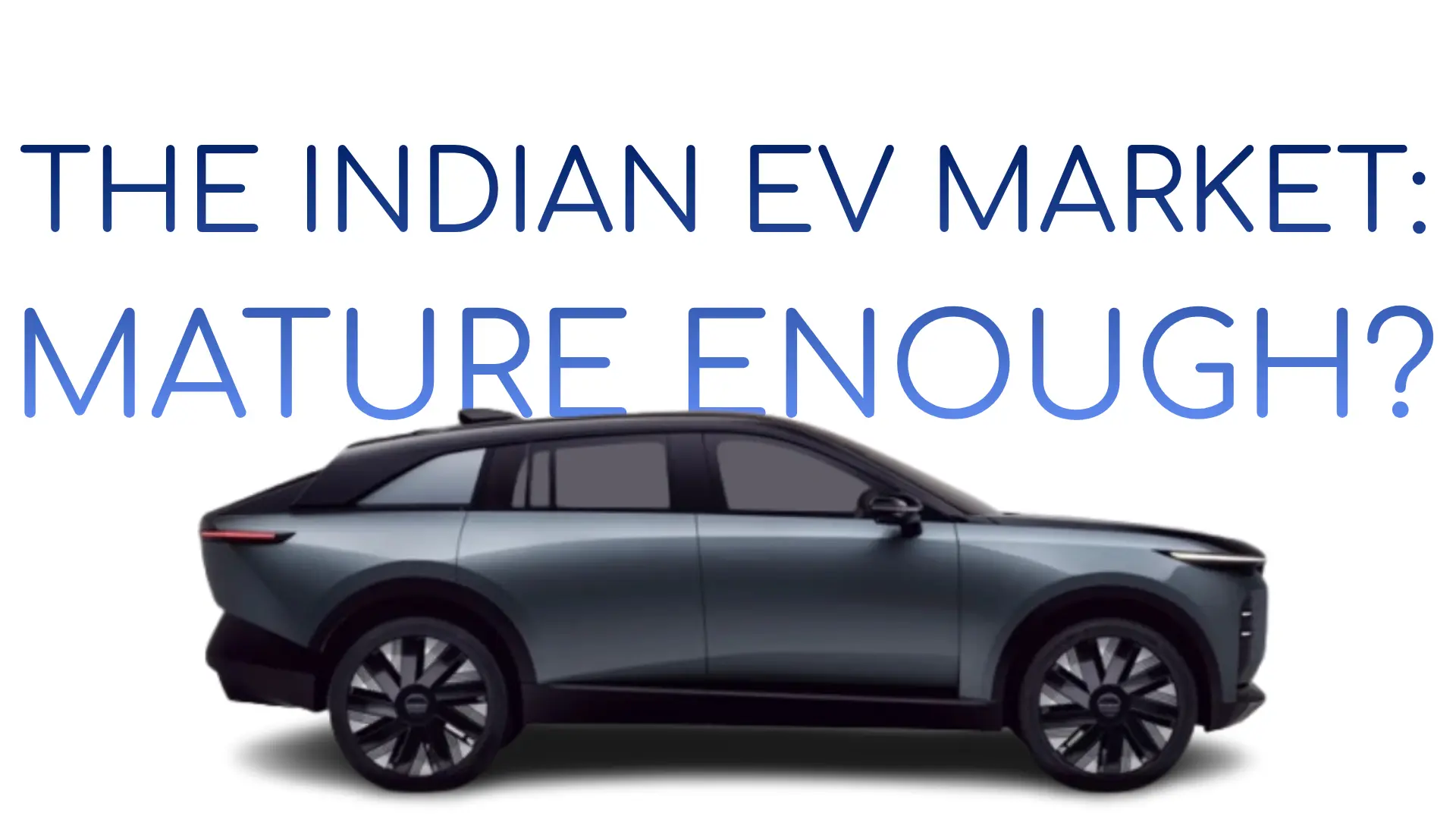
As Indian automakers abandon makeshift petrol conversions for purpose-built electric platforms, the country's EV market is rapidly catching up to global vehicle standards. But behind the high-tech dashboards and 600-km range claims, what is the reality of the industry?


Category:
Tag:
- Indian EVs
- EV Market
- Local OEMs
The Turning Point of Indian Electric Mobility
For years, the Indian EV market followed a predictable, and frankly safe bet of an engineering shortcut, which was taking a popular petrol or diesel chassis, stripping out the internal combustion engine, squeezing a battery pack into the transmission tunnel and fuel tank cavity, and rolling it out with a green license plate.
That first-generation approach was essential to kickstart adoption and prove that electric cars could survive the Indian market with minimal risk financially. However, a massive shift is now reshaping India's automotive landscape. With passenger EV retail sales climbing past 32,900 units per month, marking over 83% YoY growth, the Indian consumer is no longer a naive early adopter willing to accept design compromises.
The market is undergoing a rapid structural transition. On the product side, Indian OEMs are engineering vehicles that align with global benchmarks set in Europe, China, and North America. Yet, on the infrastructure and supply chain side, the country is navigating severe growing pains.
The Death of the Conversion EV
The clearest metric of India's EV maturity is the retirement of converted internal combustion engine (ICE) chassis in favor of dedicated, ground-up electric architectures.
Converted EVs almost always tend to carry these engineering flaws:
- The High-Floor Problem: Placing battery modules under a floorboard designed for a petrol car forced rear-seat passengers into an uncomfortable, knees-up seating position.
- Compromised Packaging: Transmission humps restricted cabin legroom, while battery integration in the rear trunk eliminated spare tire storage and reduced overall luggage capacity.
- Thermal and Charging Constraints: Retrofitted cooling loops struggled to manage heat during high-speed DC fast-charging, capping peak charging speeds at modest 30 kW–50 kW rates to prevent cell degradation.
To replace these early conversions, domestic OEMs have deployed dedicated skateboard platforms. Architectures like Tata Motors' Acti.ev, Mahindra's INGLO skateboard, and in the 2W space, Ather Energy's EL-01 modular platform feature flat cabin floors, longer wheelbases, and structural battery casings built directly into the chassis.
These ground-up platforms allow for larger 60 kWh to 80 kWh battery packs, unsurprisingly leading to longer real-world range estimates. Crucially, active liquid-cooling systems enable incredibly faster charging speeds. Then there's also the fact that ground up EVs also generally tend to be a bit lighter than their conversion EV counterparts.
The 2026 Sales Surge and Stock Clearances
The migration toward next-generation platforms and the trust built upon them has triggered a shift in showroom footfall for EVs. Monthly registration data reflects both rapid overall category expansion and intense competition among domestic powerhouses.
Indian Passenger EV Registration Data(July 2026):
| Total Passenger EV Registrations | 32,928 units |
|---|---|
| Tata Motors | 13,678 units |
| Mahindra Automotive | 7,742 units |
| JSW-MG | 5,689 units |
| Maruti Suzuki | 1,600 units |
To clear out legacy conversion stock and make room for dedicated skateboard arrivals, manufacturers have rolled out aggressive festive season promotional offers. Market leader Tata Motors led this wave by introducing stacked consumer benefits and scrappage incentives ranging up to ₹3.35 lakh on models like the Curvv.ev, alongside substantial discounts on outgoing variants of the Punch.ev and Tiago.ev. This has managed to inflate sales of otherwise low-sales models, like the Curvv.ev.
At the same time, Mahindra's surge, driven by strong demand for its expanded lineup, has pushed its market share up to 24.1%, demonstrating that Indian buyers will rapidly adopt electric SUVs when offered spacious, ground-up alternatives which are tech laden and look unique, especially when compared to their ICE counterparts.
Beyond Pure BEVs
Mature global markets have demonstrated that pure Battery Electric Vehicles (BEVs) are not the sole answer for every driver demographic, particularly in countries with vast geographic distances and variable highway charging density. India’s market is rapidly adapting by embracing multi-energy architectures and Plug-in Hybrid Electric Vehicles (PHEVs).
Rather than forcing buyers to choose strictly between ICE and pure electrics, flexible platforms are offering a hybrid bridge and can offer a more linear transition for ICE users into the EV automobile ownership world.
Through upcoming launches like JSW-MG’s ADAPT platform, paving way for the Hector Hawk, and JSW Motors’ standalone partnership with Chery to bring Jetour Plug-in Hybrids to India, the market is introducing vehicles that combine zero-emission urban commutes with range anxiety-free highway commutes. This directly addresses the concerns of long-distance highway drivers while national charging networks continue to expand.
Where India’s Infrastructure Lags Behind
While vehicle engineering has made undeniable strides, the supporting ecosystem remains incomplete. Evaluating everyday EV ownership reveals critical infrastructure gaps that keep the market in its infancy.
To just skim over the details, Vehicle quality and Engineering is maturing incredibly fast, with ground up EVs being designed and manufactured by local OEMs, although the battery technology is still borrowed or bought from Chinese or European OEMs.
The Public chargers network is expanding at a steady pace as you read this, with 52,718 stations at the time of publishing this article, out of which 16,561 are fast chargers.
However,
The Charger-to-EV Ratio Deficit
As mentioned above, according to Ministry of Heavy Industries data, India has expanded its public network to 52,718 public charging stations, including 16,561 fast-charging points. While this represents a near six-fold increase from 2022 levels, the growth rate of public chargers still lags behind vehicle adoption.
Against an active operational fleet of millions of electric two-wheelers, three-wheelers, and passenger cars, India’s public charger-to-EV ratio sits at approximately 1:54. In contrast, mature markets in China and Europe operate at ratios of around 1:20, creating a buffer against congestion at charging hubs.
"Charger Anxiety" and App Fragmentation
For the average Indian EV driver, traditional "range anxiety" has evolved into “charger anxiety”, which is the uncertainty over whether a public station will be operational, accessible, or blocked upon arrival.
Hardware Downtime: Public networks frequently report stations offline due to grid voltage spikes, unmaintained cable connectors, or severed communication modules.
Payment Fragmentation: Instead of a standardized "plug-and-charge" or unified credit card/UPI terminal at the stall, drivers are forced to download dozens of Charge Point Operator (CPO) apps, each requiring individual wallets and account setups.
Grid Sanctions and Local DISCOM Bottlenecks
Installing high-output public charging stations (150 kW to 300 kW) requires robust high-voltage grid connections. Charge Point Operators routinely encounter multi-month administrative delays in securing load approvals, transformer installations, and land-use permits from local state electricity distribution companies.
The Local Supply Chain Gap
A truly mature automotive ecosystem requires upstream supply chain independence. While Indian OEMs have mastered vehicle software, chassis design, and motor assembly, the core heart of the vehicle, the lithium-ion battery cell, remains a major vulnerability.
Indian manufacturers rely heavily on imported cells from East Asian suppliers. While Production Linked Incentive (PLI) schemes for ACC battery manufacturing are funding local Gigafactory constructions, full commercial independence is still years away. Until localized cell manufacturing reaches scale, Indian EVs remain exposed to global supply chain disruptions, shipping bottlenecks, and raw material price volatility.
The Bottom Line
India’s EV transformation has moved far beyond a niche experiment. Automakers have demonstrated that they can design, engineer, and mass-produce world-class electric vehicles on dedicated skateboard platforms tailored to local wants and needs, while also being competitive on a global level.
However, a mature electric market demands more than impressive cars in showrooms. It requires a dependable, seamlessly integrated charging grid and localized battery manufacturing. Until public infrastructure and supply chain depth catch up with the vehicles rolling off assembly lines, India’s EV revolution will remain a story of advanced machines navigating a work-in-progress ecosystem.
The future looks bright though, with massive projects and developments undergoing right as you read this article, and purchasing an EV in the Indian market is no longer a niche concept but something which has to, and is being considered by the common customer in the same light as purchasing an ICE.
Trending Articles


Recent Articles

India Clears ₹1.86 Lakh Crore Green Energy Corridor Plan With ₹50,000 Crore for Battery Storage
Porsche Cayenne Electric Launched in India at ₹1.77 Crore: 642 Km Range, 400 kW Charging and More
Government's CAFE III Norms Give EVs a 3x Credit, PHEVs 2.5x
Creta Electric Owners Approach Hyundai - File Petition for Lifetime Battery Warranty