
Government's CAFE III Norms Give EVs a 3x Credit, PHEVs 2.5x
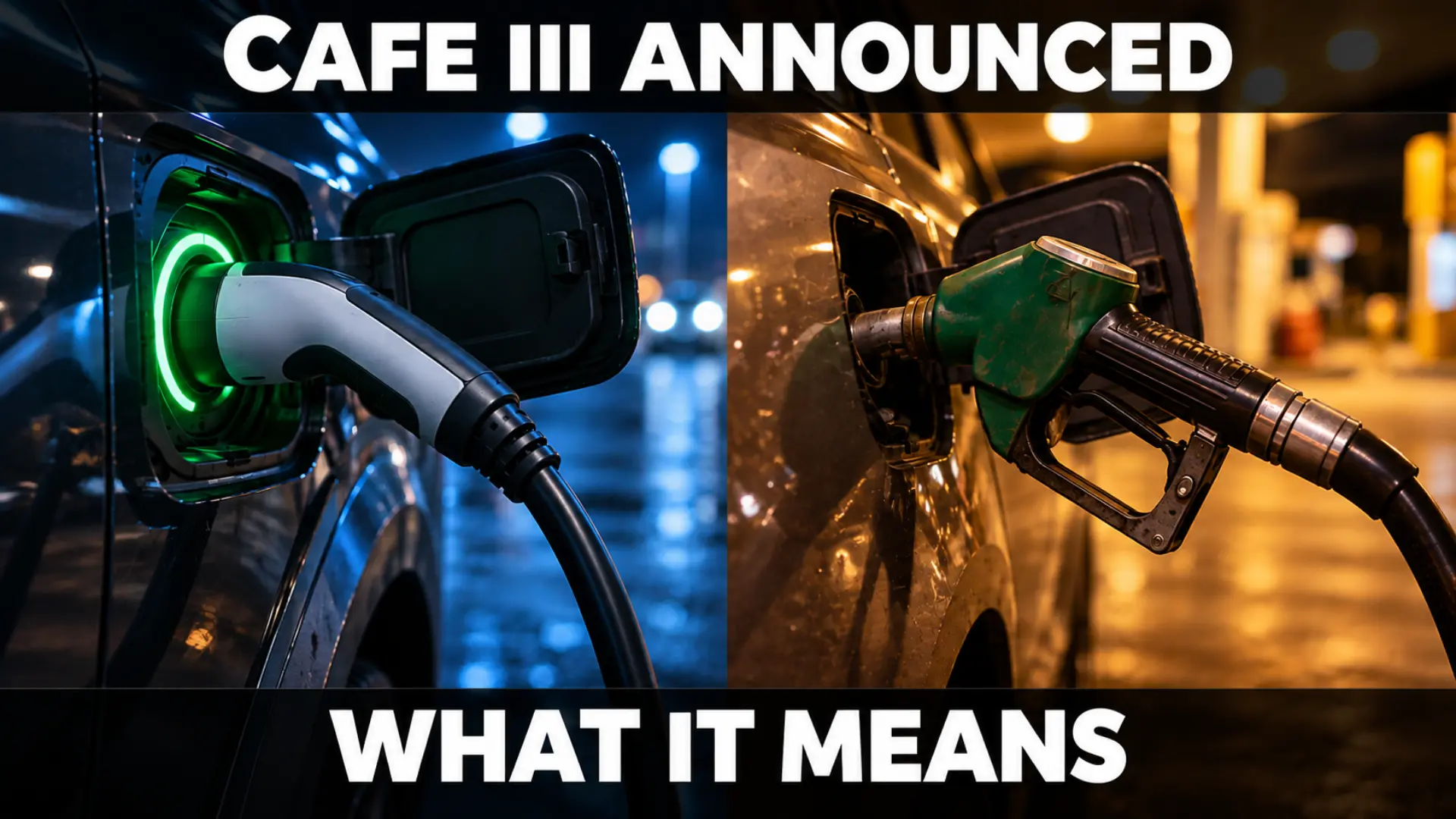
Under CAFE III, an EV sold counts as three cars and a PHEV as 2.5 when a manufacturer's fleet efficiency is calculated, a credit worth roughly ₹59,000 per car in avoided cost. Small-car makers, meanwhile, face a tougher target than SUV-heavy lineups.


Category:
Tag:
- CAFE III
The Ministry of Power has notified the next phase of India's Corporate Average Fuel Economy (CAFE) norms for passenger vehicles, covering April 1, 2027 through March 31, 2032. Under CAFE III, every carmaker gets an annual fleet-wide fuel efficiency target, based on the average weight of everything it sells, and that target gets stricter every year through the five-year period.
How EVs Get Counted
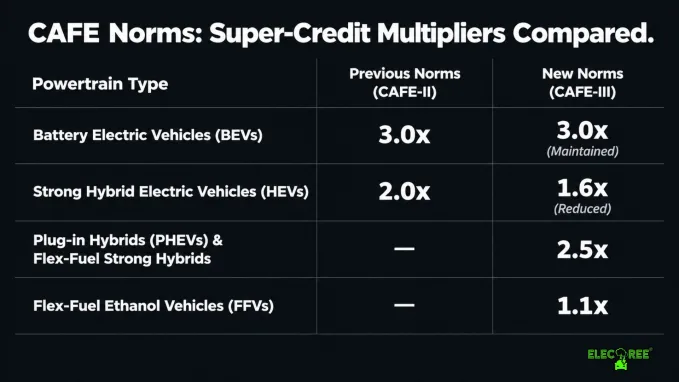
Buried inside the notification is a mechanism that matters more to carmakers' incentives than the headline targets themselves. When a manufacturer calculates how efficient its fleet actually was in a given year, every electric vehicle it sold doesn't count as one car, it counts as three. Plug-in hybrids count as 2.5. Strong hybrids count as 1.6. This credit system can be the difference between a manufacturer comfortably meeting its target and falling well short of it, without changing a single petrol engine.
How the Math Works
Take a hypothetical Manufacturer X, selling 100 cars in a year: 80 petrol cars averaging 6 litres/100km (about 16.7 km/l), and 20 EVs working out to about 1 litre/100km (100 km/l) in petrol-equivalent terms (electricity gets converted to a fuel-equivalent figure using a fixed government formula).
Simple math, without any credit boost: (80×6 + 20×1) ÷ 100 = 5 litres/100km, which works out to 20 km/l. CAFE III's target for a fleet like this comes out to roughly 25 km/l. At 20 km/l, Manufacturer X falls well short.
Now apply the government's rule that each EV counts three times over. the car count becomes 140; 80 petrol cars plus 60 EV-equivalents (20 × 3). The total fuel used barely changes, but dividing it by the inflated count of 140 instead of 100 brings the fleet average down to about 3.86 litres/100km, or roughly 25.9 km/l, clearing the 25 km/l bar.
So without selling a single additional EV beyond the 20 it already sold, or making any of its petrol engines more efficient, Manufacturer X's reported fleet efficiency jumps from 20 km/l to nearly 26 km/l, purely because of how EVs are weighted in the calculation.
Small Cars Lose Benefit
CAFE III's target isn't the same number for every manufacturer, it's tied to how heavy their fleet is on average, and it works in the SUV's favor. A manufacturer selling mostly small, light cars, averaging around 900 kg, faces a target of about 29 km/l. One selling heavier, SUV-leaning cars, averaging around 1,600 kg, only needs to manage about 22 km/l. The natural fuel-efficiency edge a small car has from being light doesn't translate into an easier target, it's held to a tougher one precisely because it's light, while heavier vehicles get more room.
Why Credits Matter
Falling short of the target isn't just a compliance problem, it has an actual rupee cost attached. Manufacturer X's 5 km/l shortfall (20 km/l against a 25 km/l target) works out to a debit of roughly 23.7 grams of CO2 per km, the standard conversion used throughout these norms. Manufacturers can offset a shortfall by buying credits from the Bureau of Energy Efficiency, at a price that starts at ₹2,500 per gram of CO2/km in FY2027-28. At that price, Manufacturer X's shortfall would cost roughly ₹59,000 per car sold. Scaled up to a manufacturer selling 100,000 such cars a year, that's close to ₹590 crore it would need to spend just to stay compliant.
The flip side works the same way. Once the EV credit lifts Manufacturer X's fleet above the 25 km/l target, it isn't just compliant, it's sitting on a surplus, worth roughly ₹8,500 per car, or about ₹85 crore across 100,000 cars, that it can either bank for a future year or sell outright to another manufacturer that's falling short.
What this means in practice is that under CAFE III, an EV isn't just worth what it sells for. It's also worth avoiding a cost, or generating a surplus, that scales into hundreds of crores for a large manufacturer. That's a direct financial incentive, separate from subsidies or consumer demand, for automakers to push EV volumes higher over the next five years, since the credit math rewards EV sales far more than the sales numbers alone would suggest.
The Case Against a 2.5x PHEV Credit
This is where the credit system's design gets questionable. A plug-in hybrid gets a 2.5x weighting in this same calculation, not far behind a full EV's 3x, even though a PHEV still depends on imported crude whenever it isn't charged. Real-world data from markets where PHEVs have been sold far longer than in India suggests that gap matters more than the credit system accounts for. The International Council on Clean Transportation and Transport (ICCT) have found that real-world PHEV emissions in Europe run far above their official, type-approved figures, in one case nearly five times higher, because a large share of PHEV owners simply don't plug in regularly and end up driving on the engine most of the time. The European Union has already had to apply corrective adjustments to PHEV test figures in response.
If Indian PHEV buyers behave anything like their counterparts elsewhere, a 2.5x credit assumes a level of real-world electric driving that may not actually happen, handing manufacturers a credit worth almost as much as a full EV's, for a car that could end up running mostly on fuel. Whether India's PHEV buyers turn out differently is something only a few years of real-world data will show, but the credit weighting is already locked in through 2032.
To comment and participate in discussion Click Here
Trending Articles




Recent Articles

Creta Electric Owners Approach Hyundai - File Petition for Lifetime Battery Warranty
PM E-DRIVE Funds New EV Crash-Test Facility at Chennai's GARC
TATA Extends BaaS Across Its Entire EV Portfolio: What the Numbers Mean
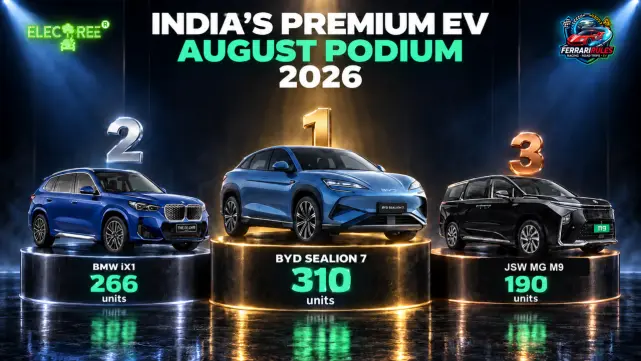
BYD Sealion 7 Leads Premium EV Registrations in August 2026; BMW iX1 and JSW MG M9 Complete Top Three