India Clears ₹1.86 Lakh Crore Green Energy Corridor Plan With ₹50,000 Crore for Battery Storage
The Union Cabinet has approved the ₹1.86 lakh crore Green Energy Corridor Phase-III, including ₹50,000 crore for 50 GWh of grid-scale battery storage and ₹1.36 lakh crore for intra-state transmission. While the scheme does not directly fund EVs or charging infrastructure, it strengthens the electricity system that will increasingly support India's wider electrification transition.



Category:
Tag:
- Green Energy Corridor
India is putting more money into the infrastructure needed to move and store renewable electricity, with the Union Cabinet approving the third phase of the Green Energy Corridor programme.
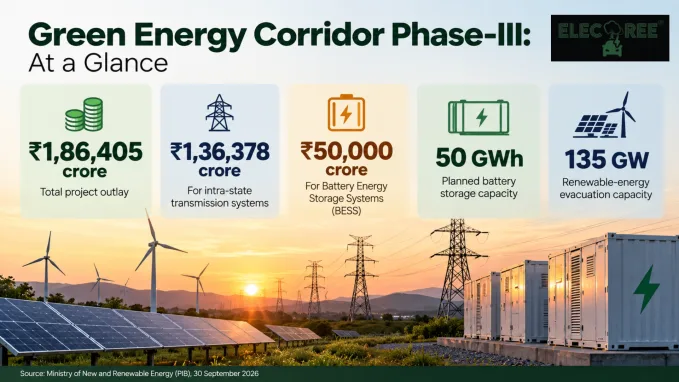
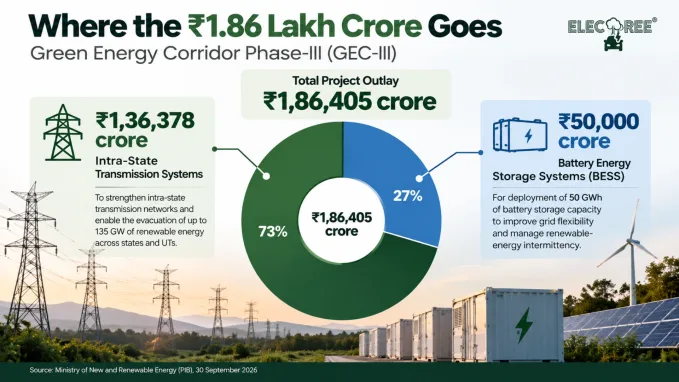
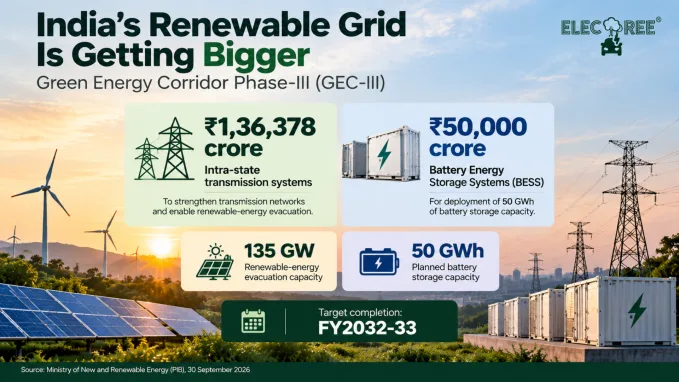
The Green Energy Corridor Phase-III (GEC-III) has a total project outlay of ₹1,86,405 crore. Of this, ₹1,36,378 crore will go towards strengthening intra-state transmission systems, while ₹50,000 crore has been earmarked for 50 GWh of Battery Energy Storage Systems (BESS).
The scheme is targeted for completion by FY2032-33 and is expected to facilitate the evacuation of up to 135 GW of renewable energy across states and Union Territories, according to the Ministry of New and Renewable Energy.
Where the ₹1.86 Lakh Crore Will Go
The largest share of the programme, ₹1,36,378 crore, is for intra-state transmission infrastructure.
This is important because adding renewable generation capacity is only one part of integrating more solar and wind power into the electricity system. The electricity also needs to be moved from generation centres to areas where it is required.
GEC-III is intended to strengthen these intra-state networks and enable the evacuation of up to 135 GW of renewable power.
The remaining ₹50,000 crore is for deploying 50 GWh of BESS. The government says these storage systems can be located at renewable-energy developer or generator sites, or at other locations where they can improve grid flexibility.
Why Does India Need Battery Storage?
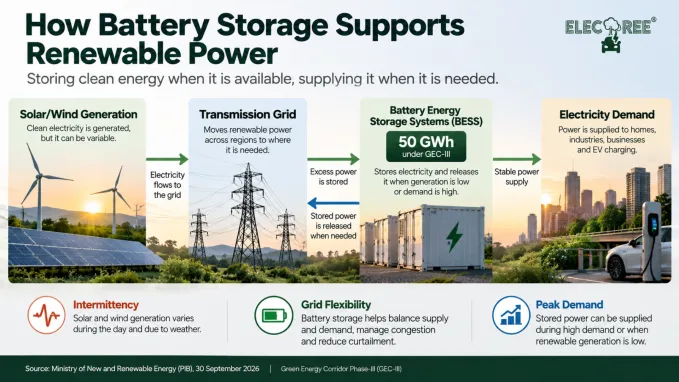
Solar and wind generation does not always match electricity demand.
Solar generation is concentrated during daylight hours, while electricity demand can continue after sunset. Wind generation can also vary depending on weather conditions.
This creates a need for storage that can hold electricity when supply is available and release it when the grid needs it.
The government says the BESS component under GEC-III is intended to address renewable-energy intermittency, transmission congestion and peak-hour curtailment, while helping meet demand during non-solar hours.
In other words, the plan is not simply about producing more renewable electricity. It is also about making that electricity more usable across different times of the day.
This Is Not an EV Battery Subsidy
For the automobile sector, one distinction is important: the ₹50,000 crore allocation is not a subsidy for batteries used in electric vehicles.
The money is intended for grid-scale Battery Energy Storage Systems.
An EV battery stores electricity to power a vehicle. A grid-scale BESS stores electricity for the power system and can release it when required. The two use related battery technologies but serve different purposes.
The direct focus of GEC-III is therefore the electricity grid, renewable-energy integration and stationary storage.
Its connection to automobiles is more indirect.
Why the Automobile Industry Should Care
Electric vehicles ultimately depend on the electricity system around them.
As EV adoption grows, charging will add to electricity demand from homes, workplaces, commercial facilities and public charging networks. At the same time, India is adding more solar and wind generation to its power mix.
That creates two parallel requirements: more electricity generation and a grid capable of moving and balancing that electricity.
GEC-III addresses part of that second requirement.
The scheme does not provide funding for EV charging infrastructure, nor does the government describe it as an EV programme. Instead, it strengthens the upstream electricity infrastructure on which charging and other forms of electrification will increasingly depend.
This makes the announcement relevant to the automobile sector without turning it into an EV policy story.
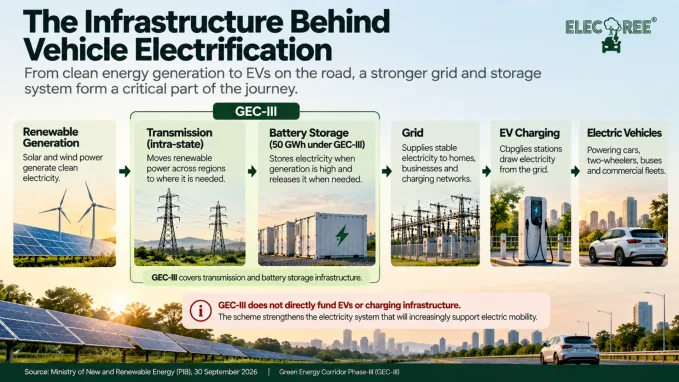
Transmission May Be the Less Visible Part of the Story
The ₹50,000 crore storage allocation is likely to attract attention because of the scale of the battery deployment. But transmission accounts for more than twice that amount under GEC-III.
That reflects another challenge facing India's renewable-energy expansion.
A solar or wind project can generate electricity, but that power still needs adequate transmission capacity to reach consumers. If the network is constrained, some available renewable generation may not be fully utilised.
By strengthening intra-state transmission, GEC-III is designed to reduce some of those constraints and prepare the grid for a larger renewable-energy base. The government expects the programme to contribute towards its target of 900 GW of installed non-fossil capacity by 2035.
What Changes for Consumers?
The government says the scheme includes ₹54,082 crore in Central Financial Support, which will help offset intra-state transmission charges and, in turn, help contain their impact on power costs for end users.
The impact on individual consumers, however, will depend on how the projects are implemented and how the resulting infrastructure affects the wider power system.
For EV owners, this is therefore not an announcement that immediately changes charging prices or charging availability. Its potential importance lies further upstream, in how India's electricity network develops as renewable generation and electricity demand increase.
The Bigger Picture for Electric Mobility
The EV transition is often discussed through vehicle sales, battery sizes, charging stations and range figures. But as electric mobility scales up, the power system behind those vehicles becomes increasingly important.
More renewable generation requires transmission. Variable renewable generation increases the need for flexibility. Storage can help shift electricity across different periods of the day. And a stronger grid can accommodate new sources of electricity demand, including transport.
GEC-III is aimed at this infrastructure layer.
It does not directly finance electric vehicles or charging stations. Instead, it is designed to make India's electricity system better equipped to integrate renewable power at scale.
For the automobile industry, that is a relevant development because the transition to electric mobility does not end when a vehicle leaves the factory. It also depends on the infrastructure that supplies the electricity needed to run it.
As India expands both renewable generation and vehicle electrification, transmission and storage are likely to become increasingly important parts of the same transition.
To comment and participate in discussion Click Here
Trending Articles


Recent Articles
Porsche Cayenne Electric Launched in India at ₹1.77 Crore: 642 Km Range, 400 kW Charging and More
Government's CAFE III Norms Give EVs a 3x Credit, PHEVs 2.5x
Creta Electric Owners Approach Hyundai - File Petition for Lifetime Battery Warranty
PM E-DRIVE Funds New EV Crash-Test Facility at Chennai's GARC