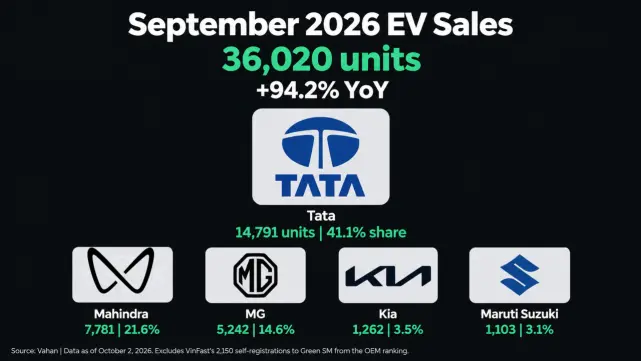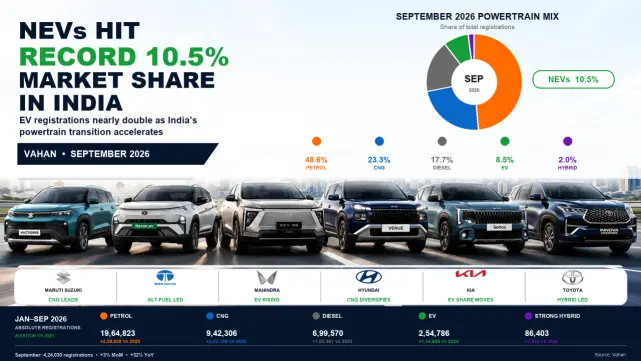
Mahindra EV Sales Nearly Double as XEV 9S Commands 57% Share
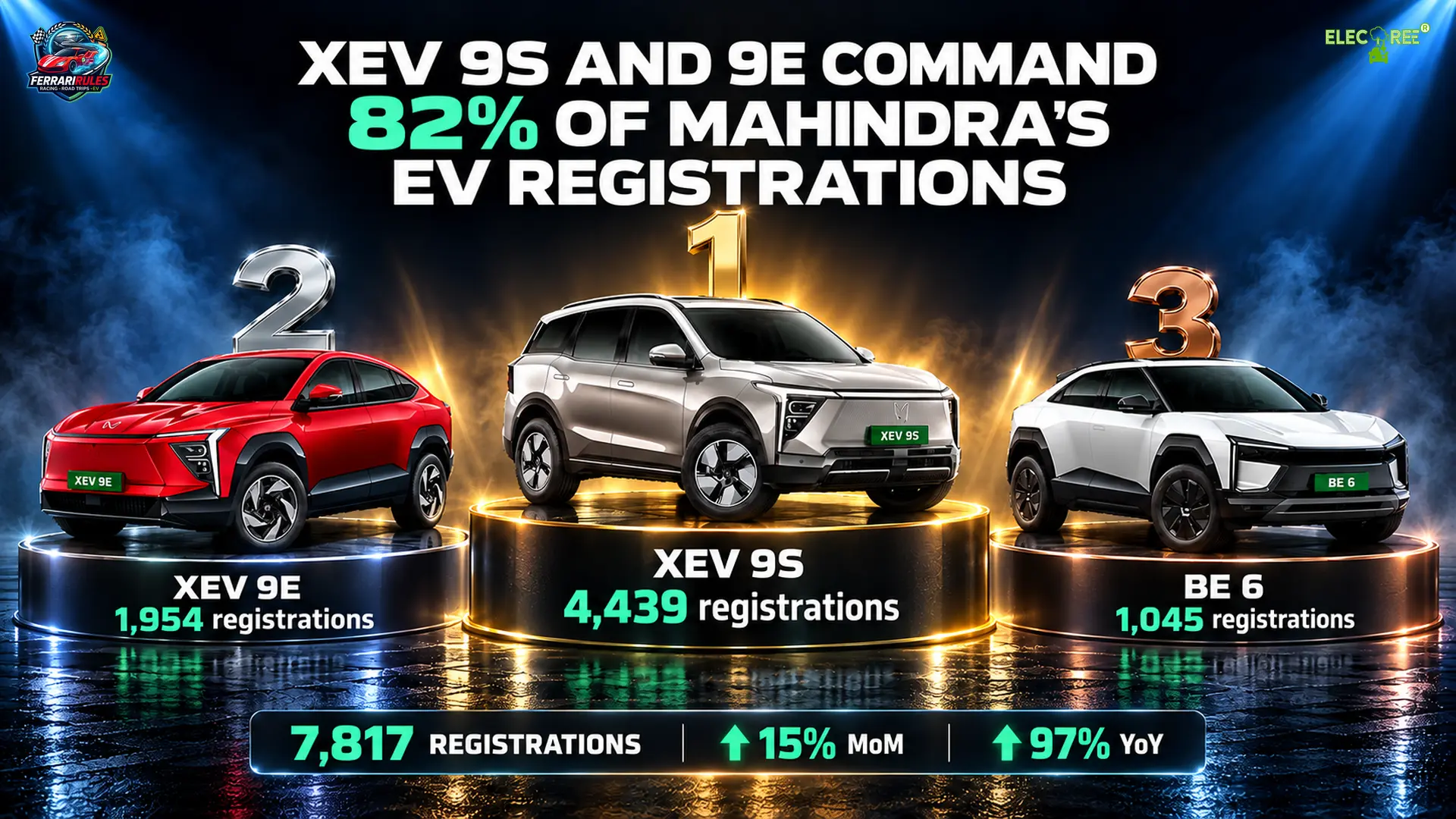
Mahindra registered 7,817 electric vehicles in September 2026, a 15% monthly and 97% annual increase. The new XEV 9S supplied 57% of the company’s EV volume, while the XEV 9S and XEV 9E together commanded an 82% share.


Category:
Tag:
- Mahindra EV sales September 2026
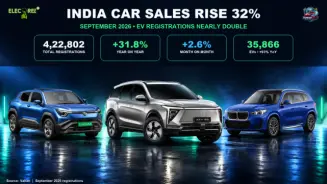
Mahindra recorded 7,817 electric vehicle registrations in September 2026, up from 6,810 in August and 3,973 a year earlier. That translates into growth of 15% month-on-month and 97% year-on-year.
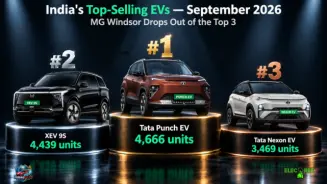
The headline is strong, but the composition matters. The new XEV 9S alone contributed 4,439 registrations, or 57% of Mahindra’s EV volume. It accounted for more than Mahindra’s net year-on-year increase of 3,844 registrations. Without the XEV 9S, the rest of the portfolio recorded 3,378 units, 15% below September 2025, even after treating the XUV 3XO EV and outgoing XUV400 as one replacement lineage.
Let's take a look at September model-wise performance
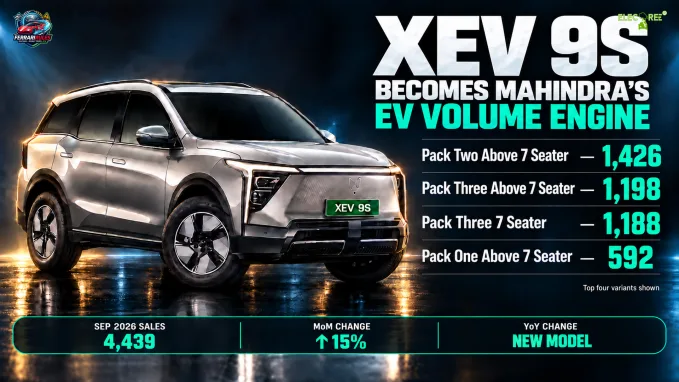
XEV 9S becomes the centre of Mahindra’s EV portfolio
The XEV 9S increased 15% over August and outsold every other Mahindra EV by a wide margin. Its three leading 7 Seater variants delivered 3,812 registrations: Pack Two Above 7 Seater at 1,426, Pack Three Above 7 Seater at 1,198, and Pack Three 7 Seater at 1,188. Those three configurations represented 86% of XEV 9S volume. Pack Two above has become the highest-selling model for XEV 9S.
Demand also skewed heavily towards the largest battery. The 79 kWh version recorded 3,718 registrations, an 84% share, while the 70 kWh and 59 kWh versions contributed 482 and 239, respectively. The mix indicates that XEV 9S buyers strongly preferred the higher-capacity, higher-specification combinations during September.
From a seat configuration standpoint, Mahindra sold 4,404 7-seaters and 35 6-seaters.
XEV 9E improves sequentially but remains below last year
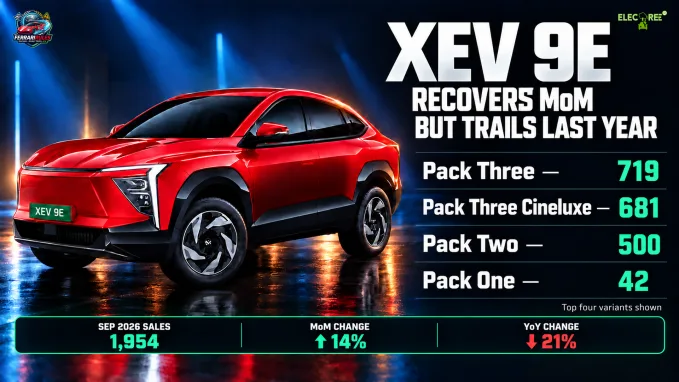
The XEV 9E reached 1,954 registrations, up 14% MoM but down 21% YoY. Pack Three led with 719 units, closely followed by Pack Three Cineluxe with 681. Together, the two accounted for 72% of model registrations. Its battery mix was even more concentrated than the XEV 9S: the 79 kWh version supplied 1,754 registrations, or 90% of the total.
BE 6 stays steady after the SPORTEQ launch
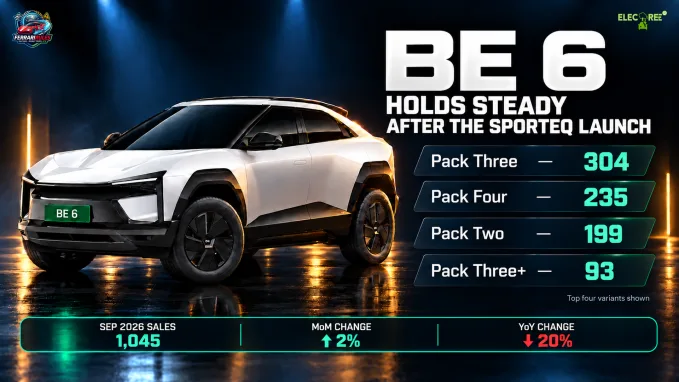
The BE 6 was steadier at 1,045 registrations, up 2% MoM and down 20% YoY. Pack Three was the largest variant at 304, followed by Pack Four at 235 and Pack Two at 199. Demand was spread across battery sizes: 599 registrations for 79 kWh, 296 for 59 kWh and 150 for 70 kWh. The 70 kWh version is gaining demand, rising from 17 registrations in August to 150 in September.
The result follows the recent BE 6 SPORTEQ launch, which replaces the earlier Pack-based range with One, Two, Three, Three+ and Four variants. The revised range introduces the 70 kWh battery more widely and redistributes equipment across variants, including cabin technology and driver-assistance features. The sharp increase in 70 kWh registrations provides an early indication that buyers are responding to the new battery choice.
XUV 3XO EV takes over from the outgoing XUV400
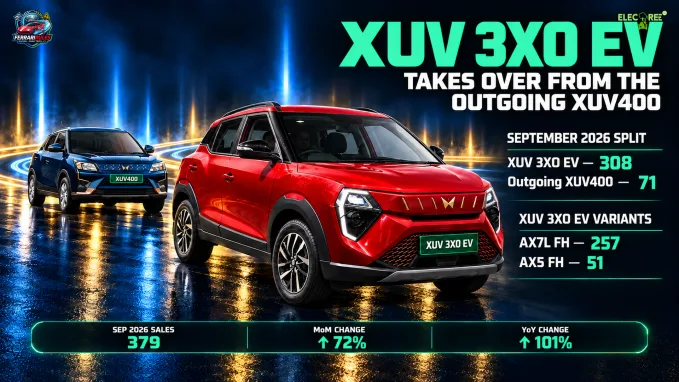
The XUV 3XO EV recorded 308 registrations, up 80% from August. The AX7L FH variant contributed 257 units, or 83% of the model total, while the AX5 FH added 51. All recorded registrations used the 39.4 kWh battery.
Because the XUV 3XO EV succeeds the outgoing XUV400, the relevant year-on-year comparison is the combined lineage. The two models registered 379 units in September 2026 versus 189 XUV400 registrations in September 2025, an increase of 101%. They also rose 72% from a combined 220 registrations in August. Within September’s total, the outgoing XUV400 contributed 71 registrations, led by 53 units of the EL FH(O) variant.
79 kWh dominates while 70 kWh gains share
Across Mahindra’s EV portfolio, the 79 kWh battery accounted for 6,071 registrations and a 77.7% share in September. Its volume rose 13% from August and 114% year on year, although its share eased from 78.7% in August. Compared with September 2025, its share increased by 6.1 percentage points to 71.5%.
The 70 kWh battery recorded 632 registrations, up 34% MoM, lifting its share from 6.9% to 8.1%. There was no 70 kWh volume in September 2025. The 59 kWh category moved in the opposite direction: registrations fell 3% MoM and 22% YoY to 735, while share dropped to 9.4% from 11.2% in August and 23.7% a year earlier. The 39.4 kWh category reached 379 registrations, up 72% MoM and 102% YoY, reflecting the combined XUV 3XO EV and XUV400 lineage.
A stronger portfolio with a clear concentration risk
Mahindra’s September result shows that its expanded electric range is creating substantial incremental volume. XEV 9S, XEV 9E and BE 6 together contributed 95% of registrations, but the XEV 9S was the decisive growth engine, carrying more than half of the portfolio and exceeding the company’s entire net year-on-year addition.
The next test is whether momentum broadens beyond the XEV 9S. The XEV 9E and BE 6 remained 21% and 20% below September 2025, respectively. September therefore marks a major increase in Mahindra’s EV reach, led overwhelmingly by the XEV 9S rather than uniform growth across the range.
Source and methodology: Vahan registration data for September 2026, August 2026 and September 2025. “New” denotes models with no comparable registrations in the supplied September 2025 dataset. Figures are registrations, not wholesale dispatches.
Trending Articles