
India Car Sales Rise 32 Percent in September 2026 as EV Registrations Nearly Double
India recorded 4,22,802 passenger-car registrations in September 2026, up 31.8% from a year earlier and 2.6% from August. The headline growth was strong, but the quarterly picture was more restrained: Q3 registrations were almost unchanged from Q2.



Category:
Tag:
- September 2026 Car Sales
- September 2026 overall EV sales
India's passenger-car market closed September 2026 with 4,22,802 registrations across the mass-market and premium segments covered by the supplied data. That was substantially higher than the 3,20,747 registrations recorded in September 2025 and moderately ahead of the 4,12,208 units registered in August 2026.
Mass-market brands accounted for 4,17,211 registrations, while manufacturers classified in the premium table contributed another 5,591 units. This made September a strong month on both a year-on-year and month-on-month basis, although the gains were not evenly distributed across manufacturers.
Mass-market 4W registrations grew 31.9% year on year
The mass-market 4W segment expanded from 3,16,401 registrations in September 2025 to 4,17,211 in September 2026, representing growth of 31.9%.
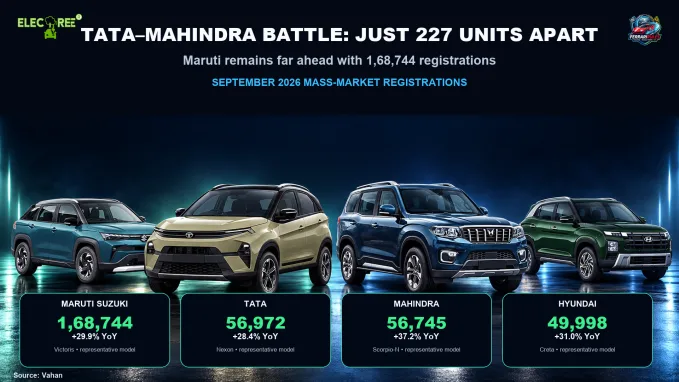
Maruti Suzuki remained the clear market leader with 1,68,744 registrations. Its volume was 29.9% higher than a year earlier, even though it was almost unchanged from August. This suggests that Maruti participated fully in the market's annual expansion without receiving an additional month-on-month boost in September.
The contest behind Maruti was exceptionally close. Tata registered 56,972 cars, while Mahindra recorded 56,745-a difference of only 227 units. Mahindra's volume rose 37.2% year on year and 8% from August. Tata grew 28.4% year on year but declined 4% month on month, allowing Mahindra to close almost the entire gap in September.
Hyundai followed with 49,998 registrations, up 31% year on year and 4% from August. Toyota reached 27,652 units, while Kia registered 26,555. Kia delivered one of the strongest performances among the established volume manufacturers, growing 45.4% year on year and 9% month on month.
Honda also had a strong annual comparison, rising 42.1% to 5,263 units. Renault grew 33% to 3,406, while Nissan more than doubled to 2,960 registrations. VinFast recorded 2,961 units, placing it one unit ahead of Nissan in the supplied September table.
September's month-on-month growth was selective
Mass-market registrations increased by only 2.3% from August, compared with the much stronger annual growth rate. Maruti was essentially flat and Tata declined, while most of the incremental volume came from Mahindra, Hyundai, Toyota, Kia and the smaller manufacturers.
Mahindra added more than 4,000 registrations over August, while Kia gained over 2,200 and Hyundai added nearly 2,000. Toyota increased by approximately 1,500 units. VinFast climbed 32% to 2,961 registrations, while Jeep rose 38% from a small base.
The declines were concentrated among Tata, Citroen and a few premium manufacturers. Tata's monthly reduction of roughly 2,300 units was the most consequential because of its larger base. Citroen declined 3%, while Maruti's 0.1% reduction left it effectively unchanged.
Premium registrations jumped 27% from August
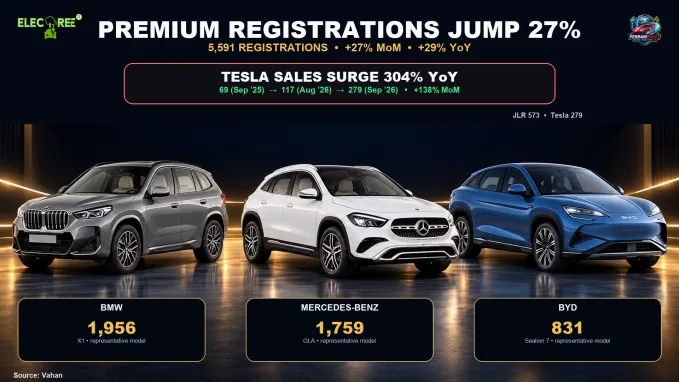
The premium segment, as classified in the supplied data, recorded 5,591 registrations in September. That was 29% higher than September 2025 and 27% above August 2026.
BMW led with 1,956 registrations, rising 44% year on year and 32% month on month. Mercedes-Benz followed with 1,759 units, up 26% year on year and 22% from August. Together, the two German manufacturers contributed nearly two-thirds of the premium volume recorded during the month.
BYD rose sharply from 566 registrations in August to 831 in September, a 47% monthly increase, although its year-on-year growth was a more moderate 14%. Jaguar Land Rover recorded 573 registrations, increasing 3% year on year but declining 7% from August.
Tesla delivered the premium market's biggest percentage surge. Registrations climbed to 279, up 138% from 117 in August and 304% from 69 in September 2025. In other words, Tesla more than doubled its monthly volume and quadrupled its year-on-year tally. Its absolute volume remained smaller than those of the established premium leaders, but the acceleration was too large to ignore. Volvo registered 126 cars.
EV registrations nearly doubled
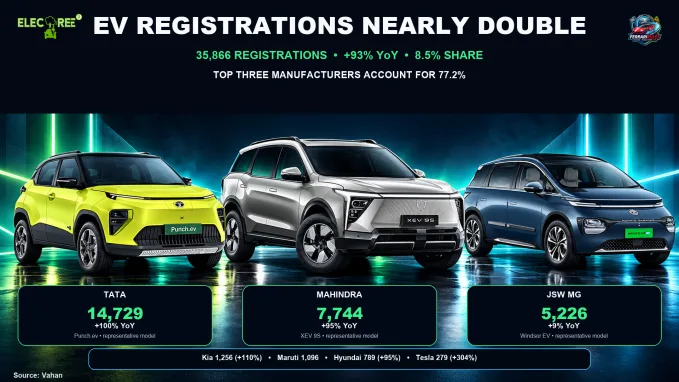
Electric-car registrations increased from 18,537 units in September 2025 to 35,866 in September 2026, representing growth of 93%. EVs therefore accounted for approximately 8.5% of the combined passenger-car registrations covered by the supplied September data.
Tata remained the largest electric-car manufacturer with 14,729 registrations, exactly double its September 2025 volume. Tata alone accounted for roughly 41% of the EV market during the month. Tata touched a new all-time high in Sep'26
Mahindra followed with 7,744 registrations, up 95% year on year, while JSW MG recorded 5,226, an increase of 9%. Together, Tata, Mahindra and JSW MG controlled about 77% of electric-car registrations in September.
Growth outside the top three broadened the market. Kia more than doubled to 1,256 registrations, while Maruti Suzuki contributed 1,096 units from a zero base in the year-earlier table. Syros EV is doing wonders for Kia; they beat Maruti in Sep'26. Hyundai reached 789 registrations, up 95%, and BYD grew 14% to 831. BMW registered 501 electric cars, and Tesla's 279 units represented a 304% annual increase.
The EV data shows that electrification is no longer being driven by one manufacturer alone. Tata still holds a commanding lead, but Mahindra's rapid expansion, Kia's growth, and Maruti's entry are creating a wider base of volume.
Q3 was strong year on year but flat against Q2
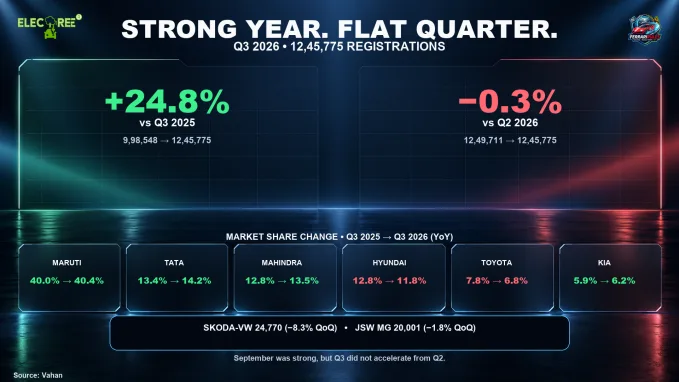
The quarterly data adds an important qualification to September's performance. Total registrations reached 12,45,775 in Q3 2026, up 24.8% from 9,98,548 in Q3 2025. However, the total was 0.3% lower than the 12,49,711 registrations recorded in Q2 2026.
Maruti Suzuki's Q3 volume was almost flat sequentially at 5,02,856 registrations. Tata declined 0.4% to 1,76,447, and Mahindra fell 1.6% to 1,67,660. Hyundai increased 3.3% to 1,46,925, while Kia edged 0.6% higher to 77,265. Toyota declined 2.9% to 84,605. Skoda-VW fell 8.3% to 24,770, while JSW MG declined 1.8% to 20,001.
The year-on-year market-share comparison shows Tata and Mahindra gaining ground. Tata's share rose from 13.4% to 14.2%, while Mahindra moved from 12.8% to 13.5%. Maruti remained broadly stable at just over 40%. Hyundai's share declined from 12.8% to 11.8%, and Toyota fell from 7.8% to 6.8%. Kia improved from 5.9% to 6.2%.
The key takeaway
September 2026 was a strong month for Indian passenger-car registrations, particularly when compared with the previous year. The market grew 31.8%, premium registrations rose 29%, and EV volume nearly doubled.
But the comparison with August and the wider Q3 result presents a more measured picture. Overall registrations rose only 2.6% month on month, several large manufacturers were flat or lower, and Q3 volume slipped marginally from Q2.
The most significant structural development was in electric cars. With 35,866 registrations and an estimated 8.5% share of the covered market, EVs contributed meaningfully to September's expansion. Tata remained dominant, but the growth of Mahindra, Kia, and new volume from Maruti indicate that the next phase of the EV market will be more competitive than the last.
FAQs
How many cars were registered in India in September 2026?
India recorded 4,22,802 passenger-car registrations across the mass-market and premium segments covered by the Vahan data.
How much did EV registrations grow in September 2026?
Electric-car registrations reached 35,866, representing year-on-year growth of 93%.
How did Tesla perform in September 2026?
Tesla recorded 279 registrations, up 138% from August 2026 and 304% from September 2025.
Which companies led India’s car market in September 2026?
Maruti Suzuki led with 1,68,744 registrations. Tata and Mahindra followed with 56,972 and 56,745 registrations, respectively.
Source: Vahan. Snapshot taken on 1-Oct-2026
Disclaimer: The values represented are new vehicle registrations and not dealer dispatches, sourced via RTOs through Vahan. The data is exclusive to ElecTree and Ferrarirules. Republishing the data on any social media platform or forum without credit is prohibited and will amount to copyright infringement and may result in appropriate legal action.
To comment and participate in discussion Click Here
Trending Articles



Recent Articles

India Clears ₹1.86 Lakh Crore Green Energy Corridor Plan With ₹50,000 Crore for Battery Storage
Porsche Cayenne Electric Launched in India at ₹1.77 Crore: 642 Km Range, 400 kW Charging and More

Government's CAFE III Norms Give EVs a 3x Credit, PHEVs 2.5x

Creta Electric Owners Approach Hyundai - File Petition for Lifetime Battery Warranty