NEVs Hit Record 10.5% Market Share as India’s Powertrain Reset Accelerates
Electric vehicles nearly doubled year on year in September 2026, while CNG added the most registrations during January–September. Beneath the national numbers, Maruti Suzuki, Tata Motors, Mahindra, Hyundai, Toyota and Kia are following six distinctly different powertrain strategies.


Category:
Tag:
- India powertrain mix September 2026
- India EV market share 2026
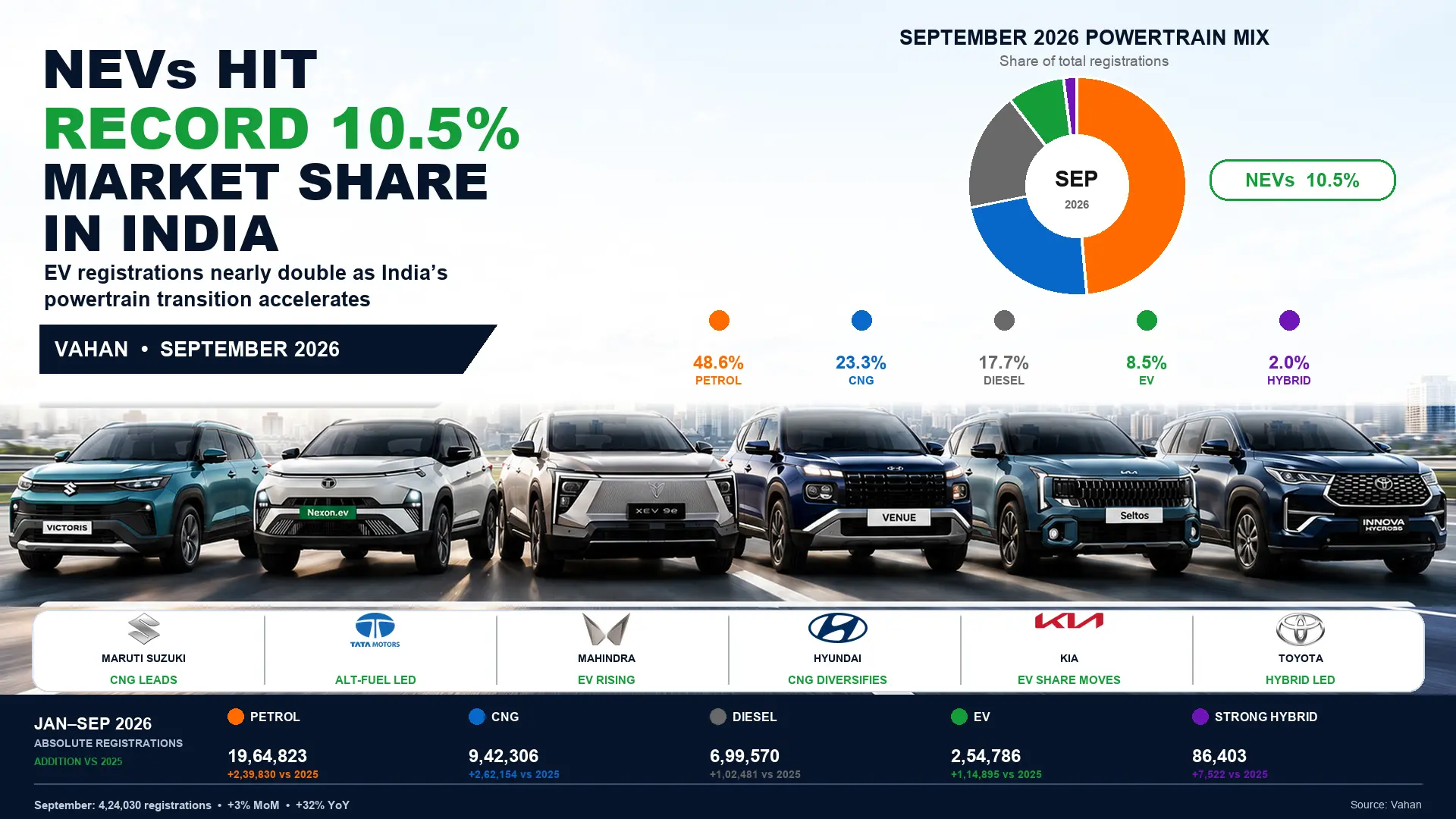
India’s passenger-vehicle market crossed an important electrification threshold in September 2026. Battery-electric vehicles and strong hybrids together accounted for 10.5% of registrations, taking their combined share above one in ten for the first time in the supplied Vahan series.
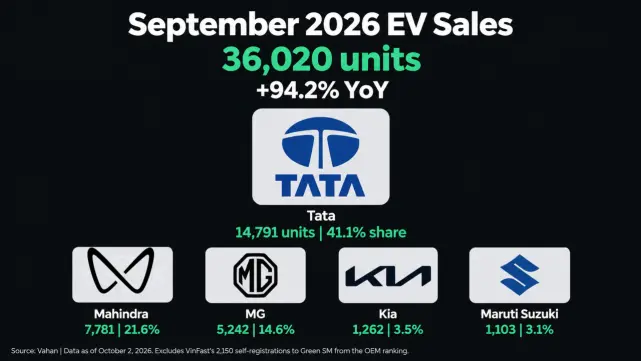
The market recorded 4,24,030 registrations, up 32% year on year and 3% from August. EVs contributed 35,978 units, while strong hybrids added 8,375, taking combined new-energy vehicle volume to 44,353 registrations.
For this analysis, new-energy vehicles, or NEVs, comprise battery EVs and strong hybrids. EVs were the main force behind the milestone: electric registrations increased 94% year on year and 11% month on month. Strong-hybrid registrations rose 10% year on year and 1% from August.
The 10.5% figure is significant, but it does not describe a uniform transition. Tata Motors and Mahindra have built meaningful EV shares, Toyota supplies most of the strong-hybrid depth, and several major manufacturers still rely heavily on petrol, diesel or CNG. India’s powertrain reset is advancing through several parallel routes.
Petrol remains the largest powertrain but stays below half the market
Petrol registrations increased 24% year on year and 6% month on month to 2,06,185 units. Even with that volume growth, petrol represented only 48.6% of September registrations, compared with 54.2% in the chart’s 2025 benchmark.
This is the central shift in India’s powertrain market. Petrol is not yet shrinking in absolute terms; faster growth elsewhere is reducing its share of a larger market.
CNG recorded 98,636 registrations and a 23.3% market share. Its volume was 39% higher than September 2025, although it declined 6% from August. Diesel contributed 74,939 registrations, equal to 17.7% of the market, after rising 29% year on year and 4% month on month.
EVs accounted for 8.5% of September registrations, while strong hybrids contributed 2%. Together, CNG, EVs and strong hybrids represented approximately 33.8% of the market. Once diesel is included, non-petrol powertrains accounted for just over half of all registrations.
EVs led September’s monthly powertrain growth
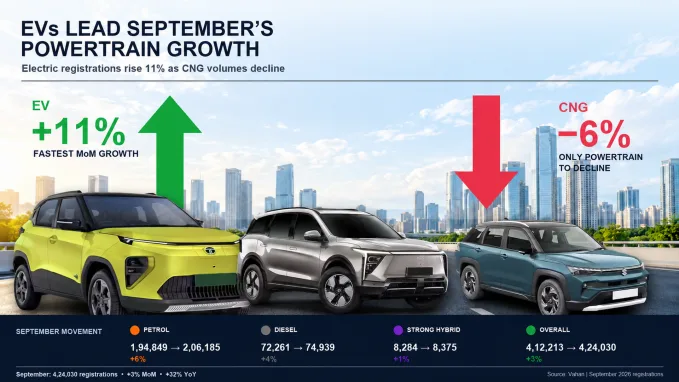
September’s month-on-month movement reinforced the electric-growth story. EV registrations increased from 32,318 in August to 35,978 in September, an 11% gain and the fastest monthly growth among the five powertrain categories.
Petrol increased from 1,94,849 to 2,06,185 registrations, a 6% rise. Diesel advanced 4%, from 72,261 to 74,939, while strong hybrids edged up 1%, from 8,284 to 8,375.
CNG was the only category to decline month on month. Registrations fell from 1,04,592 to 98,636, a 6% reduction. That decline did not overturn CNG’s longer-term expansion, but it allowed petrol and EVs to regain some momentum during September.
The monthly figures show why India’s transition cannot be reduced to a single straight line. Different powertrains can move in opposite directions from one month to the next even while the broader market continues to diversify.
CNG added the most registrations during Jan-Sep-2026 while EVs grew the fastest
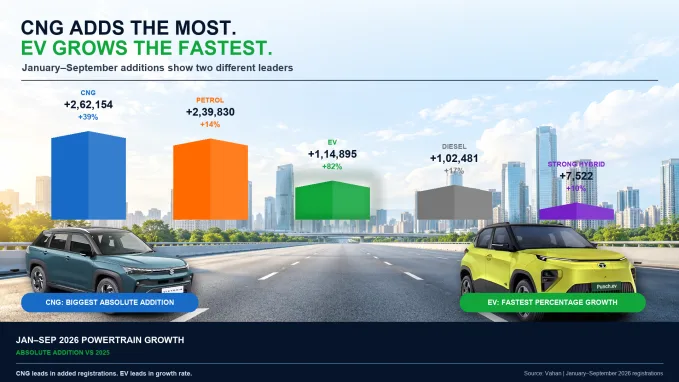
The January–September comparison separates leadership in absolute volume from leadership in growth rate.
CNG recorded the largest absolute addition, gaining 2,62,154 registrations over the corresponding 2025 period. Its cumulative volume increased 39%, from 6,80,152 to 9,42,306 units.
Petrol added 2,39,830 registrations, lifting its January–September total from 17,24,993 to 19,64,823, a 14% increase. Diesel added 1,02,481 registrations and grew 17%, from 5,97,089 to 6,99,570.
EVs added fewer vehicles than CNG or petrol in absolute terms, but recorded the fastest growth. Electric registrations rose from 1,39,891 to 2,54,786, an addition of 1,14,895 units and an 82% increase. Strong hybrids grew 10%, adding 7,522 registrations to reach 86,403 units.
The distinction matters. CNG is currently delivering the broadest mass-market scale outside petrol, while EVs are changing the market at the fastest rate. Both are weakening petrol’s share, but they are doing so from different bases and through different manufacturers.
Six OEMs are following six different powertrain strategies
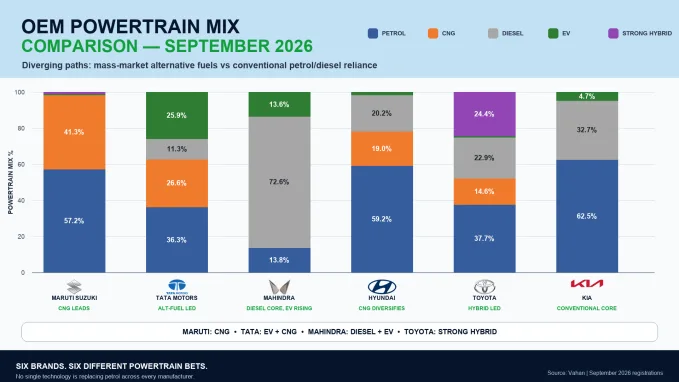
The national mix combines sharply different manufacturer portfolios. September’s six-OEM comparison shows that no common replacement for petrol has emerged.
Maruti Suzuki uses CNG as its scale alternative
Maruti Suzuki remained a petrol-and-CNG manufacturer in September. Petrol accounted for 57.2% of registrations, and CNG contributed 41.3%. EVs and strong hybrids together represented roughly 1.5%.
Maruti’s strategy is the clearest demonstration of CNG functioning as a mass-market alternative to petrol. Its CNG share is larger than the entire non-petrol mix of several competitors. Petrol recovered from 55% in August to 57.2% in September, but CNG continues to do most of the work in reducing the company’s petrol dependence.
Tata Motors has become alternative-fuel-led
Tata recorded the most diversified mix among large mass-market manufacturers. Petrol contributed 36.3%, CNG 26.6%, EVs 25.9% and diesel 11.3%.
Only 0.7 percentage points separated Tata’s CNG and EV shares. Together, the two powertrains represented 52.5% of registrations, comfortably exceeding petrol. Tata’s EV share has more than doubled from the 12.8% shown in the 2025 benchmark, while petrol’s contribution has fallen from 46.9% to 36.3%.
Tata is therefore no longer a conventional manufacturer with a small electric portfolio. Alternative powertrains now form the majority of its registration mix.
Mahindra is building an electric pillar alongside diesel
Mahindra remained the most diesel-dependent manufacturer in the comparison. Diesel accounted for 72.6% of September registrations.
The change is taking place below that dominant diesel base. EVs reached 13.6%, almost matching petrol at 13.8%. In the 2025 benchmark, EVs represented 6.1% and petrol 18.1%.
Mahindra is not replacing diesel in the near term. It is building EVs into a second meaningful pillar while petrol becomes a smaller part of its SUV-heavy portfolio.
Hyundai’s diversification is being driven by CNG
Hyundai’s September mix comprised 59.2% petrol, 20.2% diesel, 19% CNG and 1.6% EV.
CNG and diesel are now nearly equal contributors. CNG has increased from 15.5% in the 2025 benchmark, while diesel has remained close to one-fifth of the portfolio. EV share has moved only modestly, from 1.3% to 1.6%.
Hyundai’s immediate diversification story is therefore CNG rather than electric vehicles. EVs remain strategically relevant, but they have not yet reshaped the company’s overall registration mix.
Toyota maintains the broadest multi-powertrain portfolio
Toyota had the most balanced mix across conventional and electrified powertrains. Petrol led at 37.7%, followed by strong hybrids at 24.4%, diesel at 22.9%, CNG at 14.6% and EVs at approximately 0.8%.
No single category reached 40%. Strong hybrids give Toyota a distinctive position, accounting for almost one in four registrations, but diesel and CNG also remain material contributors.
Toyota’s strategy is based less on moving buyers toward one technology and more on serving several use cases simultaneously. Its limited EV share also shows that electrification can advance through hybrids without producing a large battery-EV contribution.
Kia remains conventional, but its EV share is moving
Kia was still concentrated around petrol and diesel. Petrol accounted for 62.5% of September registrations and diesel for 32.7%.
EV share nevertheless increased to 4.7%, after remaining near 1% during the earlier part of the period. The increase shows how quickly a new electric model can alter an OEM’s mix once deliveries reach meaningful volume.
Kia remains well behind Tata and Mahindra on EV penetration, but September suggests that its electric contribution is beginning to move beyond a marginal base.
India’s powertrain transition has no single playbook
September’s clearest milestone is that NEVs reached a record 10.5% market share. Yet the manufacturer data shows why that figure cannot be interpreted as a uniform march toward battery-electric vehicles.
Maruti Suzuki is scaling CNG. Tata has built a majority mix from CNG and EVs together. Mahindra combines diesel dominance with a rapidly rising electric contribution. Hyundai is diversifying through CNG, Toyota relies on strong hybrids and a balanced portfolio, and Kia is only beginning to establish meaningful EV volume.
The result is a multi-powertrain market in which the leading technology depends on the manufacturer, vehicle segment, price point, and customer use case. CNG currently delivers the largest absolute expansion outside petrol, while EVs provide the fastest growth and the main force behind the NEV milestone.
NEVs crossing one in ten registrations confirms that electrified powertrains have moved beyond a marginal presence. The next phase will depend on whether more manufacturers can turn individual EV and hybrid launches into sustained portfolio-wide volume without losing the scale that petrol, diesel and CNG still provide.
Source: Vahan | January - September 2025 and January to September 2026 registrations. Snapshot taken on 1-October-2026
Disclaimer: The values represented are new vehicle registrations and not dealer dispatches, sourced via RTOs through Vahan. The data is exclusive to ElecTree and Ferrarirules. Republishing the data on any social media platform or forum without credit is prohibited and will amount to copyright infringement and may result in appropriate legal action.
FAQ section
Q. What was India’s NEV market share in September 2026?
A. Battery EVs and strong hybrids together accounted for 10.5% of Indian passenger-vehicle registrations in September 2026. EVs contributed 8.5%, while strong hybrids represented 2%.
Q. How fast did EV registrations grow in September 2026?
A. EV registrations reached 35,978 units, increasing 94% year on year and 11% month on month. EVs were the fastest-growing powertrain category during September.
Q. Which powertrain added the most registrations during January–September 2026?
A. CNG recorded the largest absolute addition, gaining 2,62,154 registrations over January–September 2025. Its cumulative registrations increased 39% to 9,42,306 units.
Q. Which manufacturer had the highest EV share in September 2026?
A. Among the six manufacturers compared, Tata Motors had the highest EV share at 25.9%. Mahindra followed at 13.6%, while Kia reached 4.7%.
Q. Why did petrol’s market share fall below 50% despite higher registrations?
A. Petrol registrations grew to 2,06,185 units, but CNG, diesel, EV and strong-hybrid registrations expanded faster. Petrol therefore accounted for 48.6% of September registrations even though its volume rose 24% year on year.
Q. How are India’s leading carmakers approaching the powertrain transition?
A. Maruti Suzuki is scaling CNG, Tata Motors combines CNG and EVs, Mahindra is adding EVs alongside diesel, Hyundai is diversifying through CNG, Toyota relies heavily on strong hybrids, and Kia is beginning to establish a larger EV contribution.
To comment and participate in discussion Click Here
Trending Articles