TVS Orbiter V1 vs V2: Is the Bigger Battery Worth the Extra Money?
The TVS Orbiter V1 and V2 share most of their features, but differ considerably in battery capacity, range, charging time and price. Which one makes more sense for everyday commuting?


Category:
Tag:
- TVS Orbiter
- TVS Orbiter V1
- TVS Orbiter V2
- TVS Motor
- Electric Scooter Comparison
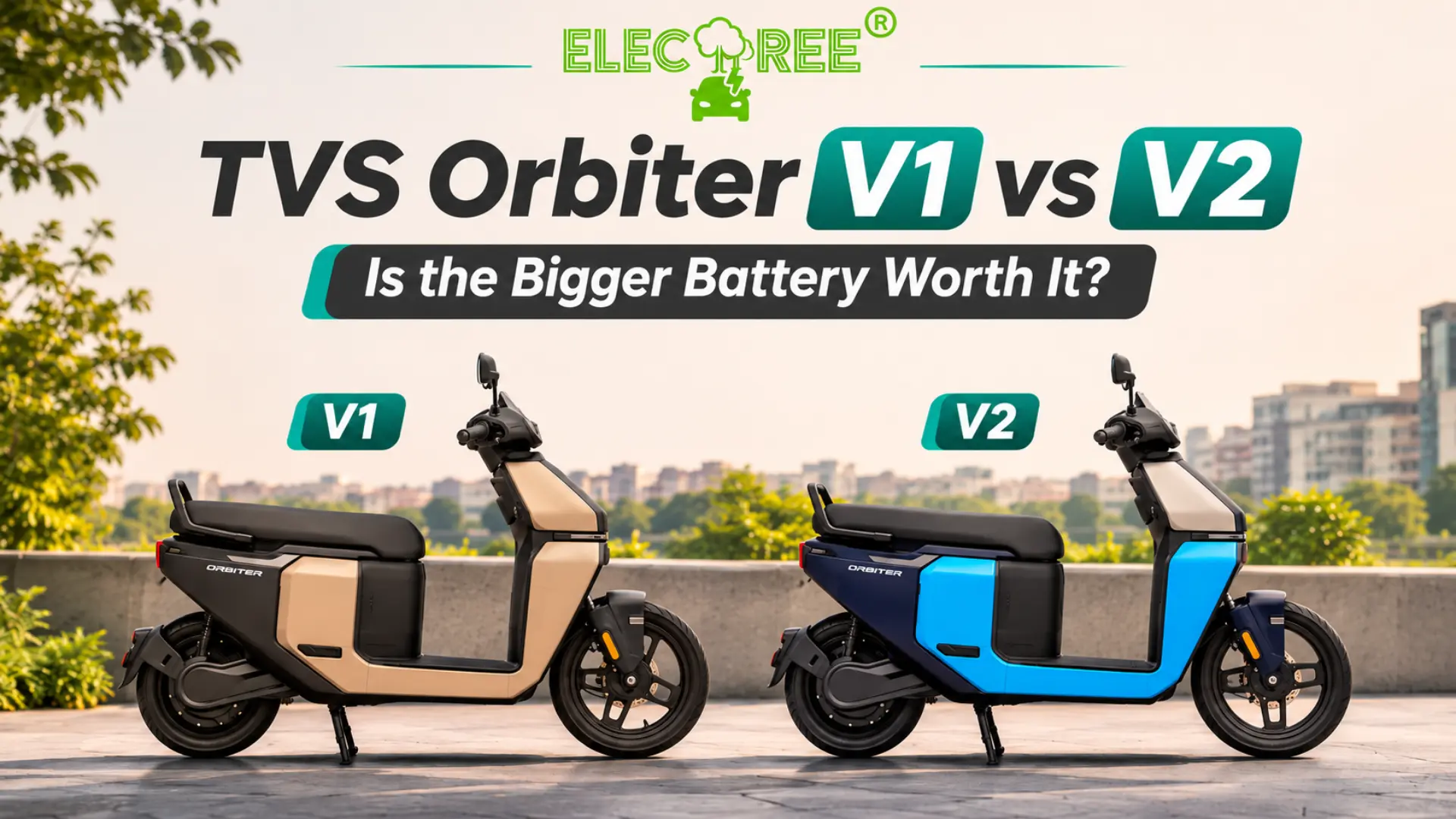
The TVS Orbiter is available in two variants, V1 and V2. Both look almost identical and offer many of the same features, but there's a significant difference in how far they can travel on a single charge.
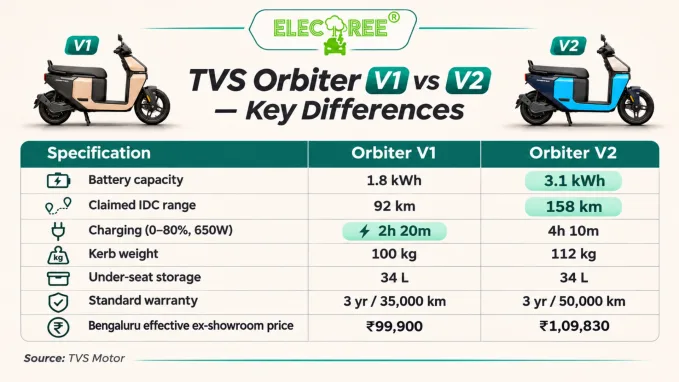
The V1 comes with a 1.8 kWh battery offering 92 km of claimed IDC range, while the V2 gets a larger 3.1 kWh battery with 158 km of range. That's an additional 66 km on paper.
Interestingly, the price difference isn't as large as the battery specifications might suggest. According to TVS's Bengaluru pricing page, the V1 is listed at ₹99,900 and the V2 at ₹1,09,830, effective ex-showroom after the applicable PM E-DRIVE incentive.
That works out to an additional ₹9,930 for the V2 in Bengaluru. The actual difference may vary by city, applicable incentives and dealer offers.
V1 vs V2: How Much Difference Does the Bigger Battery Make?
The V2's 3.1 kWh battery is approximately 72% larger than the V1's 1.8 kWh pack.
According to TVS's 2026 variant specifications, the difference translates into a claimed range of 158 km for the V2, compared with 92 km for the V1.
For someone commuting 20–30 km daily, the V1 could be sufficient with regular charging. The V2 becomes more appealing for riders who travel farther or prefer not to charge as frequently.
However, these are IDC-certified figures, not guaranteed real-world distances. Actual range will depend on riding speed, traffic, road conditions and load.
The larger battery also doesn't necessarily mean lower electricity costs per kilometre. Its main advantage is providing more range between charging sessions.
Charging: The Smaller Battery Has an Advantage
There's one trade-off worth considering before choosing the V2.
With the standard 650W charger, TVS lists a 0–80% charging time of approximately 2 hours and 20 minutes for the V1, compared with 4 hours and 10 minutes for the V2.
That's nearly two additional hours for the larger battery.
TVS also offers a more powerful 950W portable charger as an optional accessory, which can reduce charging times.
If you have dedicated parking and can charge overnight, the difference may not matter much. But for someone who needs to recharge during the day, the V1's shorter charging time could be useful.
Features: You Aren't Giving Up Much With the V1
One interesting aspect of the Orbiter lineup is that TVS hasn't reserved most of the useful features for the more expensive variant.
Both scooters offer a 34-litre under-seat storage compartment, an 845 mm seat, a digital display, cruise control, hill-hold assistance and connected features through SmartXonnect.
The basic scooter design, storage and everyday practicality are largely the same.
The V2 offers more colour choices and carries a larger, heavier battery. TVS's variant guide also lists a standard warranty of three years or 50,000 km for the V2, compared with three years or 35,000 km for the V1.
That warranty difference is worth checking when comparing ownership costs, especially for someone planning to use the scooter extensively.
Does Battery-as-a-Service Change the Calculation?
TVS also offers both Orbiter variants through its Battery-as-a-Service programme.
Under this arrangement, buyers can reduce their initial purchase payment by subscribing to the battery through a separate monthly payment plan.
However, the advertised starting price shouldn't be confused with the total cost of ownership.
Buyers should compare the vehicle price, battery subscription payments, plan duration and warranty coverage before deciding whether BaaS is preferable to buying the scooter outright.
This is particularly important when comparing the V1 and V2, since the larger battery may affect the overall financing arrangement.
Which TVS Orbiter Should You Buy?
The Orbiter V1 makes sense for someone with a shorter daily commute, dependable access to charging and a preference for spending less upfront.
It offers most of the V2's features, the same storage capacity and a shorter charging time.
The Orbiter V2, meanwhile, is worth considering if you regularly cover longer distances or want more flexibility between charges.
At the Bengaluru prices listed by TVS, an additional ₹9,930 gets you a substantially larger battery and 66 km more claimed range, making the V2 an interesting upgrade.
Ultimately, the decision comes down to how much range you actually need. If the V1 comfortably covers your commute, there's little reason to pay more just for a bigger battery. But if charging opportunities are limited or your daily travel varies considerably, the V2's extra range could make ownership more convenient.
To comment and participate in discussion Click Here
Trending Articles