
2.5 Lakh km in Six Years: EV Ownership Review
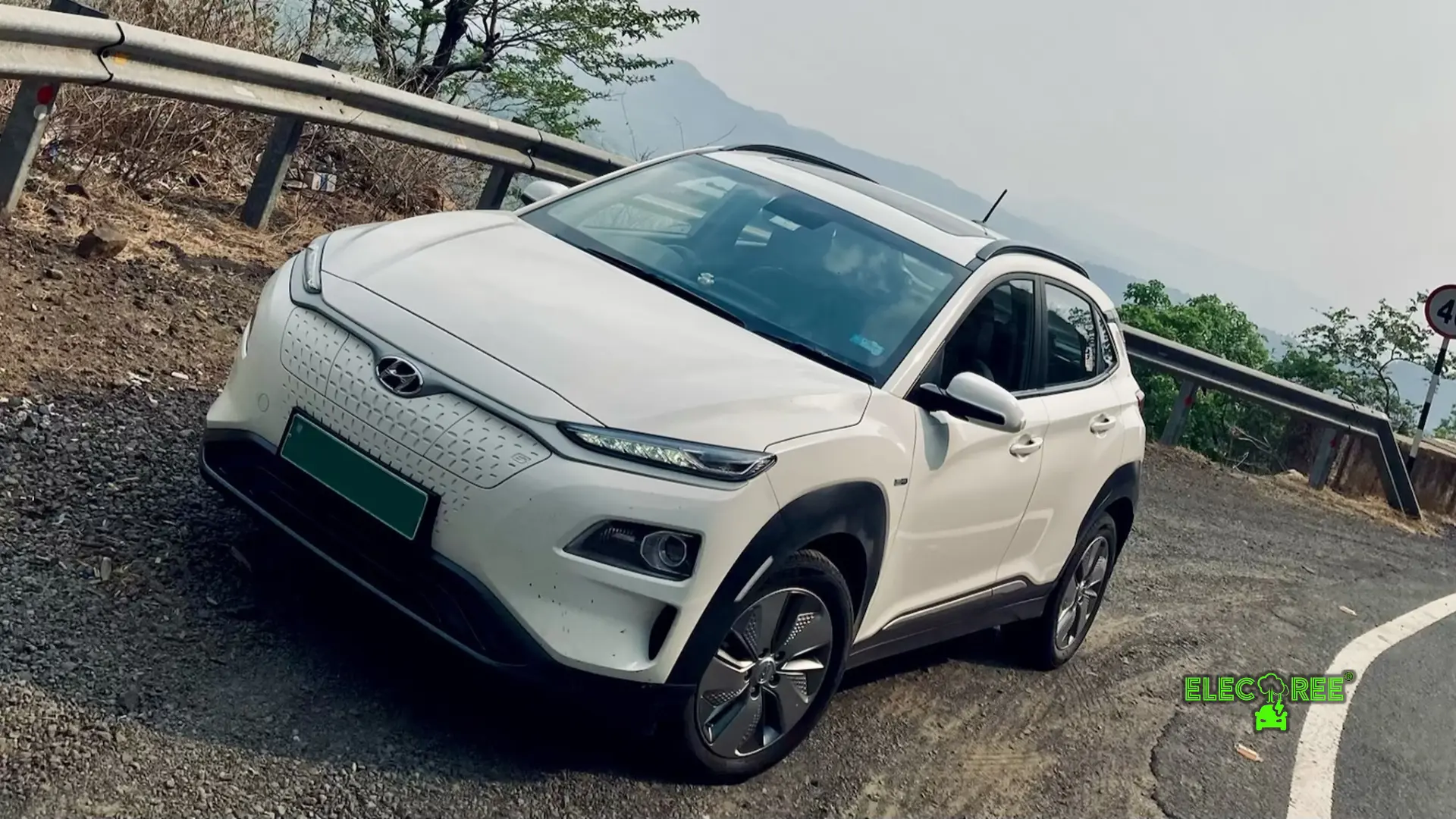
Aditya’s Hyundai Kona Electric has crossed 2.5 lakh km in six years, with 250,176 km on the odometer. He tells us about the replaced battery, when and how many times the tyres were changed, how charging changed around him in the years gone by, and much more.


Category:
Tag:
- Hyundai Kona
Every new EV buyer wonders – “What will happen to an EV once it crosses 1.6 lakh kilometres?”, “How frequently does one have to replace the tyres?”, “Will the battery survive?”
To answer all these questions, ElecTree reached out to Aditya who has crossed 2.5 lakh kilometres in his 2020 Hyundai Kona Electric.
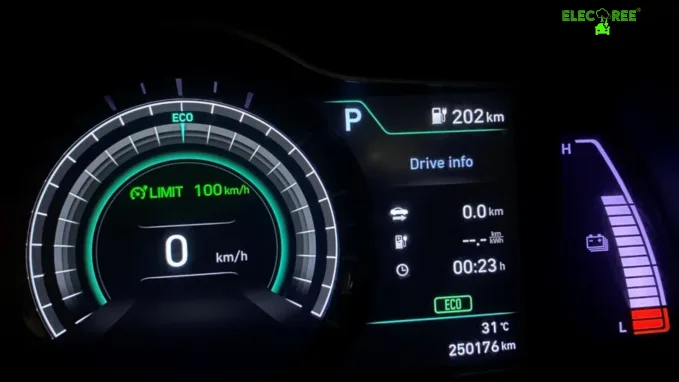
Bought in October 2020, Aditya’s Kona now reads 250,176 km and counting. In that time, it covered numerous highway trips, had its battery pack replaced, its traction motor swapped and currently runs on its fourth set of tyres.
The Kona Electric, which came with a 39.2 kWh battery pack in India, is no longer sold here. We spoke to Aditya about what six years and 2.5 lakh km of ownership has been like, and how India’s charging network changed around him.
One Car, Every Job
The Kona is Aditya’s primary car. The household had two more ICE cars, but the “long distance cruising” car, a 2019 Tata Hexa, met an unfortunate end in mid 2021. Since then the Kona has taken on all highway duties as well, and he says there are a lot of them.
Charging Then and Now
“Back in late 2020 there were hardly any chargers on majority of the highways I regularly use,” Aditya recalls. He gives Pune to Bengaluru on NH48 as an example. His first public DC charging session came in early 2021 at a Tata Motors showroom in Navi Mumbai, and it was a slow 25 kW charger.
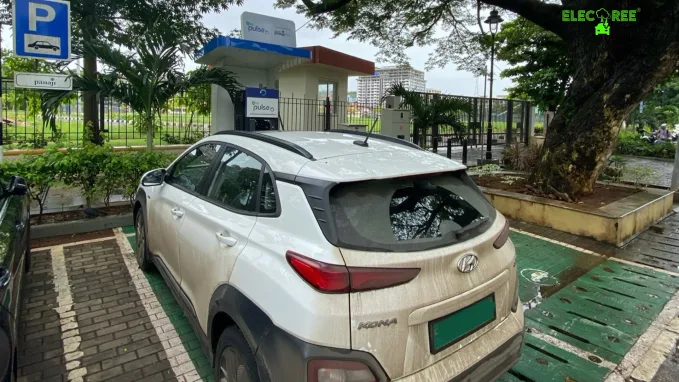
He has used the PlugShare app almost since the day he bought the car, and calls the change in charger density over the years “fascinating”. When asked what has improved, Aditya mentions “Reliability and availability has certainly gone up in last few years. I rarely face issues with the trusted CPOs like Zeon, Tata Power (though it can act strange sometimes), ChargeZone, JioBP, and Statiq. I usually avoid other CPOs simply because it is still a hassle to install their own apps, add money to the wallet and charge.”
Range Anxiety
When asked how range anxiety felt in the early years, Aditya remembers one drive. He once followed a truck at 50 km/h for a good 25 to 30 km because his state of charge was dangerously low and the nearest charger was 35 km away.
Today, he says, the thought doesn’t occur to him. The car still shows 300 to 320 km at 100% charge. On expressways at 100 km/h he wouldn’t expect more than 290 km, and on regular Indian highways he is certain of 300 km. His reasoning: “Frankly, I’ve stopped caring about range.” On highways where average speeds are 50 to 60 km/h, he gets at least four hours of driving before he needs to charge, “by which time, it is time to take a break for the sake of my bladder anyway,” he mentions candidly.
Aditya acknowledges that not all parts of the country enjoy the charger density he enjoys in Western Maharashtra and Southern India.
His longest trip was Pune to Davangere. His charging log from November 2025 shows 586 km, with four charging stops and a total of 1 hour 42 minutes spent charging. The charging cost came to ₹1,536.20, or ₹2.62 per km. The round trip covered 1,332 km at ₹3,853.24, or ₹2.89 per km. He has also done a 750 km round trip in a single day.
Charging Habits and Costs
At home, Aditya charges to 80% every single night. He says it is good practice for an NMC pack, and waking up to an almost “full tank” is reassuring too. The last 20%, from 80% to 100%, takes about 1 hour 30 minutes, so a trip planned for 6 am can still leave by 8 am with a full charge.
Charging costs have gone up. Aditya says Tata Power charged ₹18 plus GST for DC charging in 2021, and he thinks the standard he now pays is around ₹22 plus GST. His home tariff was ₹7.53 per unit in January 2021 and ₹11.46 in January 2026, a CAGR of 7.25% he mentions.
When asked about his running cost, Aditya says it comes to around ₹1.25 per km with home charging. He occasionally drives a 1.2 turbo Venue that returns 8.5 km/l in bad traffic, and wonders why anyone would pay upwards of ₹10 per km “to drive an obviously inferior drivetrain.”
Battery Health
Aditya uses an OBDII scanner which shows 94% state of health (SoH). He notes that this value can be reset to 100% with the OEM software, and that the service centre has a way to measure the “real” figure, which he hasn’t got done. Does it concern him? “Nope, zero concerns.”
His car did get a new battery. At 65,000 km, Hyundai India replaced the battery on all Konas under its precautionary global recall programme, after a couple of cars in Canada and South Korea caught fire.
What Broke
Aditya says the car has had two major part replacements, both common problems on the Kona. The first was the AC coil. The other was the traction motor and reduction gear, replaced under warranty. The motor had a well known issue of making a knocking sound, which Aditya says is “infamously known as wheel of fortune”. The same problem plagued global cars like the Kia Niro and the old Hyundai Ioniq.
Service and Tyres
Each service is due at 10,000 km or a year, whichever comes first. Aditya says it usually costs around ₹2,500, and he has stuck to Kothari Hyundai in Pune for all of them.
His maintenance sheet shows what recent servicing looked like. Between January 2025 and his April 2026 service, the odometer went from 184,000 km to 233,000 km, a distance of 49,000 km. In that period he had four regular services, costing ₹17,223 in total. That works out to an average of about ₹4,306 per service.
The car is on its fourth set of tyres, which are due for replacement in a couple of thousand km. The Kona shipped with Nexen tyres, which Aditya says were good for efficiency but not durable. He has since used the Michelin Primacy 4ST, fitted at 48,000 km for ₹47,800, and the Continental UC6, fitted at 108,000 km for ₹39,900 and again at 184,000 km for ₹41,600. He has no complaints with either, though they have slightly less range than the Nexen.
Life After Discontinuation
Hyundai’s support has remained unchanged so far. Aditya says Konas get special treatment at service centres, with higher-ups personally monitoring them.
On resale, he is blunt. “At 250k km I think this car would fetch nothing more than Rs 2.5 lakh.” He isn’t bothered, as the household likes to keep its cars for a long time.
The Verdict
Aditya remembers how curious people were in the early days of EVs. The Kona stood out because of its closed-off grille, and he has been stopped multiple times by curious people, and sometimes even cops, who wanted to ask about the car, its range and its price. He says there has been a major uptick in the general perception of EVs since 2020.
On what 2.5 lakh km has taught him, Aditya doesn’t hold back. “I think EVs have ruined normal everyday ICE cars forever for me.” He is still open to enthusiast cars for the weekends, naming the Skoda VRs, Volkswagen Golf GTI, BMW M340i and Mercedes E450, but says there is nothing exciting this side of ₹60 lakh in the ICE space. “Nothing can beat the daily-ability of an EV paired with that mouth watering running cost.”
Would he choose an EV again? “100%.” His next car would be a larger one with 450 to 500 km of range, and AWD would be “a cherry on the cake.”
Disclaimer: Images used are sole property of Aditya and have been used with permission. Removing the logo and re-using them without his permission will be copyright infringement.
Trending Articles




Recent Articles
“I Was Saved by My EV”: Tata Curvv.ev Comes to Its Owner’s Rescue During Cyclone Arnab
VinFast VF5 Facelift Design Patent Surfaces in India, Hints at Smaller Electric SUV
Tata Motors CEO Says EV Demand Has Crossed 10%, Dealer Stock Under 10 Days

Ather Expands Production Capacity to 11.4 Lakh Units as Q2 Volumes Rise 42%