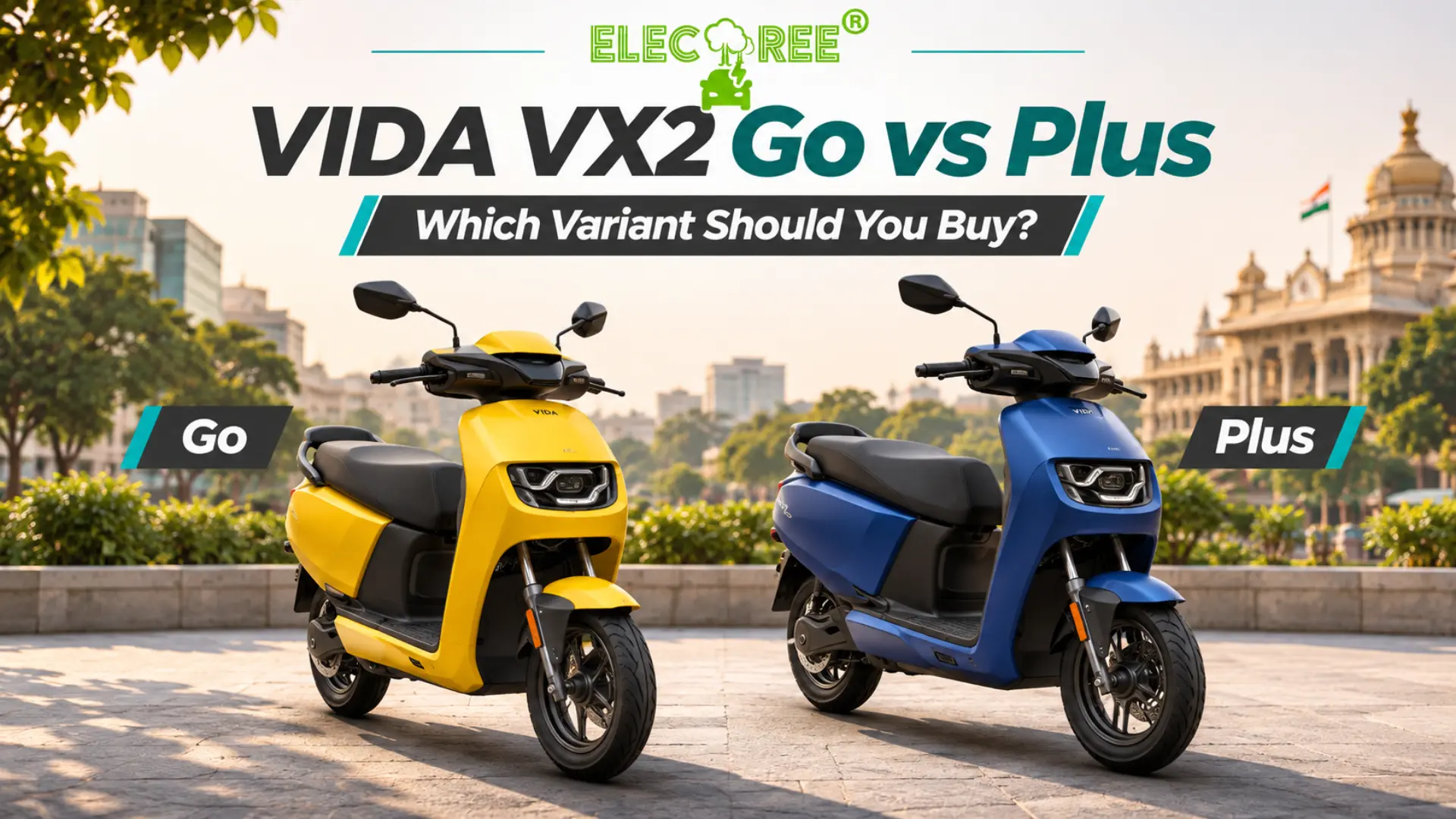
VIDA VX2 Go vs Plus: Which Variant Should You Buy?
From the entry-level Go 2.2 to the long-range Plus 4.4, the VIDA VX2 offers different batteries, charging arrangements and features. Here's what buyers should consider before choosing.


Category:
Tag:
- VIDA VX2
- VIDA VX2 Go
- VIDA VX2 Plus
- Hero VIDA
- Electric Scooter Comparison
The VIDA VX2 lineup has grown considerably since its introduction. What began as a relatively simple choice between Go and Plus now includes six main configurations, with batteries ranging from 2.2 kWh to 4.4 kWh.
But choosing the right VX2 isn't just about getting the biggest battery. Some variants have removable batteries, one uses a fixed battery, and the more expensive Plus versions offer additional performance and features.
Interestingly, two variants even offer the same claimed range despite belonging to different price and feature categories.
VIDA VX2 Go 2.2 and 2.2 RQ: The Entry-Level Options
The VX2 Go 2.2 is the most affordable configuration in the lineup. It gets a 2.2 kWh removable battery, 93 km of claimed IDC range and a top speed of 70 km/h.
For buyers with relatively short daily commutes, it offers the essential features of the VX2 without requiring a larger battery.
There's also the Go 2.2 RQ, which offers an interesting upgrade.
Both scooters have the same battery capacity, claimed range and performance. The main difference is the bundled charger.
The standard Go 2.2 uses a 580W charger, while the RQ gets a more powerful 1,000W unit. According to Autocar India's variant breakdown, this reduces the claimed 0–80% charging time from 3 hours and 7 minutes to 1 hour and 41 minutes.
So, rather than paying for additional range, the RQ buyer is primarily paying for quicker charging.
That could be useful for someone who regularly needs to recharge between journeys.
VX2 Go 3.1: More Range, But No Removable Battery
The Go 3.1 takes a different approach.
Introduced in July 2026 as the VX2 Go FB, it gets a 3.1 kWh fixed battery instead of the removable setup offered on other Go variants.
VIDA's current product specifications list 127 km of certified range and a top speed of 70 km/h.
The fixed battery makes this version more suitable for buyers who have access to a charging socket in their parking area and don't want to carry batteries indoors.
However, apartment residents without parking-level charging may find the removable-battery variants more convenient.
This is an important distinction because the VX2 range is often associated with removable batteries, but that doesn't apply to every configuration.
VX2 Go 3.4 vs Plus 3.4: Same Range, Different Experience
Perhaps the most interesting comparison is between the Go 3.4 and Plus 3.4.
Both use 3.4 kWh removable batteries and offer 146 km of claimed certified range.
However, the Go is limited to 70 km/h, while the Plus reaches 80 km/h.
The Plus also offers Sport mode, a colour TFT display and quicker acceleration. VIDA claims a 0–40 km/h time of 3.1 seconds for the Plus, compared with 4.2 seconds for the Go.
This means buyers choosing the Plus 3.4 aren't necessarily getting more range for their money. They're paying for additional performance and equipment.
For everyday commuting, the Go 3.4 may already provide sufficient range. The Plus makes more sense for riders who value stronger acceleration and the additional features.
VX2 Plus 4.4: The Longest-Range Option
At the top of the lineup sits the VX2 Plus 4.4, featuring a 4.4 kWh removable battery and 187 km of claimed IDC range.
It also has the highest top speed in the VX2 family at 90 km/h, compared with 80 km/h for the Plus 3.4.
The larger battery could appeal to riders who regularly travel longer distances or want to charge less frequently.
However, buyers should remember that certified range isn't the same as real-world range. Riding speed, traffic, terrain and passenger load can affect the actual distance covered.
For someone travelling just 20–30 km daily, the extra battery capacity may not necessarily justify the higher purchase price.
Does VIDA's Battery-as-a-Service Make It Cheaper?
VIDA also offers a Battery-as-a-Service (BaaS) financing option, which reduces the initial payment by separating the battery financing from the scooter's upfront cost.
However, there's an important detail worth understanding.
According to VIDA's official BaaS terms, the customer owns both the scooter and battery from the beginning. The programme is structured as financing rather than conventional battery rental.
Buyers make payments based on their selected usage plan, with additional charges potentially applying if usage exceeds the stipulated limits.
For BaaS purchases from September 2025 onward, VIDA also requires a paid extended battery warranty.
Therefore, a lower advertised initial price doesn't automatically mean lower total ownership costs.
Before purchasing, compare the full vehicle price with the initial BaaS payment, ongoing instalments, mileage limits and warranty charges. Prices and offers can also vary between cities and dealerships.
Which VIDA VX2 Variant Makes the Most Sense?
The Go 2.2 is worth considering for shorter commutes and buyers who want to keep their purchase costs down. The Go 2.2 RQ adds faster charging without changing the scooter's range.
The Go 3.1 offers additional range for buyers comfortable with a fixed battery, while the Go 3.4 combines longer range with removable charging.
For those wanting stronger performance and additional features, the Plus 3.4 offers a meaningful upgrade. The Plus 4.4 is aimed at buyers prioritising the maximum range available in the VX2 lineup.
Ultimately, the best variant depends less on the highest specification and more on how the scooter will be used.
A buyer with reliable home charging, a short daily commute and a limited budget may choose very differently from someone who needs removable batteries or travels longer distances.
Understanding those differences before visiting the dealership can make the choice considerably easier.
Trending Articles



Recent Articles