
Home Charging vs Removable Batteries vs Battery Swapping: What's Better for Electric Scooter Buyers?
Electric scooters offer different ways to recharge, but the most convenient option depends on where you live, how you commute, and whether you have access to a charging point.


Category:
Tag:
- Electric Scooter Charging
- Battery Swapping
- Removable Batteries
- TVS Orbiter
- VIDA VX2
- Honda Activa e
When buying an electric scooter, most people compare the range, price, and features. But there's another question that's just as important: where will you charge it?
For someone living in an independent house with dedicated parking, charging may be straightforward. But for someone living on the third floor of an apartment without a charging point downstairs, things can get complicated.
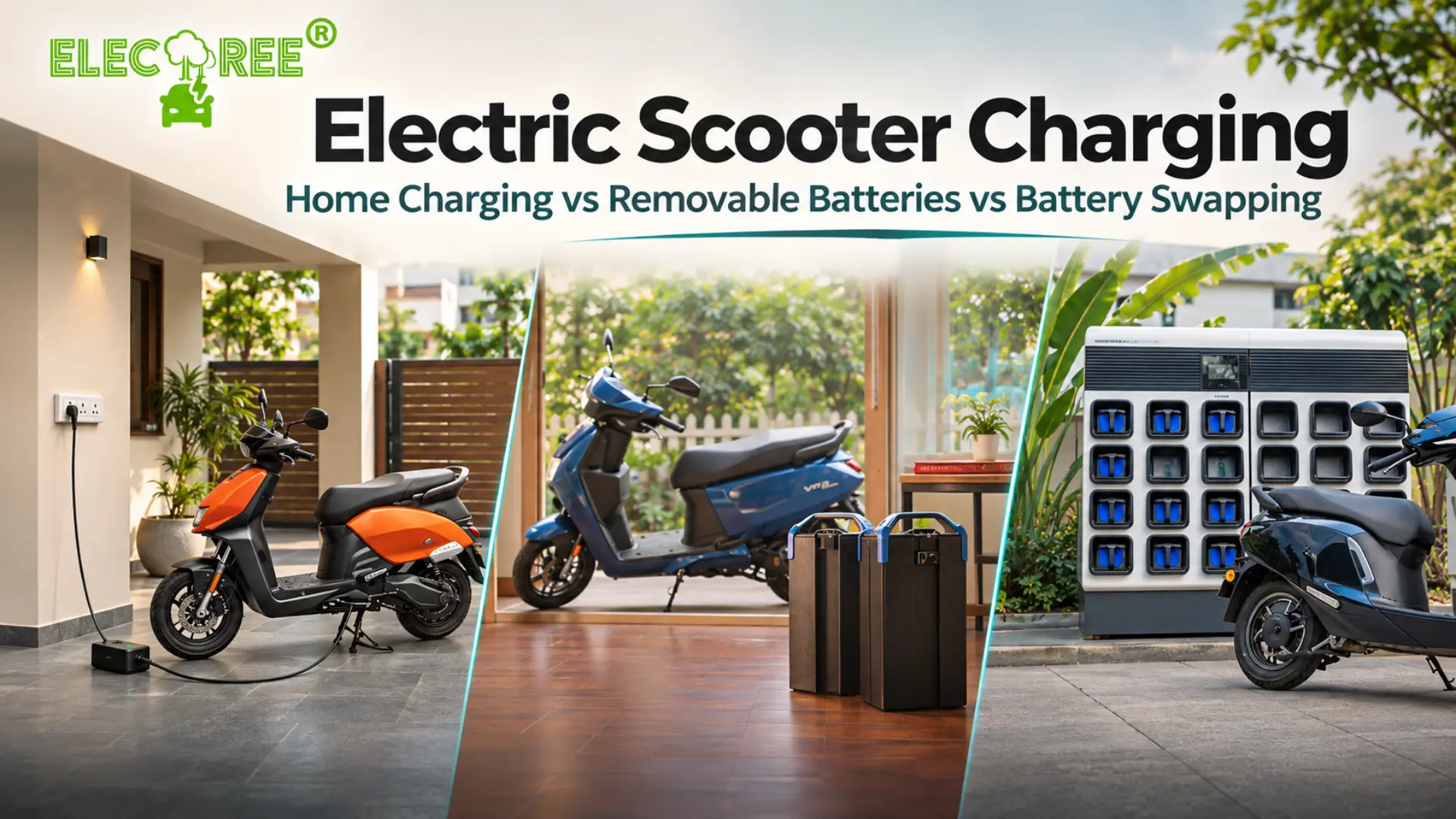
Manufacturers are approaching this problem differently. The TVS Orbiter uses a fixed battery that can be charged at home, the VIDA VX2 offers removable-battery variants, while the Honda Activa e: relies on battery swapping.
Each approach has its advantages, but none works equally well for everyone.
Home Charging: Simple, If You Have Parking and a Socket
Home charging is probably the most straightforward option for buyers who have a dedicated parking space with access to electricity.
Take the TVS Orbiter, for example. Its battery cannot be removed, but the scooter comes with a portable 650W charger that works with a standard 15A domestic socket.
You park the scooter, plug it in, and leave it charging. There's no battery to carry upstairs or swapping station to visit.
The Orbiter is offered with 1.8 kWh and 3.1 kWh battery options, with charging time depending on the variant.
However, the convenience changes if your parking area doesn't have an electrical connection.
In an apartment building, arranging a suitable socket may require permission from the housing society and proper electrical installation.
For buyers with dependable overnight charging, a fixed-battery scooter is convenient. Without that access, it can become difficult to manage.
Removable Batteries: Useful for Apartment Residents
Removable batteries offer another solution. Instead of taking electricity to the scooter, you take the battery to an electrical socket.
The VIDA VX2 is an example. Removable-battery variants, including the VX2 Plus, allow the batteries to be taken out and charged using a portable charger and a compatible domestic socket.
This can be particularly useful for apartment residents who cannot charge their scooters in the parking area.
However, there's a practical consideration that buyers shouldn't overlook: carrying the batteries.
Removing and taking a battery upstairs may be manageable occasionally, but doing it every day can become inconvenient, especially if you live on a higher floor without a lift.
It's also important to check the exact variant before buying. VIDA introduced the VX2 Go FB in July 2026 with a fixed 3.1 kWh battery. Not every VX2 therefore offers removable charging.
For buyers without dedicated parking electricity, removable batteries offer greater flexibility, provided carrying and charging them indoors is practical.
Battery Swapping: Quick, But Dependent on the Network
Honda has taken a different approach with the Activa e:.
Rather than plugging in the scooter at home, owners replace depleted batteries with charged ones at designated Honda e stations.
Honda says the battery exchange can be completed in about a minute, eliminating the need to wait for the scooter's batteries to recharge.
This sounds particularly convenient for people who travel frequently and cannot leave their scooters charging for several hours.
However, there's a catch.
The Activa e: cannot be charged at home. Battery swapping is its only charging option, according to Honda.
That makes the availability of swapping stations especially important. A quick swap isn't particularly useful if the nearest operational station is several kilometres away or outside your usual route.
Honda's swapping service also requires a separate plan. Buyers should check station availability, operating hours, battery availability, and applicable charges before purchasing.
Removable Batteries and BaaS Are Not the Same Thing
There's another distinction worth understanding.
Battery-as-a-Service, or BaaS, is often marketed as a way to reduce an electric scooter's upfront purchase cost. However, BaaS doesn't necessarily mean that the battery can be swapped at a station.
For instance, VIDA's BaaS programme is structured as a financing arrangement in which the customer retains ownership of the scooter and battery.
Honda's e, on the other hand, involves exchanging batteries through a dedicated network.
Similarly, a scooter with a fixed battery may still be offered with a BaaS purchase plan.
The charging arrangement and the payment arrangement are two separate things, and buyers should examine both.
Which Charging Option Should You Choose?
For someone with dedicated parking and a suitable electrical connection, home charging is generally the simplest option. The scooter can recharge overnight without requiring additional trips.
For apartment residents without parking-level electricity, removable batteries may be more practical, provided carrying them is manageable.
Battery swapping can work well for riders whose daily routes are covered by a reliable swapping network. However, the dependence on station availability makes it important to verify the service locally.
Running costs also differ. With home charging, electricity tariffs and charging efficiency influence expenses. With swapping, subscription terms and usage charges become important. Neither should be assumed cheaper without comparing the actual plans and usage.
Ultimately, the best charging option isn't necessarily the fastest or most advanced.
It's the one that fits your parking arrangement, daily commute, and access to electricity. Getting that decision right can make electric scooter ownership considerably easier.
To comment and participate in discussion Click Here
Trending Articles




Recent Articles
JSW MG Motor Hikes MG Hector Tomahawk EV Prices by ₹75,000 Just Months After Launch
Two-Wheeler EV Sales in October 2026: TVS Leads, Hero Gains Ground

October 2026 4-Wheeler EV Sales: Market Share Drops to 7.3%

October 2026 Car Registrations Rise 15% MoM; GST 2.0 Festive Base Distorts YoY Comparison