TATA Extends BaaS Across Its Entire EV Portfolio: What the Numbers Mean
TATA has extended its Battery-as-a-Service offering across its entire EV portfolio, using a dual-loan structure that finances the vehicle and battery separately. The article explains what the quoted BaaS prices and ₹/km figures actually represent and what buyers should consider before comparing financing options.


Category:
Tag:
- TATA EV
- BaaS
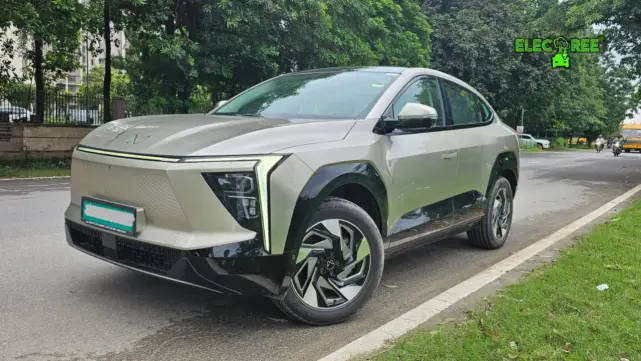
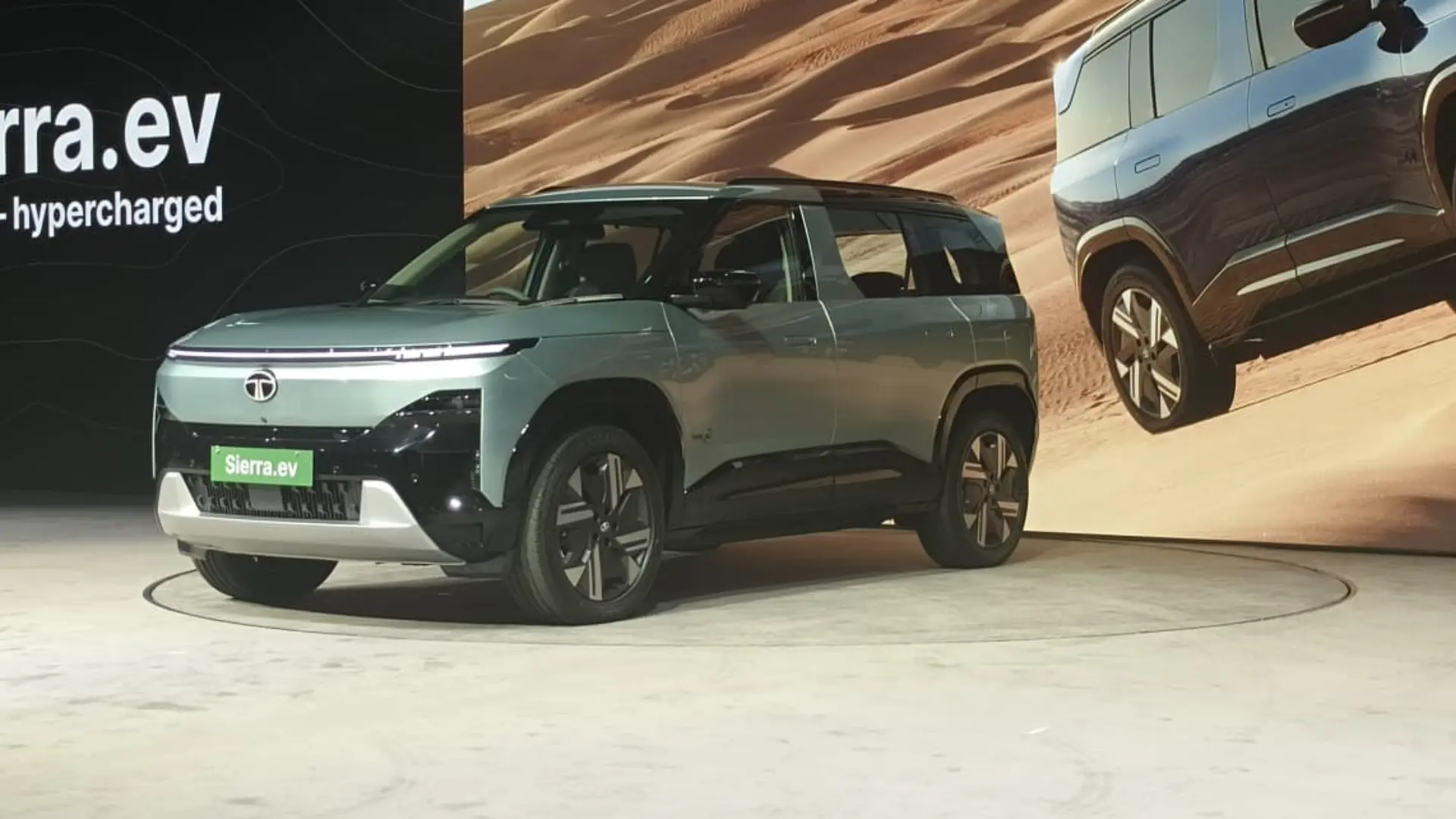
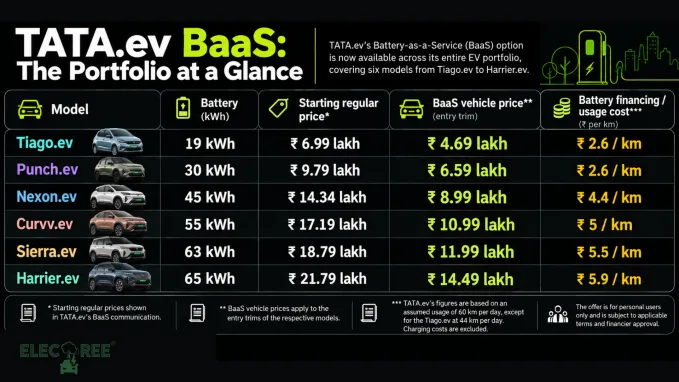
TATA EV has extended its Battery-as-a-Service (BaaS) offering across its entire electric-car portfolio. The option, earlier available on the Tiago and Punch, now covers the Nexon , Curvv , Sierra and Harrier as well.
The important part for buyers is how the BaaS structure works. It is not simply a different way of displaying the price of an EV. TATA describes BaaS as a dual-loan finance product, where the vehicle and battery are financed separately, subject to the approval and terms of the financier.
That distinction matters when comparing the BaaS figure with the regular price of an EV.
First, What Exactly Is BaaS?
Under the BaaS structure, the vehicle and battery are financed separately.
This means the BaaS vehicle price shown by TATA is not the complete financial obligation for the EV. The battery forms a separate part of the financing arrangement.
TATA's existing Tiago BaaS information explicitly describes BaaS as a dual-loan finance product and states that the offer is subject to financier approval and applicable terms and conditions.
In simple terms, the structure can be understood as:
Vehicle component
→ Vehicle price under BaaS
→ Applicable vehicle financing
Battery component
→ Financed separately
→ Applicable battery financing terms
The exact amount a customer pays will depend on the financing arrangement offered to them.
Why the BaaS Price Looks Lower
Consider the Nexon.ev.
Its starting price in the BaaS table is shown as ₹8.99 lakh, compared with ₹14.34 lakh for the corresponding starting price with the battery included.
The difference between those two displayed figures is ₹5.35 lakh.
But that ₹5.35 lakh should not be described as a saving on the EV's total cost.
The reason is straightforward: under BaaS, the battery is financed separately.
The same applies across the range. The Harrier, for example, is shown at ₹14.49 lakh under BaaS against a ₹21.79 lakh starting price in the table. The battery component has not disappeared from the transaction; it is financed separately.
This is why the BaaS vehicle price and the regular vehicle price should not be compared as if they represent two different total purchase costs.
What Does the ₹/km Figure Mean?
This is where the BaaS terminology needs some explanation.
TATA's table presents a “battery financing / usage cost” in rupees per kilometre. The figures range from ₹2.6/km for the Tiago and Punch to ₹5.9/km for the Harrier.
TATA says these figures are based on an assumed daily usage of 60 km, except for the Tiago, where the assumption is 44 km per day.
The ₹/km figure therefore should not automatically be interpreted as a conventional pay-per-kilometre bill where the customer is charged according to every kilometre actually driven.
It is a figure presented by TATA to communicate the battery-financing/usage component under its stated assumptions.
The actual amount payable depends on the financing terms applicable to the battery.
TATA's existing Tiago information also notes that estimated EMI calculations are based on specified financing assumptions, including loan tenure and interest rate.
The Important Difference: Usage Figure vs Actual Payment
For a buyer, this distinction is important.
If a BaaS table says ₹4.4/km for the Nexon, that does not mean Tata will simply multiply every kilometre driven by ₹4.4 and send the customer a monthly bill.
Nor should ₹4.4/km be treated as the complete running cost of the vehicle.
The figure is presented using TATA's stated usage assumption. The actual financing terms determine the customer's financial obligation.
That also means the ₹/km figure should not be added directly to electricity cost and presented as the EV's total running cost.
Charging Is Separate
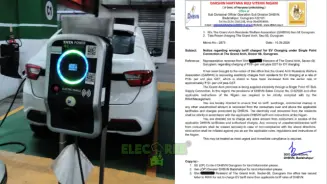
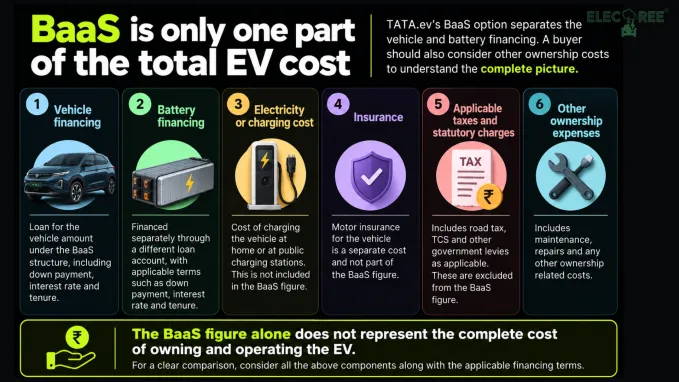
TATA's BaaS information specifically excludes charging costs from the displayed BaaS calculation. Its Tiago.ev information also states that the BaaS price excludes government statutory levies such as road tax, insurance, TCS and other applicable government levies.
What Should Buyers Compare?
The most useful comparison is not simply ₹14.34 lakh versus ₹8.99 lakh for the Nexon, for example.
A buyer should instead ask for the complete financing structure and compare the applicable terms.
Before choosing BaaS, check:
Vehicle
- Vehicle amount being financed
- Down payment
- Interest rate
- Loan tenure
- Total repayment
Battery
- Battery financing amount
- Down payment, if applicable
- Interest rate
- Battery loan tenure
- EMI or payment structure
- Total repayment
Other costs
- Insurance
- Statutory charges
- Charging costs
- Applicable processing or other financing charges
This is particularly important because TATA's official information makes clear that the BaaS arrangement is subject to financier approval and applicable terms.
One BaaS Structure Across Six EVs
The expansion means the BaaS option now spans Tata's EV range from the Tiago to the Harrier, with the Punch, Nexon, Curvv and Sierra in between.
TATA's current electric portfolio also lists the Sierra, Harrier, Curvv, Nexon, Punch and Tiago among its electric models.
The significance of the latest announcement, therefore, is not just the number attached to each BaaS vehicle price. It is that the same broad financing approach is now being offered across different vehicle segments, giving customers another way to structure the purchase of a Tata EV.
What the BaaS Numbers Really Tell You
TATA's expanded BaaS offering changes how the price of its EVs is presented, but the lower vehicle figure should not be mistaken for the complete cost of the EV.
The battery is financed separately, while the ₹/km figures are presented using TATA's stated usage assumptions. Charging and other applicable costs are outside that figure.
For a buyer, the meaningful question is therefore not simply:
“How much lower is the BaaS price?”
It is:
“What are the vehicle and battery financing terms, and what will I repay over the full tenure?”
That is the number that allows a proper comparison between BaaS and a conventional purchase structure.
Trending Articles