Tata Motors CEO Says EV Demand Has Crossed 10%, Dealer Stock Under 10 Days
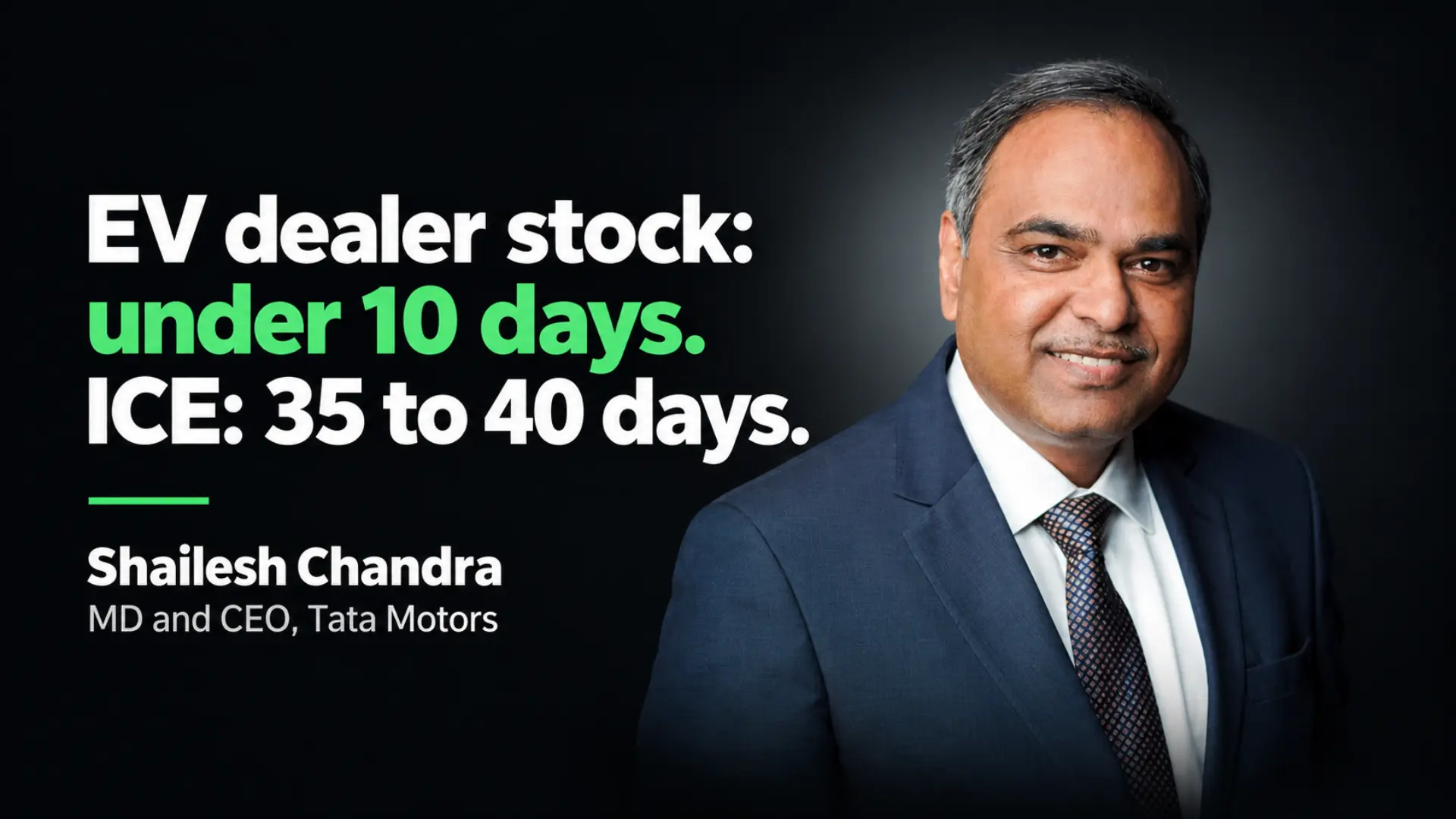
Tata Motors MD and CEO Shailesh Chandra said EV stock at dealerships is under 10 days, against 35 to 40 days for ICE vehicles, and that EV bookings have tripled since February 2026. Tata leads the EV market with a 39.9% year-to-date share.


Category:
Tag:
- Tata Motors
Tata Motors is the leader in India’s EV market with a 39.9% year-to-date market share (January to September 2026), based on 102,864 registrations. Mahindra is second with 22.7% (58,419 units), which puts Tata 17.2 percentage points and 44,445 units ahead.
At Autocar Professional’s India EV Conclave in Delhi on October 28, 2026, Tata Motors’ MD and CEO, Shailesh Chandra, explained how the company got here, and where the industry goes next. Hormazd Sorabjee moderated the panel.
Mr. Sorabjee opened by noting that EVs make up 23% of Tata’s portfolio, above the industry average. He asked what enabled this growth, and what it would take for the industry to reach double digit penetration.
Early Conviction
Mr. Chandra said it started with conviction. Tata began work on the technology when uncertainty was high, with no charging ecosystem, no supplier base and no customers. People questioned whether it would work at all. He said the key takeaway for Tata is to believe.
He added that being an early mover gave Tata time to mature the technology and build the portfolio it has today.
Ecosystem First
Unlike CNG, hybrid, petrol and diesel, EV was a new category, he said. Building a new category means building the entire ecosystem, and the ecosystem matters more than just the product. If the ecosystem does not grow, he said, the product has no relevance. Working with ecosystem players has been important for Tata’s growth.
Lifecycle Management
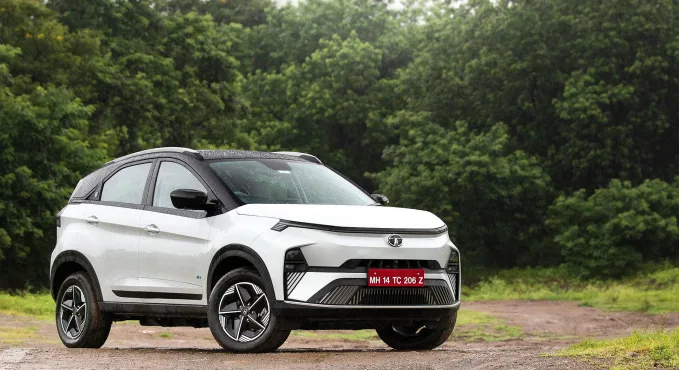
The technology keeps evolving, so product lifecycle management is important. Mr. Chandra used the Nexon as his example. The 2020 Nexon was a 30 kWh product at ₹13.99 lakh (ex-showroom). The Nexon today starts at the same ₹13.99 lakh (ex-showroom), but with a 45 kWh battery. He said this takes significantly more intervention.
Tata launched the first Tata EV — Nexon EV Prime in 2020 which was equipped with a 30.2 kWh battery pack. After three facelifts, it now comes with a 45 kWh pack which was launched in 2024.
Reaching Double Digits
On whether the industry can cross 10%, Mr. Chandra said that in demand terms it already has. He pointed to dealership stock, which is under 10 days for EVs against 35 to 40 days for ICE vehicles.
The bigger question, he said, is how the industry gets to 15 to 20%. He sees two challenges. One is charging infrastructure. The other is bringing EVs to different affordability points. The product itself, he said, is more or less set.
Supply Constraints
Mr. Sorabjee noted that everyone is facing supply constraints, as EV penetration has exceeded expectations. Mr. Chandra said Tata’s planning was based on the policy and market conditions of the time. He added that adverse factors on the conventional side also worked in EVs’ favour, and that this was not part of the forecast.
He explained that the Middle East crisis, which began in February 2026, created uncertainty about fuel prices and, at some stage, about whether fuel would be available at pumps. Crude has reached $100 a barrel, but this has not yet reached the retail level in India. In the West, he said, it has almost reached retail, customers there are suffering, and EV uptake is rising there too.
Bookings have tripled since February 2026, Mr. Chandra said. Multiple launches also worked in Tata’s favour. Together, the favourable factors for EVs and the unfavourable ones on the conventional side worked in combination.
He said the industry has an overall capacity issue because of how fast it is growing. Tata Motors, however, can direct production capacity towards either EV or ICE. From that standpoint, he said, Tata is secure on capacity.
The constraint lies with sub-system suppliers. Mr. Chandra said Tata keeps its schedules, revises them, and suppliers respond in two to three months. He gave semiconductors and power electronics as examples, which need schedules to be given well in advance. He said there is a capacity shortage in this area because of the AI industry.
This combination of factors has led to a slight delay. Mr. Chandra said Tata will be able to ramp up supply to match demand in two to three months.
To comment and participate in discussion Click Here
Trending Articles



Recent Articles