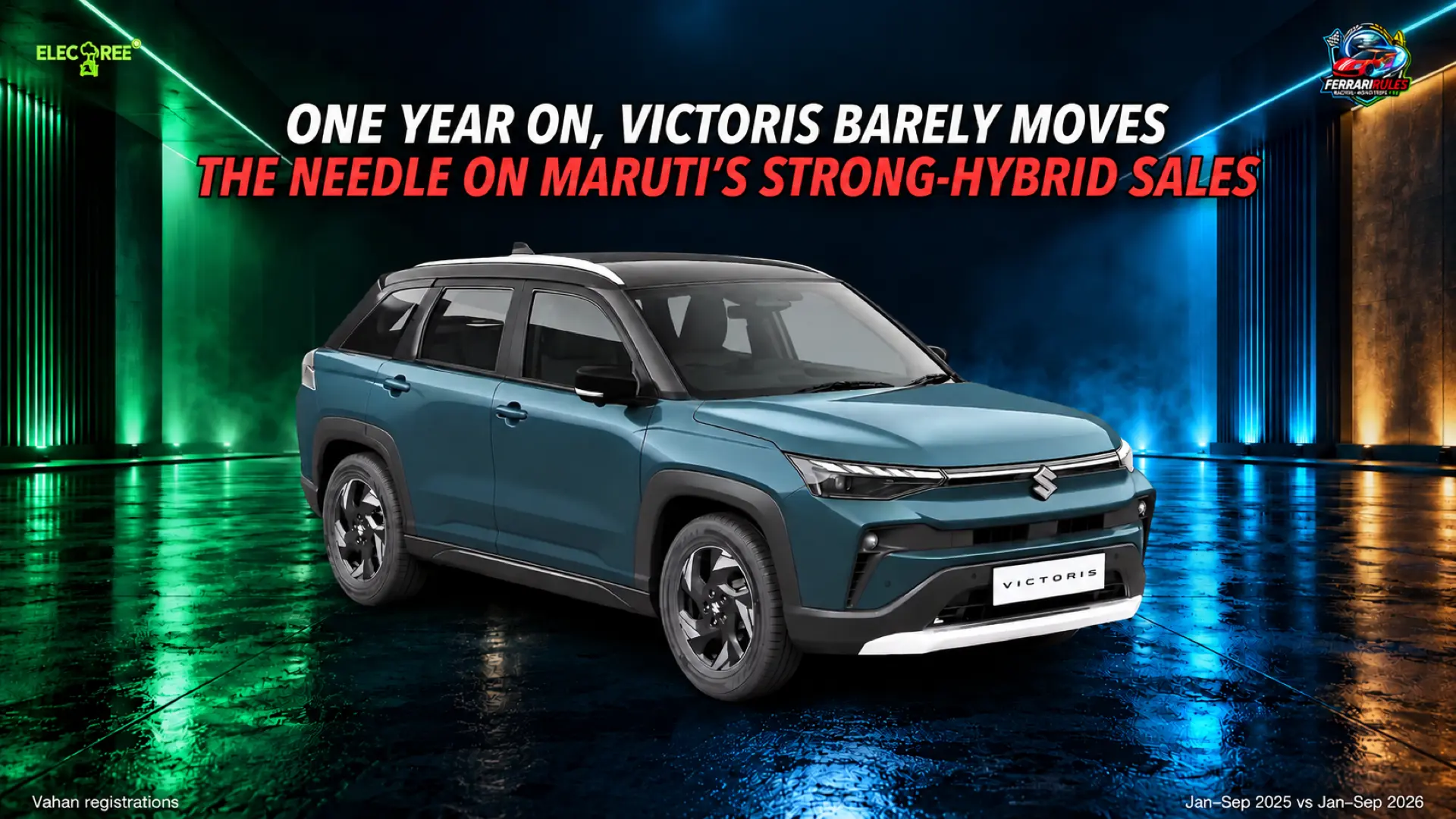
One Year On, Victoris Barely Moves the Needle on Maruti’s Strong-Hybrid Sales
The Victoris expanded Maruti’s strong-hybrid reach from NEXA to the much larger Arena network, but the result has been modest. Between September 2025 and September 2026, the Victoris registered 5,547 strong hybrids, compared with 13,068 Grand Vitara hybrids.


Category:
Tag:
- Maruti Suzuki
- Grand Vitara
- Maruti Victoris
When Maruti Suzuki introduced the Victoris through its Arena channel, it appeared to have the right product to take strong-hybrid technology to a much wider audience.
Until then, Maruti sold its strong-hybrid SUVs through NEXA. That channel crossed 500 sales outlets in August 2024, while Arena operated more than 3,069 outlets across 2,596 cities by September 2024.
The Victoris therefore took Maruti’s strong-hybrid technology from a premium retail channel to a network with more than six times as many touchpoints. One year later, the registration data shows that the expanded reach has delivered only a minor improvement in strong-hybrid volumes.
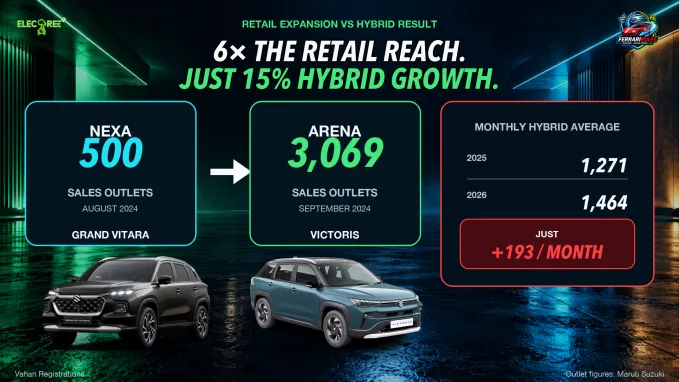
The Victoris brought strong-hybrid technology to the larger Arena network, but average monthly registrations increased by only 193 units.Average Monthly Hybrid Registrations Increased by Just 193 Units
The Grand Vitara and Victoris recorded a combined 11,439 strong-hybrid registrations between January and September 2025. This translates to an average of 1,271 units per month.
During the corresponding period of 2026, combined strong-hybrid registrations increased to 13,172 units, or an average of 1,464 units per month.
Strong-hybrid performance | Jan–Sep 2025 | Jan–Sep 2026 |
|---|---|---|
Total registrations | 11,439 | 13,172 |
Monthly average | 1,271 | 1,464 |
Increase in monthly average | — | 193 |
Year-on-year growth | — | 15% |
Despite the substantial increase in retail reach, average monthly strong-hybrid registrations improved by only 193 units.
That is particularly modest when compared with the combined growth of the two SUVs. Total Victoris and Grand Vitara registrations increased from 77,007 units to 1,76,987 units, representing growth of approximately 130%.
The Grand Vitara registered 11,407 strong hybrids during January–September 2025. That figure declined to 8,915 units during the corresponding period of 2026—a fall of approximately 22%.
The Victoris added 4,257 strong-hybrid registrations, but a large part of this volume merely compensated for the Grand Vitara’s decline.
Model | Jan–Sep 2025 hybrids | Jan–Sep 2026 hybrids | Change |
|---|---|---|---|
Grand Vitara | 11,407 | 8,915 | -22% |
Victoris | 32 | 4,257 | — |
Combined | 11,439 | 13,172 | +15% |
On average, the Victoris contributed 473 hybrid registrations per month in 2026. However, the Grand Vitara’s monthly average declined by approximately 277 units.
The net improvement across Maruti Suzuki’s two strong-hybrid SUVs was therefore only 193 registrations per month.
CNG Dominates the Victoris as Strong-Hybrid Share Remains at Just 4%
The Victoris registered 1,05,476 units between January and September 2026. However, only 4,257 units were strong hybrids, giving the powertrain a share of just 4%.
CNG emerged as the Victoris’ dominant powertrain, contributing 58,808 registrations, or nearly 56% of the total. Petrol accounted for another 42,411 units and a 40% share.
A major differentiator for the CNG version was its factory-fitted underbody fuel-tank design. Conventional CNG installations occupy a substantial portion of the boot, but the Victoris positioned its tank beneath the vehicle to retain the luggage space expected from a midsize SUV. Maruti Suzuki describes it as a segment-first design offering uncompromised boot space. Maruti Suzuki Victoris launch
The registration mix suggests that this practical packaging advantage resonated more strongly with buyers than the availability of the strong-hybrid powertrain.
In September 2026 alone, the Victoris recorded:
6,965 CNG registrations
5,711 petrol registrations
424 strong-hybrid registrations
Strong hybrids accounted for only 3.2% of Victoris registrations during the month.
The same shift is visible when the Victoris and Grand Vitara are considered together. Combined CNG registrations increased from 13,679 units during January–September 2025 to 77,223 units in 2026, representing growth of approximately 465%.
Strong-hybrid registrations increased by only 15%, from 11,439 to 13,172 units.
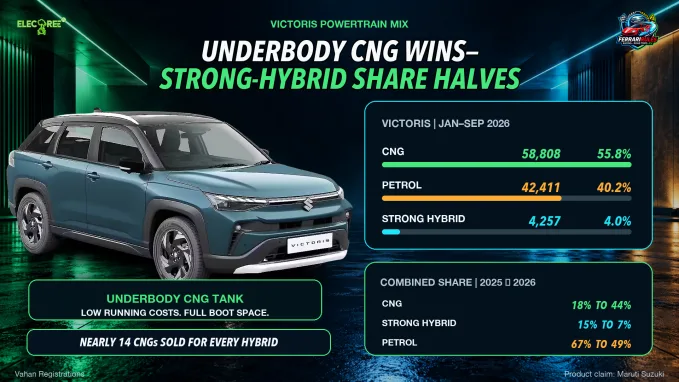
CNG accounted for 55.8% of Victoris registrations, while the strong hybrid contributed only 4%.CNG’s share of combined Victoris and Grand Vitara registrations increased from approximately 18% to 44%. Over the same period, the strong hybrid’s share fell from nearly 15% to 7%.
The Victoris therefore succeeded in expanding Maruti Suzuki’s midsize-SUV volumes, but its underbody CNG system—not its strong-hybrid technology—became the principal powertrain draw.
ElecTree Take
The Victoris should have been a significant opportunity for Maruti Suzuki’s strong-hybrid technology.
It brought the powertrain from NEXA’s comparatively limited footprint to Arena’s nationwide network of more than 3,000 outlets. Yet this vast increase in accessibility added only 193 strong-hybrid registrations to the combined monthly average.
The Victoris succeeded, but not because of its strong-hybrid option.
Its underbody CNG system addressed a more immediate customer concern: reducing running costs without losing valuable boot space. That combination turned CNG into the Victoris’ largest powertrain, accounting for nearly 56% of its registrations.
One year on, the Victoris has become a major volume generator for Maruti Suzuki, but it has barely moved the needle on strong-hybrid sales. Instead, it has demonstrated that a cleverly packaged CNG system can be considerably more compelling to mainstream SUV buyers than a technically sophisticated but more expensive hybrid powertrain.
Sources and methodology
• Registration figures compare January–September 2025 with January–September 2026.
Disclaimer: The values represented are new vehicle registrations and not dealer dispatches, sourced via RTOs through Vahan. The data is exclusive to ElecTree and Ferrarirules. Republishing the data on any social media platform or forum without credit is prohibited and will amount to copyright infringement and may result in appropriate legal action.
Trending Articles