Mahindra Thar.e vs JSW iCar V23 : Electric 4x4 Comparison
By 2027, two distinct approaches to the electric 4x4 formula will arrive: the born-electric Mahindra Thar.e and the retro-modern JSW iCar V23. How will they stack up against each other?



Category:
Tag:
- Mahindra Thar.e
- JSW Chery iCar V23
- Electric 4x4 off-roader
While standard electric SUVs dominate Indian city roads, a new segment is forming in the extreme terrain and lifestyle segments. For the first time, Maruti Suzuki's Jimny and Mahindra’s legacy Thar will face authentic, ground-up electric off-road competition.
The Thar.e vs the JSW iCar V23. This isn’t just a battle of brands but a direct technical contest between a localized manufacturing titan and a new, technology-first challenger. Here is a definitive, technical head-to-head.
Engineering Comparison: INGLO vs Global Tech Architecture
1. Powertrain Configuration and Output
The entire performance characteristic of an electric off-roader hinges on instantaneous torque delivery at near-zero RPM.
Mahindra Thar.e: Mahindra is developing the Thar.e on a specialized, heavy-duty adaptation of its 'Born EV' INGLO architecture. While base variants may use single rear-wheel-drive motors, the authentic off-road derivative utilizes a dual-motor, all-wheel-drive system (AWD). Specific motor specs aren't finalized, but early projections suggest a combined system output exceeding 280 PS and over 550 Nm of peak torque, making it drastically more powerful than any production ICE Thar.
JSW iCar V23: The iCar V23 leverages global EV expertise via JSW’s technology partners. It utilizes a similar logic: a dual-motor configuration with one independent electric motor mounted on each axle. The system is designed for massive torque multiplication to handle slow, precise technical crawling. The iCar’s global iteration offers approximately 260 hp (263 PS) and a headline-grabbing, constant system torque of nearly 600 Nm.
2. Battery Engineering and Thermal Endurance
Unlike city cars, off-road EVs need to manage battery temperature during sustained high-load, slow-speed crawls in extreme Indian heat.
Mahindra Thar.e: Localized production is Mahindra’s biggest asset. The Thar.e is slated to use a large, modular high-density battery module from the INGLO portfolio, likely in the 60–80 kWh NMC (Nickel Manganese Cobalt) range. Key technical features include a dedicated liquid cooling plate running beneath the battery module to ensure cell temperature stability while managing extreme heat. It targets an MIDC estimated range exceeding 450–500 km.
JSW iCar V23: The V23 also aims for high endurance. While JSW's localized cell sourcing is in development, initial models may utilize batteries in the 65–70 kWh LFP (Lithium Iron Phosphate) bracket, which are inherently more robust and stable in high temperatures. The LFP pack is paired with active thermal management and targets a CLTC estimated range of nearly 501 km (approximating 380–420 km real-world).
3. Off-Road Geometry and Architecture
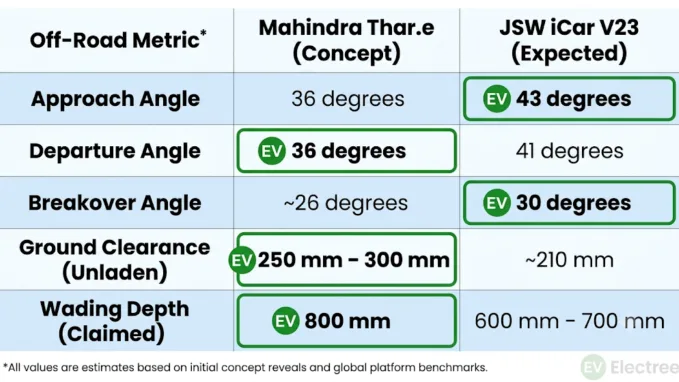
- Mahindra Thar.e: Mahindra’s concept geometry is aggressive. The skateboard platform allows the brand to minimize front and rear overhangs. However, the conceptual design prioritizes departure angle over approach, offering a standard 36-degree departure but a more conventional approach angle.
- JSW iCar V23: The iCar V23 wins the purely geometric numbers game. Its extremely short overhangs and compact 2,600 mm wheelbase allow it to achieve a spectacular 43-degree approach angle and a critical 30-degree breakover angle. While its ground clearance might be slightly lower than the Thar.e's concept, its overall boxy dimensions prioritize technical capability.
Design Philosophy
Exterior Styling & Structural Aesthetics
Mahindra Thar.e
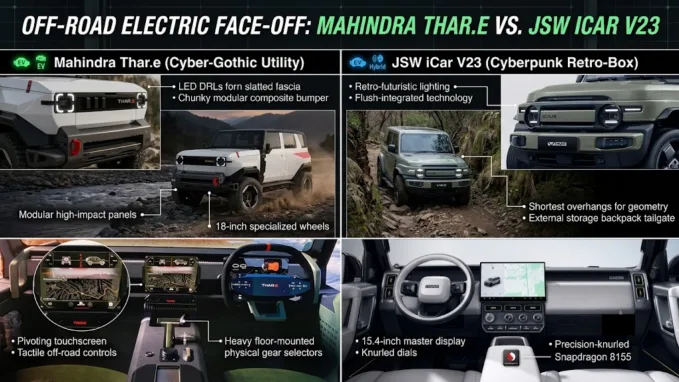
The Thar.e breaks completely away from its traditional CJ/Wrangler-derived heritage. Instead, it adopts a sharp, cyber-gothic industrial language characterized by:
Modular Body Panels: Unpainted, high-impact composite bumpers and wheel-arch cladding designed for easy, low-cost replacement after heavy off-roading.
Geometric Front Fascia: A closed-off, illuminated slatted grille framed by signature square LED halo DRLs.
Exposed Stance: Ultra-wide track width with wheels pushed out far beyond the main cabin body lines, yielding a planted, aggressive stance.
Asymmetrical Tail Gate: A sharp, boxy rear section with a side-hinged door carrying an exposed spare tire and dual-square LED taillamps.
JSW iCar V23
The iCar V23 blends iconic 1980s 4x4 silhouettes (reminiscent of the original Land Cruiser FJ40 and Suzuki Jimny) with clean, flush surfaces:
Classic Front End: Circular split-LED headlamps set inside a bold rectangular grille bar.
Ultra-Short Overhangs: Near-zero front and rear overhangs with flush door handles and flat side glass panels to optimize aerodynamic efficiency without losing its boxy posture.
Rear External Storage Box: Rather than a traditional spare tire, the tailgate features a distinct, lockable "backpack" external storage container for off-road recovery straps and charging cables.
Interior Architecture & Ergonomics
1. Mahindra Thar.e Cabin
Inside, Mahindra prioritizes a rugged, hose-down "tactile utility" environment engineered for dirt and water exposure:
Aviation-Inspired Cockpit: A multi-function steering wheel with flat top and bottom sections, paired with a central live status/pitch-and-roll pictogram on the digital instrument cluster.
Central Pivoting Display: A high-mounted central touchscreen that can pivot toward either the driver or the front passenger during technical off-road navigation.
Heavy-Duty Grab Handles: Massive passenger-side dashboard and A-pillar grab handles integrated into the structural roll-cage architecture.
Drive Selector & Terrain Dials: A heavy, floor-mounted physical gear lever paired with rotary terrain-mode selectors for easy operation while wearing off-road gloves.
2. JSW iCar V23 Cabin
The V23's interior trades raw industrial utility for a futuristic, tech-forward aesthetic:
Monolithic Central Display: A 15.4-inch 2.5K central touchscreen running on a Qualcomm Snapdragon 8155 processor, handling all primary climate and vehicle telemetry controls.
Knurled Physical Controls: Below the main display sits a row of oversized, knurled metal toggles and rotary dials specifically designated for drive modes and 4WD lock settings.
High-Roof Visibility: A high seating position paired with a flat, upright windshield and low window beltlines, offering expansive outward trail visibility.
Modular Dashboard Mounts: Built-in threaded accessory mounting points along the upper dashboard for GoPro cameras, GPS units, and off-road pitch/roll clinometers.
Key Feature Philosophies
1. Localized Manufacturing vs. Tech Adoption
The final deciding factor will be price and service support. Mahindra is a fully integrated localized manufacturer in India. This scale gives the Thar.e a massive cost advantage in localized assembly of battery cells, motors, and high-tensile steel bodies, making an aggressive launch price near ₹20 Lakh entirely possible. Furthermore, every Mahindra workshop in India will be EV-certified to service it.
Conversely, the JSW iCar V23 enters as an entirely new ecosystem. Its biggest advantage is the speed of technology integration. Instead of localizing a legacy platform, it imports a fully optimized, purpose-built EV architecture with pre-validated high-performance dual motors. JSW's primary hurdle will be building a cohesive service and dealer footprint across the country.
2. V2L and Infrastructure
Both off-roaders are designing the capability to run a campsite entirely on battery power. The Thar.e utilizes Vehicle-to-Load (V2L) via standard AC ports inside the cabin. The iCar V23, however, expands on this concept with dedicated exterior waterproof ports specifically to power external cooking equipment and tools, positioning it closer to the global "adventure vehicle" standard.
Trending Articles