
Kia EV Registrations Rise 86.5% YoY in October 2026; Syros EV Holds Steady as Clavis Falls
Kia registered 1,404 electric vehicles in October 2026, an 86.5% YoY increase but a 2.3% sequential decline. Syros EV remained the portfolio leader with 880 registrations, while Carens Clavis EV declined both monthly and yearly.



Category:
Tag:
- Kia India
- Kia Syros EV
- Carens Clavis EV
Kia recorded 1,404 electric-vehicle registrations in October 2026, according to the latest Vahan data. Registrations declined 2.3% month-on-month from 1,437 units in September but increased 86.5% year-on-year from 753 units in October 2025.
Yearly growth remains impressive, but the model-wise split paints a more measured picture. The Syros EV remained almost unchanged at 880 registrations, while the Carens Clavis EV declined by 6.5% and Kia’s premium EV6 and EV9 contributed just five units combined.
The latest Vahan database also revises Kia’s September total from the 1,271 registrations reported in our previous analysis to 1,437 units as delayed registrations were added. September’s revised model totals are therefore used for all month-on-month comparisons in this article.
Syros EV stabilises at 880 registrations
The Syros EV recorded 880 registrations, broadly unchanged from 878 units in September. It accounted for 62.7% of Kia’s October EV volume, retaining its position as the company’s electric-volume engine.
Its variant mix was led by the entry-level HTK:
- HTK: 455 registrations
- HTX: 132 registrations
- X-Line: 116 registrations
- HTX+: 91 registrations
- HTK+: 86 registrations
The HTK alone generated 51.7% of Syros EV registrations. The three largest variants—HTK, HTX and X-Line—contributed 703 units, representing almost 80% of the model’s volume.
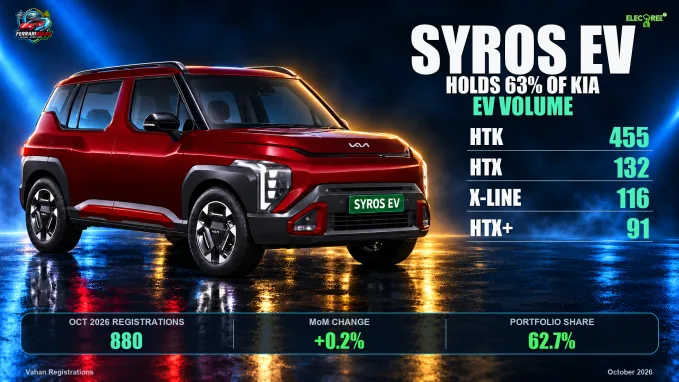
The result shows that the Syros EV sustained its September run rate rather than extending it. However, maintaining nearly 900 monthly registrations was sufficient for it to remain Kia’s dominant EV by a wide margin.
Smaller battery becomes the preferred Syros EV configuration
The more significant change occurred in the Syros EV’s battery mix.
The 42 kWh version increased from 471 registrations in September to 562 units in October, a rise of 19.3%. Meanwhile, the 51.4 kWh version declined from 407 to 318 units, a fall of 21.9%.
Consequently, the smaller battery’s share increased to 63.9%, while the 51.4 kWh version accounted for 36.1%.
The September mix had been relatively balanced. October moved decisively towards the smaller battery, aligning with the HTK’s position as the model’s highest-volume variant.
Carens Clavis EV declines both monthly and yearly
The Carens Clavis EV recorded 519 registrations, down 6.5% month-on-month from 555 units. Compared with its October 2025 volume of 700 units, registrations declined 25.9%.
It contributed 37% of Kia’s October EV registrations, compared with the Syros EV’s 62.7%.
The HTK+ remained the clear volume leader:
- HTK+: 304 registrations
- HTX: 88 registrations
- HTX+: 43 registrations
- HTM: 36 registrations
- HTX(E): 20 registrations
- GTX+: 20 registrations
- X-Line: 6 registrations
- GTX: 2 registrations
The HTK+ contributed 58.6% of the model’s registrations. The three leading variants accounted for nearly 84% of Carens Clavis EV volume, indicating a high level of concentration around the lower and middle sections of the range.
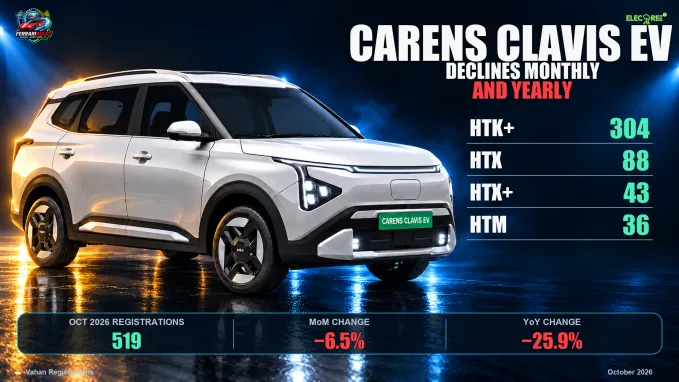
The Clavis decline was also responsible for Kia’s overall monthly contraction. Syros EV registrations increased by two units, while Clavis lost 36 registrations. The premium models added only one additional registration between them and could not offset the decline.
Carens Clavis EV also shifts towards the 42 kWh battery
The 42 kWh Carens Clavis EV recorded 377 registrations, increasing 4.1% from 362 units in September. Its 51.4 kWh counterpart declined 26.4%, from 193 to 142 registrations.
The smaller battery consequently accounted for 72.6% of the model’s October volume, up from 65.2% in September.
This means the Clavis’s overall decline came entirely from the larger-battery configuration. Registrations of the smaller pack continued to grow despite the model recording a lower total.
EV6 and EV9 remain peripheral
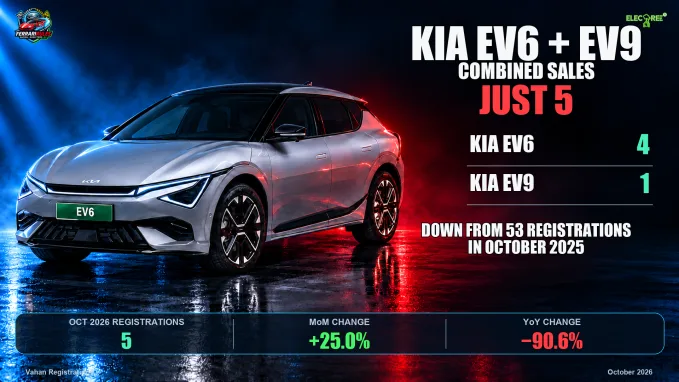
The EV6 recorded four registrations in October, compared with three in September and 52 in October 2025. Despite the small monthly increase, its yearly volume declined 92.3%.
The flagship EV9 contributed only one registration, unchanged both month-on-month and year-on-year.
Together, the EV6 and EV9 represented just 0.4% of Kia’s electric registrations. The company’s EV performance is therefore almost entirely dependent on the locally oriented Syros EV and Carens Clavis EV.
The 42 kWh battery now accounts for two-thirds of Kia’s EV volume
Across Kia’s electric portfolio, 42 kWh models generated 939 registrations, accounting for 66.9% of the company’s October EV volume.
The complete battery mix was:
- 42 kWh: 939 registrations — 66.9%
- 51.4 kWh: 460 registrations — 32.8%
- 84 kWh: 4 registrations — 0.3%
- 99.8 kWh: 1 registration — 0.1%
The 42 kWh category rose from 833 registrations in September to 939 in October, up 12.7%. The 51.4 kWh category moved in the opposite direction, declining from 600 to 460 registrations, or 23.3%.
The shift occurred across both mainstream models, indicating that Kia’s October volume increasingly came from the more accessible battery configurations rather than the longer-range alternatives.
Electree Take
Kia’s 86.5% yearly growth was driven by adding the Syros EV. Without its 880 registrations, the rest of the portfolio would have recorded 524 units—below the 753 units registered in October 2025.
The Syros EV has successfully expanded Kia’s electric scale, but October also demonstrates the limits of relying on one model for growth. Syros remained stable, Clavis declined, and the premium EVs remained negligible.
The next test is whether the Syros EV can move beyond its current 880-unit level while the Carens Clavis EV stabilises. October’s battery and variant mix also suggests that the more affordable configurations are doing most of the work across both models.
For now, Kia’s EV portfolio is substantially larger than it was a year ago—but nearly two-thirds of its volume comes from the Syros EV, and approximately two-thirds uses the smaller 42 kWh battery.
Source: Vahan registration data. October 2026 model-, variant- and battery-wise analysis. September figures reflect the latest revised Vahan database and may differ from figures reported immediately after the month ended.
Disclaimer: The figures represent vehicle registrations rather than wholesale dispatches. Vahan totals may be revised as delayed registrations are added. The data is exclusive to ElecTree and FerrariRules. Republishing it without attribution is prohibited.
To comment and participate in discussion Click Here
Trending Articles
JSW MG Motor Hikes MG Hector Tomahawk EV Prices by ₹75,000 Just Months After Launch

Top 4 Best Selling EVs in October 2026: Punch EV Leads Again
VIDA VX2 and Ather Grid: Which Chargers Work, and Why Charging Stops at 80%

TVS Orbiter V1 vs Bajaj Chetak C2501 vs VIDA VX2 Go: Which Electric Scooter Should You Buy?
Recent Articles
MG’s October 2026 Retail Sales: Tomahawk Falls Short of Expectations

Mahindra EV Registrations Rise 86.5% YoY in October 2026; XEV 9S Leads, BE6 Rebounds

Kerala Commission Awards ₹44,000 Over Electric Scooter Repair Delay: What Owners Should Know

Tata EV Sales October 2026: Punch Leads as Total Registrations grow 78% YoY