
TVS Orbiter V1 vs Bajaj Chetak C2501 vs VIDA VX2 Go: Which Electric Scooter Should You Buy?
Three affordable electric scooters, three different approaches to everyday commuting. We compare their range, charging, storage and ownership costs to find out which makes the most sense.


Category:
Tag:
- TVS Orbiter V1 vs Chetak C2501 vs VIDA VX2 Go
Choosing an affordable electric scooter isn't just about finding the lowest price or the highest claimed range. How you charge it, how much you carry and where you get it serviced can make a bigger difference over several years of ownership.
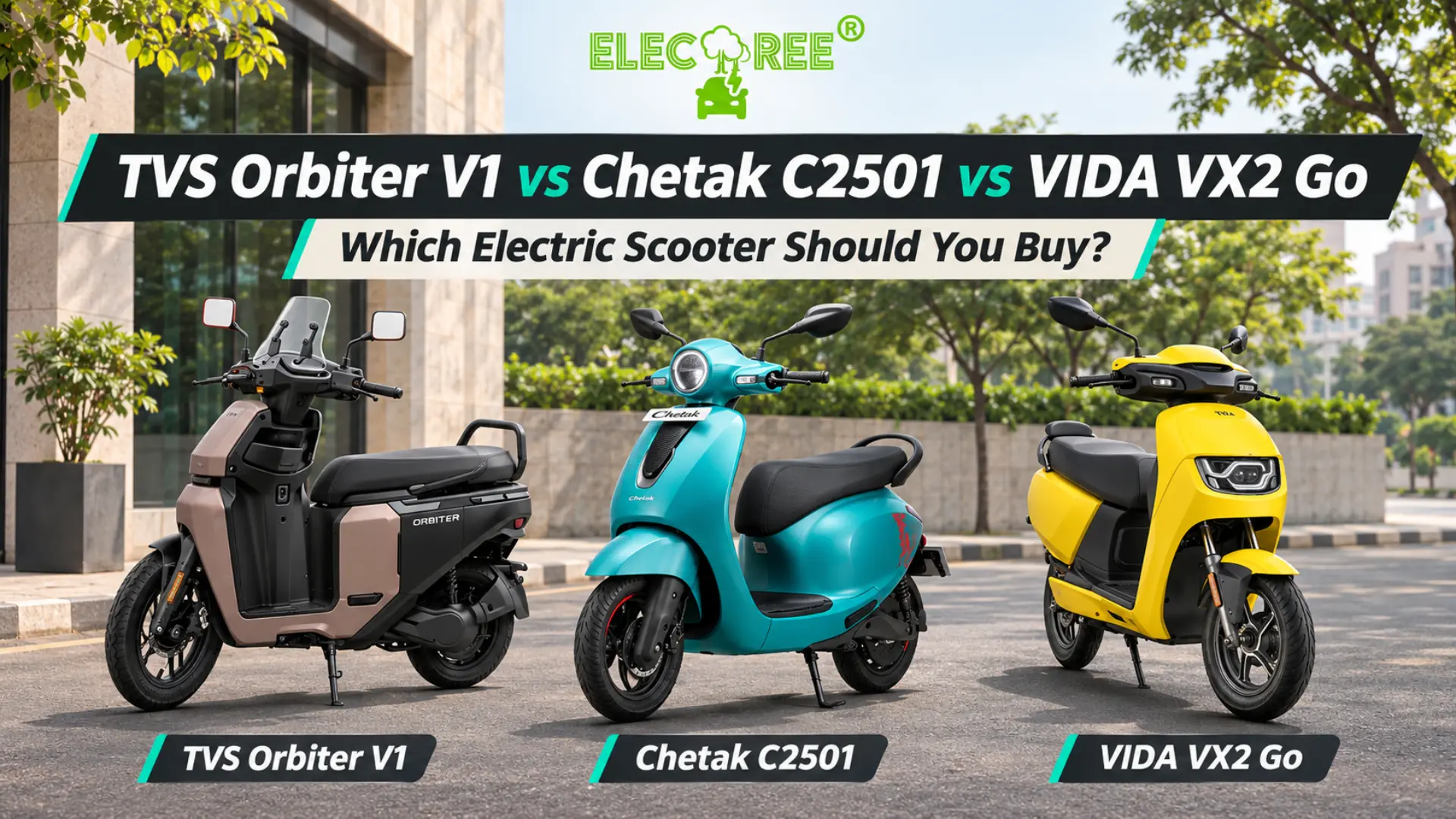
The TVS Orbiter V1, Bajaj Chetak C2501 and VIDA VX2 Go 2.2 are three options worth considering. All are designed primarily for city commuting, but their strengths are quite different.
The Orbiter focuses on space and convenience, the Chetak offers more claimed range and a compact metal-bodied design, while the VIDA brings removable-battery flexibility.
So which one should you choose?
Battery and Range: Chetak Has the Advantage on Paper
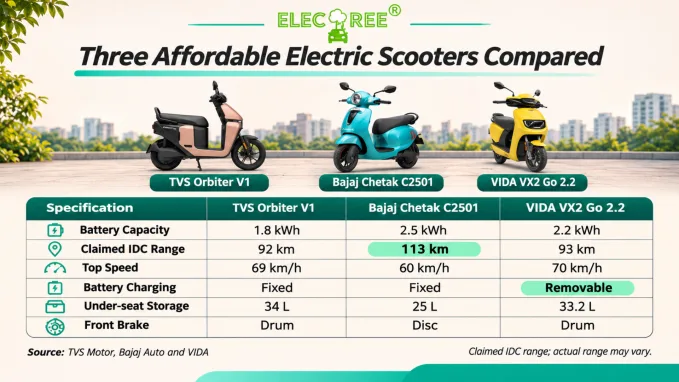
The Bajaj Chetak C2501 comes with a 2.5 kWh battery and 113 km of claimed IDC range. That's 21 km more than the TVS Orbiter V1's 92 km and 20 km more than the VIDA VX2 Go 2.2's 93 km.
Interestingly, the Orbiter and VIDA offer almost identical claimed range despite having different battery capacities: 1.8 kWh and 2.2 kWh respectively.
However, IDC figures are standardised test results, not guarantees of everyday riding distance. Traffic conditions, speed, gradients, passenger load and riding style can all affect the actual range.
For someone travelling 20–30 km daily, all three could be suitable if charging is readily available. Those with longer commutes or less frequent charging opportunities may appreciate the Chetak's additional claimed range.
But range alone doesn't settle the comparison.
Charging Convenience Could Change Your Decision
This is where the VIDA VX2 Go offers a meaningful advantage.
Its 2.2 kWh battery is removable, allowing owners to charge it away from the scooter. For people living in apartments without charging sockets near their parking spaces, that could make electric scooter ownership considerably easier.
The TVS Orbiter V1 and Bajaj Chetak C2501 use fixed-battery arrangements, so buyers need a suitable charging point accessible to the parked scooter.
With their standard charging arrangements, TVS quotes approximately 2 hours 20 minutes for a 0–80% charge on the Orbiter V1, while Bajaj quotes 2 hours 25 minutes for the Chetak C2501.
VIDA also supports public fast charging, with a claimed 0–80% time of around 65 minutes. However, that figure should not be confused with ordinary home charging, which takes longer.
There's another consideration: the larger VX2 Go 3.4 has a removable battery arrangement and 146 km of claimed range, while the Go 3.1 FB uses a fixed battery. Buyers should verify the exact variant rather than assume every VX2 charges the same way.
For apartment residents, charging access could be more important than a 20 km difference in claimed range.
Storage, Braking and Everyday Practicality
The Orbiter V1 offers 34 litres of under-seat storage, slightly ahead of the VX2 Go 2.2's 33.2 litres and comfortably more than the Chetak C2501's 25 litres.
That matters for carrying bags, groceries or rain gear, although the actual shape of the compartment is just as important as its capacity.
The Chetak takes a different approach. Its compact dimensions and metal body may appeal to riders looking for a traditional scooter feel.
There are differences in braking hardware too. The Chetak C2501 gets a front disc brake, while the Orbiter V1 and VX2 Go 2.2 use drum brakes at the front.
A disc brake can offer advantages in heat management and braking consistency, but real stopping performance also depends on tyres, weight and brake tuning. A test ride is more useful than judging braking quality by hardware alone.
For outright speed, the VIDA reaches a claimed 70 km/h, the Orbiter approximately 69 km/h, and the Chetak 60 km/h. The difference may matter on faster urban roads, although all three are primarily commuter scooters.
Price: Don't Compare Different Ownership Plans
The TVS Orbiter V1 and Bajaj Chetak C2501 are surprisingly close in Bengaluru.
TVS lists the Orbiter V1 at ₹99,900, effective ex-showroom after the applicable PM E-DRIVE incentive. Bajaj's current Bengaluru listing puts the Chetak C2501 at ₹99,802 ex-showroom.
That's a difference of just ₹98 at the listed prices, making features and everyday suitability far more important than the initial price gap.
The VIDA VX2 requires more careful comparison because of its Battery-as-a-Service (BaaS) financing option.
Under BaaS, buyers can pay a lower amount upfront and make additional payments linked to battery usage. Importantly, VIDA describes this as a financing arrangement rather than a system in which the battery remains owned by a separate swapping operator.
A lower advertised upfront price therefore doesn't necessarily mean a lower overall ownership cost.
Before deciding, buyers should compare the total amount payable, financing charges, kilometre limits and any additional fees—not just the initial vehicle price.
What About After-Sales Support?
All three manufacturers have established two-wheeler businesses or service networks behind them. But the relevant question is whether the exact electric scooter can be serviced conveniently in your city.
Ask the dealership about the battery warranty, service location, roadside assistance, software updates and parts availability.
Connected features and paid software packages can also affect the overall value. For example, some Chetak C2501 features depend on the optional TecPac, while the Orbiter offers a more extensive connected-feature package.
These differences are worth checking against the final quotation.
Which Electric Scooter Should You Buy?
Choose the TVS Orbiter V1 if you prioritise storage, connected features and a spacious everyday commuter. It makes sense for riders with reliable access to charging.
Choose the Bajaj Chetak C2501 if you prefer a compact metal-bodied scooter, want the highest claimed range among these three and value its front disc brake. Check whether its 60 km/h top speed and smaller boot suit your routine.
Choose the VIDA VX2 Go 2.2 if removable-battery charging is important. Its flexibility could outweigh the Chetak's additional claimed range, particularly for apartment residents.
For buyers considering longer commutes, it's also worth comparing the larger battery variants before making a decision.
Ultimately, there isn't one scooter that wins every category. The better purchase is the one whose charging arrangement, practical features and total cost fit your daily routine.
Specifications and prices are based on published manufacturer information. Claimed ranges are IDC figures; actual performance and final on-road prices may vary.
To comment and participate in discussion Click Here
Trending Articles



Recent Articles

Top 4 Best Selling EVs in October 2026: Punch EV Leads Again

Mercedes-Benz GLC Electric Launched at ₹78.50 Lakh: Just ₹1.5 Lakh Above Petrol and Diesel GLC

Honda Alpha Global Debut Set for 2 December: First Made-in-India Electric SUV Nears Production
TVS Orbiter V1 vs V2: Is the Bigger Battery Worth the Extra Money?