
VIDA VX2 and Ather Grid: Which Chargers Work, and Why Charging Stops at 80%
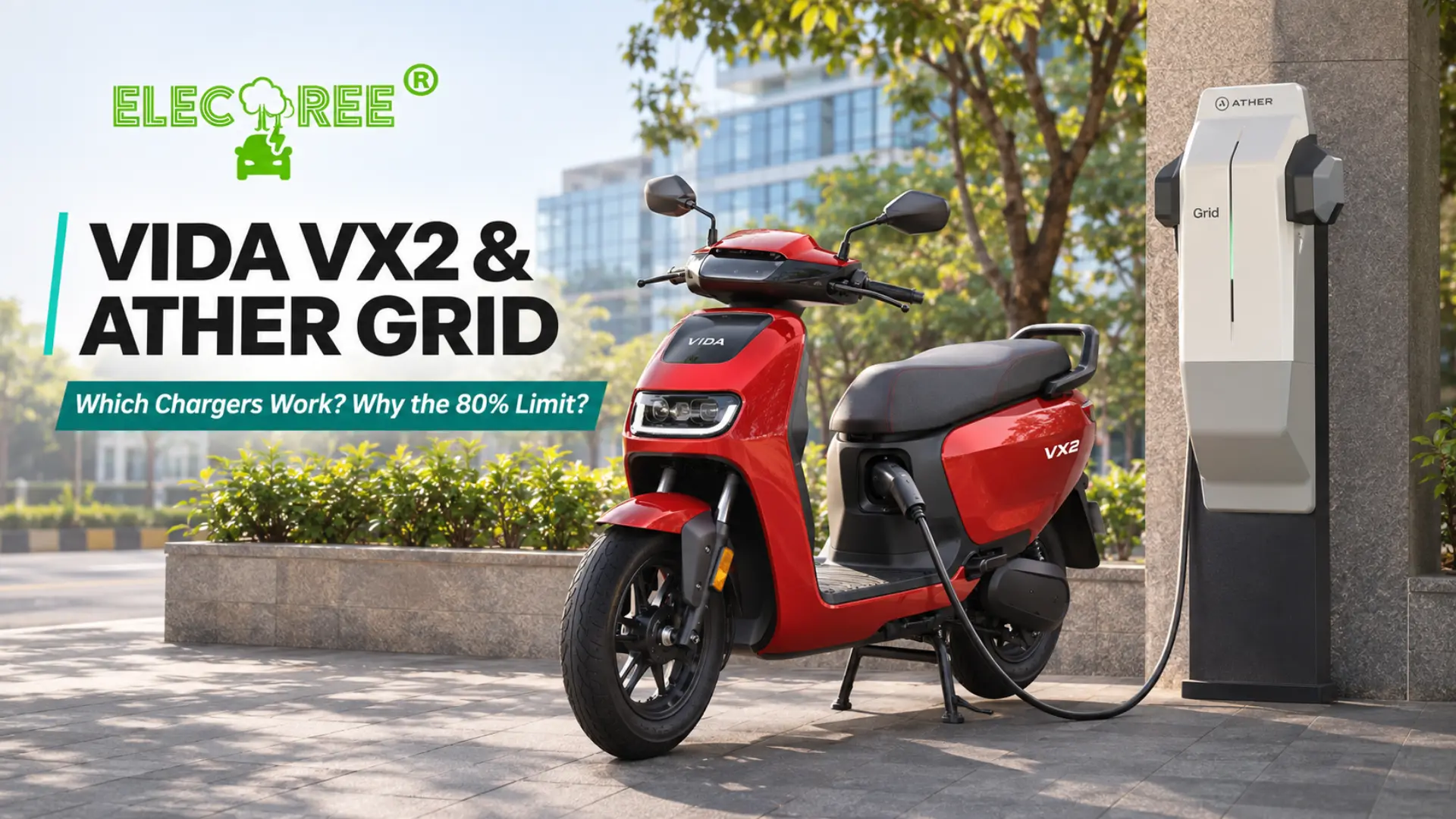
VIDA electric scooters can use compatible Ather Grid fast chargers, but there are a few important restrictions. From charger compatibility to vehicle registration and charging limits, here's what VX2 owners should know.


Category:
Tag:
- VIDA VX2
- Ather Grid
- Electric Scooter Charging
- Public EV Charging
- Fast Charging
- VIDA Electric
One of the advantages of owning a VIDA electric scooter is access to public charging infrastructure beyond the company's own network.
Thanks to Hero MotoCorp's charging partnership with Ather Energy, VIDA owners can use compatible Ather Grid fast chargers. For someone running low on charge away from home, that can make a real difference.
However, not every Ather Grid charging point is necessarily compatible with a VIDA scooter. There are also conditions involving the vehicle's registration details, charger connection and battery percentage.
VIDA's published charging instructions explain these restrictions. Understanding them before arriving at a charging station could save owners considerable inconvenience.
Which Charging Connector Do VIDA and Ather Use?
Both VIDA and Ather use the Type 7 connector, also known as LECCS (Light Electric Combined Charging System). Standardised under IS 17017 (Part 2/Sec 7):2023, it supports both AC and DC charging through a single connector.
The Type 7 standard is used by Ather's 450 and Rizta scooters and Hero MotoCorp's VIDA range. Matter has also adopted the LECCS standard.
This shared connector makes cross-brand charging possible. However, having the same connector doesn't guarantee compatibility with every charging station. The charger must also support the vehicle's communication and authentication requirements.
What About Type 6?
Type 6 (LEVDC) is another charging standard used in India's electric two-wheeler market. Unlike Type 7, it is designed for DC charging.
Examples of vehicles using Type 6 include the Ola S1 series, Ultraviolette F77 and Tork Kratos R.
Type 6 and Type 7 connectors are not physically interchangeable. A scooter equipped with a Type 6 charging port cannot directly connect to a Type 7-only Ather Grid charger.
This distinction matters as manufacturers expand their charging networks. Even when a public charging station is nearby, riders need to check whether its connector and charging system are compatible with their vehicle.
Can Every Ather Grid Charger Charge a VIDA VX2?
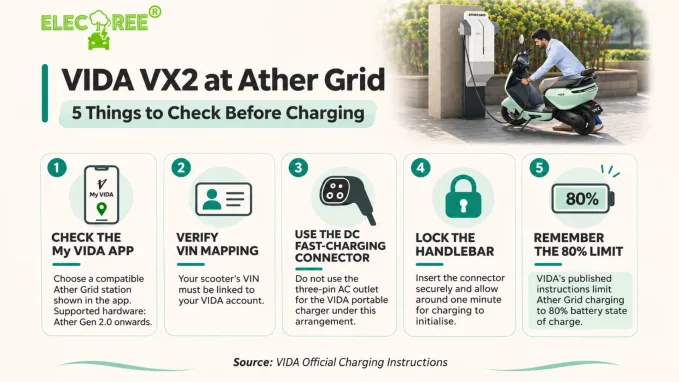
No. VIDA specifies that its scooters can use Ather Grid Gen 2.0 and newer compatible fast chargers.
Older chargers may not support the required charging arrangement. Since most riders cannot easily identify the hardware generation by looking at a charging station, VIDA advises customers to use the My VIDA app to locate supported charging points.
This is an important distinction.
Seeing an Ather Grid charger nearby does not automatically mean it will work with your scooter. The most reliable starting point is to check whether that location appears as a compatible charging station in the VIDA app.
Owners should also use the dedicated DC fast-charging connector. VIDA's instructions state that the three-pin AC sockets found at some charging locations are not suitable for its portable charger under this arrangement.
Why Does Charging Stop at 80%?
This is perhaps the most important restriction for owners planning longer journeys.
According to VIDA's charging instructions, its scooters cannot charge beyond 80% battery state of charge at Ather Grid stations.
If a rider arrives with 50% battery remaining, the charger can provide a top-up until the 80% threshold, assuming the charging session is otherwise functioning normally.
But if the scooter already has 80% charge or more, a charging session may not begin.
That does not necessarily mean the charger or scooter is faulty. It may simply be the network's charging limit for VIDA vehicles.
The difference matters when planning a trip. A rider expecting to reach 100% at a public Ather Grid charger should instead plan around the 80% limit and use an appropriate alternative charging arrangement when a full charge is needed.
VIDA quotes DC fast-charging times of around 62–65 minutes from 0–80% for several VX2 variants under specified test conditions. Actual charging times can vary, and those figures should not be treated as a guarantee at every Ather Grid location.
Why VIN Mapping Matters
There is another condition that owners may not be aware of.
VIDA's technical instructions state that the vehicle identification number, or VIN, must be properly linked to the customer's account before the scooter can use Ather Grid charging.
This mapping normally happens during invoicing.
However, if the process was missed, the vehicle may fail to initiate charging even when the owner reaches a compatible station.
VIDA advises customers to log in to the My VIDA app using their registered mobile number and confirm that the correct VIN is associated with their account.
If it is missing, owners can contact VIDA customer support to resolve the issue.
For someone who has recently purchased a VX2, checking this before relying on public charging is particularly sensible.
What Should You Do When You Reach an Ather Grid Charger?
The charging process is straightforward, but a few details matter.
First, locate a compatible station through the My VIDA app and check its availability before travelling there.
Once at the station, park the scooter safely, switch it off and make sure the handlebar is securely locked.
Insert the compatible DC fast-charging connector into the scooter's charging port and ensure it is properly seated.
VIDA advises allowing approximately one minute for the charging session to initialise. The connection process involves communication between the scooter and charger before energy transfer begins.
If charging doesn't start immediately, waiting briefly may be enough.
Owners should also check whether the battery is already at or above 80%, since that can prevent further charging.
What if the Charger Still Doesn't Work?
If the charging session fails after these checks, the issue may involve the charging station, vehicle authentication or connector.
A charger showing a fault indication may require attention from the charging-network operator. In that case, owners should report the problem through the available support channel and consider another compatible location.
If VIN mapping appears to be the problem, VIDA customer support can help confirm the vehicle's account registration.
Owners should never forcefully remove a connector that remains locked to the scooter. Follow the manufacturer's normal stop-charging and connector-release procedure, and contact support if it does not disengage.
It is also worth checking the applicable charging charges in the app before starting a session, as network terms and tariffs may change.
What Does This Mean for VIDA Owners?
Ather Grid compatibility gives VIDA owners more public charging options, particularly when they are away from their usual home or workplace charging arrangement.
However, having access to a charging network is not the same as having unrestricted access to every charger within it.
The supported hardware generation, VIN mapping requirement and 80% charging limit all affect the actual experience.
For everyday commuting, these conditions may make little difference to owners who primarily charge at home. But for anyone relying regularly on public infrastructure, they are worth understanding.
The practical takeaway is simple: check the My VIDA app before travelling to a station, confirm that the scooter is correctly registered, and plan your charging stop around the 80% limit.
A little preparation can make the difference between a convenient top-up and an unsuccessful charging stop.
To comment and participate in discussion Click Here
Trending Articles


Recent Articles
MG’s October 2026 Retail Sales: Tomahawk Falls Short of Expectations
Mahindra EV Registrations Rise 86.5% YoY in October 2026; XEV 9S Leads, BE6 Rebounds
Kerala Commission Awards ₹44,000 Over Electric Scooter Repair Delay: What Owners Should Know
Tata EV Sales October 2026: Punch Leads as Total Registrations grow 78% YoY