India’s Powertrain Reset Deepens: Petrol Falls Below 50% as EV and CNG Lead Growth
India’s passenger-vehicle market is moving beyond petrol, but no single powertrain is taking its place. August 2026 data shows EV and CNG sales growing strongly year on year, while Maruti Suzuki, Tata Motors, Mahindra, Hyundai, Kia, and Toyota follow distinctly different powertrain strategies.


Category:
Tag:
- EV Sales
- CNG Cars
- Powertrain Analysis
India’s passenger-vehicle market slowed in August 2026, but the shift in vehicle powertrains continued.
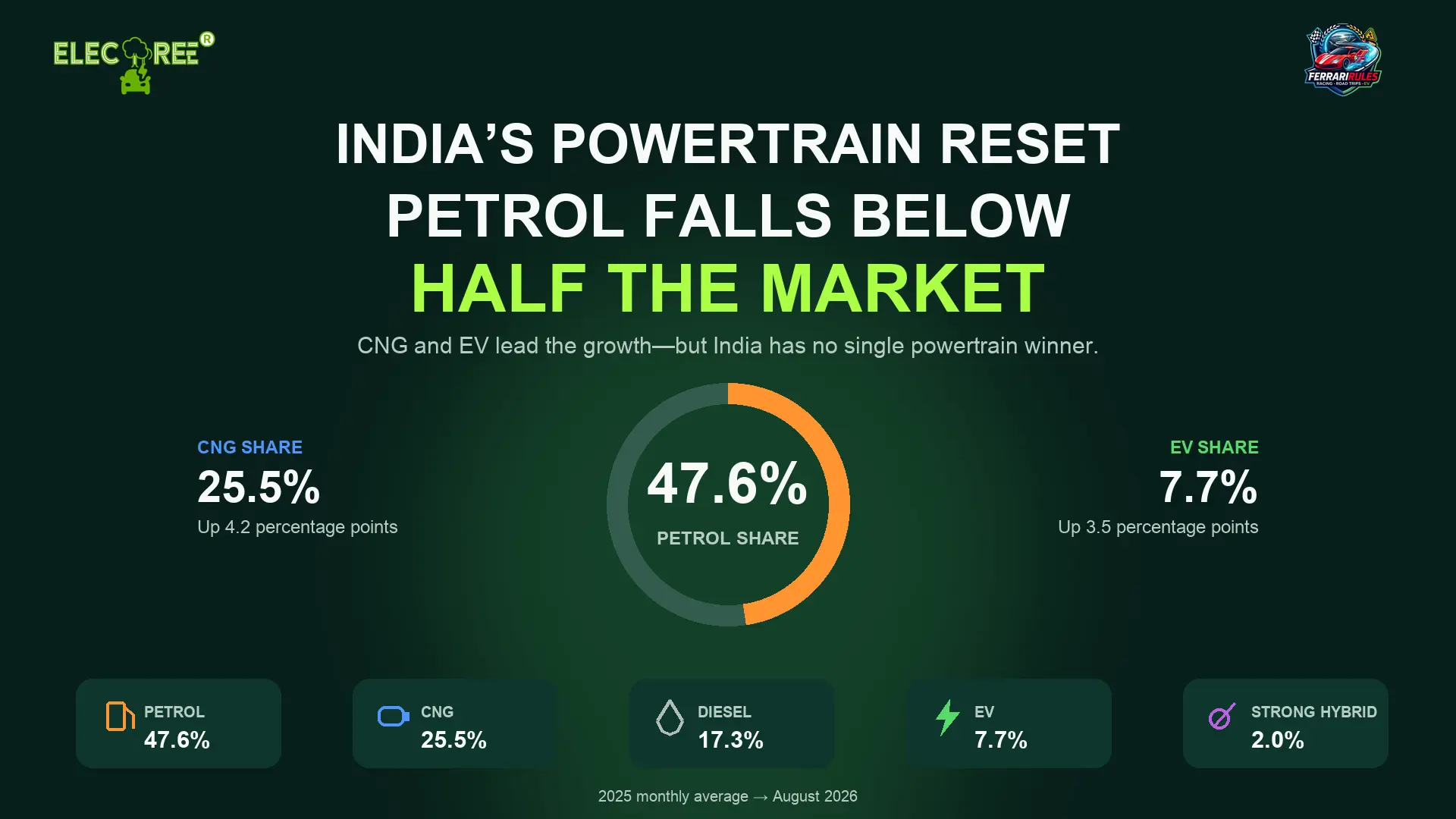
Total sales stood at 4,05,157 units, down 5% from July’s 4,25,139 units. Compared with August 2025, however, the market was 17% larger. More revealing than the headline volume was the powertrain mix: petrol accounted for only 47.6% of August sales.
Petrol remains India’s largest powertrain, but it no longer represents more than half the market. CNG reached a new high of 25.5%, EVs held a meaningful 7.7%, diesel contributed 17.3%, and strong hybrids slipped to 2%.
The transition is accelerating, but no single option has emerged as the clear winner.
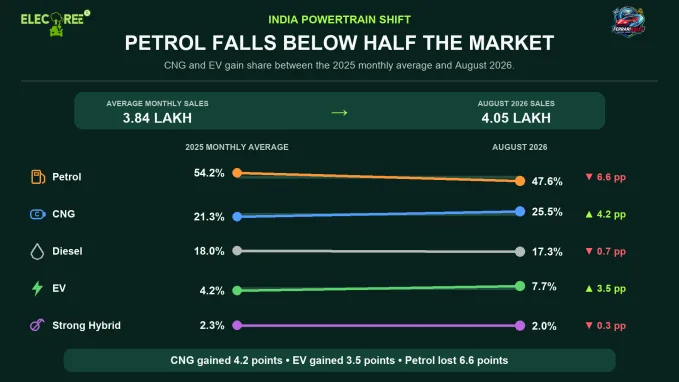
EV and CNG lead a stronger year-on-year market
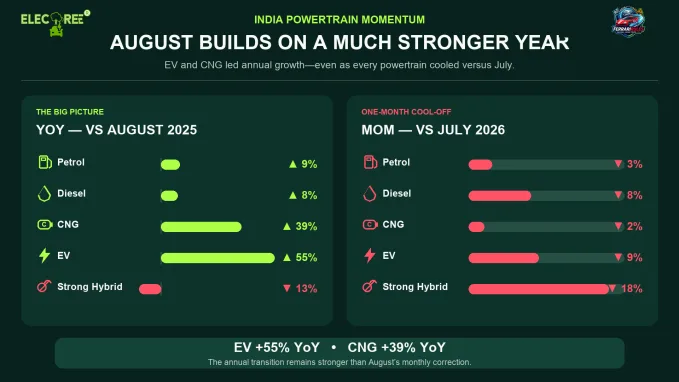
- EV sales increased 55%, from 20,213 to 31,364 units.
- CNG sales rose 39%, from 74,421 to 1,03,182 units.
- Petrol grew 9%, and diesel increased 8%.
- Strong hybrids declined 13%, from 9,206 to 7,966 units.
The year-on-year numbers show that India’s passenger-vehicle market is not merely expanding; its growth is increasingly being driven by alternative powertrains. EV volumes grew more than six times as quickly as petrol, while CNG grew more than four times as quickly.
The month-on-month picture was weaker. Compared with July 2026, petrol declined 3%, CNG fell 2%, diesel dropped 8%, EV sales contracted 9%, and strong hybrids recorded the sharpest fall at 18%.
August was therefore a monthly correction within a market that remains considerably larger than a year ago. The short-term slowdown affected every powertrain, but it did not alter the broader direction: EV and CNG continue to be the fastest-growing choices.
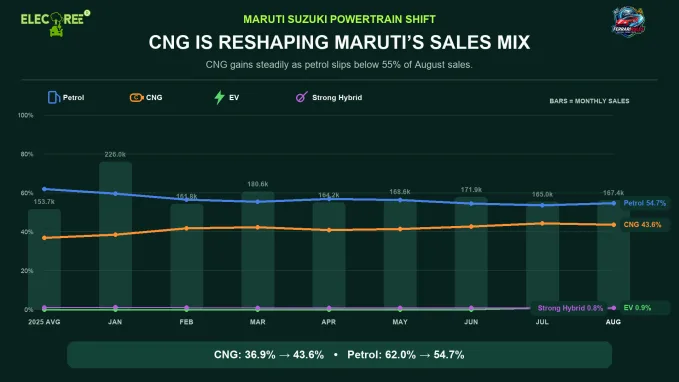
Maruti Suzuki: CNG is powering the transition
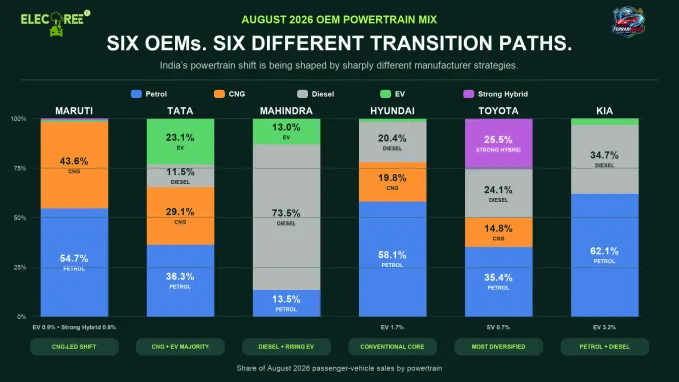
For Maruti Suzuki, the powertrain transition is overwhelmingly a CNG story. CNG contributed 43.6% of August sales, against 36.9% in the 2025 monthly average. Petrol fell from 62% to 54.7%, while EVs and strong hybrids together accounted for less than 2%.
Nearly 44 out of every 100 Maruti cars sold in August were CNG. Its shift away from petrol is being driven by lower running costs and a familiar refuelling model, rather than electrification.
Tata Motors: alternative powertrains are now the majority
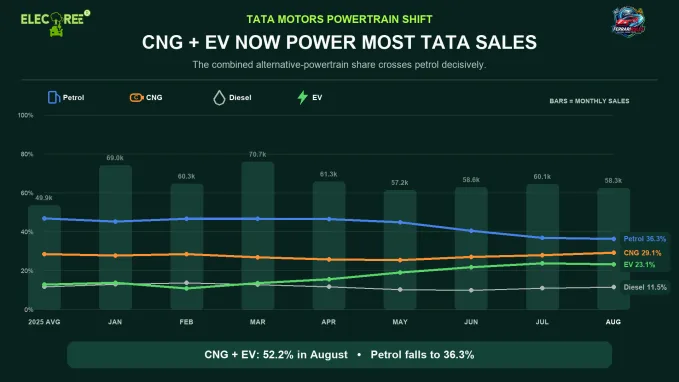
Tata’s mix is fundamentally different. CNG represented 29.1% and EVs 23.1% of August sales. Together, they contributed 52.2%, comfortably exceeding petrol’s 36.3% share. Diesel accounted for the remaining 11.5%.
Tata is now the clearest example of a major Indian manufacturer whose sales mix has become alternative-powertrain-led. It also shows why the national transition cannot be described as CNG versus EV: within Tata’s portfolio, both are expanding together.
Mahindra: diesel dominates, but EVs have caught petrol
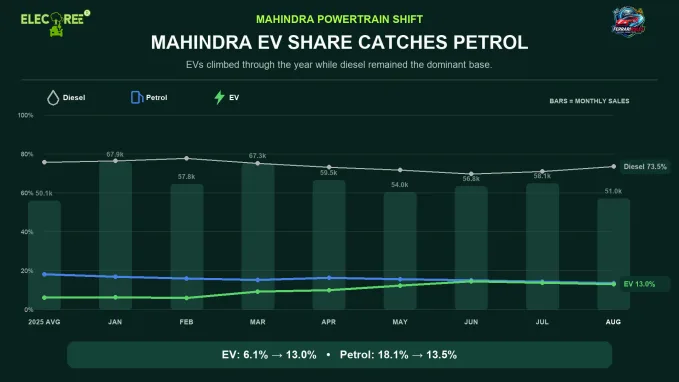
Mahindra remains India’s strongest diesel-led outlier. Diesel accounted for 73.5% of its August sales. Yet the emerging change is electric: EVs reached 13%, almost matching petrol at 13.5%.
Mahindra is not replacing diesel. It is building an electric second pillar while petrol becomes the smaller part of its portfolio. That is a different path from Tata, where CNG and EV have already become the majority.
Hyundai: CNG gains ground while EVs remain small
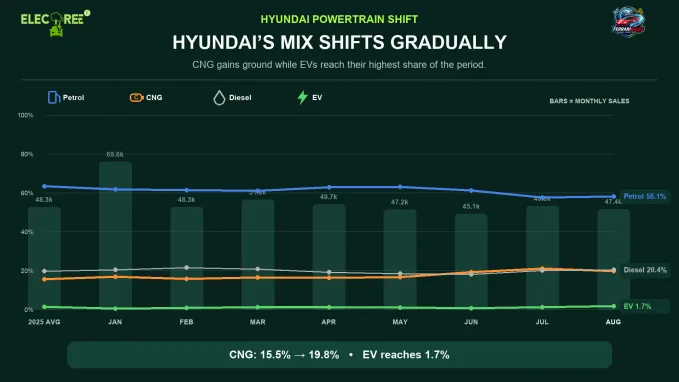
Hyundai’s mix remained relatively stable in August. Petrol led at 58.1%, followed by diesel at 20.4% and CNG at 19.8%. EV share reached 1.7%, its highest point in the period shown, but it remains too small to reshape Hyundai’s overall mix.
Hyundai is gradually reducing its dependence on petrol through CNG rather than through a rapid electric shift. Conventional powertrains still contributed more than 98% of its August sales.
Toyota: the most diversified powertrain portfolio
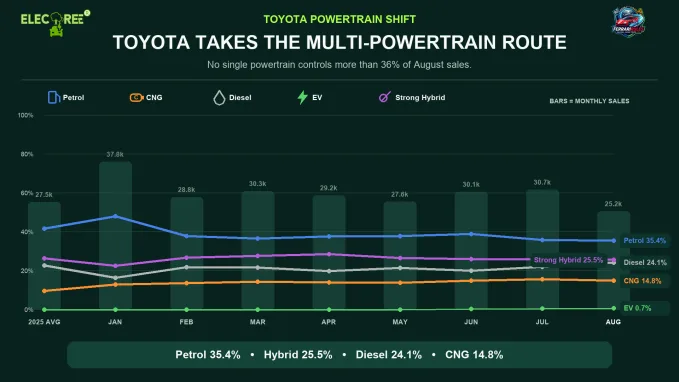
Toyota has the market’s most diversified mix. Its August sales comprised 35.4% petrol, 25.5% strong hybrid, 24.1% diesel, 14.8% CNG and 0.7% EV. No single powertrain crossed 36%.
Toyota’s strategy is less about migrating buyers toward one technology and more about covering multiple use cases. Hybrids remain central, but diesel and CNG together accounted for a larger share than strong hybrids.
Kia: petrol and diesel still define the portfolio
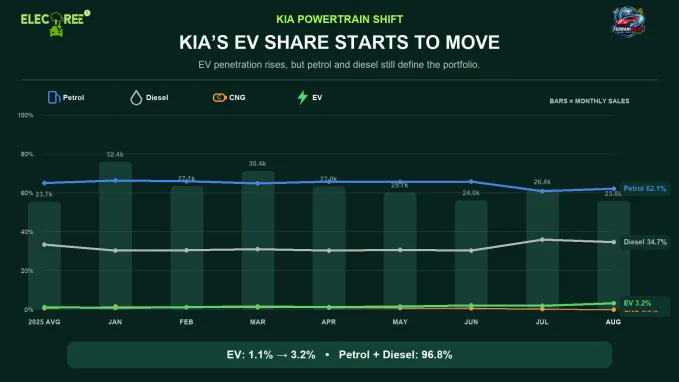
Kia is the most concentrated around conventional fuels. Petrol contributed 62.1% and diesel 34.7%, leaving EVs at 3.2% and CNG effectively absent. Its EV share is beginning to rise, but the portfolio remains dependent on petrol and diesel.
The recent increase in EV contribution is a development to watch, although it starts from a small base. For now, Kia’s mix shows how unevenly India’s national EV growth is distributed across manufacturers.
India is building a multi-powertrain market
August reinforces three conclusions.
First, petrol is losing share even though its sales volume remains substantial. Second, CNG currently delivers the widest mass-market alternative to petrol. Third, EV growth is rapid but highly concentrated among manufacturers with competitive electric portfolios.
The result is not a straight transition from petrol to electric. It is a collection of parallel shifts:
- Maruti Suzuki is moving from petrol toward CNG.
- Tata is increasingly led by CNG and EVs together.
- Mahindra remains diesel-led while developing a meaningful EV base.
- Hyundai is diversifying through CNG while EV penetration stays modest.
- Kia continues to rely on petrol and diesel.
- Toyota is maintaining the broadest multi-powertrain portfolio.
The next phase of India’s transition will not be decided by one fuel winning the entire market. It will be shaped by which manufacturers can match powertrain, price, infrastructure, and customer use case more effectively.
Petrol’s dominance is weakening. What replaces it will depend on the buyer—and on the brand.
P.S. - If you read the FADA report calling out Hybrid retail sales at 9% in Aug-26, they are counting Mild Hybrids as Hybrids as well. We consider mild hybrids as petrol cars only, as mild hybrids have no electric motor driving the car
To comment and participate in discussion Click Here
Trending Articles