India’s 3-Row EV Market Has Grown 20× In A Year — MG Is Arriving At The Right Time
India’s 3-row EV market has expanded rapidly, with private registrations rising from 811 units in H1’CY25 to 16,716 in H1’CY26. The Mahindra XEV 9S has been the biggest driver of this growth, while the Carens Clavis EV and BYD eMAX 7 are adding depth to the segment. Cab demand is rising too, led by LimoGreen, showing that 3-row EVs are beginning to find traction with both family buyers and commercial fleets.


Category:
Tag:
- 3-Row EVs
- Electric SUVs
- Electric MPVs
India barely had a three-row EV market a year ago.
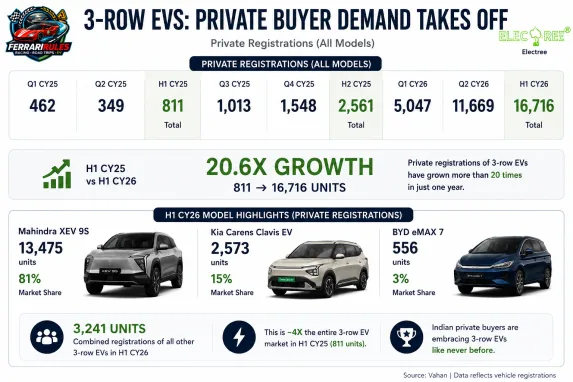
In H1’CY25, just 811 three-row electric vehicles were registered, with the BYD eMAX 7 effectively representing the category on its own. By H1’CY26, that number had jumped to 16,716 registrations, excluding the fleet-focused VinFast LimoGreen.
That is more than 20 times the volume in just one year. More importantly, the momentum is still building. That makes this more than a simple year-on-year growth story. The category appears to be gaining momentum as buyers get more choice and larger EVs become increasingly credible as primary family cars.
The biggest catalyst has been the Mahindra XEV 9S. It registered 13,475 units in H1’CY26, accounting for roughly 81% of the three-row EV market. That level of concentration shows Mahindra has a substantial early lead, but it also proves something more important: Indian buyers are willing to buy a three-row electric SUV in meaningful numbers. The XEV 9S registered 3,593 units in Q1 and 9,882 in Q2, making it the biggest contributor to the category’s recent acceleration.
It Is No Longer Just One Product
Mahindra may dominate the numbers, but demand is beginning to spread across multiple products.
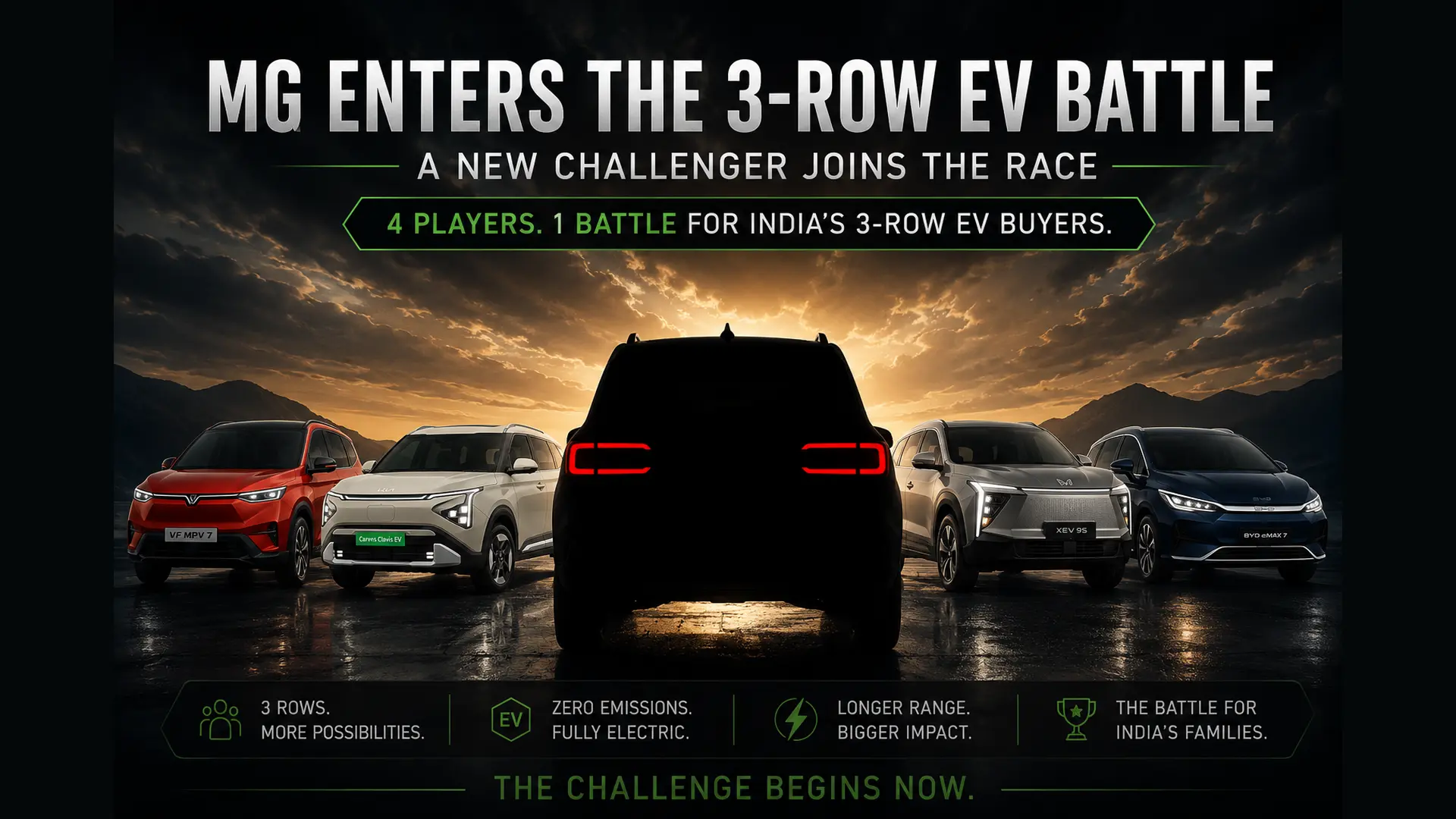
The Kia Carens Clavis EV registered 2,573 units in H1’CY26, while the BYD eMAX 7 added 556 units. VinFast's MPV7 contributed another 112 registrations.
Even excluding the XEV 9S, these models together registered 3,241 units in H1’CY26.
For perspective, the entire three-row EV market managed only 811 registrations in H1’CY25.
So Mahindra has accelerated the market dramatically, but it is not the only evidence that demand is expanding.
Fleet Demand Is Growing Too, But It Is A Different Market
There is also an emerging commercial use case for three-row EVs, although it needs to be separated from private consumer demand.
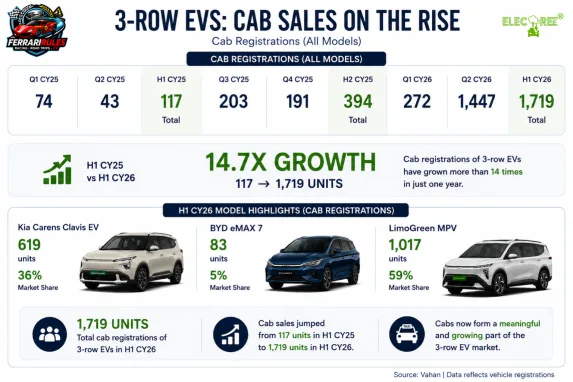
H1’CY26 saw 1,719 three-row EVs registered as cabs. Of these, 1,017 were VinFast LimoGreen registrations, largely associated with VinFast's own fleet deployment. The Kia Carens Clavis EV contributed another 619 cab registrations, while the BYD eMAX 7 accounted for 83.
Its deployment still matters, but it represents a different demand pool. What is more significant for the broader EV market is that most of the growth in models such as the XEV 9S is coming outside the cab category. That suggests three-row EVs are increasingly being considered as family vehicles, not just high-utilisation commercial products.
MG Is Entering A Market That Has Already Been Validated
That is what makes MG’s next launch particularly interesting.
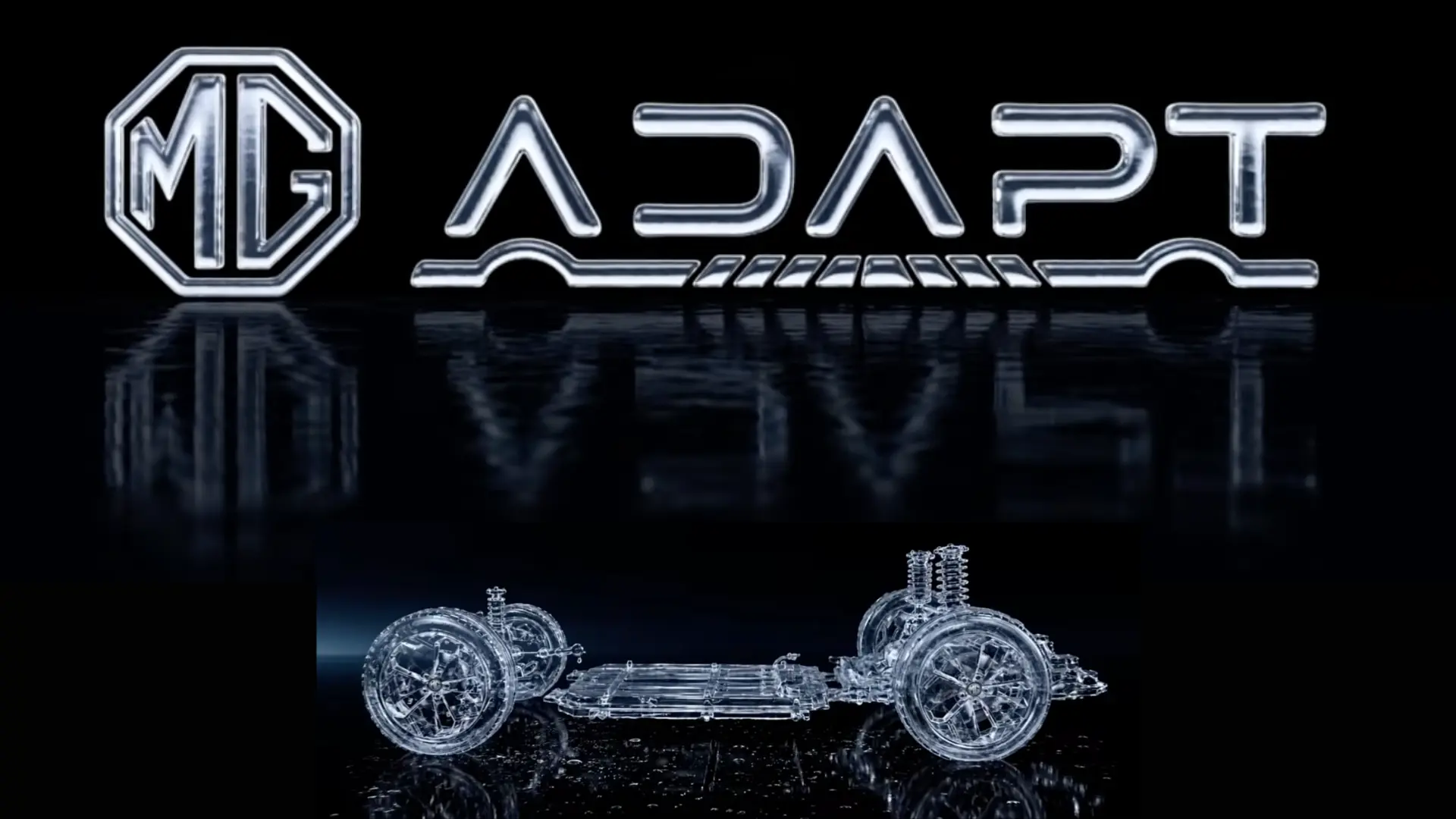
On August 26, JSW MG Motor will unveil its first production vehicle based on the company’s new ADAPT architecture.
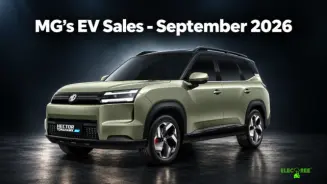
MG’s teaser confirms that the first Indian application of ADAPT will be electric, carrying the message “ADAPT takes its first electric form.” The company has not yet officially confirmed the production name in its teaser, although the SUV has been widely linked with the Hector Hawk name.
ElecTree has previously detailed how ADAPT — Advanced Drive Architecture Platform Technology — is designed as a flexible new-energy platform capable of supporting battery EVs, plug-in hybrids, strong hybrids and range-extender vehicles. MG has indicated that BEVs and PHEVs will be its initial focus. That broader platform strategy matters, but the immediate significance is simpler: MG’s first ADAPT product is entering one of the fastest-growing parts of India’s EV market.
The upcoming SUV is expected to offer three rows of seating, while earlier reports have pointed to a 69.2kWh battery and around 530km of CLTC range. MG has not yet confirmed the final India-spec battery, certified range, motor output or pricing, so those numbers remain indicative until the official unveiling.
You can read our earlier coverage of the upcoming ADAPT-based SUV and MG’s wider platform strategy here: MG Teases Its First ADAPT-Based EV and MG Unveils ADAPT Platform.
The Question Has Changed
A year ago, a manufacturer launching a three-row EV in India would have been betting on whether enough buyers actually wanted one. The market looks very different today.
Registrations have moved from 811 units in H1’CY25 to 16,716 in H1’CY26. Mahindra has already demonstrated that a three-row electric SUV can attract substantial private demand. Kia has added another proposition at a different price and body-style point, while commercial deployment is developing alongside the private market.
The segment will further heat up with the Maruti YMC - eVitara-based 7-seater EV launch and the Tata Safari EV launch
Are you excited for the MG launch? Catch it live on YouTube at 11:30 AM tomorrow
To comment and participate in discussion Click Here
Trending Articles