
How Battery-as-a-Service Pricing Actually Works
Battery-as-a-Service is often understood as a simple per-km running cost, but it's structurally two separate loans — one for the vehicle, one for the battery — each with its own tenure.



Category:
Tag:
- Battery as a Service
Battery-as-a-Service (BaaS) has become a mainstream financing option across India's EV market. Seven mass-market brands — Tata, Hyundai, Citroen, MG, Maruti, Kia, and Toyota — now offer it across eleven models, lowering upfront prices in exchange for a per-kilometre charge on the battery.
It's commonly understood as a simple running cost: pay less upfront, then pay per kilometre for the battery. In reality, the structure is two separate loans — one for the vehicle, one for the battery — each carrying its own tenure. Tata Motors' Chief Commercial Officer has publicly described the company's BaaS scheme in these terms, with the vehicle loan running a standard tenure while the battery loan can be stretched up to 8 years.
The Loan Math
Here's how that structure affects the numbers, using a simple ₹20 lakh example at 8% interest over 5 years. A single loan for the full amount carries an EMI of ₹40,553. Splitting that same ₹20 lakh into two loans — say ₹13 lakh and ₹7 lakh — while keeping both at the same 5-year tenure changes nothing: the combined EMI and total amount paid stay exactly the same as the single loan. In both cases — the customer pays ₹24,33,167 at the end of the tenure. It's only when the second loan's tenure is stretched further, to 8 years in this case, that the blended EMI drops — while the total paid over the full period actually rises because the customer has to pay the single EMI of ₹9,896 for additional 3 years. The total amount paid at the end of 8 years is ₹25.31,544. Please note the EMI values have been rounded off for better understanding.
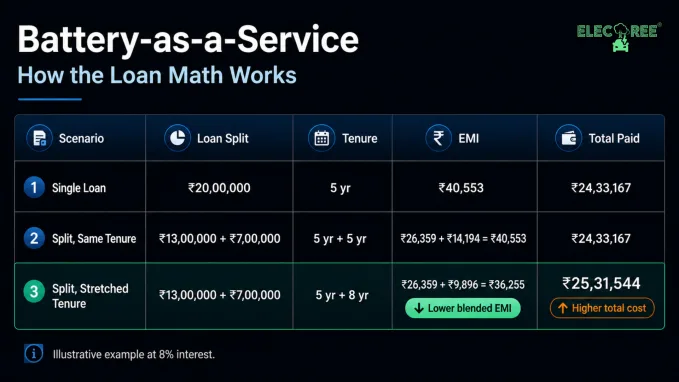
This is the same principle behind BaaS: the vehicle loan and the battery loan are split, and the battery loan typically runs a longer tenure than the vehicle loan, which is why the combined monthly outgo looks smaller in the early years.
The advertised per-kilometre rate follows from this battery loan. It's simply the battery EMI divided by an assumed monthly distance — for instance, an EMI of ₹9,896 divided by an assumed 2,500 km a month works out to roughly ₹3.95 per km. Change the assumed distance, and the advertised rate changes with it, even though the EMI itself stays exactly the same. It can be marketed as ₹1 per km assuming 9,896 km driven in a month.
To comment and participate in discussion Click Here
Trending Articles



Recent Articles

India Clears ₹1.86 Lakh Crore Green Energy Corridor Plan With ₹50,000 Crore for Battery Storage
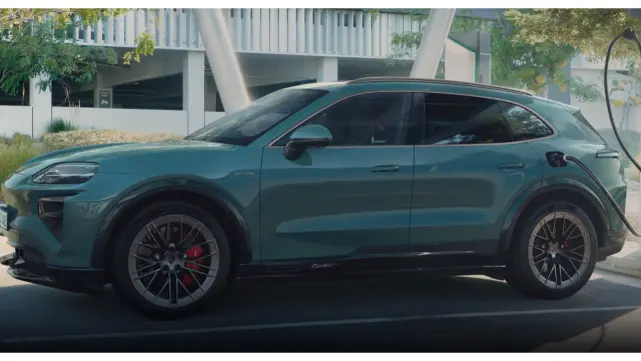
Porsche Cayenne Electric Launched in India at ₹1.77 Crore: 642 Km Range, 400 kW Charging and More
Government's CAFE III Norms Give EVs a 3x Credit, PHEVs 2.5x

Creta Electric Owners Approach Hyundai - File Petition for Lifetime Battery Warranty