Honda Elevate Facelift Fixes the Features but Not the Powertrain Gap
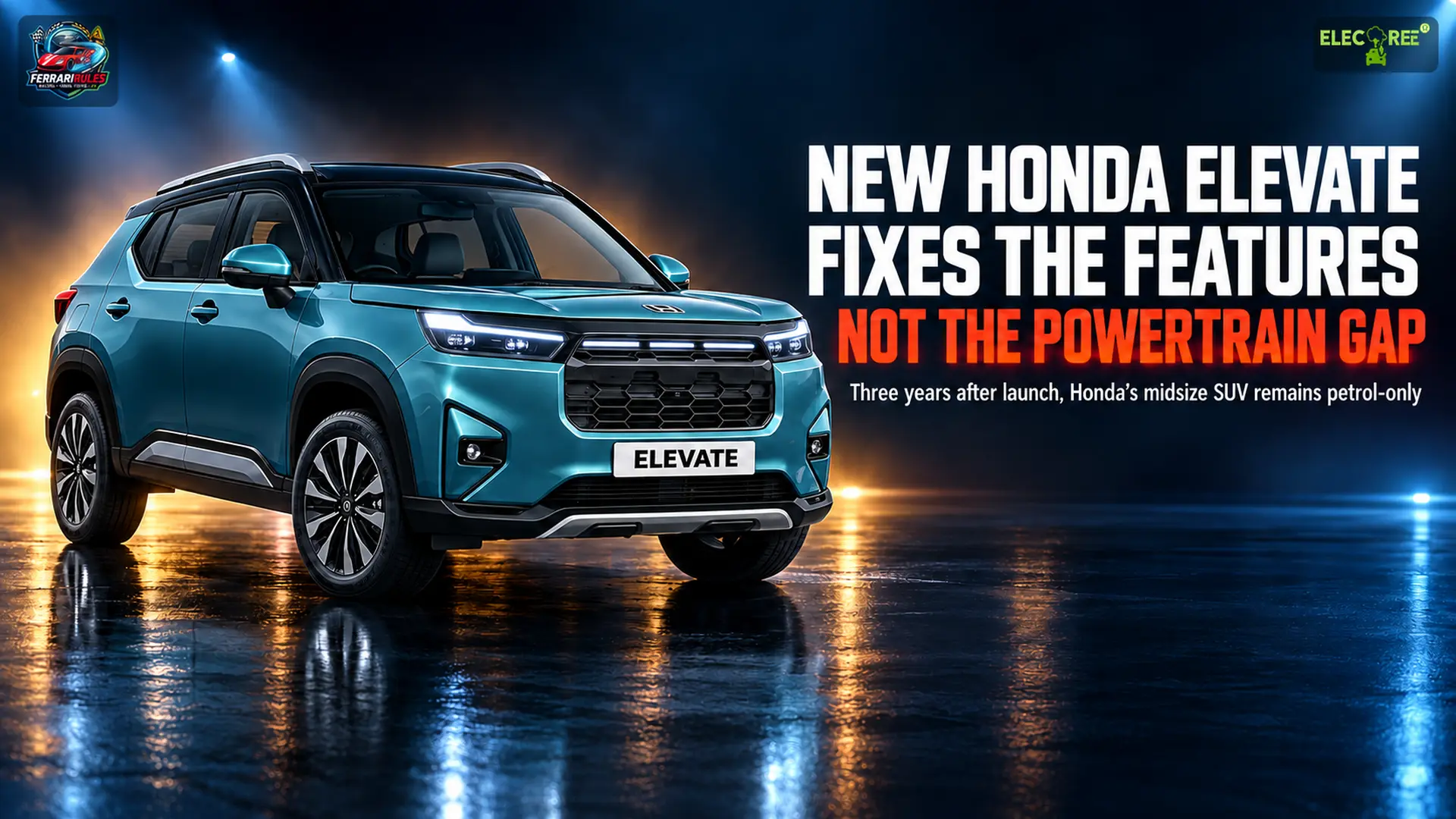
Honda has comprehensively updated the Elevate three years after its Indian launch, but the SUV still offers only a petrol engine. September 2026 registration data shows that diesel, CNG, hybrid, and electric variants are driving the segment’s leading models.


Category:
Tag:
- Honda Elevate
- Hybrid Cars
- Electric Cars
- CNG Cars
- Vahan Data
Honda launched the facelifted Elevate on October 6, just two days ago. The major update arrives a little over three years after the original SUV reached Indian showrooms. It addresses many of the original model’s feature gaps, but leaves the more consequential limitation untouched: the Elevate remains available with only a naturally aspirated petrol engine.
That matters because the midsize SUV market has changed around it. Non-petrol powertrains supplied 32,949 registrations in September 2026, or 48% of the Elevate's segment total. Every one of the six highest-volume nameplates offered at least one diesel, CNG, hybrid or electric option. The Elevate’s petrol-only strategy increasingly resembles the lower-volume end of the market rather than its leaders.
A substantial facelift with an unchanged engine strategy
Launched on October 6, the new Elevate starts at ₹11.80 lakh and reaches ₹18.40 lakh for the ZX+ Black CVT. Honda has added a redesigned mesh grille, tri-bar LED position lights, a connected rear light signature, and revised 17-inch alloy wheels. Inside, the update brings front and rear ventilated seats, powered front seats, a 360-degree camera, an electronic parking brake, additional charging ports, and Low-Speed Follow for Honda Sensing.
The mechanical package, however, is unchanged. The 1.5-litre i-VTEC petrol engine continues to produce 121 PS and 145 Nm, paired with a six-speed manual or CVT. There is no diesel, CNG, strong-hybrid or electric option within the Elevate range.
The successful rivals are not relying on petrol alone
The registration mix shows how heavily alternative powertrains are supporting the segment’s largest models. Across the six highest-volume nameplates, non-petrol variants contributed 30,105 registrations, equal to 50% of their combined volume.
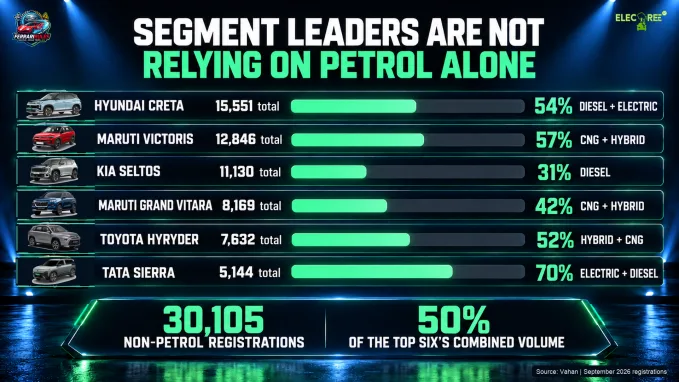
Source: Vahan registration data. Non-petrol includes diesel, CNG, hybrid and electric registrations.
The Creta gets 54% of its registrations from diesel and electric versions. CNG and hybrid variants contribute 57% of Victoris volume, while the Grand Vitara and Hyryder receive 42% and 52%, respectively, from their alternative powertrains. Even the Seltos, which remains petrol-led, gets nearly one-third of its volume from diesel.
The new Sierra makes the contrast sharper: electric and diesel versions account for 70% of its registrations. These powertrains are not peripheral additions. They are doing the volume work.
The petrol-only group is barely making a dent
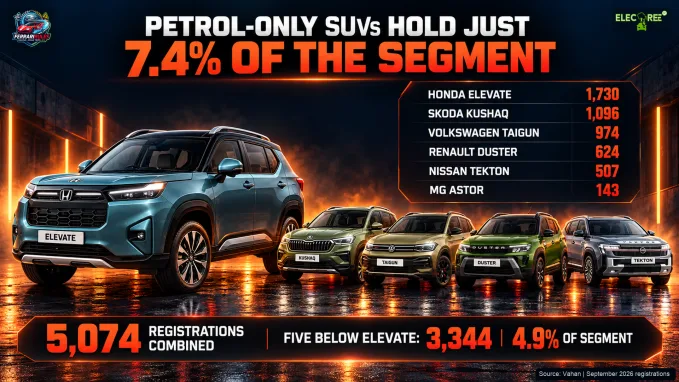
The models that mirror the Elevate’s petrol-only strategy sit much lower on the sales chart. The Skoda Kushaq recorded 1,096 registrations, followed by the Volkswagen Taigun at 974, Renault Duster at 624, Nissan Tekton at 507 and MG Astor at 143.
Together, those five petrol-only SUVs generated just 3,344 registrations, or 4.9% of the entire segment. Even after adding the Elevate, the six petrol-only nameplates reached 5,074 units and a combined share of only 7.4%.
For perspective, the non-petrol versions of the Creta alone delivered 8,375 registrations, while the Victoris generated 7,294 from CNG and hybrid variants. Either competitor’s alternative-powertrain volume exceeded the entire petrol-only group.
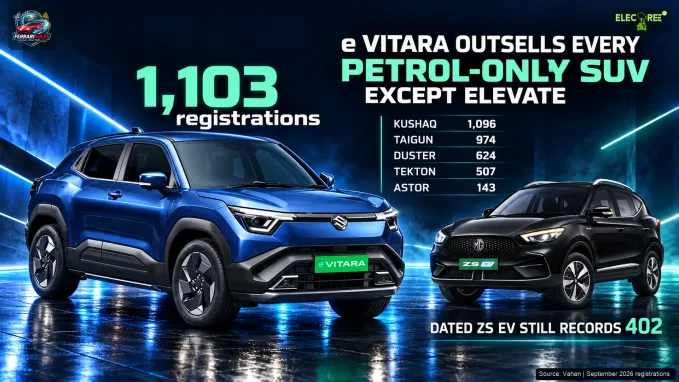
The electric-only comparisons are revealing too. The Maruti e Vitara recorded 1,103 registrations, outselling every petrol-only SUV except the Elevate. The older MG ZS EV still delivered 402 registrations — close to the new Tekton’s 507 and almost three times its sister car Astor’s 143.
The Elevate’s segment share fell from 4.1% in September 2025 to 2.5% in September 2026 as new and refreshed rivals expanded the market. Its 1,730 registrations were less than one-quarter of the Urban Cruiser Hyryder’s volume and only 11% of the Creta’s.
Petrol-only competitors such as the Kushaq and Taigun also remained close to or below 1,100 registrations. That does not prove a second powertrain guarantees success, but the pattern is clear: the segment’s highest-volume products use powertrain choice to reach customers that petrol alone cannot.
This does not mean petrol demand has disappeared; petrol remains the largest single fuel for several leading models. The weakness lies in offering petrol as the only choice when rivals use multiple powertrains to address different running-cost, performance and ownership needs.
Honda has shifted the electrification plan away from Elevate
When Honda unveiled the original Elevate in June 2023, it said its first Indian battery-electric vehicle would be based on the SUV and arrive within three years. The current roadmap is different. Honda has now confirmed that its first Indian BEV will be the 0 Alpha, a separate model rather than an electric Elevate. We caught it testing recently
Honda also says hybrid technology remains in its future roadmap, but neither option is part of the refreshed Elevate today. The facelift therefore improves the product without changing its position in the market’s powertrain transition.

Electree's Take: The facelift solves yesterday’s problem
The new Elevate is better equipped, more premium and visually fresher. Those changes were necessary after three years of rapidly intensifying competition. But feature parity is only part of the challenge.
Honda is asking one petrol engine to compete against rivals that spread demand across diesel, CNG, hybrid and electric derivatives. September’s numbers suggest the Elevate’s bigger problem is no longer what it lacks in the cabin, but what it still lacks under the bonnet.
FAQ:
Q. What engine does the Honda Elevate facelift offer?
A. The facelift continues with a 1.5-litre naturally aspirated petrol engine producing 121 PS and 145 Nm, paired with a six-speed manual or CVT.
Q. Does the Honda Elevate have a hybrid, diesel, or electric option?
A. No. The refreshed Elevate remains petrol-only, with no diesel, CNG, strong-hybrid, or electric derivative.
Q. How many Honda Elevates were registered in September 2026?
A. The Elevate recorded 1,730 registrations, rising 3% month-on-month and 26% year-on-year.
Q. What was the Honda Elevate’s segment share in September 2026?
A. Its share of the midsize SUV segment was 2.5%, down from 4.1% in September 2025.
Q. Why are alternative powertrains important in this SUV segment?
A. Diesel, CNG, hybrid, and electric versions generated 50% of the combined registrations of the six highest-volume models in September 2026.
Source: Vahan registration data. Current month: September 2026; previous month: August 2026; same month last year: September 2026
Disclaimer: The values represented are new vehicle registrations and not dealer dispatches, sourced via RTOs through Vahan. The data is exclusive to ElecTree and Ferrarirules. Republishing the data on any social media platform or forum without credit is prohibited and will amount to copyright infringement and may result in appropriate legal action.
Trending Articles