
Audi Has An India Comeback Plan. Here's Why It Needs One
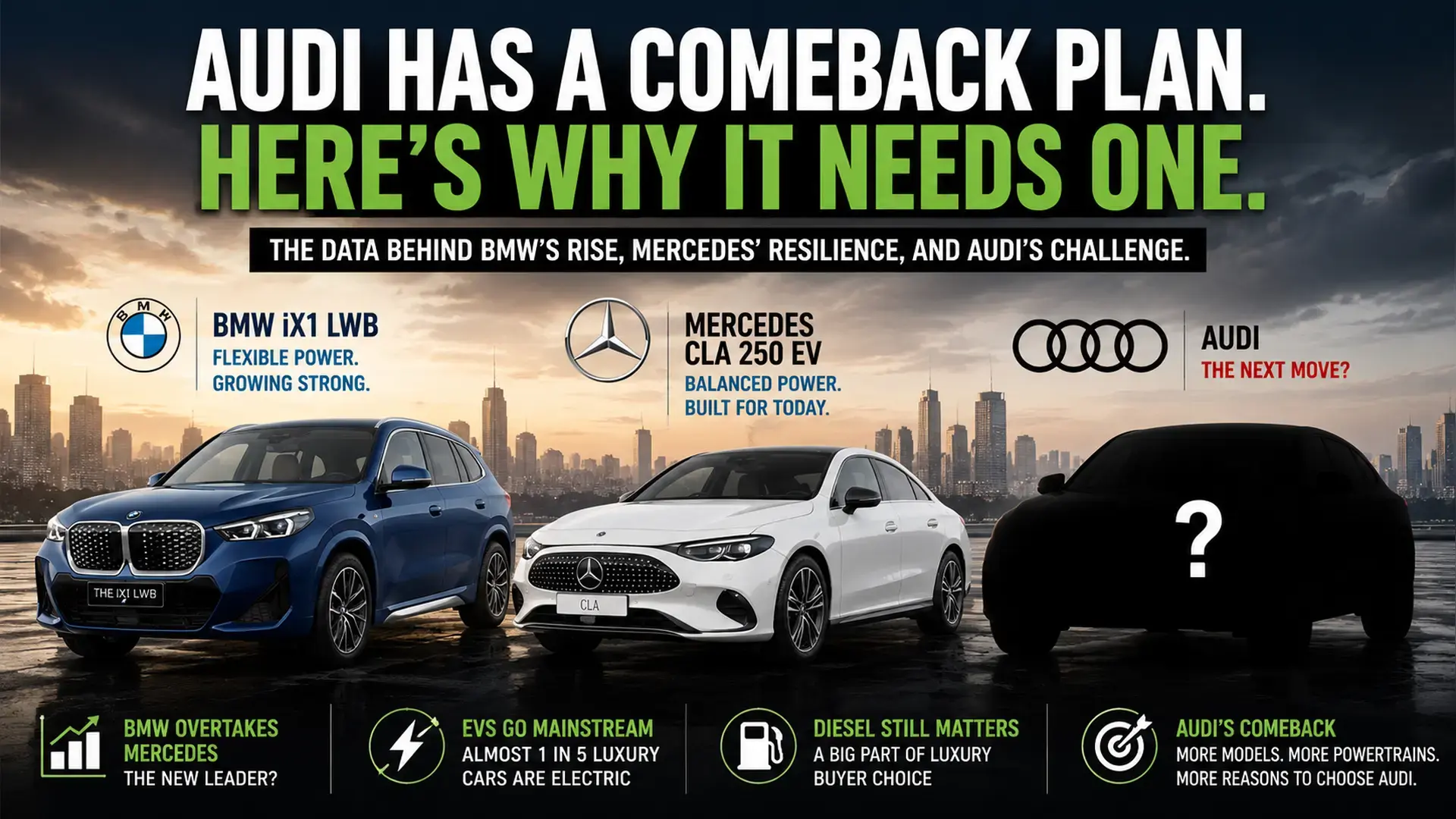
Audi India is preparing for a major comeback, with a renewed product offensive, faster launches, deeper localisation and a plan to rebuild its position in the luxury-car market. As discussed in Autocar India’s Deep Drive Podcast, the brand is expected to introduce several new locally assembled models over the next 18 months. Registration data shows why such a reset is necessary.


Category:
Tag:
- Audi
- BMW
- Mercedes-Benz
Audi Has An India Comeback Plan. Here's Why It Needs One.
Audi India appears ready to go back on the offensive. That was the central theme of the latest Autocar India Deep Drive Podcast, where the team discussed what it describes as Audi’s most ambitious Indian product offensive in more than a decade. Three locally assembled models are planned over the next 12 months as Audi tries to rebuild its position in the luxury market.
Audi global CEO Gernot Döllner has been equally candid about the challenge. The company wants faster launches, a more focused portfolio and much greater local assembly, with the ambition of eventually taking its India luxury-market share from around 8–9% to 18–20% over the next three to five years.
The strategy sounds aggressive. The registration data explains why it needs to be.
Audi has been steadily losing ground
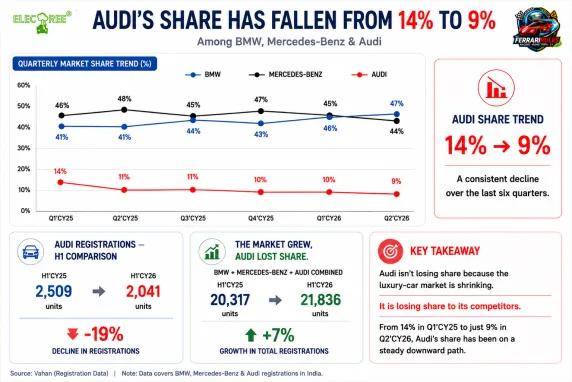
Among BMW, Mercedes-Benz and Audi, Audi's share has fallen from 14% in Q1 CY2025 to just 9% in Q2 CY2026. More importantly, that decline has come while the combined registrations of the three brands have grown. So this isn't simply a story of weak luxury-car demand.
Audi is losing ground to its competitors.
Its H1 registrations are down about 20% year on year, even as the combined three-brand market grew approximately 5%. That's the backdrop against which Audi's comeback plan should be viewed. It isn't trying to defend its position. It is trying to win one back.
Meanwhile, something significant has happened at the top
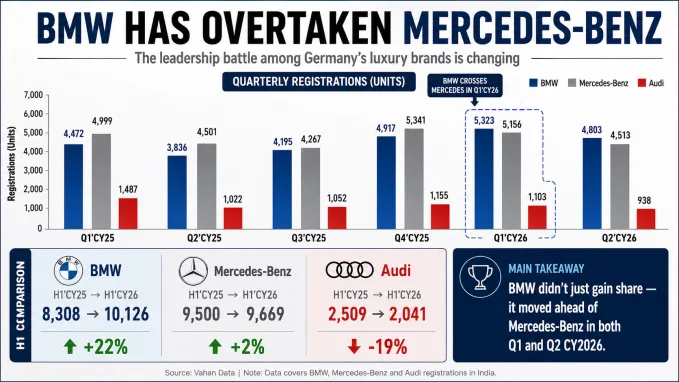
While Audi has slipped, BMW has moved sharply in the opposite direction. Mercedes-Benz started CY2025 comfortably ahead, but by Q1 CY2026 BMW had crossed it in quarterly registrations. It stayed ahead again in Q2.
In H1 CY2026, BMW also finished ahead of Mercedes-Benz. That makes the BMW story particularly relevant to Audi. Because BMW's growth hasn't come from simply doing more of the same. One of the more striking differences is the breadth of its powertrain mix.
BMW isn't asking every buyer to make the same choice
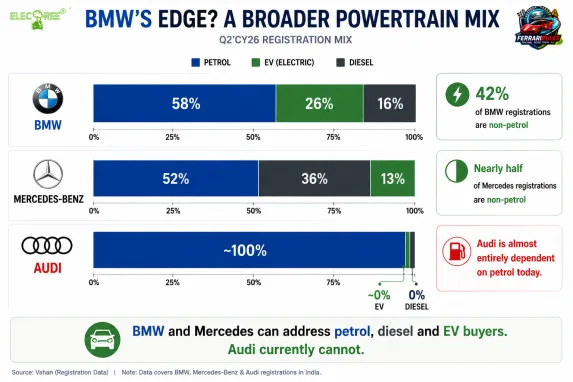
In Q2 CY2026, petrol still accounted for the majority of BMW registrations. But a substantial 42% came from diesel and EVs combined. Mercedes-Benz is similarly diversified, with almost half its registrations coming from non-petrol powertrains.
Audi's situation is very different. Its current registrations are almost entirely petrol, with negligible EV contribution and no diesel offering. That creates a fundamentally different competitive position. A BMW buyer can choose petrol, diesel or electric. So can a Mercedes-Benz buyer. An Audi customer today has far fewer powertrain paths.
BMW's rise has coincided with successful participation across multiple powertrains rather than dependence on a single one.
And EVs are becoming an increasingly important part of that equation.
Luxury EVs are moving beyond the early-adopter phase
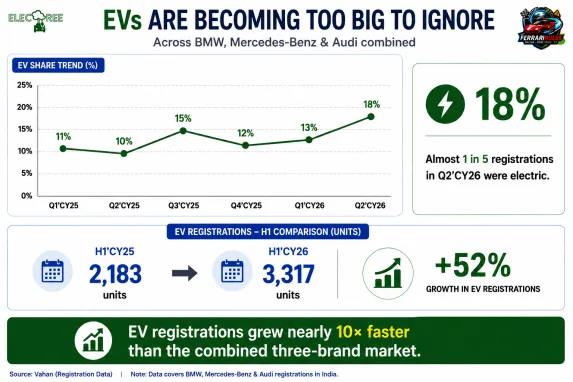
EVs accounted for around 18% of BMW, Mercedes-Benz and Audi registrations combined in Q2 CY2026. That's already almost one in five cars. The growth rate is even more revealing. H1 EV registrations across the three brands were up approximately 52% year on year, far outpacing growth in their overall registrations.
For luxury manufacturers, EVs therefore aren't just halo products anymore. They're becoming a meaningful source of volume.
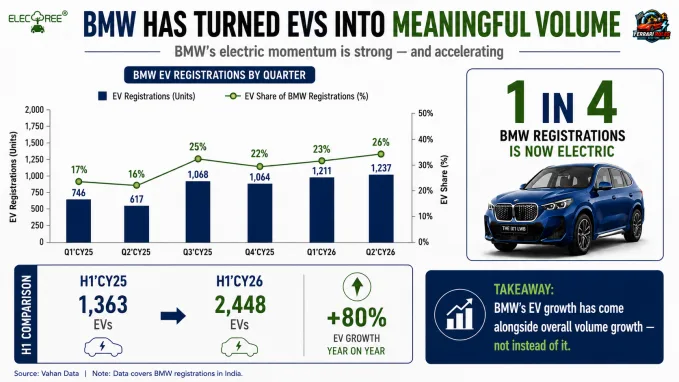
BMW illustrates that better than anyone in the dataset. Its EV registrations increased by roughly 80% in H1 CY2026, and by Q2, electric cars accounted for about 26% of BMW registrations.
Put another way, roughly one in four BMWs being registered is now electric. And this has happened even as BMW's overall volumes have grown strongly. That's an important distinction. EV growth hasn't merely changed BMW's internal mix. It has accompanied expansion of the overall business.
But the market isn't simply going electric
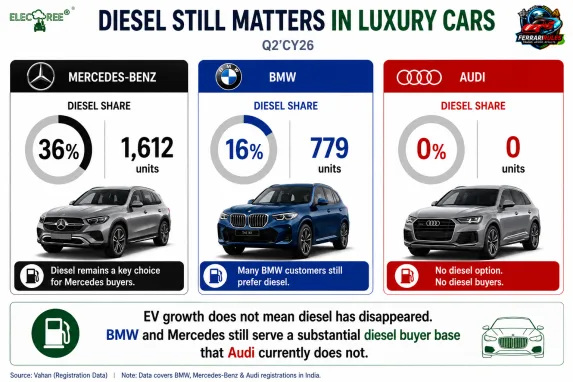
There is an equally important counterpoint. Diesel remains highly relevant. More than a third of Mercedes-Benz's Q2 CY2026 registrations were diesel, while diesel still accounted for a meaningful portion of BMW's volumes. So the emerging luxury-market story isn't really ICE versus EV.
It's about choice. There remains a sizeable petrol market. There remains a sizeable diesel market. And an increasingly significant EV market is forming alongside both.
BMW and Mercedes-Benz are participating in all three.
Which brings us back to Autocar's Audi discussion
In the Deep Drive Podcast, Autocar's discussion centres on Audi finally returning to attack mode after spending years relatively quiet in India. Autocar
The product reset starts with the new-generation Q3, due in Q4 2026, followed by the A5 in the first half of 2027. Audi is also studying the Q9 for India and wants to significantly reduce the delay between global and Indian product introductions. Autocar
But arguably the most consequential part of Döllner's comments is localisation. Audi expects locally assembled vehicles eventually to account for around 90–95% of its India business. Döllner's message was clear: meaningful local content is necessary if the brand wants to compete properly in India. On the surface, that's a cost and pricing story. Look at it alongside the registration data, however, and it becomes a product-strategy story too.
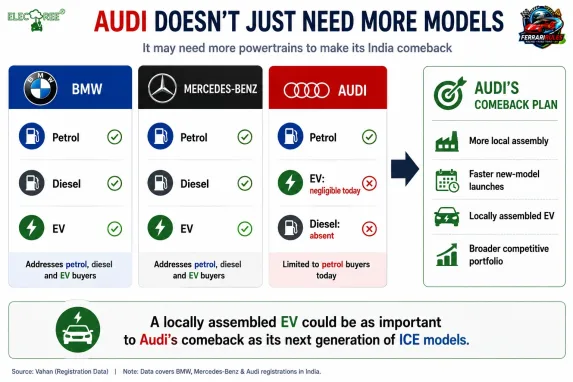
Audi doesn't just need more models. It may need more powertrains.
And if the luxury EV market continues developing at its current pace, a locally assembled EV could prove just as important to Audi's comeback as its next generation of combustion-engine cars.
Registration analysis based on Vahan data. The comparison covers BMW, Mercedes-Benz and Audi registrations in India and does not represent the entire Indian luxury-car market.
To comment and participate in discussion Click Here
Trending Articles

Recent Articles
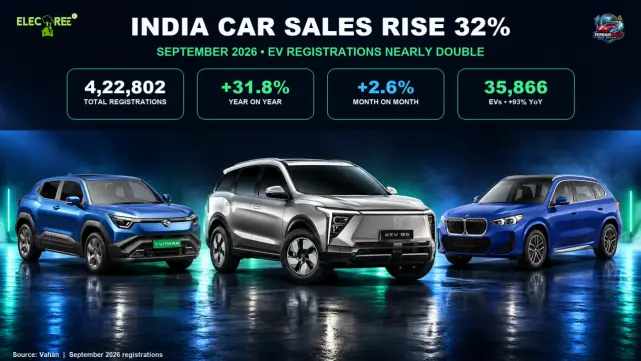
India Car Sales Rise 32 Percent in September 2026 as EV Registrations Nearly Double

India Clears ₹1.86 Lakh Crore Green Energy Corridor Plan With ₹50,000 Crore for Battery Storage
Porsche Cayenne Electric Launched in India at ₹1.77 Crore: 642 Km Range, 400 kW Charging and More
Government's CAFE III Norms Give EVs a 3x Credit, PHEVs 2.5x