
Ather Konarc vs Ola S1Z: How Do the Two New Electric Scooters Compare?
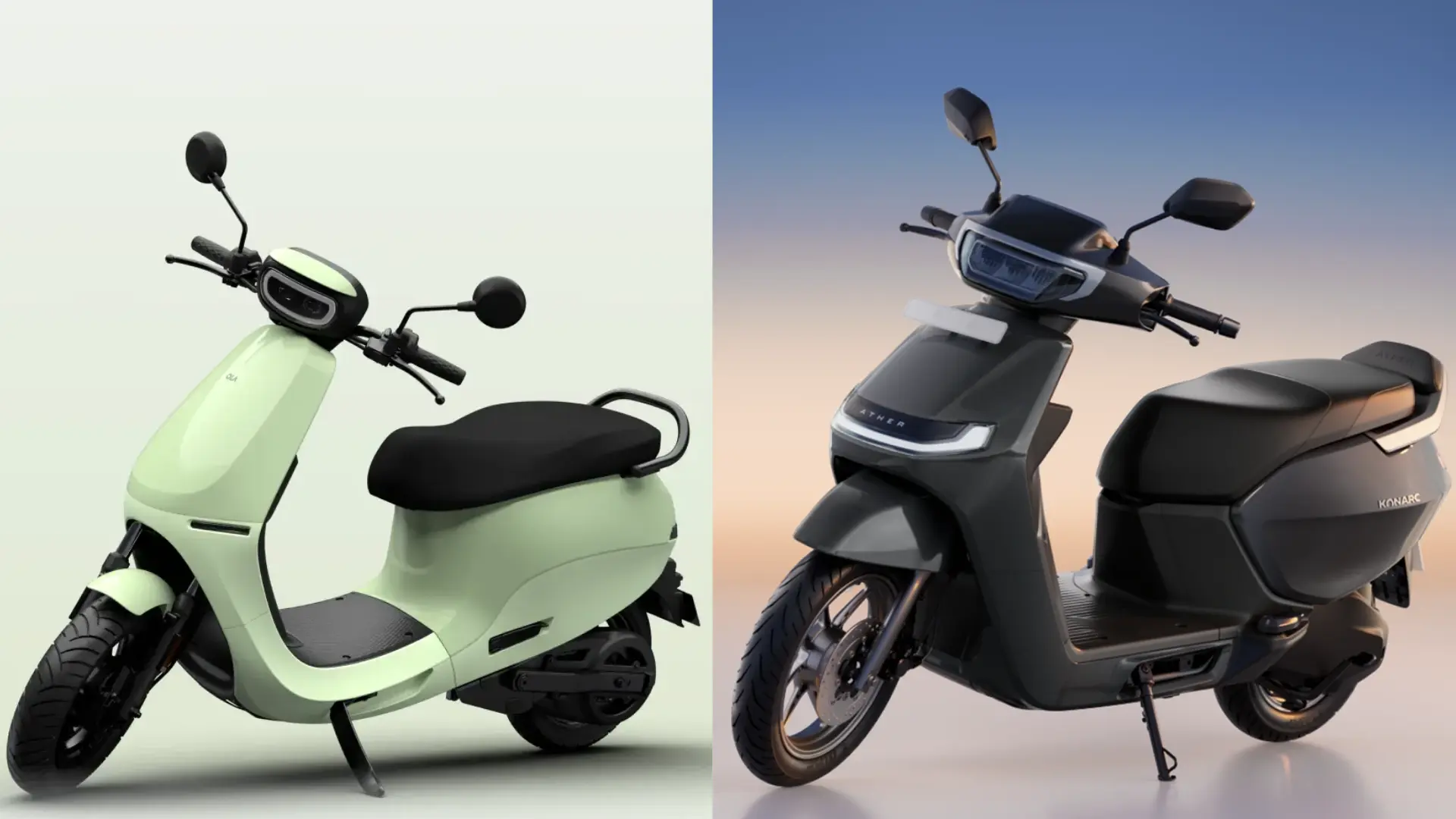
Ather Konarc and Ola S1Z bring new competition to India's electric scooter market with different approaches to price, range, battery technology and features. Here's how the two new launches compare.


Category:
Tag:
- Ather Konarc vs Ola S1Z
India's electric scooter market has two new contenders to watch. Ather Energy has launched the Konarc, while Ola Electric has introduced the S1Z, bringing new battery options, software features and aggressive pricing to the segment.
While both scooters compete for buyers looking at electric mobility, their priorities are different. The Konarc focuses on its new EL platform, hardware, practicality and charging flexibility. The S1Z puts greater emphasis on battery capacity, claimed range and an accessible price.
So, how different are these two new electric scooters?
Price and variants
The Ola S1Z has the lower starting price. Its 3.1 kWh version is priced at ₹79,999, while the 5.1 kWh version costs ₹99,999. These are introductory prices.
The Ather Konarc starts at ₹99,999. Ather currently offers the 125 km and 161 km S variants for sale in select cities. The 100 km and 200 km S variants are upcoming, while the Z line, with 125 km and 161 km IDC range options, is also planned for a later launch.
| Model | Battery | IDC range | Price |
|---|---|---|---|
| Ather Konarc S 125 | 2.7 kWh | 125 km | From ₹99,999* |
| Ather Konarc S 161 | 3.5 kWh | 161 km | From ₹99,999* |
| Ola S1Z 3.1 kWh | 3.1 kWh | 179 km | ₹79,999 |
| Ola S1Z 5.1 kWh | 5.1 kWh | 301 km | ₹99,999 |
*₹99,999 is the Konarc's starting price; Ather does not currently list individual variant prices in the same format.
Ola has the headline range advantage
Range is where the S1Z immediately stands out.
The 3.1 kWh S1Z claims 179 km of IDC range, while the 5.1 kWh version claims 301 km. Ola's official product page highlights these figures as key selling points of the new scooter.
The Konarc S comes in four announced IDC range options: 100 km, 125 km, 161 km and 200 km. However, Ather currently says the 125 km and 161 km versions are the ones available for sale in select cities. The 100 km and 200 km versions are scheduled for later availability.
For the currently available Konarc S variants, Ather gives TrueRange figures of 100 km for the 125 km version and 130 km for the 161 km version.
That distinction matters because IDC and TrueRange are different measurements. The 301 km figure of the S1Z is therefore best understood as a certified test-cycle figure, rather than a guarantee of everyday riding range.
On claimed range, the Ola S1Z has the clear advantage on paper.
Battery technology takes different routes
Ola's S1Z uses LFP battery cells, with Ola highlighting its Bharat Cell technology. The company says its LFP cell is designed, engineered and manufactured in India, including production at its Gigafactory.
Ather's current Konarc specification page lists installed battery capacities of 2.1 kWh, 2.7 kWh and 3.5 kWh for the S 100, S 125 and S 161, respectively. It does not specify the cell chemistry on that specification page.
Therefore, it would be inaccurate to declare one battery chemistry better than the other based only on the published product specifications.
The more useful distinction is that Ola makes LFP battery technology and capacity central to the S1Z's proposition, while Ather places greater emphasis on the complete Konarc platform.
Performance is closely matched
The Konarc S 125 and S 161 use PMSM motors producing 4.7 kW of peak power and 16 Nm of maximum torque. Both have a listed top speed of 70 km/h. The S 100 uses a 4 kW motor.
The S1Z uses a 4 kW peak-power motor and has a 70 km/h top speed. The 3.1 kWh version accelerates from 0 to 40 km/h in 4.6 seconds, while the 5.1 kWh version takes 4.9 seconds.
Ather lists 0-40 km/h acceleration of 4.7 seconds for both the S 125 and S 161.
So while the S1Z offers the larger battery options, the published performance figures put the two scooters relatively close in everyday urban performance.
Konarc puts greater emphasis on hardware
The Konarc is built on Ather's new EL platform, with a steel unibody chassis and metal body panels.
It gets 14-inch front and 12-inch rear alloy wheels, along with 90 mm of front suspension travel and 100 mm at the rear. Ather also lists a 31-litre boot and 2-litre front storage.
The S1Z's official information focuses more strongly on its battery, range and software proposition. The current product information does not provide enough directly comparable data on chassis construction, suspension travel or boot capacity to make a fair hardware comparison.
That gives the Konarc a more clearly defined hardware proposition, while the S1Z's strongest numbers remain its price and battery range.
Charging takes a different route
The Konarc gets a 450W onboard charger as standard. Ather lists 0-80% home charging times of 4 hours 30 minutes for the S 125 and 5 hours 40 minutes for the S 161.
Ather also offers Combined Charging, which adds another 450W of charging capacity. The company lists 0-80% charging times of 2 hours 25 minutes for the S 125 and 3 hours 10 minutes for the S 161 with the combined setup.
The S1Z takes 5 hours 42 minutes for a 0-80% home charge with its 3.1 kWh battery and 6 hours 16 minutes with the 5.1 kWh battery.
Ather therefore offers more charging flexibility on the currently detailed Konarc variants, while the S1Z's larger battery packs contribute to longer home-charging times.
Both scooters bring connected features
Software is another area where the two manufacturers are competing closely.
The S1Z runs MoveOS 5, with features including OTA updates, GPS tracking, ride statistics, geo and time fencing, cruise control, regenerative braking and reverse mode.
The Konarc uses Ather's connected ecosystem. The S 125 and S 161 get a 7-inch DeepView display, 4G LTE/GNSS connectivity, OTA updates, remote charging status, Find My Scooter, Tow & Theft notifications, and call and music controls.
Both therefore offer substantial connected functionality, although the software interfaces and ecosystems are different.
Ather adds electronic braking technology
One of the Konarc's notable technology additions is its Advanced Electronic Braking System, or AeBS.
Ather says the system is designed to improve braking performance, including reducing stopping distance and minimising rear-wheel lockups.
The Konarc also offers features such as AutoHold, Reverse Park Assist and AirWalk on applicable variants. AirWalk provides motor assistance when the scooter is manually pushed or pulled.
The S1Z's feature list focuses more heavily on MoveOS 5 and its connected functions.
Warranty and ownership
The standard Konarc vehicle and battery warranty is 3 years or 30,000 km, whichever comes first. With AtherStack Pro, battery coverage is upgraded to 5 years or 60,000 km, while optional extended battery warranty packages can take coverage to 8 years/80,000 km or 10 years/1,00,000 km.
Ola lists a 3-year or 40,000 km scooter warranty for the S1Z.
Ather also gives the Konarc a 12-month or 10,000 km service interval, whichever comes first.
Where the TVS iQube and Bajaj Chetak fit in
The Konarc and S1Z are entering a segment that already includes established products such as the TVS iQube and Bajaj Chetak.
The iQube is currently offered in several battery configurations, including 2.3 kWh, 3.1 kWh, 3.5 kWh, 4.7 kWh and 5.3 kWh variants. TVS lists IDC range figures of up to 212 km, depending on the version. Its effective price varies by variant and applicable benefits.
The Bajaj Chetak C25, meanwhile, uses a 2.5 kWh battery and offers a certified range of up to 113 km. It also gets a 25-litre boot and a metal body, making it another established option in the urban electric scooter segment.
The iQube and Chetak are useful benchmarks, but the Konarc and S1Z remain the focus here because both are newer launches bringing fresh approaches to pricing, battery technology and software.
Ather Konarc vs Ola S1Z: Which one makes more sense?
There is no single winner across every parameter.
The Ola S1Z makes the stronger case on price and claimed range. Its ₹79,999 starting price is significantly below the Konarc's ₹99,999 starting price, while the ₹99,999 S1Z 5.1 kWh claims 301 km of IDC range.
The Ather Konarc takes a broader approach. Its metal body, steel unibody chassis, 14-inch front wheel, long-travel suspension, 31-litre boot, Combined Charging option and electronic braking system give it a more hardware-focused proposition.
For buyers primarily looking for the lowest entry price and highest claimed range, the S1Z has the stronger argument.
For those who place greater importance on hardware, storage, charging flexibility and the overall scooter package, the Konarc makes a compelling case.
Two new scooters, two different bets
The arrival of the Konarc and S1Z shows how India's electric scooter market is changing.
Range and battery size remain important, but buyers now have more factors to consider, including battery technology, charging options, software, connected features, hardware, storage, service intervals and warranty coverage.
The two new launches approach that equation differently. Ola is pushing price and claimed range, while Ather is using a new platform to build a broader package around hardware, practicality and charging flexibility.
With established models such as the iQube and Chetak continuing to compete in the segment, the Konarc and S1Z add another layer of choice for electric scooter buyers.
To comment and participate in discussion Click Here
Trending Articles



Recent Articles

Top 5 Best Selling EVs This Year: Windsor Leads with Clear Margin

Renault Duster Hybrid vs Maruti Suzuki Grand Vitara Hybrid: Base, Mid, and Top Variant Comparison

Exclusive: MG Hector Tomahawk EV Charges Faster than MG Advertises

Renault Duster Hybrid Launched At ₹16,99,000 - See How It Compares With Its Rivals