Mercedes-Benz GLC Electric Launched at ₹78.50 Lakh: Just ₹1.5 Lakh Above Petrol and Diesel GLC
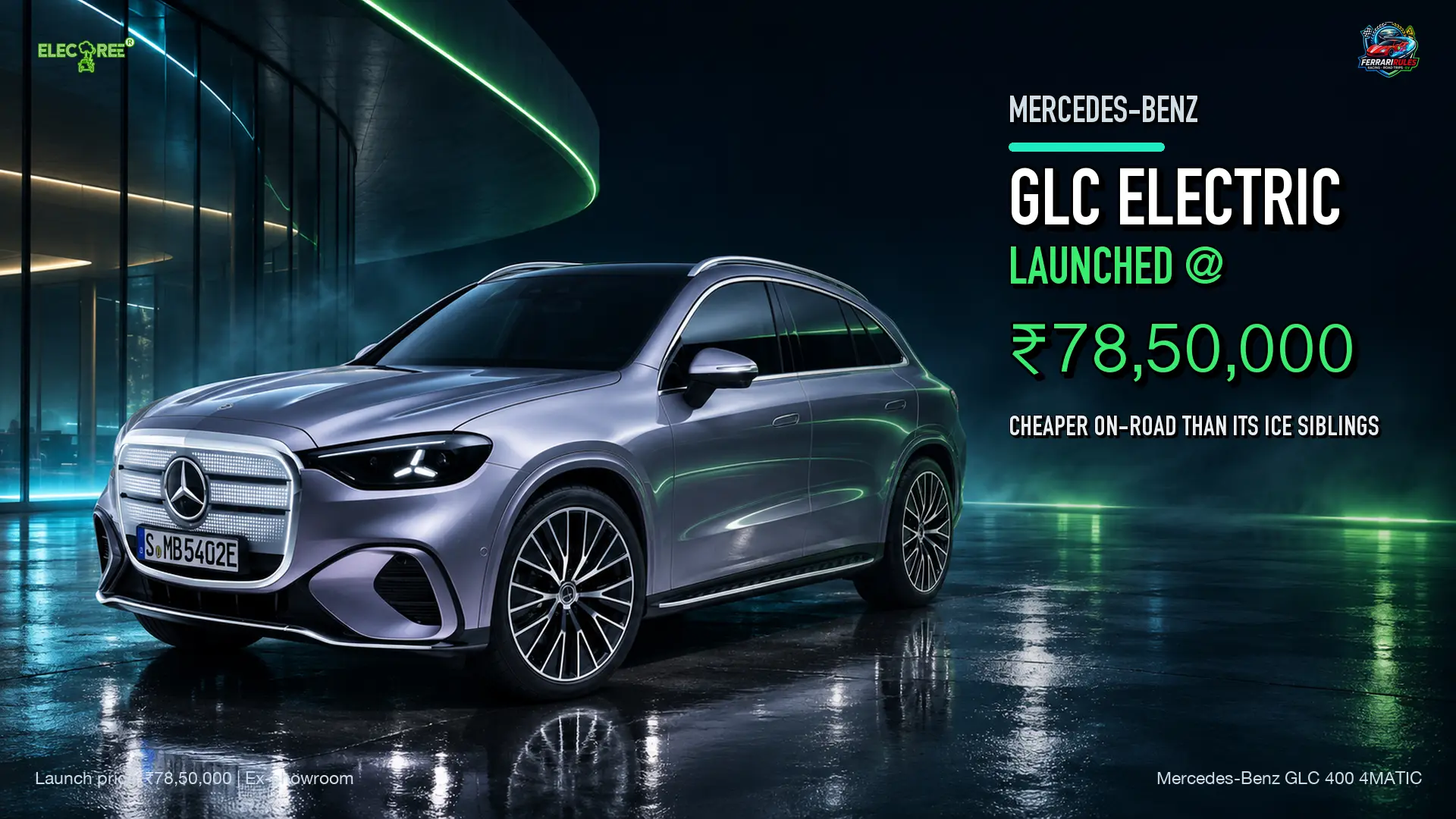
The Mercedes-Benz GLC 400 4MATIC electric has arrived at ₹78.50 lakh—only ₹1.5 lakh above the petrol and diesel GLC. It offers 489hp, 800Nm, a 4.3-second 0–100km/h time, and up to 715km of WLTP range.


Category:
Tag:
- Mercedes-Benz
- GLC Electric
- GLC 400 4MATIC
- Electric SUVs
Mercedes-Benz has launched the GLC 400 4MATIC electric in India at an introductory ex-showroom price of ₹78.50 lakh.
That places the new electric SUV just ₹1.50 lakh above the GLC 220d 4MATIC diesel and GLC 300 4MATIC petrol, both priced at ₹77 lakh. In percentage terms, the electric GLC carries a premium of less than 2% over its combustion-powered siblings.
Yet the difference in performance is far more substantial. The GLC 400 4MATIC electric produces 489hp and 800Nm, accelerates from 0–100km/h in 4.3 seconds, and offers up to 715km of WLTP range.
The introductory pricing turns the new model into more than an electric alternative to the regular GLC. On paper, it may be the most compelling version in the range.
Mercedes-Benz GLC Price and Specification Comparison
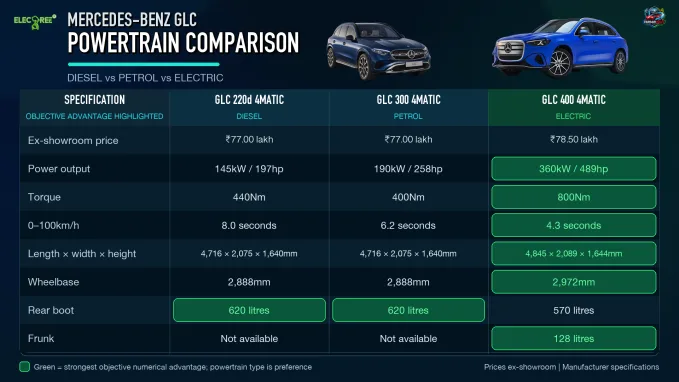
Less Than 2% More Expensive, Nearly Twice as Powerful
The GLC 400 4MATIC electric’s pricing is the biggest surprise.
Compared with the 258hp petrol GLC 300, the electric model offers approximately 90% more power and twice the torque for an additional ₹1.50 lakh. It is also 1.9 seconds quicker from 0–100km/h.
The difference is even more striking against the diesel GLC 220d. The electric model develops around 148% more power and 82% more torque, reducing the 0–100km/h time from eight seconds to 4.3 seconds.
This is not a mildly quicker electric derivative. With 360kW or 489hp, 800Nm and dual-motor all-wheel drive, the GLC 400 4MATIC electric delivers performance approaching that of substantially more expensive high-performance SUVs.
The Electric GLC Uses a Dedicated Platform
Despite sharing the GLC name, the electric model is not simply the existing SUV with its engine replaced by a battery and motors.
It is built on a dedicated electric architecture and is physically larger than the petrol and diesel GLC. At 4,845mm, it is 129mm longer than the combustion model. It is also 14mm wider and 4mm taller.
More importantly, its 2,972mm wheelbase is 84mm longer than that of the petrol and diesel versions. The additional distance between the axles should contribute to improved cabin space, particularly for rear-seat passengers.
The proportions also allow Mercedes-Benz to give the electric GLC a distinct identity. Its illuminated front grille, flush door handles, smoother body surfaces and more aerodynamic profile separate it visually from the combustion SUV without abandoning the familiar GLC design language.
94kWh Battery and Up to 715km WLTP Range
The GLC 400 4MATIC electric uses a 94kWh lithium-ion battery and two electric motors driving all four wheels.
Mercedes-Benz lists a WLTP range of between 568km and 715km, depending on the vehicle specification, wheels, equipment and operating conditions. The upper figure places it among the longest-range luxury electric SUVs currently available.
The new architecture also supports up to 330kW DC fast charging. Under suitable conditions, the battery can be charged from 10–80% in approximately 22 minutes.
Mercedes-Benz says the vehicle can recover as much as 305km of WLTP range in a ten-minute charging stop under ideal conditions. Maximum AC charging capacity is 11kW as standard, with 22kW charging supported where equipped.
The battery, range and charging specifications are detailed in Mercedes-Benz’s technical information for the electric GLC.
Smaller Rear Boot, but More Total Luggage Capacity
The combustion-powered GLC offers a 620-litre rear luggage compartment. The electric model’s rear boot is smaller at 570 litres, a reduction of 50 litres.
However, the dedicated electric architecture creates a 128-litre storage compartment beneath the bonnet. Combining the rear boot and frunk gives the electric GLC 698 litres of total luggage capacity—78 litres more than the petrol or diesel GLC.
The frunk should also prove useful for storing charging cables separately from luggage. Mercedes-Benz officially quotes the electric model’s combined luggage capacity as 698 litres.
39.1-Inch MBUX Hyperscreen Dominates the Cabin
One of the electric GLC’s most prominent features is its 39.1-inch MBUX Hyperscreen.
The display stretches across the dashboard and combines the driver display, central infotainment interface, and front-passenger screen beneath one glass surface. It runs the fourth-generation MBUX system with a zero-layer interface designed to surface frequently used functions without requiring occupants to navigate through multiple menus.
The cabin also receives a 15-speaker, 670-watt Burmester 3D surround-sound system with Dolby Atmos.
Another highlight is the SKY CONTROL panoramic roof. It can switch between clear and opaque states and incorporates illuminated Mercedes-Benz stars that coordinate with the vehicle’s ambient-lighting colour.
The specification also includes MB.DRIVE Level 2 driver assistance. Mercedes-Benz says selected Level 2+ capabilities, including an enhanced Steering Assist function, can be added through over-the-air upgrades.
Illuminated Grille Creates a New GLC Identity
The electric model introduces a substantially different interpretation of the traditional Mercedes-Benz grille.
Fibre-optic lighting is integrated into the chrome grille frame, allowing it to illuminate after dark. The vehicle also receives DIGITAL LIGHT headlamps with adaptive lighting and ULTRA RANGE high beam.
Made in India at Chakan
The GLC 400 4MATIC electric is manufactured in India at Mercedes-Benz’s Chakan facility near Pune.
Local production has likely played a major role in allowing Mercedes-Benz to price the electric SUV so close to the petrol and diesel GLC. Imported luxury EVs frequently attract a substantial price premium, whereas the locally made electric GLC enters the market at almost the same ex-showroom price as its combustion counterparts.
Mercedes-Benz describes it as a made-in-India model built on a dedicated electric platform. Its arrival also expands the company’s locally manufactured EV portfolio and demonstrates how localisation can narrow the traditional price gap between electric and combustion luxury cars.
Electree Take
The GLC 400 4MATIC electric asks buyers to pay ₹1.50 lakh more than the petrol or diesel GLC. The car will be cheaper than the ICE variants in states with no or lower road tax for EVs
In exchange, it offers:
- 489hp and 800Nm
- Dual-motor all-wheel drive
- A 4.3-second 0–100km/h time
- Up to 715km of WLTP range
- 330kW DC fast charging
- A longer wheelbase
- More combined luggage capacity
- A 39.1-inch MBUX Hyperscreen
- A dedicated electric platform
- Local production in India
The combustion models will continue to appeal to buyers who regularly travel through areas with limited charging infrastructure or simply prefer the convenience of petrol and diesel refuelling.
However, the electric GLC’s sub-2% price premium fundamentally changes the comparison. Buyers no longer need to justify a large upfront expenditure merely to choose the electric powertrain.
Trending Articles


Recent Articles