TVS Orbiter Europe vs India: Why One Plans Removable Batteries and the Other Does Not
The European TVS Orbiter proposes removable batteries, while the Indian model uses fixed packs. Here is what that changes for charging and buyers.


Category:
Tag:
- TVS Orbiter
- TVS Motor
- Removable Battery
- Fixed Battery
- Electric Scooter Charging
- EICMA 2026
- EV Technology
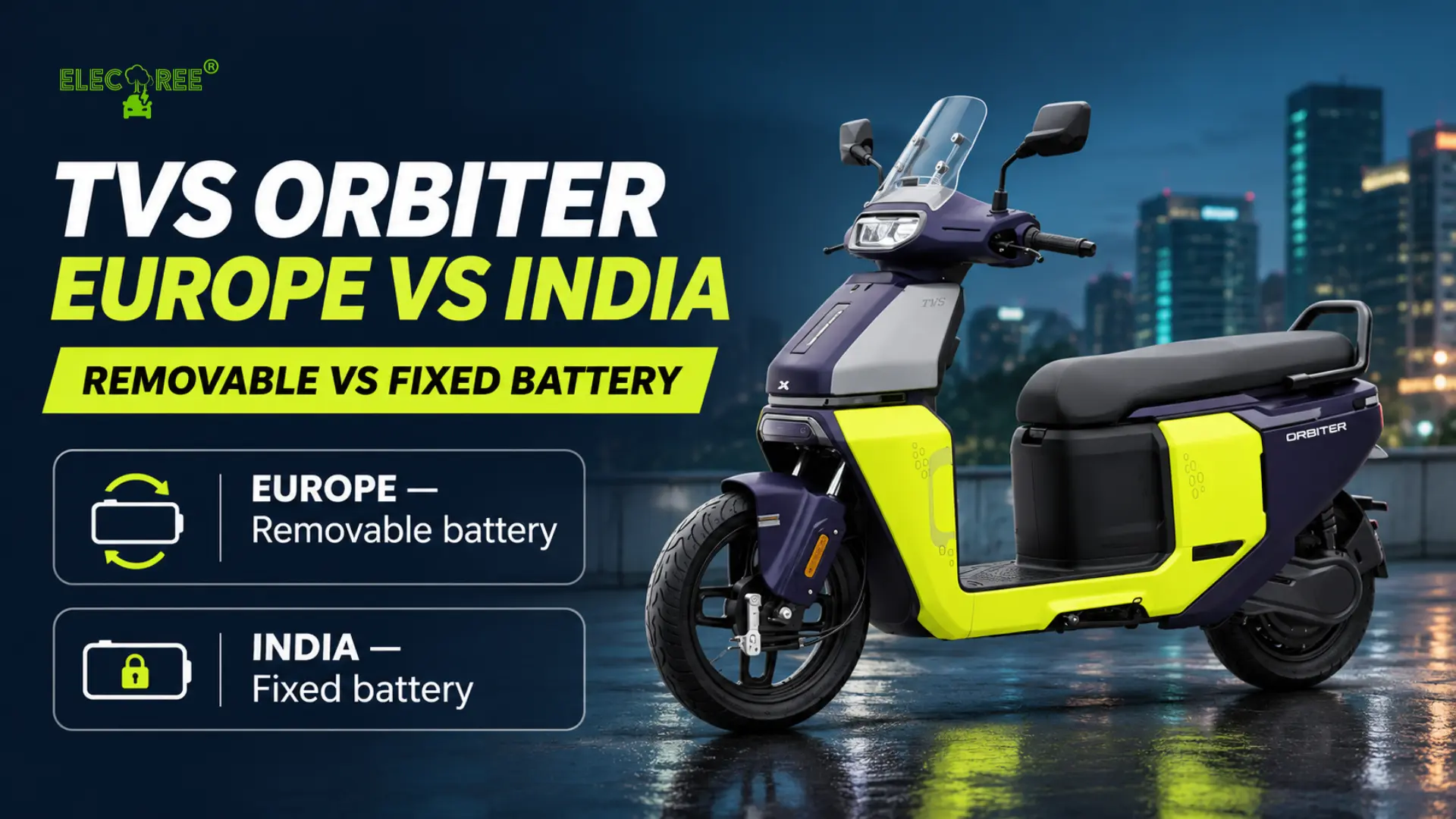
TVS has unveiled a European version of its Orbiter electric scooter with a feature that Indian buyers cannot use on the model sold here: a proposed removable battery. At EICMA 2026, the company said riders in Europe would be able to charge the battery either on the scooter or separately using an optional dock.
The India-spec Orbiter offers the same two battery-capacity choices, 1.8 kWh and 3.1 kWh, but TVS explicitly describes its batteries as non-removable. Owners are advised not to disconnect them, and doing so may affect warranty coverage.
There is one important qualification: the European arrangement has not received final confirmation. TVS says battery removal is subject to homologation, with European type approval expected in 2027. That makes this a comparison between the current Indian scooter and the European configuration TVS has announced, rather than two equally established retail products.
| Specification | India-spec Orbiter | Europe-spec Orbiter (announced) |
|---|---|---|
| Battery capacity | 1.8 kWh (V1); 3.1 kWh (V2) | 1.8 kWh; 3.1 kWh |
| Battery removal | Fixed / non-removable | Planned removable on both; subject to type approval |
| Advertised range | 92 km / 158 km (IDC) | 70 km / 105 km (expected WMTC) |
| Top speed | 69 km/h (Indian specification) | 45 km/h (European L1e specification) |
| Standard charging | 650 W charger; battery stays in scooter | 550 W charging; optional off-scooter dock |
| Quoted charging window | 10–80%: 2 h (V1) / 3 h 30 min (V2) | 0–80%: 2 h 39 min / 4 h 33 min |
| Under-seat storage | 34 litres | 34 litres |
| Availability | Available in India | European type approval expected in 2027; prices and on-sale dates not confirmed |
Manufacturer specifications reviewed November 2026. India and Europe use different range-test cycles and charge windows; the European battery-removal proposal remains subject to final approval.
What the European Orbiter Offers
TVS presented the European Orbiter on 3 November as a city-focused scooter with two NMC lithium-ion battery options. The smaller 1.8 kWh version has an expected range of 70 km under the WMTC cycle, while the 3.1 kWh option is rated at an expected 105 km. Both are planned to use a 550 W charging arrangement, with an optional dock for charging the battery away from the vehicle.
That last detail matters more than it may first appear. An owner who parks in a shared basement or on a street without a convenient power socket could, if the final approved configuration retains battery removal, take the battery to a suitable charging location rather than needing a charging point beside the scooter.
TVS also positions the European Orbiter as a low-speed city commuter, with a specified top speed of 45 km/h in Europe’s L1e category. Final regional prices and on-sale dates have not been announced.
India’s Orbiter Takes a Different Charging Approach
In India, the Orbiter V1 and V2 use fixed battery packs. The V1 has a 1.8 kWh battery and the V2 a 3.1 kWh battery, with TVS advertising IDC-certified ranges of 92 km and 158 km respectively on its Indian product page.
Indian owners charge the scooter through the vehicle using the supplied charger. The current TVS product page lists approximately two hours for a 10–80% charge on the V1 and three hours 30 minutes on the V2 with the included 650 W charger. This is a different charging window and different equipment from the European figures.
For a buyer with reliable access to a plug socket near the parking space, a fixed pack can be straightforward. But someone living in a flat without such access may find the inability to carry the battery indoors a much bigger limitation than a modest difference in claimed range.
Why Would the Same Scooter Use Two Battery Arrangements?
The clearest verified explanation is market positioning: TVS describes its European line-up as tailored to local mobility needs, and presents the Orbiter as a practical city vehicle. A removable pack is especially relevant where customers lack private charging infrastructure.
There are also engineering trade-offs, although TVS has not publicly attributed this particular decision to any one of them. A removable pack needs secure electrical connectors, safe handling provisions, an accessible enclosure and a suitable charging interface. The convenience has to be balanced against packaging, weight, weather protection, durability and cost.
It would therefore be misleading to suggest that Indian owners can simply buy the European battery or docking accessory and convert their existing scooters. TVS has not announced any such retrofit, and removing an Indian battery against the manufacturer’s instructions is not an approved charging method.
The Range Numbers Are Not Directly Comparable
The European 70 km and 105 km figures use the WMTC test cycle and are expected values ahead of final approval. The Indian 92 km and 158 km figures come from the IDC test cycle. These are different testing methods, so the numbers cannot establish that one market’s scooter is inherently more efficient or has less usable range.
The same caution applies to charging-time claims: Europe quotes 0–80%, while the current Indian product page quotes 10–80%. Starting charge level and charger rating both matter.
Will India Get the Removable-Battery Orbiter?
There is no confirmed Indian launch plan for this configuration. European battery removal still requires final approval, and TVS has not announced that the system will be offered to Indian Orbiter owners.
For Indian buyers, the practical question remains simple: can you charge at your usual parking spot? If the answer is no, the European proposal highlights an everyday convenience that the current domestic Orbiter does not provide. For TVS, the comparison shows how one scooter platform can be positioned differently across markets—without proving that either battery arrangement is universally better.
Trending Articles
Electric Scooter Battery Warranties Compared: What Do Ather, TVS, Bajaj and VIDA Actually Cover?
Ather Konarc Registrations More Than Double in October as Rizta Slips
Top Electric Two-Wheeler Models in October 2026: Chetak Leads, VIDA VX2 Gains Ground
Top 10 Best Selling EVs in India: September 2026
Recent Articles