Top Electric Two-Wheeler Models in October 2026: Chetak Leads, VIDA VX2 Gains Ground
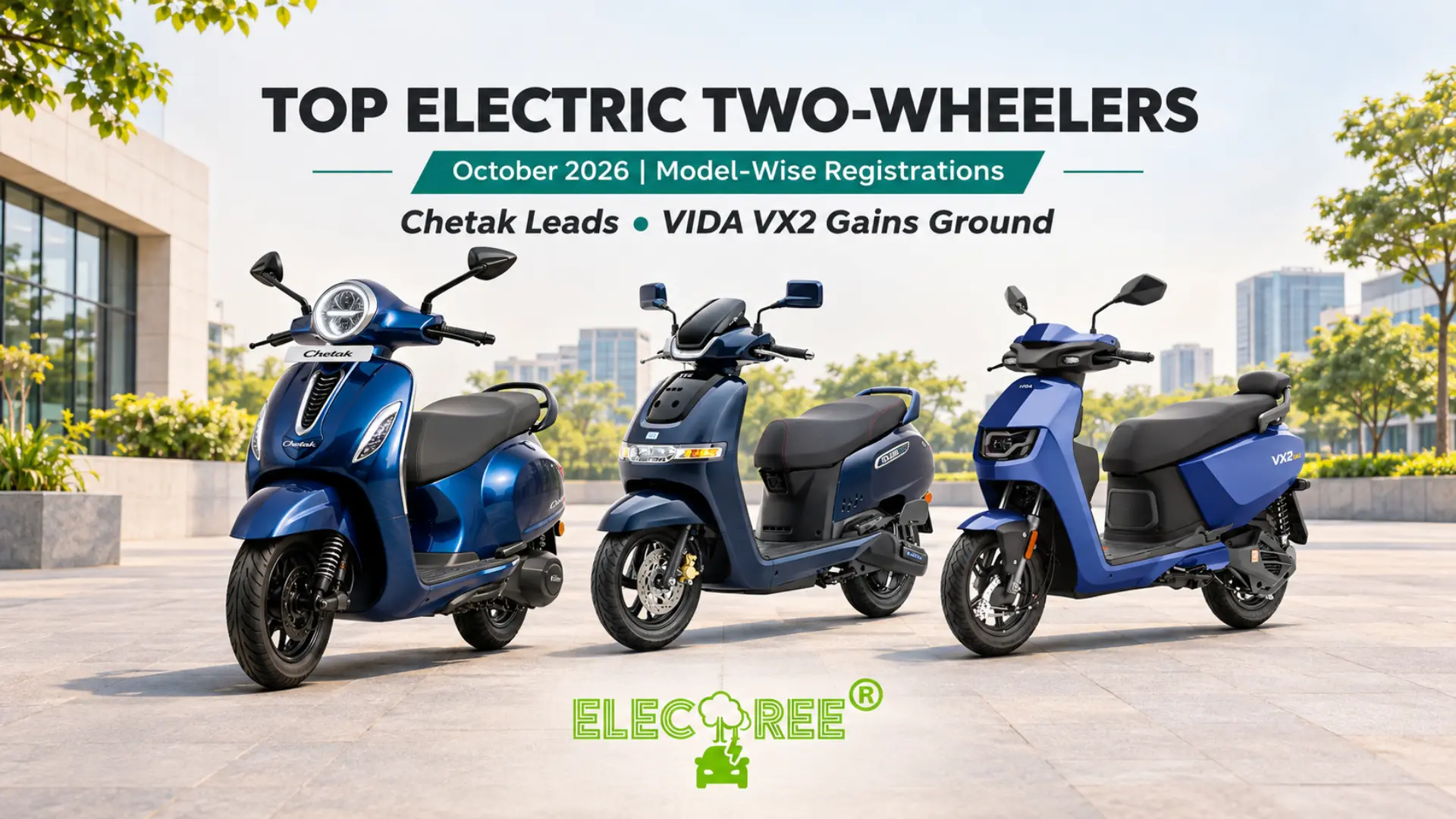
Bajaj Chetak retained the lead, but TVS iQube narrowed the gap. VIDA VX2 posted the strongest monthly growth among the top five, while Orbiter moved closer to Ather Rizta.


Category:
Tag:
- Electric Two-Wheelers
- EV Sales
- October 2026
- Bajaj Chetak
- TVS iQube
- VIDA VX2
- Ather Rizta
- TVS Orbiter
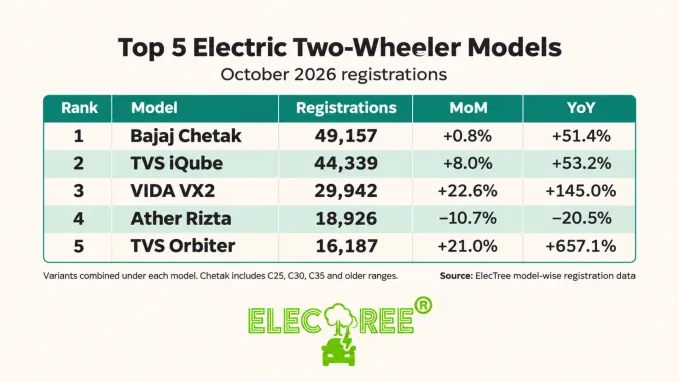
Bajaj Chetak, TVS iQube, VIDA VX2, Ather Rizta and TVS Orbiter were India’s top five electric two-wheeler models by registrations in October 2026. Together, they accounted for 70.7% of the month’s 2,24,234 registrations, according to model-wise data sourced by ElecTree on November 4, 2026.
The ranking combines variants under each parent model, including Go and Plus within VX2, S and Z within Rizta, and V1 and V2 within Orbiter. Chetak includes its C25, C30, C35 and older ranges. Figures represent registrations, not manufacturer dispatches.
1. Bajaj Chetak Leads, but iQube Narrows the Gap
Bajaj Chetak recorded 49,157 registrations, up 0.8% month-on-month and 51.4% year-on-year.
Within the Chetak range, C3503 led with 32,022 registrations, accounting for 65.1% of the total. C3502 followed with 5,852 units (11.9%), while C3501 contributed 4,563 (9.3%). Nearly two-thirds of Chetak’s registrations therefore came from C3503.
Chetak retained its lead, but October brought little additional volume compared with September. It added 410 registrations, while second-placed iQube added 3,298. Consequently, the gap between them narrowed from 7,706 to 4,818.
2. TVS iQube Narrows Chetak’s Lead
TVS iQube finished second with 44,339 registrations, rising 8.0% month-on-month from 41,041 and 53.2% year-on-year from 28,935. The total includes the S and ST versions.
Chetak leads the model ranking, while TVS leads at the manufacturer level because it has two substantial contributors: iQube and Orbiter. Together, they registered 60,526 units, compared with Chetak’s 49,157. TVS’s volume is spread across two models in the top five, while Bajaj’s electric scooter range is grouped under Chetak.
3. VIDA VX2 Posts the Strongest Monthly Growth
VIDA VX2 recorded 29,942 registrations, up 22.6% month-on-month and 145.0% year-on-year. Its increase of 5,511 registrations was the largest monthly gain among the top five, in both absolute and percentage terms.
VX2 is offered in Go and Plus versions, with multiple battery configurations. While V1 has been discontinued, V2 Pro and V2 Plus remain in VIDA’s line-up. October’s registrations were nevertheless overwhelmingly concentrated in VX2.
Go FB contributed substantially to the increase. Its registrations rose from 5,356 to 8,462, accounting for 56.4% of VX2’s monthly gain. Its share within VX2 also increased, from 21.9% in September to 28.3% in October.
4. Ather Rizta Holds Fourth as Orbiter Moves Closer
Ather Rizta recorded 18,926 registrations, down 10.7% month-on-month and 20.5% year-on-year.
The Z versions accounted for 10,417 units, or 55.0% of Rizta registrations, while S versions contributed 8,509, or 45.0%.
Rizta’s decline also brought fifth-placed Orbiter closer. The gap between the two fell from 7,827 registrations in September to 2,739 in October as Rizta lost volume and Orbiter gained it.
5. TVS Orbiter Grows as V2 Dominates the Mix
TVS Orbiter completed the top five with 16,187 registrations, up 21.0% month-on-month and 657.1% year-on-year.
The large annual increase partly reflects a low base of 2,138 registrations in October 2025.
Within the range, V2 contributed 15,128 registrations, or 93.5%, against V1’s 1,059. TVS specifies a 3.1 kWh battery and 158 km of claimed IDC range for V2, compared with 1.8 kWh and 92 km for V1.
The longer-range V2 dominates the mix, although the registration figures alone do not establish what drove buyers’ choice.
Trending Articles


Recent Articles