Paytm Partners up with ChargeZone to Bring QR Payments to 15,000+ EV Charging Points Across India
Paytm and ChargeZone partner to introduce QR-based payments across 15,000+ EV charging points in India, making public EV charging payments simpler.


Category:
Tag:
- EV Charging India
- UPI Payments
- QR Payments
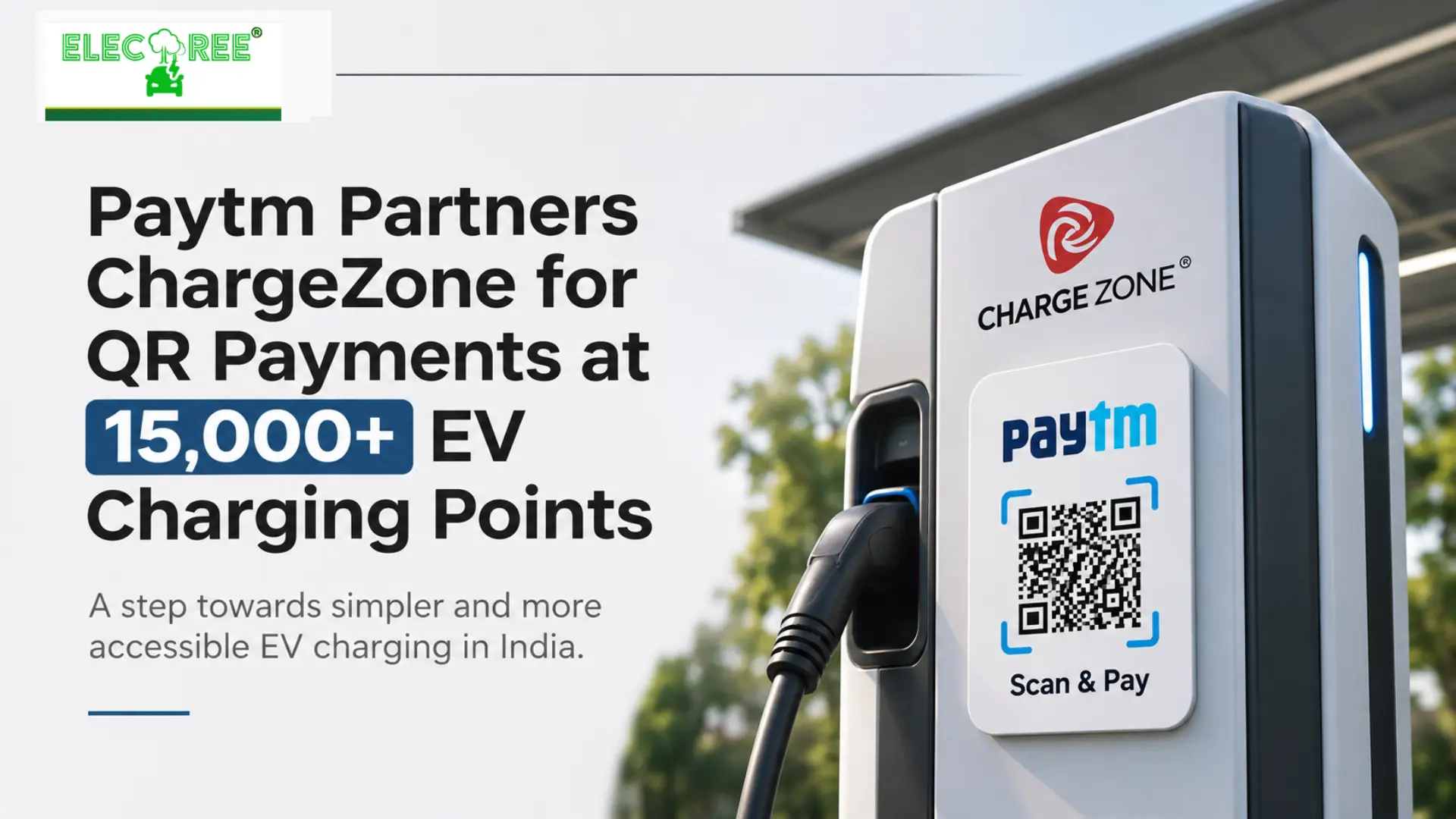
Paying for an electric vehicle charging session in India could become a little simpler. Paytm has partnered with electric vehicle charging network operator ChargeZone to introduce QR-based payments across more than 15,000 high-speed EV charging points in India.
Announced on November 23, 2026, the partnership will allow EV owners to scan a dedicated Paytm QR code displayed at participating ChargeZone charging points, enter their preferred payment amount and complete the transaction through Paytm before beginning a charging session.
The integration will be facilitated through ChargeIndia, an EV charging aggregation platform that connects Paytm with multiple charging networks through a single integration.
Importantly, these are existing ChargeZone charging points being enabled for Paytm payments, not 15,000 newly installed chargers.
How will Paytm QR payments work at ChargeZone stations?
The payment process is designed to be straightforward for EV owners.
At participating ChargeZone stations, drivers will be able to:
- Open the Paytm application.
- Scan the dedicated Paytm QR code displayed at the charging point.
- Enter the preferred payment amount.
- Complete the payment through Paytm.
- Begin the charging session after successful payment.
This brings a familiar QR-based payment experience to EV charging, potentially reducing the need to navigate a separate payment process for these transactions.
However, the announcement specifically concerns payments. It does not establish that Paytm replaces ChargeZone's charging application or that charger discovery, activation and session monitoring can all be completed through Paytm.
15,000+ charging points across 1,200 locations
According to Paytm's announcement, ChargeZone operates more than 15,000 high-speed EV charging points across over 1,200 locations in India. Its network covers major highways, urban centres and commercial hubs, making the partnership relevant to both city-based EV owners and people travelling between cities.
ChargeZone has also stated an ambition to establish one million charging points by 2030. The Paytm integration supports its wider effort to make its existing charging infrastructure easier to access and use.
ChargeIndia: The integration behind the partnership
An important part of this partnership is the role played by ChargeIndia.
According to Paytm, ChargeIndia provides the aggregation layer connecting Paytm with multiple charging networks through a single integration. This allows payment services to connect with charging operators without requiring every network to build an entirely separate integration.
This is relevant in India's fragmented public charging ecosystem, where different operators maintain their own charging infrastructure and digital systems.
The partnership demonstrates how aggregation platforms can help connect payment services with existing charging networks. However, the announcement does not establish that every charging operator connected to ChargeIndia will automatically accept Paytm QR payments.
Why this matters with regard to India's EV charging app problem
For many EV owners, finding a charging station is only one part of the problem. Actually using it can involve navigating multiple applications, creating separate accounts and managing different payment systems across charging networks.
We explored this issue in our earlier article, Your EV Says There's a Charger Nearby. But Will It Actually Work?, which examined the challenges Indian EV owners face with unreliable public chargers, fragmented charging applications, payment difficulties and unexpected charging speeds.
The Paytm–ChargeZone partnership addresses one part of this problem by introducing a familiar QR-based payment option across ChargeZone's network. However, whether integrations like this can eventually reduce the need for multiple charging applications remains to be seen.
QR payments fit into India's digital payment ecosystem
India already has an extensive QR-based digital payments ecosystem, with UPI used across everyday retail transactions. According to the National Payments Corporation of India (NPCI), UPI processed approximately 25.47 billion transactions worth ₹31.53 lakh crore in October 2026.
Bringing a familiar QR payment process to EV charging could make the experience easier for people who are already comfortable scanning QR codes to pay for everyday purchases. It could also benefit occasional EV users and intercity travellers who may prefer not to maintain separate prepaid balances across multiple charging operators.
However, the Paytm integration announced here covers ChargeZone's network. It should not be interpreted as universal QR payment acceptance across India's public charging infrastructure.
What happens next?
The Paytm–ChargeZone partnership is a useful step towards simplifying payments across India's public EV charging network. The larger opportunity lies in extending similar integrations across more charging operators, reducing the need for drivers to maintain multiple accounts and payment arrangements. As India's EV charging network grows, convenience will become just as important as infrastructure deployment.
For EV owners, the ideal experience is simple: find a working charger, plug in, pay without unnecessary complications and get back on the road.
The Paytm–ChargeZone partnership takes a step in that direction. Whether it becomes part of a broader shift towards interoperable EV charging will depend on how widely similar payment and access systems are adopted.
Trending Articles
Electric Scooter Battery Warranties Compared: What Do Ather, TVS, Bajaj and VIDA Actually Cover?
Ather Konarc Registrations More Than Double in October as Rizta Slips
Top Electric Two-Wheeler Models in October 2026: Chetak Leads, VIDA VX2 Gains Ground
Top 10 Best Selling EVs in India: September 2026