
Tata Aeris: Why Relaunch a Sedan When Private Sales Grew Just 0.4%?
Cab registrations are driving India’s sub-4m sedan segment, while demand from private buyers remains almost unchanged.



Category:
Tag:
- Tata Aeris
- Tata Aeris launch
- Sedan sales
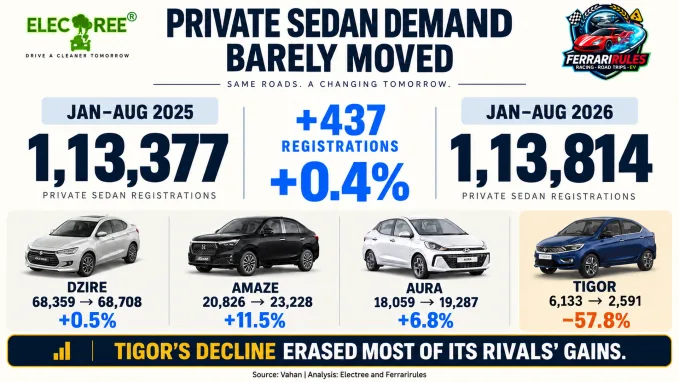
Tata is preparing to replace the Tigor nameplate with Aeris at a time when India’s private sub-4m sedan market shows almost no growth. Private registrations across the Dzire, Aura, Amaze, and Tigor rose from 1,13,377 units in January-August 2025 to 1,13,814 units in January-August 2026. That is an increase of only 437 registrations, or 0.4%.
The headline sedan market looks healthier only when cab registrations are added. Historical Vahan data shows that the expansion of the sub-4m sedan segment has come entirely from commercial registrations, while the number of private registrations has declined. That raises a basic question: if private buyers are not driving the market, what does Tata expect the Aeris to achieve that the Tigor could not?
Private sedan registrations are almost unchanged
The four-model private market grew by just 0.4% during the first eight months of 2026. Even after excluding the Tigor, the Dzire, Amaze and Aura collectively increased from 1,07,244 to 1,11,223 registrations. Their combined gain was 3,979 units, or 3.7% across eight months. That shows resilience, but it is not rapid growth.
Model | Jan-Aug 2025 | Jan-Aug 2026 | Change |
Dzire | 68,359 | 68,708 | Up 0.5% |
Amaze | 20,826 | 23,228 | Up 11.5% |
Aura | 18,059 | 19,287 | Up 6.8% |
Tigor | 6,133 | 2,591 | Down 57.8% |
Total | 1,13,377 | 1,13,814 | Up 0.4% |
The Tigor is the clear outlier. Its private registrations fell from 6,133 to 2,591, a decline of 57.8%. Its share of the four-model private market dropped from 5.4% to 2.3%. Tata is therefore not relaunching a sedan into a growing retail category; it is trying to rebuild a position that has weakened much faster than the market around it.
Total sedan growth is coming from cabs
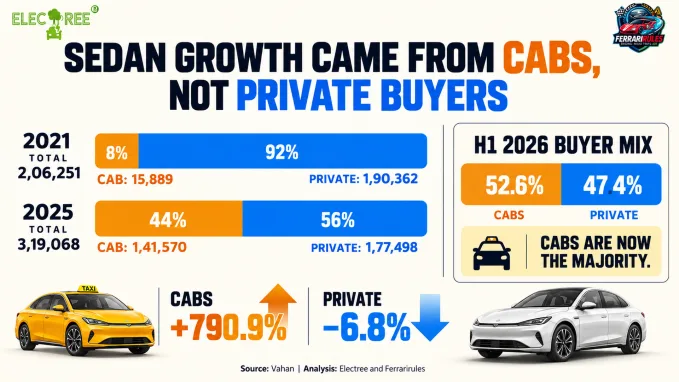
The longer-term registration mix explains why total sedan figures can create the impression of stronger demand. Total sub-4m sedan registrations increased from 2,06,251 in 2021 to a record 3,19,068 in 2025, a gain of 54.7%.
However, cab registrations increased from 15,889 to 1,41,570 during the same period. Private registrations, calculated by subtracting cabs from the total, moved in the opposite direction: they fell from approximately 1,90,362 to 1,77,498, a decline of 6.8%.
In other words, cabs generated more than the segment’s entire net growth between 2021 and 2025. The sedan market expanded because its buyer mix changed, not because more private customers started choosing sedans.
Cabs have become the majority of the sub-4m sedan market
The shift continued in 2026. During H1 2026, the segment recorded 1,89,590 registrations. Cabs accounted for 99,685 units, or 52.6%, while private buyers accounted for 89,905 units, or 47.4%. A category that was only 8% cab-driven in 2021 had become majority-fleet by the first half of 2026.
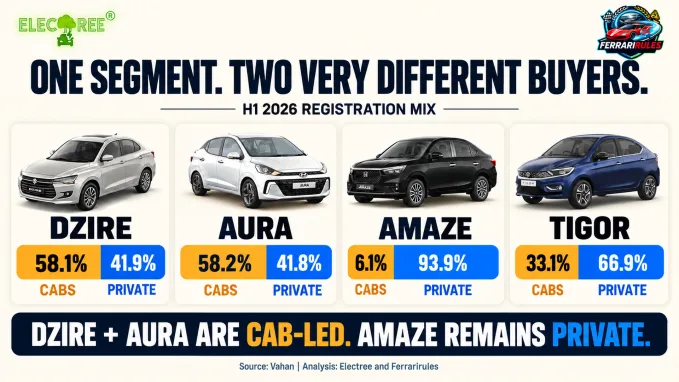
The model mix shows that there are now two different sedan businesses. Dzire recorded a 58.1% cab share in H1 2026, while Aura was at 58.2%. Amaze followed a very different strategy: only 6.1% of its registrations were cabs, leaving it at 93.9% private. Amaze proves that a private-focused sedan can survive, but its volume is much smaller than the cab-supported Dzire.
Where does that leave the Tata Aeris?
Tata has confirmed that the Aeris will debut on 25 September 2026 as a substantially updated replacement for the Tigor. The teaser points to major exterior changes, while reports indicate that petrol and CNG powertrains are expected to continue. An electric derivative has been reported as likely, but Tata has not formally confirmed an Aeris EV.
For private buyers, a new identity could help Tata distance the product from the Tigor’s declining position. But Aeris cannot depend on overall sedan growth because that growth is coming from commercial registrations. It must persuade buyers to switch from the Dzire, Amaze or Aura, or bring customers back from similarly priced hatchbacks and compact SUVs.
That requires more than a new badge. Aeris needs competitive pricing, a visibly improved cabin, meaningful safety and convenience equipment, strong CNG packaging, better refinement and a clear ownership proposition. Tata must give private customers a reason to choose a sedan when most new product attention and consumer demand have moved towards SUVs.
The larger sedan opportunity for Tata is Xpres
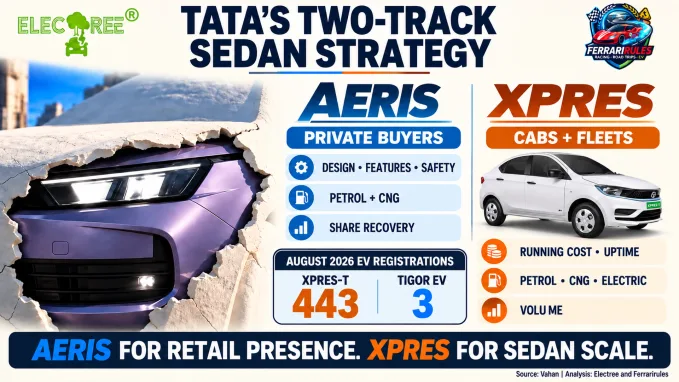
The fleet data suggests that Tata’s main sedan-volume strategy should sit under the Xpres brand rather than depend on Aeris. Tata created Xpres specifically for government, corporate and mobility-service fleets, and has since re-entered the combustion-engine fleet market with petrol and twin-cylinder CNG variants alongside the Xpres-T EV.
The electric split is particularly revealing. In August 2026, Vahan data recorded 443 Xpres-T registrations and only 3 Tigor EV registrations. One month does not establish a complete trend, but it shows where Tata’s electric-sedan demand currently sits: overwhelmingly with the commercial product rather than the private one.
Sedans retain a practical fleet use case. A separate boot, rear-seat comfort and predictable road behaviour suit airport transfers, corporate fleets and app-based taxis. Petrol, CNG and electric versions allow operators to choose around acquisition cost, daily utilisation, refuelling access and running expenses. These are functional advantages that do not depend on changing private buyers’ preference for SUVs.
Aeris for private presence and Xpres for scale
The case for Aeris is therefore narrower than the headline size of the sedan market suggests. Tata can use it as a focused private offering, similar in principle to the Amaze’s overwhelmingly retail-oriented role. The objective should be to recover some of Tata’s lost private share and maintain a credible alternative for buyers who still prefer a compact sedan.
The larger volume opportunity lies with Xpres. Cab registrations already form the majority of the sub-4m sedan category, and they explain the segment’s long-term growth. Tata’s sedan strategy should reflect that reality: Aeris for retail presence, Xpres for fleet scale.
The real test for Aeris is not whether India still buys sedans. It is whether Tata can create fresh private demand in a market where private sales grew only 0.4% and where almost all structural growth is coming from cabs.
Data and Methodology
Source and extraction date: Vahan data through 31 August 2026; snapshot taken on 12 September 2026. Scope: Sedan registrations from January 2025 to August 2026. Metric: New registration transactions; not wholesale dispatches. Coverage and exclusions: All available Vahan coverage with no additional state or registration-category exclusions.
Disclaimer: The values represented are new vehicle registrations and not dealer dispatches, sourced via RTOs through Vahan. The data is exclusive to ElecTree and Ferrarirules. Republishing the data on any social media platform or forum without credit is prohibited and will amount to copyright infringement and may result in appropriate legal action.
Recent Articles


Trending Articles
Kerala Makes EVs More Affordable: Revised Road Tax Structure to Accelerate Adoption

India Car Sales by Fuel Type — March 2026: EV Share Hits New High, CNG Surges, Petrol Loses Ground
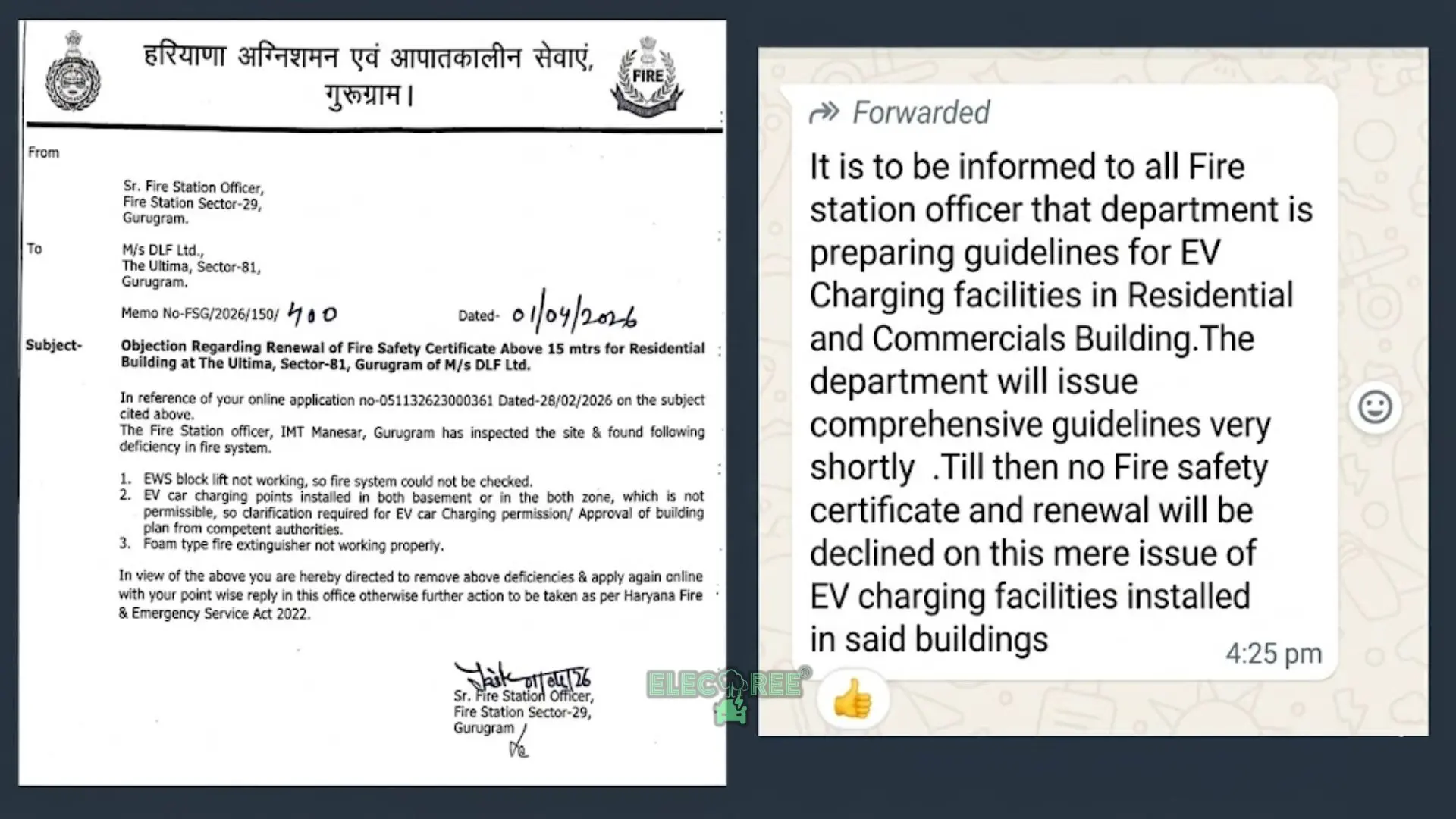
No Fire Safety Certificate Will Be Declined Over EV Chargers, Says Haryana Fire Department

Haryana Releases Draft Fire Safety Guidelines for EV Charging