
Haryana Releases Draft Fire Safety Guidelines for EV Charging
The Government of Haryana has released draft fire safety guidelines for EV charging stations. ElecTree, which exclusively broke the story of the fire department's internal clarification on this issue, brings you the key points from the document.


Category:
Tag:
- Haryana Fire Safety Guidelines for EVs
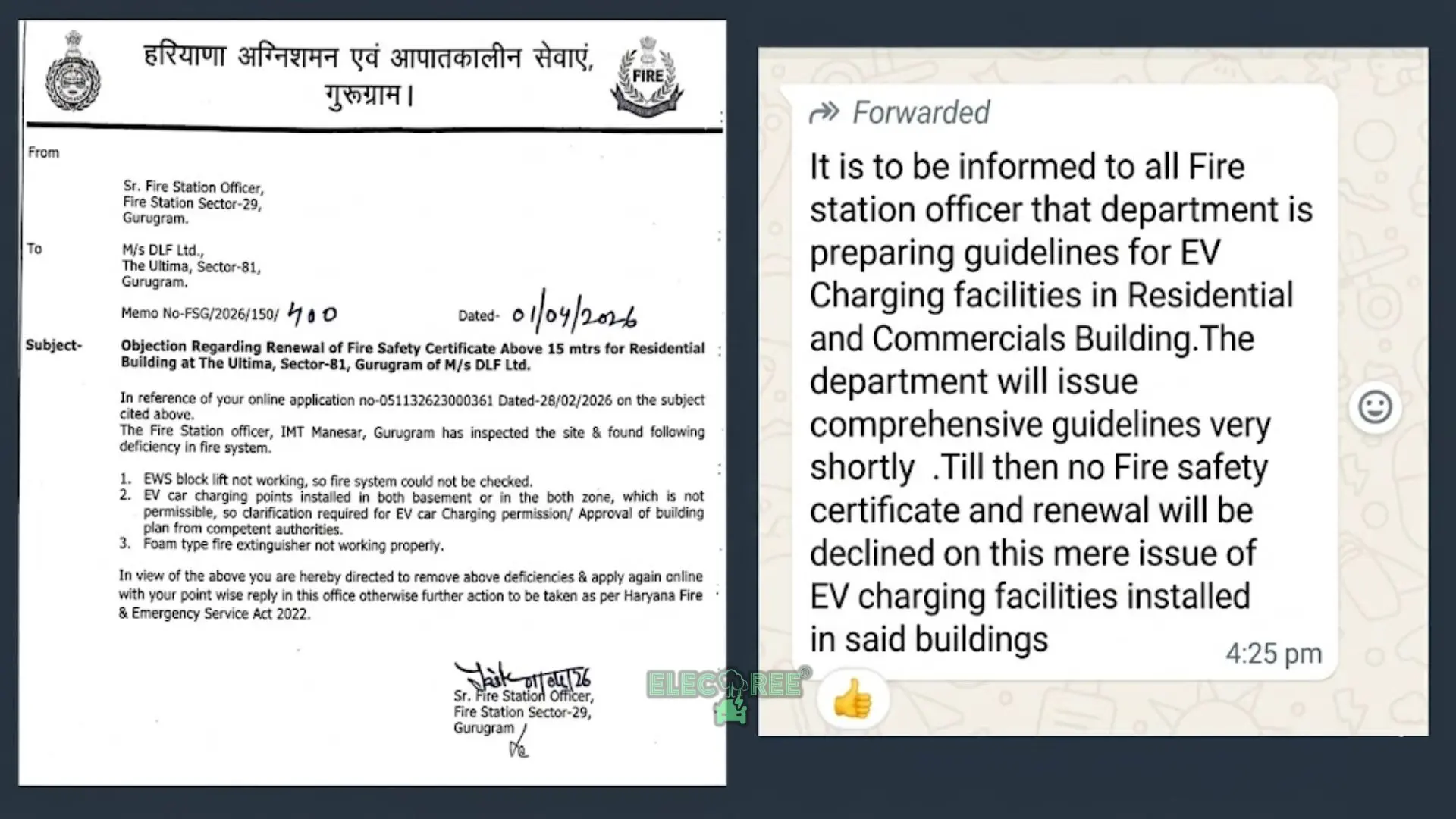
On 27 April 2026, ElecTree exclusively reported that the Haryana Fire Department had issued an internal clarification stating that no fire safety certificate would be declined solely on the basis of EV chargers installed in residential buildings. That story began when societies across Gurugram started receiving notices flagging basement EV chargers as non-permissible. An ElecTree community member also filed an RTI with the Director General of Fire Emergency Services, Haryana, seeking the very guidelines that did not exist at the time. You can read that full story here: No Fire Safety Certificate Will Be Declined Over EV Chargers, Says Haryana Fire Department.
Those guidelines are now here — as a draft.
The Government of Haryana's Revenue and Disaster Management Department — Fire and Emergency Services — has released a draft notification dated 29 April 2026, laying down fire safety guidelines for EV charging stations across the state. It is signed by the Additional Chief Secretary to the Government of Haryana.
You can read the full draft here: Haryana Draft Fire Safety Guidelines for EV Charging
This is a draft notification. The government has invited objections and suggestions from the general public and all stakeholders within 15 days of 29 April 2026 — which means the deadline is 13 May 2026. You can send your feedback to: technical-dfs@hry.gov.in
If you are a society resident, RWA member, or EV owner with a home charger, this is your opportunity to be heard before the guidelines are finalized.
What the Document Covers
The guidelines cover three categories of EV charging — private, semi-public and public — and lay down general fire safety requirements that apply across all three. We have focused on the points most relevant to residential society EV owners.
General Fire Safety Requirements
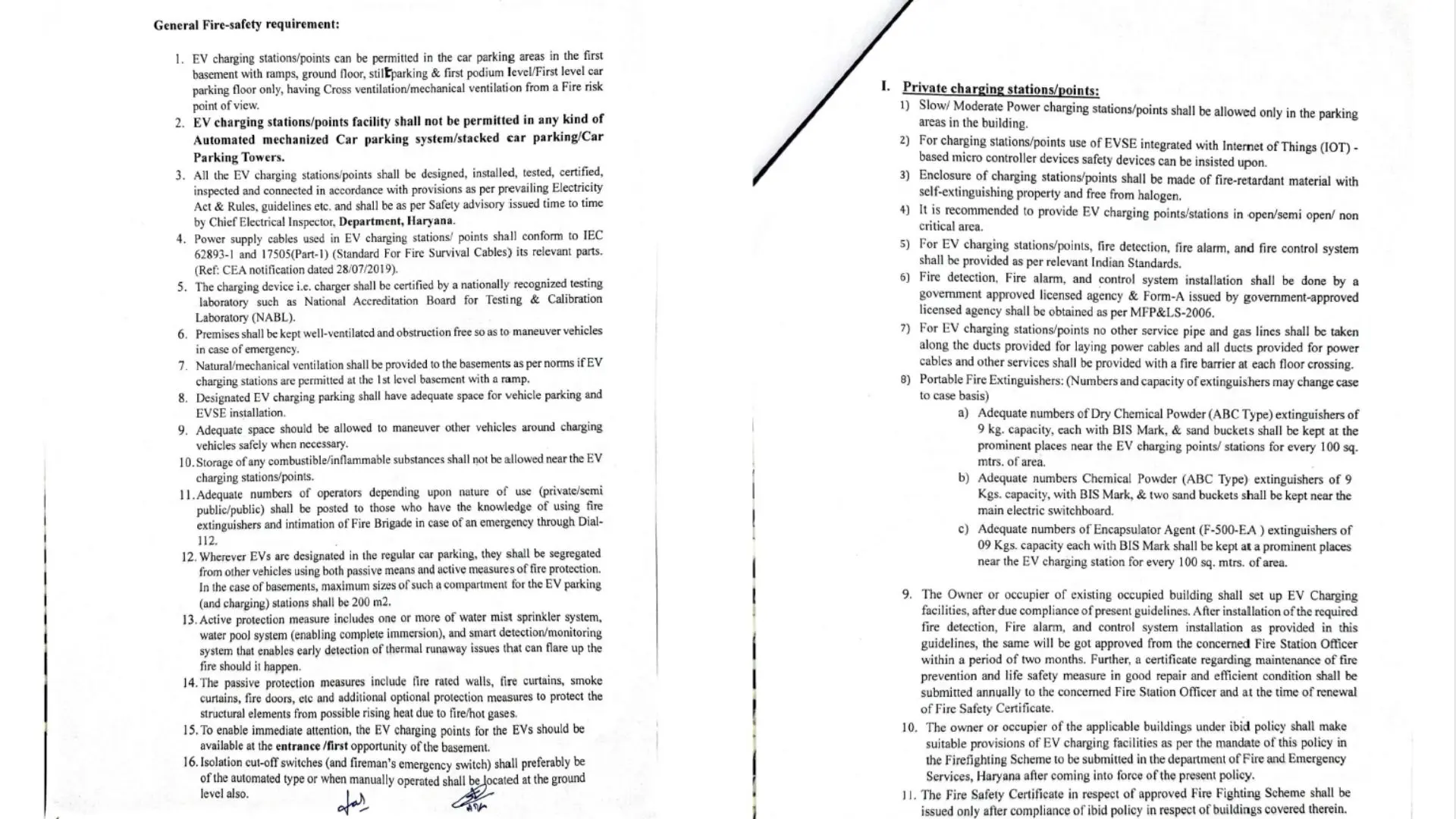
These apply to all EV charging installations regardless of category.
Where charging is permitted:
Point 1 of the General Fire Safety Requirements states:
"EV charging stations/points can be permitted in the car parking areas in the first basement with ramps, ground floor, stilt parking & first podium level/First level car parking floor only, having Cross ventilation/mechanical ventilation from a Fire risk point of view."
Basement charging is permitted — but only at the first basement level with a ramp, and only where cross ventilation or mechanical ventilation is in place.
Where charging is not permitted:
Point 2 states:
"EV charging stations/points facility shall not be permitted in any kind of Automated mechanized Car parking system/stacked car parking/Car Parking Towers."
This is a significant point for premium societies that use automated stacking systems or car parking towers. EV charging is not permitted in these setups under the draft guidelines.
Segregation of EV parking:
Point 12 states:
"Wherever EVs are designated in the regular car parking, they shall be segregated from other vehicles using both passive means and active measures of fire protection. In the case of basements, maximum sizes of such a compartment for the EV parking (and charging) stations shall be 200 m2."
The document requires segregation using active and passive fire protection measures — not necessarily a physical separation of all EVs from all other vehicles. The 200 sq metre limit applies to each such designated compartment. A society with a larger basement could potentially have more than one such compliant compartment. The precise interpretation of what constitutes adequate segregation will depend on the specific layout of each society and the assessment of the concerned Fire Station Officer.
Active fire protection required:
Point 13 states:
"Active protection measure includes one or more of water mist sprinkler system, water pool system (enabling complete immersion), and smart detection/monitoring system that enables early detection of thermal runaway issues that can flare up the fire should it happen."
Passive fire protection required:
Point 14 states:
"The passive protection measures include fire rated walls, fire curtains, smoke curtains, fire doors, etc and additional optional protection measures to protect the structural elements from possible rising heat due to fire/hot gases."
Private Charging — What Applies to Home Chargers in Societies
This section applies to chargers installed for personal use in society parking — the most common scenario for residential EV owners.
Point 1 of the Private Charging section states:
"Slow/Moderate Power charging stations/points shall be allowed only in the parking areas in the building."
Only slow or moderate speed chargers are covered under private charging. DC fast chargers are not part of this category.
Point 3 states:
"Enclosure of charging stations/points shall be made of fire-retardant material with self-extinguishing property and free from halogen."
The housing or enclosure of the charger must be fire-retardant.
Point 4 states:
"It is recommended to provide EV charging points/stations in open/semi open/non critical area."
This is a recommendation, not a mandatory requirement. Where possible, the guidelines suggest placing chargers in open or semi-open areas.
Point 5 states:
"For EV charging stations/points, fire detection, fire alarm, and fire control system shall be provided as per relevant Indian Standards."
A fire detection and alarm system is required.
Point 9 states that after installation of fire detection and alarm systems, approval must be obtained from the concerned Fire Station Officer within two months. It further states:
"A certificate regarding maintenance of fire prevention and life safety measure in good repair and efficient condition shall be submitted annually to the concerned Fire Station Officer and at the time of renewal of Fire Safety Certificate."
An annual maintenance certificate must be submitted to the local fire station.
Point 11 states:
"The Fire Safety Certificate in respect of approved Fire Fighting Scheme shall be issued only after compliance of ibid policy in respect of buildings covered therein."
Semi-Public Charging — Relevant for Society-Wide CPO-Operated Chargers
This section is relevant for societies that have or are planning to install chargers operated by a Charge Point Operator — chargers that are shared among residents but managed commercially. The document defines semi-public charging as:
"A shared charging facility for a restricted set of EV users and is owned by either host properties, Original Equipment Manufacturers (OEMs) & CPOS, it is managed by a CPO. It can be placed in apartment complexes, office campuses, gated communities, shopping malls, government buildings, etc."
This directly includes apartment complexes and gated communities.
Key additional requirements for semi-public chargers in enclosed areas include:
Point 6 states:
"EV charging stations/points with load capacity exceeding 11kW located in the covered/enclosed area then the flooring, side walls, and ceiling area in the proximity shall be provided with Cladding of the Fire resistance boards/material with at least 02 Hours of Fire resistance."
Any semi-public charger above 11 kW in an enclosed area requires fire-resistance cladding of at least 2 hours on the surrounding floor, walls and ceiling.
Point 8 states:
"The EV charging station/points located in the covered/enclosed area, shall be provided with addressable automatic fire alarm system with main control panel at Fire control room in the building / at ground floor level."
Point 9 states:
"An automatic sprinkler system and detection system conforming to the prevailing standards and relevant I.S. specifications shall be provided with a sprinkler head around each car parking space for semi public charging stations/points in covered/enclosed areas."
A sprinkler head above each car parking space is required for semi-public chargers in covered areas.
What This Means for Existing Chargers
These are draft guidelines and are not yet in force. However the direction is clear. Societies that comply with these requirements when the final notification is issued will have no difficulty obtaining their fire safety certificate. The guidelines do not ban basement charging. They regulate it — with specific requirements around ventilation, fire detection, enclosures, segregation and annual certification.
For EV owners with existing home chargers in society basements — the path forward is compliance, not removal.
Your Window to Respond
This is a draft. The government has specifically invited public feedback. If you believe any of these guidelines are impractical, too restrictive, or need modification — you have until 13 May 2026 to say so.
Send your objections or suggestions to: technical-dfs@hry.gov.in
Source: Government of Haryana, Revenue and Disaster Management Department — Fire and Emergency Services. Notification No. 2947, dated 29 April 2026. Full document linked above.
Recent Articles
Kia EV Registrations Rise 24% in August as Syros Offsets Clavis Decline
DISCOM Issues Notice to Gurugram RWA for Overcharging EV Users

Hyundai EV Sales August 2026: Creta Electric Rebounds, but Year-to-Date Sales Fall

Omega Seiki Mobility Begins Development of Accessible EV for Persons with Disabilities
Trending Articles
Kerala Makes EVs More Affordable: Revised Road Tax Structure to Accelerate Adoption

India Car Sales by Fuel Type — March 2026: EV Share Hits New High, CNG Surges, Petrol Loses Ground
No Fire Safety Certificate Will Be Declined Over EV Chargers, Says Haryana Fire Department
Are EV Connected Car Apps Worth Paying For? We Asked Real Owners