
Maruti eVitara Records 1,438 August Sales as Delta’s 49 kWh Share Rises
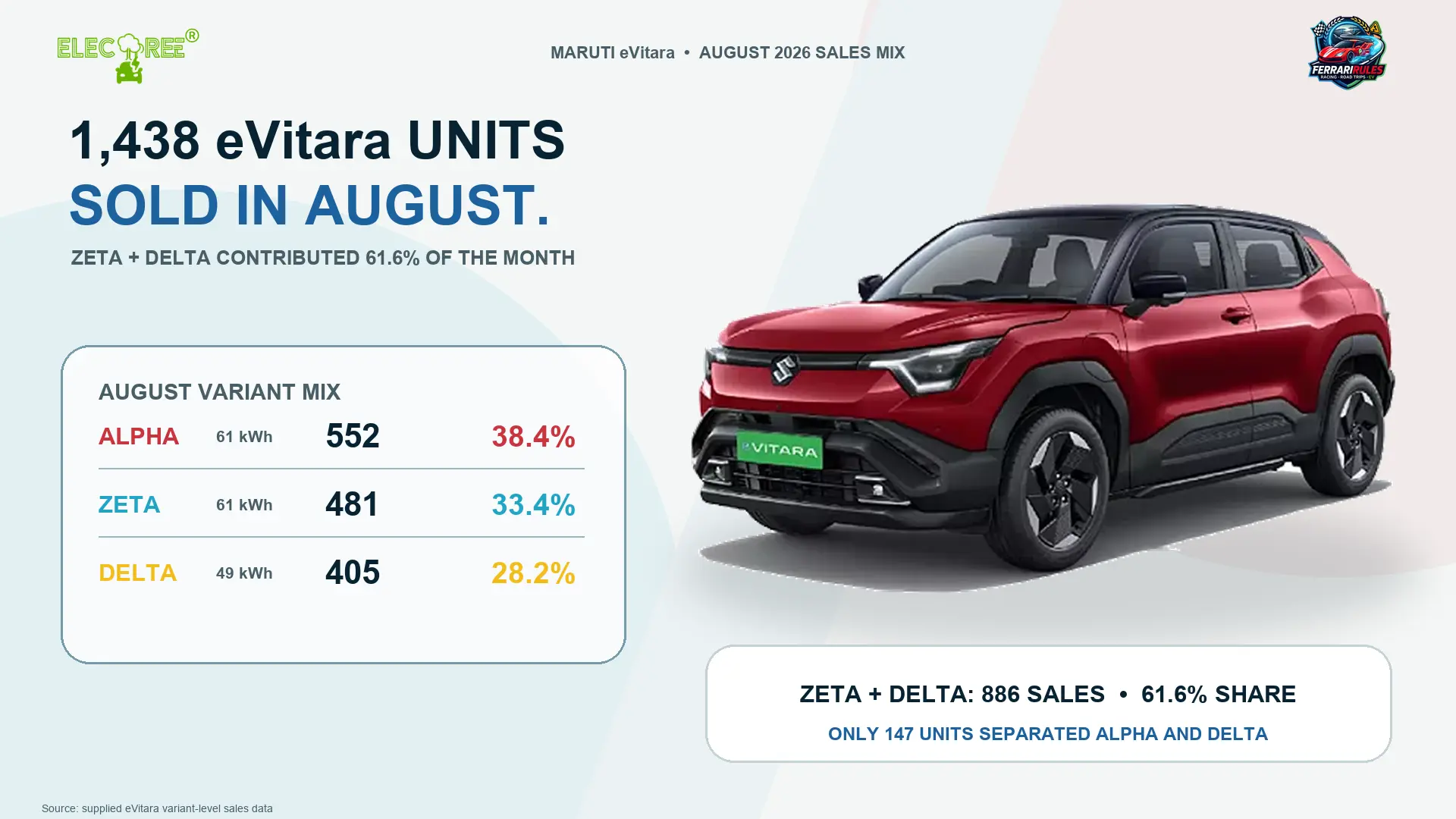
Maruti sold 1,438 eVITARAs in August 2026. Alpha remained the largest variant, but Zeta and Delta together contributed 886 units and accounted for 61.6% of the month’s sales.


Category:
Tag:
- Maruti Suzuki
- eVitara
- EV Sales
The Maruti eVITARA recorded 1,438 sales in August 2026, down from 1,669 units in July and the June peak of 1,972. This made eVitara the 8th best-selling EV in India.
The top Alpha variant led August with 552 units and a 38.4% share. The mid Zeta followed with 481 units and 33.4%, while the base Delta was close behind at 405 units and 28.2%. Alpha and Zeta use the larger 61 kWh battery pack, while Delta comes with the smaller 49 kWh pack.
Only 147 units separated Alpha and Delta. More significantly, Zeta and Delta together generated 886 sales, which was 60.5% more than Alpha’s monthly volume.
The August result therefore shows a much broader variant mix than the eVITARA recorded earlier in 2026. Most of the month’s sales came from outside the top variant.
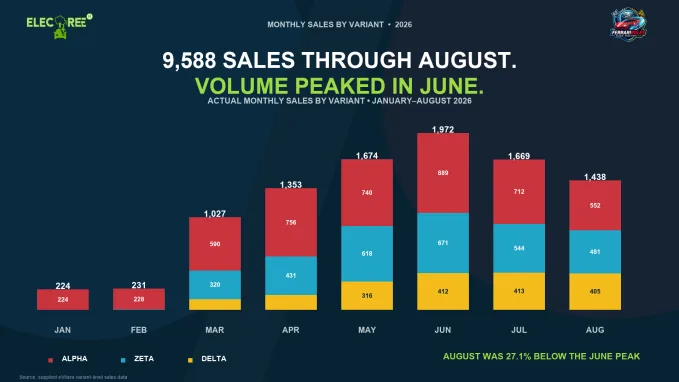
eVITARA sales reached 9,588 through August
Across January–August 2026, the eVITARA recorded 9,588 sales. Alpha remained the cumulative leader with 4,691 units and a 48.9% share. Zeta contributed 3,068 units, or 32.0%, while Delta added 1,829 units and held a 19.1% share.
Monthly sales were limited to 224 units in January and 231 in February, when there was little or no volume from Zeta and Delta. Sales increased to 1,027 units in March, 1,353 in April and 1,674 in May.
The eVITARA reached its 2026 monthly peak of 1,972 units in June, before easing to 1,669 in July and 1,438 in August. August was therefore 13.8% below July and 27.1% below the June peak.
The variant and battery mix is moving away from Alpha
The cumulative numbers still make Alpha look dominant because January and February sales came almost entirely from the top variant. March is the first useful month for comparing all three variants at material volumes.
In March, Alpha contributed 57.4% of eVITARA sales, Zeta held 31.2%, and Delta accounted for 11.4%. Because both Alpha and Zeta use the 61 kWh battery, the larger pack represented 88.6% of the month’s sales. The 49 kWh Delta accounted for the remaining 11.4%.
By August, Alpha’s share had fallen to 38.4%, a decline of 19.0 percentage points. Zeta remained relatively stable at 33.4%, while Delta climbed to 28.2%, gaining 16.8 points. The 49 kWh battery’s share therefore rose from 11.4% in March to 28.2% in August, while the combined share of the 61 kWh variants fell from 88.6% to 71.8%.
The shift also appears in absolute sales. From June to August, Alpha fell from 889 to 552 units, and Zeta declined from 671 to 481. Delta was almost unchanged, moving from 412 to 405 units. Its steadier volume allowed the base variant to gain share even as overall eVITARA sales softened.
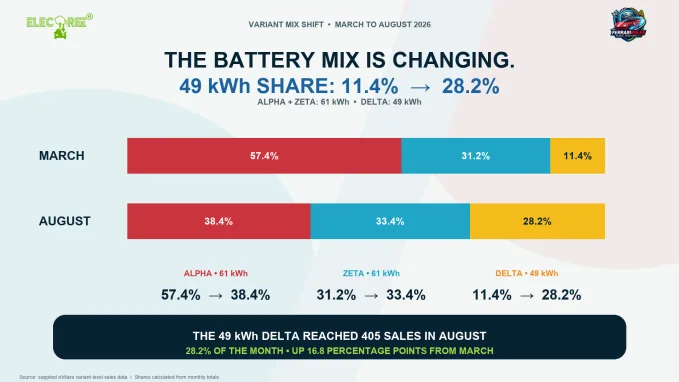
The direction is clear in the recorded sales: Alpha remains the cumulative leader, but the monthly mix has broadened considerably. By August, nearly two out of every three eVITARAs sold were Zeta or Delta variants, and more than one in four used the smaller 49 kWh battery.
Sales data alone cannot establish whether this reflects buyer preference, variant availability, production allocation or the timing of deliveries. The next few months will show whether the August mix becomes the e VITARA’s normal structure or represents its opening supply pattern.
eVITARA outsold Maruti’s two strong hybrids combined in last 4 months
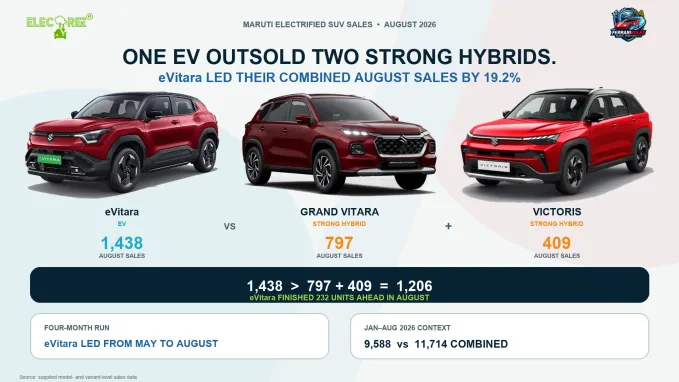
The e VITARA’s August volume also remained ahead of Maruti’s two mass-market strong-hybrid SUVs. The Grand Vitara recorded 797 strong-hybrid sales during the month, while the Victoris added 409. Together, they generated 1,206 sales.
At 1,438 units, the eVITARA outsold their combined August volume by 232 units, or 19.2%. This was not an isolated crossover: the electric SUV has remained ahead of the two strong hybrids combined for four consecutive months from May through August. In April, the difference was only two units—1,353 eVITARAs against 1,355 Grand Vitara and Victoris strong hybrids.
The year-to-date picture remains different because the eVITARA was still ramping up during January and February. Across January–August, the Grand Vitara contributed 7,902 strong-hybrid sales and the Victoris added 3,812, taking their combined total to 11,714 units. That remains 22.2% above the eVITARA’s 9,588 sales over the same period. Read more on our strong hybrid coverage here
What do you think? Do engage with us on our social media handles. We would love to hear your thoughts
Disclaimer: The values represented are new vehicle registrations and not dealer dispatches, sourced via RTOs through Vahan. The data is exclusive to ElecTree and Ferrarirules. Republishing the data on any social media platform or forum without credit is prohibited and will amount to copyright infringement and appropriate legal action.
To comment and participate in discussion Click Here
Recent Articles
Trending Articles
Kerala Makes EVs More Affordable: Revised Road Tax Structure to Accelerate Adoption
India Car Sales by Fuel Type — March 2026: EV Share Hits New High, CNG Surges, Petrol Loses Ground
No Fire Safety Certificate Will Be Declined Over EV Chargers, Says Haryana Fire Department
Haryana Releases Draft Fire Safety Guidelines for EV Charging