
India's EV Transition Is Taking Two Different Paths, July Registrations Show
India's July 2026 vehicle registrations reveal that EV adoption is accelerating at different speeds across vehicle segments. While electric two-wheelers continue to strengthen their position against petrol, passenger cars are transitioning through a broader mix of CNG, hybrid and electric powertrains.


Category:
Tag:
- July 2026 Fuel Mix Analysis
India's shift towards electric mobility is unfolding differently across vehicle segments. July's vehicle registrations show battery-electric vehicles steadily strengthening their position in the two-wheeler market, while passenger cars continue to evolve through a mix of EVs, CNG and hybrid technologies. The contrast highlights how electrification is progressing at different speeds across India's largest automotive segments.
India's journey towards cleaner mobility is becoming increasingly nuanced. While electric vehicles continue to gain traction, consumer preferences vary significantly depending on the type of vehicle they are buying.
For two-wheelers, battery-electric models are emerging as the fastest-growing alternative to conventional petrol-powered vehicles. Passenger cars, meanwhile, continue to diversify across multiple cleaner powertrains as buyers weigh factors such as affordability, driving range, charging infrastructure, fuel availability and long-term ownership costs.
Passenger Cars Are Evolving Differently
Passenger cars present a markedly different picture.
While petrol remains the largest fuel category, buyers today have a much broader range of powertrain choices. Registrations across CNG, hybrid and battery-electric vehicles indicate that the market is embracing multiple technologies rather than transitioning directly from internal combustion engines to fully electric vehicles.
The wider spread of powertrain choices reflects the different priorities of passenger vehicle buyers, including running costs, charging availability, long-distance usability and upfront purchase price.
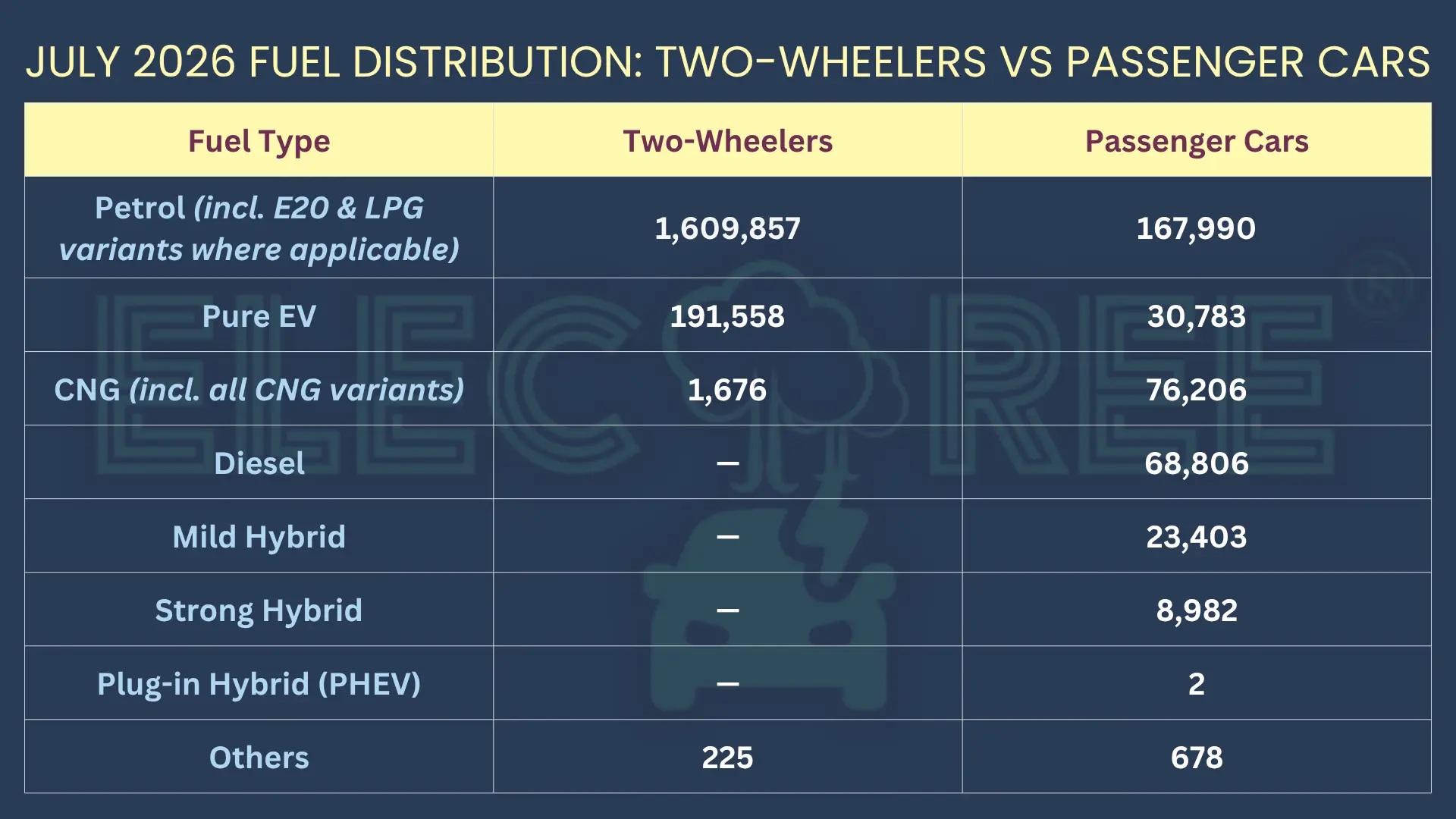
Fuel Distribution - Passenger Cars (July 2026)
| Fuel Type | July Registrations |
|---|---|
| Petrol | 1,67,990 |
| CNG | 76,206 |
| Diesel | 68,806 |
| Pure EV | 30,783 |
| Mild Hybrid | 23,403 |
| Strong Hybrid | 8,982 |
| Plug-in Hybrid (PHEV) | 2 |
| Others | 678 |
Unlike the two-wheeler segment, where EVs are increasingly becoming the primary alternative fuel choice, passenger cars continue to adopt multiple cleaner powertrains simultaneously, resulting in a more diversified fuel mix.
Electric Two-Wheelers Continue to Build Momentum
Petrol remains the dominant fuel choice in India's two-wheeler market. However, electric scooters and motorcycles continue to strengthen their presence, supported by lower running costs, expanding product choices and improving charging infrastructure.
With over 1.91 lakh Pure EV registrations during July, battery-electric two-wheelers have emerged as the fastest-growing alternative fuel option in the segment. Meanwhile, CNG-powered two-wheelers continue to account for only a marginal share of registrations.
Fuel Distribution - Two-Wheelers (July 2026)
| Fuel Type | July Registrations |
|---|---|
| Petrol | 16,09,857 |
| Pure EV | 1,91,558 |
| CNG | 1,676 |
| Others | 225 |
The numbers suggest that India's two-wheeler market is gradually evolving into a predominantly petrol-versus-electric ecosystem, with battery-electric vehicles steadily moving beyond the early-adopter phase into mainstream urban mobility.
Three Trends Stand Out
July's registration trends highlight three clear developments shaping India's electric mobility landscape.
First, electric mobility continues to advance fastest in the two-wheeler segment. Lower ownership costs, improving charging access and a growing portfolio of electric scooters are making EVs an increasingly attractive choice for urban commuters.
Second, passenger car buyers are following a more diversified path. Instead of shifting directly from petrol to battery-electric vehicles, many consumers continue to choose CNG and hybrid models alongside EVs, depending on their driving requirements and ownership priorities.
Third, battery-electric vehicles now represent a meaningful presence in both segments, although adoption patterns differ considerably between two-wheelers and passenger cars.
Why This Matters
The contrasting fuel mix reinforces an important reality for India's automotive industry: electrification will not progress uniformly across every vehicle segment.
For two-wheelers, the market is increasingly becoming a contest between petrol and battery-electric vehicles. Passenger cars, meanwhile, continue to remain a multi-powertrain market, with EVs competing alongside CNG and hybrid technologies as consumers evaluate different pathways towards cleaner mobility.
For manufacturers, this means product strategy will matter as much as technology itself. Companies that can offer the right mix of powertrains for different customer segments are likely to be better positioned as India's automotive market continues to evolve.
Industry Perspective
Monthly EV sales offer only part of the story. Looking at how buyers are shifting across different fuel technologies provides a much clearer picture of where India's automotive market is headed.
The latest registration trends show battery-electric vehicles steadily strengthening their position, particularly in the two-wheeler market, while passenger cars continue to evolve through a broader mix of cleaner powertrains. For the EV industry, that distinction matters. The pace of electrification is accelerating, but the route to adoption is proving very different across vehicle segments, a trend that will shape future product strategies, charging infrastructure and policy priorities.
Recent Articles
Trending Articles
Kerala Makes EVs More Affordable: Revised Road Tax Structure to Accelerate Adoption
India Car Sales by Fuel Type — March 2026: EV Share Hits New High, CNG Surges, Petrol Loses Ground
No Fire Safety Certificate Will Be Declined Over EV Chargers, Says Haryana Fire Department
Haryana Releases Draft Fire Safety Guidelines for EV Charging