
India Could Avoid 1.7 Million Premature Deaths by 2050 Through Vehicle Electrification, ICCT Study Finds
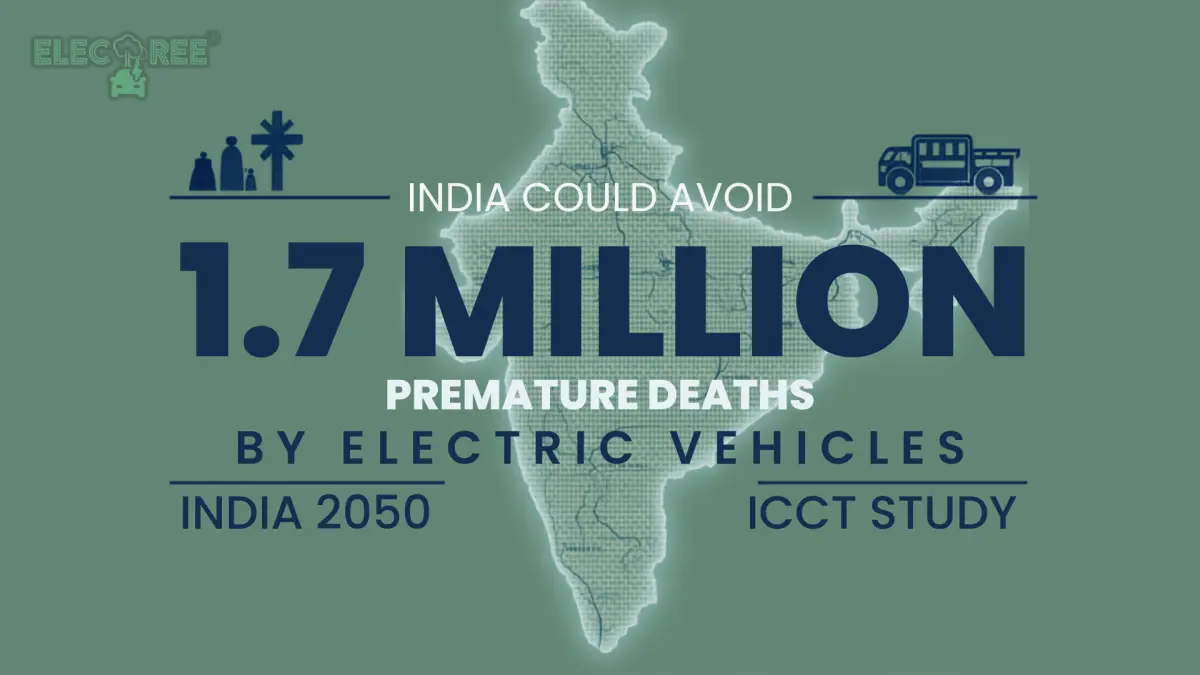
A new ICCT study finds India could avoid 1.7 million premature deaths and nearly 97,200 pediatric asthma cases by 2050 through accelerated vehicle electrification, but only if the country hits a 100% zero-emission vehicle sales target by 2045.


Category:
Tag:
- ICCT's "Health Benefits of Zero-Emission Transport Through 2050" (June 2026)
Today, the International Council on Clean Transportation (ICCT) presented new modeling on what road transport pollution is costing India, and what an accelerated shift to zero-emission vehicles could prevent. The findings come from ICCT's global report, Health Benefits of Zero-Emission Transport Through 2050 (June 2026), and an accompanying India-specific fact sheet (July 2026).
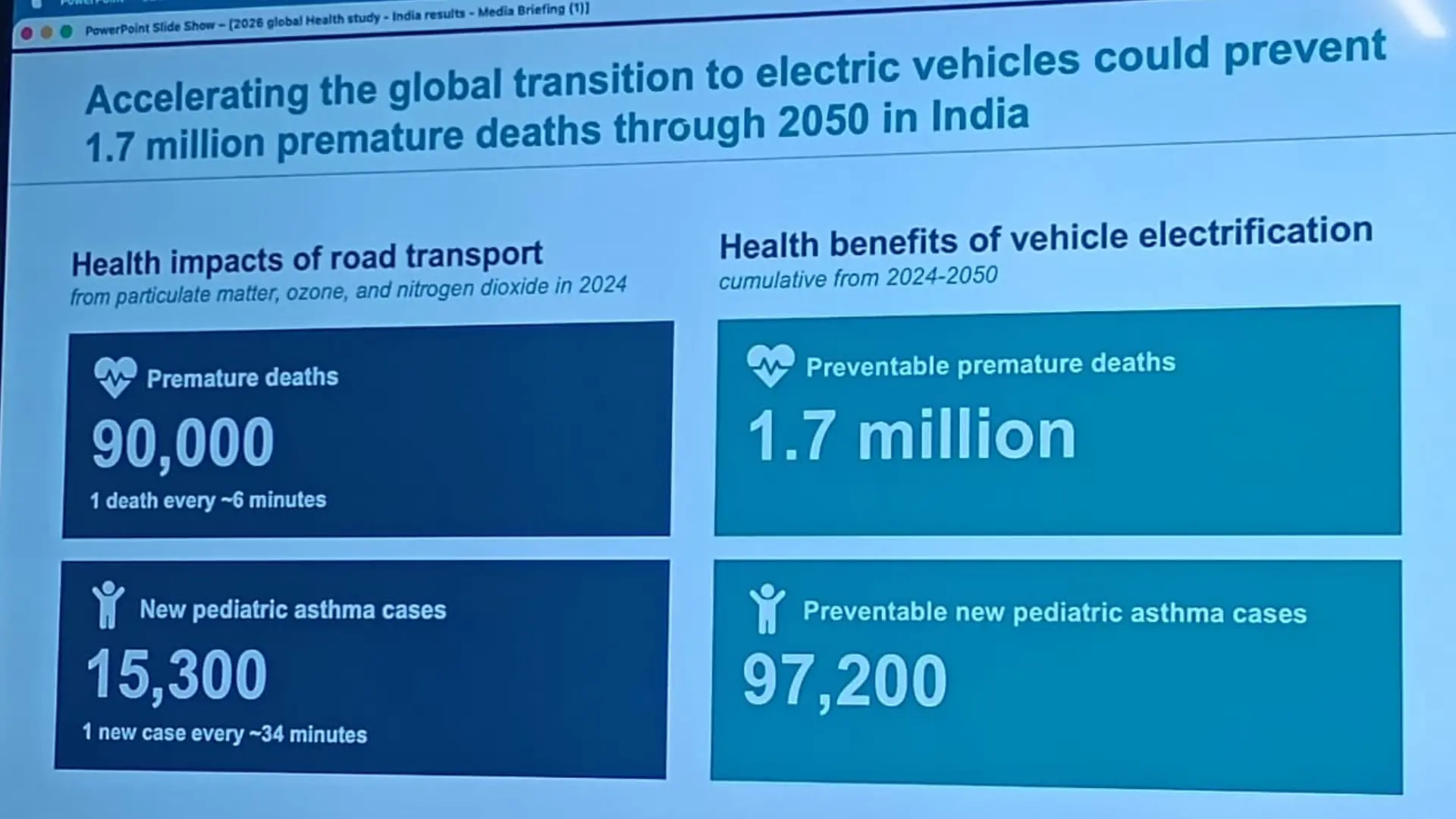
In 2024, road transport pollution was responsible for an estimated 90,000 premature deaths and 15,300 new pediatric asthma cases in India, equivalent to one premature death every 6 minutes and one new childhood asthma case every 34 minutes. India ranks second globally for road transport-attributable premature deaths in 2024, behind only China (171,800).
India, NCR, and Delhi NCT: Where the Burden Concentrates
The report breaks down 2024 health impacts by region, showing that pollution burden is not distributed in proportion to population. The National Capital Region carries a disproportionate share of new pediatric asthma cases in particular, nearly a quarter of India's total from just 5% of its population.
| Region | Population | Premature Deaths (2024) | New Pediatric Asthma Cases (2024) |
|---|---|---|---|
| India | 1.47 billion | 90,000 | 15,300 |
| NCR | 71 million (5% of India) | 8,100 (9% of India total) | 3,500 (23% of India total) |
| Delhi NCT | 21 million (1.2% of India) | 2,800 (3% of India total) | 1,500 (10% of India total) |
The report attributes this concentration to traffic density and NO2 exposure: in the most heavily trafficked parts of the NCR, road transport emissions alone exceed the WHO's annual NO2 guideline of 10 µg/m³ for all sources combined, meaning vehicles alone push past a limit meant to cover every pollution source in the region.
The Core Finding: What Vehicle Electrification Could Prevent
This is the central result of the report, and the one ICCT's presenters returned to repeatedly at the briefing. The study models two main pathways: a Baseline 2025 scenario (current adopted policies, no further action) and an Ambitious scenario, which assumes 100% zero-emission vehicle (ZEV) sales across all vehicle types globally by 2045, with an earlier 2040 deadline for light-duty vehicles worldwide, and 2035 for light-duty vehicles specifically in 11 advanced markets (the EU, UK, US, China, Canada, and others, India is not among this earlier-deadline group).
Under Baseline 2025, India's road transport-attributable premature deaths are projected to keep rising through 2050, driven by vehicle activity growth and an aging population. Under the Ambitious scenario, that trend reverses sharply:
| Metric | India (Ambitious scenario, by 2050 vs. 2024) | Global (Ambitious scenario, by 2050 vs. 2024) |
|---|---|---|
| Reduction in annual premature deaths | 55% | 63% |
| Reduction in new pediatric asthma cases | 85% | 80% |
| Cumulative avoided premature deaths (2024–2050) | 1.7 million - highest of any country modeled | 8.8 million |
| Cumulative avoided new pediatric asthma cases (2024–2050) | 97,200 - ranks 6th globally | 1.7 million |
Two figures stand out from an electrification-policy standpoint. First, India accounts for more avoidable premature deaths through 2050 than any other country in the model, a position ICCT's researcher Moorthy Nair emphasized directly, noting that hitting the 2045 100%-ZEV-sales threshold is not a stretch case in the model but the precondition for these gains materializing at all. Second, the reduction in India's pediatric asthma cases (85%) is projected to outpace the global average (80%), a divergence the report links to India's relatively young population and its correspondingly larger pool of children exposed to NO2 from traffic.
Heavy-Duty Vehicles: A Disproportionate Pollution Source
The fact sheet flags heavy-duty vehicles (HDVs) - trucks and buses, as a disproportionate contributor to India's tailpipe pollution relative to their share of the vehicle fleet, a pattern more pronounced in India than the global average.
| India (2024) | Global (2024) | |
|---|---|---|
| Share of tailpipe NOx emissions | 79% | 60% |
| Share of tailpipe PM2.5 emissions | 64% | 55% |
HDVs make up a small fraction of India's on-road fleet by vehicle count, which makes this gap significant for electrification planning: a comparatively small number of vehicles is responsible for a majority of tailpipe NOx and a majority of tailpipe PM2.5. Asked directly what the biggest barriers are to transitioning India's heavy-duty fleet to zero-emission technology, ICCT's team said this specific question has not yet been the subject of dedicated research in this report, the current study's ambition is calibrated around the aggregate 2045 100%-ZEV-sales target rather than a vehicle-category-by-category roadmap. HDV decarbonization, with its distinct payload, range, and charging-infrastructure requirements, remains a gap the researchers acknowledged directly rather than speculated on.
Data Sources and Methodology
Asked about the provenance of India-specific vehicle data, Nair confirmed that fleet and registration figures were drawn primarily from Vahan, India's national vehicle registration database, supplemented with historical sales data from third-party industry sources. This feeds into ICCT's Roadmap model (v2.18), which for this report incorporated real-world, on-road emission factors from the TRUE Initiative, a partnership between the FIA Foundation and ICCT using roadside remote-sensing and mobile plume-chasing measurements, rather than relying solely on laboratory type-approval limits. TRUE's India-specific measurement work includes a 2024 study of real-world exhaust emissions in Delhi and Gurugram. The NO2-attributable mortality pathway, newly added in this report using updated 2021 Global Burden of Disease methodology, is by contrast invisible, shorter-lived in the atmosphere, and concentrated hyperlocally around traffic corridors, a harder pollutant to build public urgency around, even though globally the report attributes 37% of road transport's total premature-death toll to NO2 specifically (a global, not India-specific, figure).
No Single Policy Lever: China's Manufacturing Push vs. Europe's Infrastructure Bet
Asked which policy intervention would deliver the biggest health benefit over the next decade - faster EV adoption, stricter emission norms, or faster retirement of older diesel vehicles, Amit Bhatt, ICCT's Managing Director for India, declined to name a single lever. Instead, he contrasted how China and Europe each built their EV transitions differently: China's approach centered on industrial policy, building domestic manufacturing capacity and supply chains ahead of adoption; Europe's centered more on infrastructure investment, charging networks and grid readiness, as the precondition for adoption.
Bhatt did not prescribe a single model for India to follow, but he did not leave the question entirely open either. He pointed to Delhi's EV policy as a domestic example already in motion, and, when asked, agreed that a number of other states, including Meghalaya, Haryana, Kerala, and Uttar Pradesh, have introduced their own EV subsidy programs in the recent past. Read alongside the China/Europe contrast, this suggests Bhatt sees India's transition less as a single national industrial-policy or infrastructure-policy choice and more as a patchwork of state-level experiments running in parallel, with Delhi's policy serving as the most visible reference point of that patchwork rather than a template being centrally rolled out.
Beyond what Bhatt said directly, the China/Europe contrast is also a useful lens for thinking through India's own market structure. India's fleet is dominated by two- and three-wheelers rather than passenger cars, a segment where domestic manufacturing capacity is already comparatively mature, closer to China's starting conditions than Europe's. Charging infrastructure buildout for four-wheelers and HDVs, on the other hand, remains far behind both China's and Europe's current stage, closer to the kind of constraint Europe's infrastructure-led policy was designed to address. On that reading, India's transition may end up drawing on pieces of both approaches, leaning on existing two-wheeler manufacturing strength while still needing an infrastructure-led push for larger vehicle categories, on top of the state-by-state subsidy activity Bhatt described, rather than following either country's template wholesale.
Reframing Electrification as Public Health Policy
The most pointed exchange of the briefing came when Bhatt was asked what message he'd give policymakers who still treat EV adoption primarily as a climate initiative rather than a public health intervention. He pointed to Delhi's EV policy as already aligned with national health messaging, framing it as a public health intervention in its own right rather than solely a climate or emissions exercise.
Asked whether India's EV transition, and this kind of health-outcome research, represents a late start relative to other major economies, Bhatt's response was direct: "At least we started." He called for closer collaboration between national health targets and state-level EV policy design, pointing to Delhi's policy stance as a model for tying electrification explicitly to public health outcomes.
What This Means for India's Electrification Trajectory
The report's central message, is that the health case for vehicle electrification in India is now backed by numbers on the same order of magnitude as the climate case, and arguably larger, given India's #1 global ranking for avoidable premature deaths. But the 55%/85% reduction figures and the 1.7-million-death, 97,200-case avoided totals are conditional on hitting the Ambitious scenario's 100%-ZEV-sales-by-2045 target. Under the Baseline 2025 path, continuation of currently adopted policy with no further acceleration, those gains do not materialize, and premature deaths from road transport pollution instead continue to climb through 2050.
It's worth noting how ICCT is structured. ICCT describes itself as an independent, nonprofit research organization founded to provide objective technical analysis to environmental regulators, funded primarily by philanthropic foundations, with additional support from government contracts and international bodies, rather than from vehicle manufacturers or industry groups. ICCT's own stated mission is explicitly oriented toward improving the environmental performance of transportation to benefit public health and mitigate climate change, and readers weighing the "Ambitious scenario" figures against "Baseline 2025" should know they're seeing the outer bound of the case for acceleration, from a research body whose institutional purpose is to make exactly that case.
The gaps acknowledged during the briefing are as informative as the topline figures: no dedicated HDV-transition research yet, no single confirmed policy lever, and an explicit acknowledgment that India's electrification push, while underway, started later than some peers.
To comment and participate in discussion Click Here
Recent Articles
Trending Articles
Kerala Makes EVs More Affordable: Revised Road Tax Structure to Accelerate Adoption

India Car Sales by Fuel Type — March 2026: EV Share Hits New High, CNG Surges, Petrol Loses Ground
No Fire Safety Certificate Will Be Declined Over EV Chargers, Says Haryana Fire Department
Haryana Releases Draft Fire Safety Guidelines for EV Charging