
The 15-Year EV Battery Warranty Explained: What Indian Electric Car Buyers Actually Get
A fact-checked guide to Indian EV battery warranties, explaining 8–15-year coverage, ownership eligibility, battery-health thresholds and the fine print.


Category:
Tag:
- Electric Vehicles
- EV Battery
- Battery Warranty
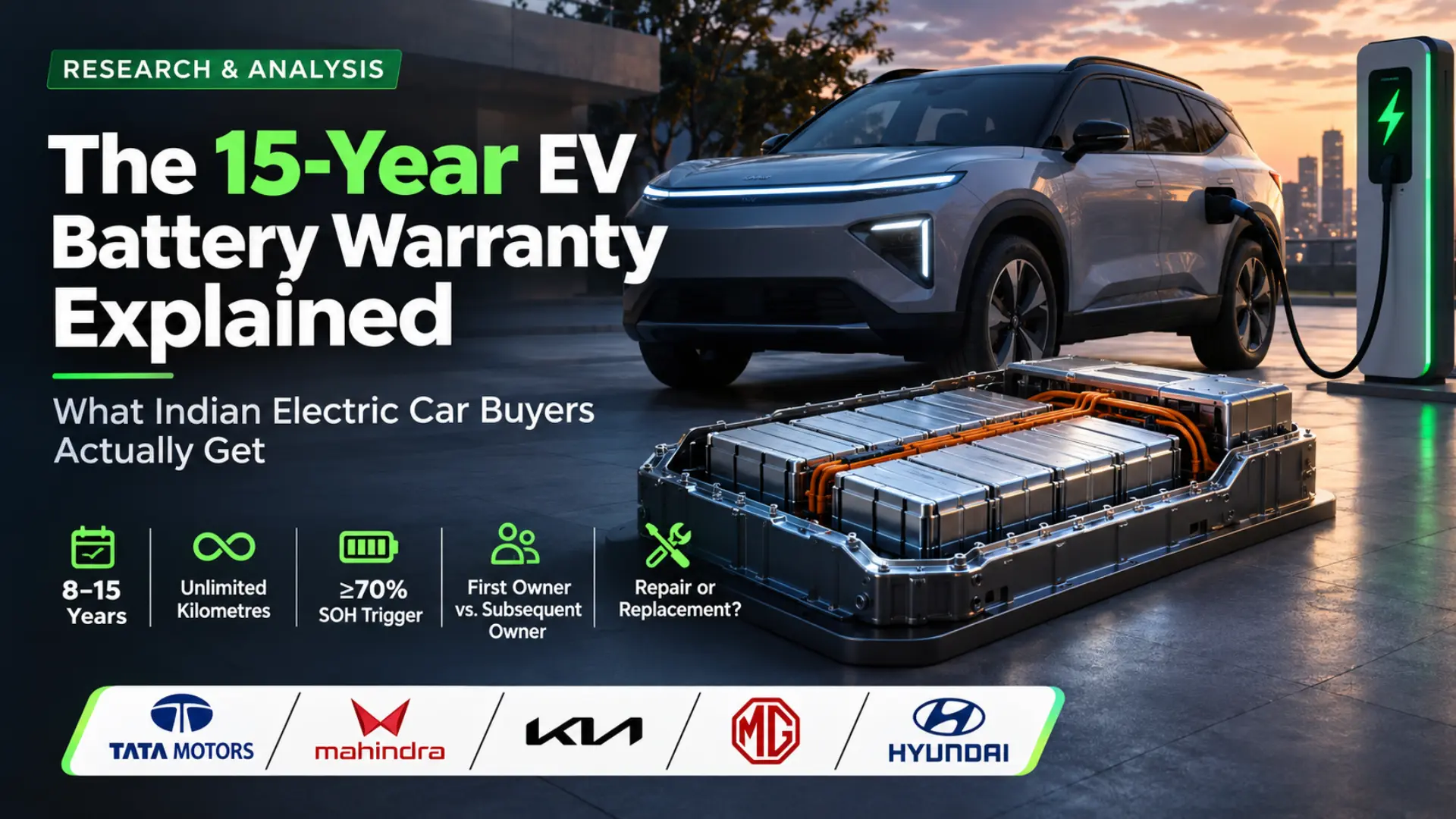
India's electric carmakers are offering battery warranties of up to 15 years, but the actual coverage varies significantly between manufacturers. Some programmes are restricted to first owners, while others have specific kilometre limits, battery-health thresholds and ownership-transfer conditions.
We compare the battery warranty policies of Tata Motors, Mahindra, Kia, JSW MG Motor and Hyundai to explain what buyers actually get.
Why EV battery warranties matter
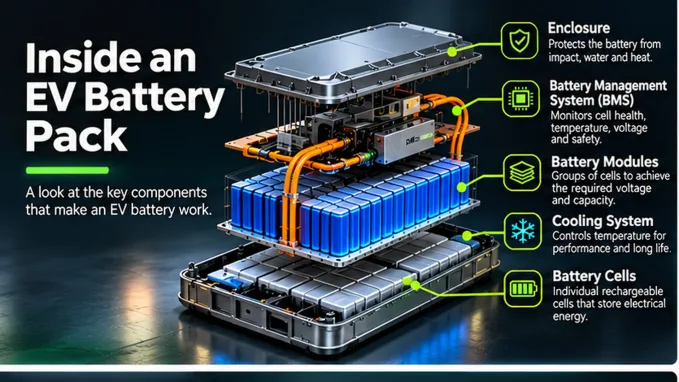
Unlike a conventional internal combustion engine, an electric vehicle's battery pack is an integrated high-voltage energy storage system.
It consists of multiple battery cells, modules, electronic monitoring systems, cooling components and protective structures.
Over time, the battery gradually loses some of its original energy-storage capacity. This process is known as battery degradation.
The rate of degradation depends on several factors:
- Battery chemistry and cell design.
- Operating temperatures and thermal management.
- Charging and discharging patterns.
- Time spent at very high or very low states of charge.
- Number of charge cycles.
- Overall vehicle usage and maintenance.
Battery degradation is a normal characteristic of lithium-ion technology. It does not automatically indicate a manufacturing defect.
However, excessive capacity loss or a qualifying battery-system failure can affect the vehicle's usability and potentially result in expensive repairs.
A battery warranty establishes the conditions under which the manufacturer is responsible for addressing qualifying defects or excessive capacity degradation.
It is important to distinguish between two types of protection:
Battery component warranty: Covers qualifying defects in materials, workmanship and specified battery components.
Battery capacity warranty: Provides protection when the battery's remaining capacity falls below a specified threshold during the warranty period.
Not every manufacturer's published warranty summary explains these two aspects in the same level of detail. Buyers should therefore examine the complete model-specific warranty document.
Eight years versus 15 years: What has changed?
An eight-year battery warranty has traditionally been a familiar benchmark for electric passenger vehicles in India.
However, selected manufacturers have now extended coverage to 15 years or introduced programmes described as lifetime warranties.
The difference is not simply the number of additional years.
A buyer must also consider:
- Whether extended coverage is restricted to the first registered owner.
- Whether unlimited kilometres apply.
- Whether the warranty transfers to subsequent owners.
- Whether commercial and fleet vehicles qualify.
- What battery degradation threshold triggers a claim.
- Whether the manufacturer repairs individual components or replaces the complete battery pack.
A 15-year warranty restricted to the first private owner may provide excellent protection to someone intending to retain the car for a decade.
However, someone purchasing the same vehicle second-hand may receive significantly shorter coverage.
Similarly, unlimited-kilometre coverage does not automatically mean that commercial or taxi usage is permitted.
The eligibility conditions are just as important as the duration.
What Indian manufacturers actually offer
Several manufacturers operating in India have introduced extended battery warranty programmes for selected electric passenger vehicles.
The following comparison uses the manufacturers' published warranty information available as of 8 November 2026.
| Manufacturer | Selected electric models | First-owner battery coverage | Subsequent-owner coverage |
|---|---|---|---|
| Tata Motors | Sierra.ev, Harrier.ev | 15 years / unlimited km | 10 years / 2 lakh km |
| Tata Motors | Curvv.ev, Nexon.ev 45, Punch.ev 40, Tiago.ev 24 | 15 years / unlimited km | 8 years / 1.6 lakh km |
| Mahindra | BE 6, XEV 9e, XEV 9S | Lifetime for first registered private owner | 10 years / 2 lakh km |
| Kia | Carens Clavis EV, Syros EV | 15 years / unlimited km for eligible first purchasers | 8 years / 1.6 lakh km |
| JSW MG Motor | Windsor EV | Lifetime for eligible first owner | 8 years / 1.6 lakh km |
| Hyundai | Creta Electric | 8 years / 1.6 lakh km | Subject to the applicable warranty terms |
This is a selected-model comparison, not a claim that every model from each manufacturer receives identical coverage. Eligibility, registration date, private or commercial usage and ownership-transfer conditions apply.
Tata Motors: A 15-year warranty across selected EVs
Tata Motors has made its lifetime high-voltage battery warranty an important part of its electric vehicle ownership proposition.
Its current published policy covers the following models:
- Sierra.ev
- Harrier.ev
- Curvv.ev
- Nexon.ev 45 kWh
- Punch.ev 40 kWh
- Tiago.ev 24 kWh
The manufacturer defines lifetime as 15 years from the vehicle's first registration with the regional transport office.
For eligible first private owners, the programme provides unlimited-kilometre coverage.
However, coverage changes when the vehicle is transferred to another owner.
| Model | First owner | Second or subsequent owner |
|---|---|---|
| Sierra.ev | 15 years / unlimited km | 10 years / 2 lakh km |
| Harrier.ev | 15 years / unlimited km | 10 years / 2 lakh km |
| Curvv.ev | 15 years / unlimited km | 8 years / 1.6 lakh km |
| Nexon.ev 45 | 15 years / unlimited km | 8 years / 1.6 lakh km |
| Punch.ev 40 | 15 years / unlimited km | 8 years / 1.6 lakh km |
| Tiago.ev 24 | 15 years / unlimited km | 8 years / 1.6 lakh km |
There is another important condition: subsequent owners must notify Tata Passenger Electric Mobility Limited about the ownership transfer for the applicable warranty to remain valid.
The lifetime programme is intended for eligible private registrations. Vehicles used for commercial operations, fleet management, taxi services, demonstrations and other excluded purposes receive the specified alternative warranty coverage.
This makes Tata's programme particularly relevant to private buyers intending to retain their electric vehicles for an extended period.
Mahindra: Lifetime coverage for first registered private owners
Mahindra has also introduced lifetime high-voltage battery warranty coverage across its electric SUV range.
The manufacturer's current FAQ confirms lifetime coverage for the first registered private owner.
In the event of an ownership change, battery coverage becomes 10 years or 2,00,000 km, whichever occurs earlier, calculated from the first delivery of the vehicle.
This applies to its electric SUV portfolio, including the BE 6, XEV 9e and XEV 9S.
However, Mahindra's published BE 6 warranty guide provides an additional technical detail: battery repair or replacement is governed by minimum State of Health restoration levels.
The guide specifies the following:
| Vehicle age / distance | Minimum battery SOH after repair or replacement |
|---|---|
| Up to 3 years or 60,000 km, whichever occurs first | 85% |
| From 3 years / 60,000 km up to 7 years / 1,40,000 km | 75% |
| From 7 years / 1,40,000 km onwards, subject to the applicable warranty limit | 70% |
The guide also specifies a minimum 70% usable-energy SOH requirement for battery warranty coverage.
An important distinction is that Mahindra does not promise that every qualifying repair will restore the battery to its original factory-new condition.
Instead, its published guide defines minimum capacity levels that the repaired or replacement battery must achieve.
These technical conditions should be checked against the latest warranty booklet supplied with the particular model.
Kia: Extended battery coverage for selected electric models
Kia India has also introduced a 15-year battery capacity warranty for selected electric vehicles.
Its official EV warranty policy identifies the Carens Clavis EV and Syros EV under this programme.
For eligible first purchasers, the high-voltage battery capacity warranty provides 15 years of unlimited-kilometre coverage.
However, this is not a universal 15-year warranty for every Kia electric vehicle.
For the Carens Clavis EV, the extended programme applies to vehicles retailed from 1 August 2026 onwards.
The policy also identifies an important battery-health condition: coverage applies when capacity falls below 70% of the original high-voltage battery capacity.
For subsequent purchasers and vehicles used commercially, the applicable capacity warranty is eight years or 1,60,000 km, whichever occurs first, calculated from delivery to the first purchaser.
This makes ownership eligibility particularly important when purchasing a used Carens Clavis EV.
JSW MG Motor: Understanding the Windsor EV lifetime warranty
JSW MG Motor India offers a lifetime high-voltage battery warranty for the Windsor EV under its e-Shield programme.
However, the official warranty document uses a specific definition of lifetime.
For an eligible first owner with a personal registration, coverage continues until the validity period of the vehicle's first registration certificate.
In the event of an ownership change, battery coverage becomes eight years or 1,60,000 km, whichever occurs earlier, calculated from the original delivery date.
Commercially registered vehicles receive eight years or 1,00,000 km of battery coverage.
This means that the lifetime programme is not an unconditional promise of unlimited coverage for every Windsor EV owner.
The registration category and ownership history determine the applicable warranty.
Hyundai: The conventional eight-year benchmark
Hyundai's Creta Electric offers an eight-year or 1,60,000-km high-voltage battery warranty.
Unlike some of the extended programmes introduced by competitors, Hyundai's published Creta Electric warranty remains within the conventional eight-year coverage category.
This does not automatically make the warranty inferior.
The actual value of battery coverage also depends on the manufacturer's repair support, warranty conditions, service network and the terms applicable to the vehicle.
For buyers comparing the Creta Electric with models offering extended coverage, the eight-year period should be considered alongside the vehicle's overall ownership proposition.
What does 70% State of Health actually mean?
One of the most important technical terms in EV battery warranties is State of Health, commonly abbreviated as SOH.
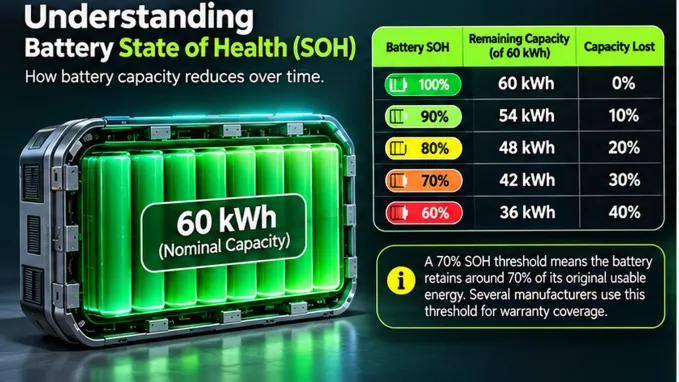
SOH indicates the battery's remaining capacity relative to its original reference capacity.
A battery with 100% SOH is at its original reference capacity. As the battery ages, this percentage gradually decreases.
Consider an illustrative electric car with a nominal 60 kWh battery pack.
| Battery SOH | Remaining nominal capacity | Capacity lost |
|---|---|---|
| 100% | 60 kWh | 0% |
| 90% | 54 kWh | 10% |
| 80% | 48 kWh | 20% |
| 70% | 42 kWh | 30% |
| 60% | 36 kWh | 40% |
For example, if the battery reaches 70% SOH, it retains approximately 42 kWh of its original 60 kWh nominal capacity.
However, this is an illustrative capacity calculation, not a direct driving-range prediction.
Actual usable energy, battery-management buffers, operating conditions, temperature and driving efficiency influence the range available to the driver.
Why is the 70% threshold important?
A 70% SOH threshold appears in several Indian manufacturers' published battery capacity warranty provisions.
For Tata Motors, the policy states that if the high-voltage battery falls below 70% of its nominal-energy SOH during the warranty period, the manufacturer will repair or replace it to achieve the specified capacity restoration level.
The stated restoration target is the steady-state SOH before the repair or replacement, or 80% SOH, whichever is higher.
Kia's Carens Clavis EV and Syros EV policy also specifies coverage for capacity loss below 70% of the original high-voltage battery capacity.
Mahindra's BE 6 warranty guide specifies its own minimum usable-energy SOH and restoration conditions.
It is important not to assume that every EV manufacturer uses an identical measurement procedure or warranty threshold.
The exact definition of SOH, measurement conditions and remedy must be taken from the vehicle-specific warranty document.
Does an EV battery warranty guarantee complete battery replacement?
In one word, No.
This is one of the most common misunderstandings surrounding electric vehicle warranties.
A battery pack is made up of multiple components, including:
- Individual battery cells.
- Battery modules.
- Battery Management System (BMS).
- Thermal management and cooling systems.
- High-voltage wiring and connectors.
- Battery enclosure and protective structures.
If a fault develops in an individual module or component, the manufacturer may choose to repair or replace that component rather than replace the entire battery pack.
Similarly, when excessive capacity degradation is established, the manufacturer's obligation may be to restore the battery to a specified minimum capacity rather than return it to 100% of its original capacity.
Tata's policy, for example, expressly allows the manufacturer to decide whether the battery pack or cells should be repaired or replaced.
Mahindra's BE 6 guide also clarifies that a warranty replacement may not restore the vehicle to a like-new condition.
For buyers, this means the repair or replacement policy is just as important as the advertised warranty duration.
What can void an EV battery warranty?
Extended battery coverage is not unconditional.
Manufacturers specify operating, maintenance and ownership requirements that customers must follow.
Some circumstances that can affect coverage, depending on the manufacturer's policy, include:
- Unauthorised opening, repair or modification of the battery pack.
- Physical damage to battery modules.
- Tampering with battery components.
- Failure to follow prescribed service requirements.
- Certain over-discharge conditions.
- Commercial or fleet usage where the extended programme is restricted to private owners.
- Damage resulting from accidents, flooding or external impact.
Mahindra's published BE 6 warranty guide specifically identifies unauthorised battery repairs, physical damage or tampering, missed battery service requirements and certain over-discharge situations as grounds that can invalidate battery coverage.
Tata's published policy separately excludes several non-private vehicle registrations from its lifetime programme.
It is important to understand that exclusions vary between manufacturers. A condition mentioned in one manufacturer's warranty should not automatically be assumed to apply identically to another brand.
Do longer battery warranties improve EV resale value?
Battery warranty coverage can influence the resale appeal of an electric vehicle.
Unlike conventional cars, where prospective buyers may focus on engine condition and maintenance history, an EV's battery health is a particularly important consideration.
A used electric vehicle with a healthy battery and transferable warranty coverage may provide greater confidence than an otherwise similar vehicle with little remaining coverage.
However, a longer first-owner warranty does not necessarily translate into equivalent protection for the second owner.
For example:
- Tata reduces the coverage period for subsequent owners on selected models.
- Mahindra offers 10 years or 2 lakh km following ownership change.
- Kia's 15-year capacity warranty is restricted to eligible first purchasers.
- MG Windsor EV's subsequent-owner coverage becomes eight years or 1.6 lakh km.
Therefore, prospective used-EV buyers should verify the original registration date, remaining coverage, battery SOH and ownership-transfer conditions.
A longer warranty may support buyer confidence, but it does not guarantee a higher resale price.
What should buyers check before purchasing an electric car?
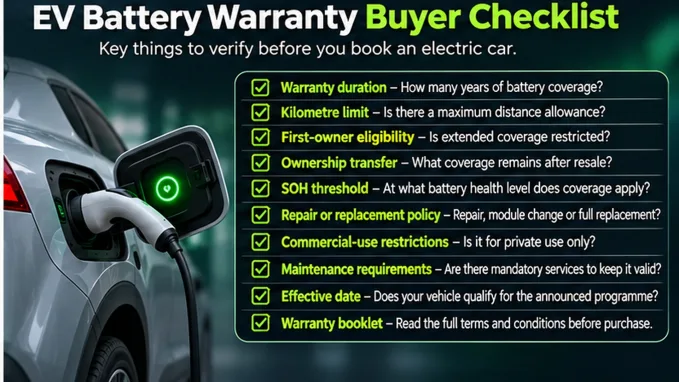
Before booking an electric vehicle, buyers should examine the actual warranty document rather than relying entirely on the manufacturer's promotional material.
EV battery warranty buying checklist
| What to check | Why it matters |
|---|---|
| Warranty duration | Establishes how long battery coverage remains active |
| Kilometre limit | Determines whether there is a maximum distance allowance |
| First-owner eligibility | Identifies whether extended coverage is restricted |
| Ownership transfer | Determines how much protection remains after resale |
| SOH threshold | Establishes the battery degradation trigger, where specified |
| Repair or replacement policy | Clarifies what the manufacturer must provide |
| Commercial-use restrictions | Important for taxi, fleet and business buyers |
| Maintenance requirements | Helps avoid preventable warranty disputes |
| Effective date | Determines whether the vehicle qualifies for the programme |
| Warranty booklet | Contains the complete legal terms and conditions |
Buyers should also request written clarification from the dealership if a particular warranty condition is unclear.
For used EVs, an authorised battery-health assessment and confirmation of remaining warranty coverage are especially important.
Conclusion: Is a 15-year EV battery warranty worth it?
A longer battery warranty can make EV ownership more reassuring, but the actual coverage matters more than the advertised duration.
Buyers should consider ownership eligibility, resale transferability, battery-health thresholds and repair or replacement conditions.
Ultimately, the best warranty is the one that offers meaningful protection for as long as you own the vehicle.
Trending Articles

Recent Articles
VIDA VX2 and Ather Grid: Which Chargers Work, and Why Charging Stops at 80%
MG’s October 2026 Retail Sales: Tomahawk Falls Short of Expectations
Mahindra EV Registrations Rise 86.5% YoY in October 2026; XEV 9S Leads, BE6 Rebounds
Kerala Commission Awards ₹44,000 Over Electric Scooter Repair Delay: What Owners Should Know