Your EV Says There's a Charger Nearby. But Will It Actually Work?
India's public EV charging network is growing, but owners still face broken chargers, unreliable availability information, payment problems and unexpected delays.


Category:
Tag:
- EV Charging
- Electric Vehicles India
- Public EV Charging
Finding a public EV charging station is easier than it used to be. But finding one that works when you arrive is another matter.
Across India, EV owners have reported arriving at stations that are closed, occupied or unable to start a charging session. Others struggle with multiple charging applications, unexpected charging speeds and limited access to home charging.
As India's charging network expands, the question is no longer just how many chargers are being installed. It is whether drivers can depend on them.
The charger is on the map. But does it work?
One of the biggest frustrations for EV owners is the difference between what charging applications display and what they encounter at the actual location.
A station might appear available on an app but turn out to be closed, occupied or temporarily out of service. For someone travelling on a highway, an unsuccessful charging stop can mean losing valuable time and searching for another station with limited battery remaining.
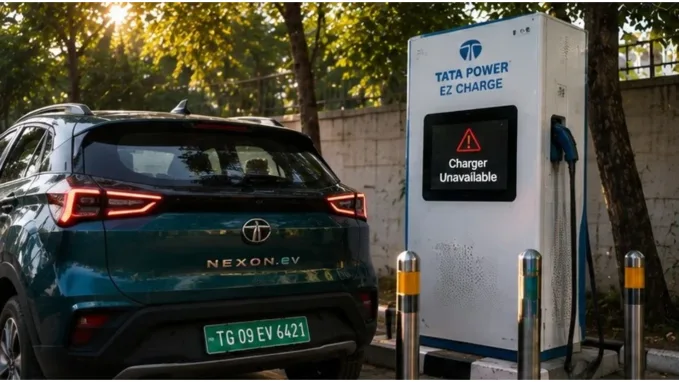
A Tata Curvv EV owner's Hyderabad–Bengaluru experience
On 15 February 2026, Reddit user u/Tharkula shared their experience driving a Tata Curvv EV 55 kWh from Hyderabad to Bengaluru.
During the overnight journey, the owner reported finding multiple charging locations closed, despite appearing on maps. After several unsuccessful attempts to find an operational charger, the vehicle reached 7% battery.
The driver contacted Tata Roadside Assistance and was eventually towed approximately 40 km to an operational charging station in Penukonda.
The return journey was reportedly smoother after the owner planned the charging stops more carefully.
Source: u/Tharkula, “TRAVELED HYD TO BLR BY ROAD IN TATA CURV EV (55KWH)”, r/CarsIndia, 15 February 2026.
Another example came from an MG Windsor EV owner travelling between Delhi and Moradabad. In a Reddit post on 23 February 2026, u/sj_reddit_user described encountering occupied connectors, application errors and power outages before eventually finding a working charger at a dhaba.
Source: u/sj_reddit_user, “My first experience of Highway charging”, r/EVIndia, 23 February 2026.
These are individual experiences, not evidence that every public charging station is unreliable. However, they illustrate why accurate, real-time availability information and faster maintenance are essential.
Too many apps, too many wallets
India's public charging network includes several operators, such as Tata Power, ChargeZone, Statiq, Jio-bp and Zeon. While having multiple networks gives drivers more options, accessing them can involve a frustrating number of applications and payment systems.
Different operators may require separate accounts, applications and prepaid wallet balances. Drivers can end up managing several apps just to complete a single road trip.
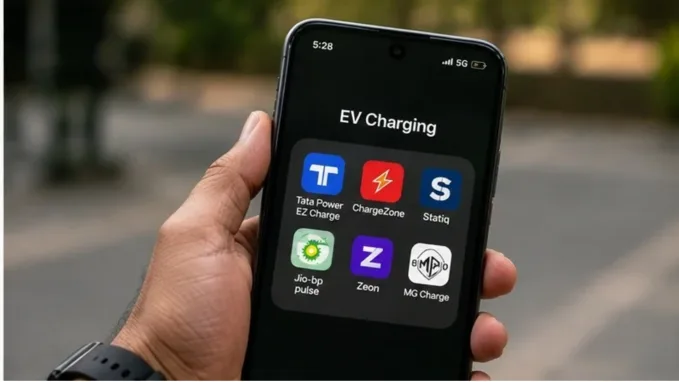
One owner's experience: 112 charging applications
In an article published by The Core on 16 January 2024, journalist Jessica Jani interviewed Bengaluru-based EV owner Chintan, who owned a Tata Nexon EV and a TVS iQube.
Chintan revealed that he had accumulated 112 charging applications over approximately three years, although he regularly used around 20–25.
He also highlighted the inconvenience of maintaining separate prepaid balances across different charging networks and the difficulty of recovering unused money.
Source: Jessica Jani, “Indian EV Owners Are Forced To Download Hundreds Of Apps: Here's Why”, The Core, 16 January 2024. Interviewee: Chintan.
A more integrated charging experience could make a significant difference. Drivers should ideally be able to locate chargers, check availability, start sessions and make payments across different networks without constantly switching applications.
Why your EV might not receive the advertised charging speed
A public charger rated at 120 kW does not necessarily deliver 120 kW to every electric vehicle connected to it.
One important factor is the current rating of the charging connector, measured in amperes (A). The voltage of the vehicle's battery system also influences the maximum power it can receive.
The basic relationship is:
Power (kW) = Voltage (V) × Current (A) ÷ 1,000
Consider a simplified example:
- Charger advertised output: 120 kW
- Connector maximum current: 200 A
- Vehicle battery voltage: 400 V
The maximum power under these conditions would be:
400 × 200 ÷ 1,000 = 80 kW
In other words, even though the charger is advertised as 120 kW, a 400 V vehicle drawing a maximum of 200 A through that connector would receive approximately 80 kW.
Actual charging power can be lower depending on the vehicle's charging limits, battery temperature, state of charge and other operating conditions.
This means that a difference between advertised and received charging power does not automatically indicate a faulty charger. The charger and vehicle need to be compatible to achieve the advertised output.
What charging applications should do differently
Charging applications should provide more transparent, vehicle-specific information before a driver starts a session.
Ideally, an application should show the expected charging power for the selected vehicle at a particular connector, taking its voltage and current limitations into account.
This would help drivers estimate charging times more realistically and choose suitable charging stations instead of relying solely on the maximum kW rating displayed on a charger.
More chargers are only part of the solution
India's public charging network has expanded considerably. A September 2026 report by the Institute for Energy Economics and Financial Analysis (IEEFA) reported 52,718 public charging stations by July 2026, compared with 5,151 in 2022.
However, the report also highlighted challenges involving reliability, interoperability, charging costs and residential access.
Source: IEEFA, “Improving the EV Charging Experience in India: Beyond Charger Deployment”, September 2026.
The experiences shared by EV owners show that infrastructure growth needs to be accompanied by better maintenance, accurate availability information, simpler payments and more transparent charging specifications.
Conclusion: Reliability matters as much as availability
India has made significant progress in expanding its EV charging network, but the ownership experience still depends on more than the number of chargers installed.
Drivers need stations that work when they arrive, applications that simplify payments and provide realistic charging-speed estimates, and access to convenient charging at home.
The next step for India's charging ecosystem should not simply be installing more chargers. It should be making the existing network more dependable and easier to use.
Because the true measure of a charging network isn't how many stations appear on a map. It's how confidently drivers can depend on them.
Trending Articles
Electric Scooter Battery Warranties Compared: What Do Ather, TVS, Bajaj and VIDA Actually Cover?
Top 4 Best Selling EVs in October 2026: Punch EV Leads Again
VIDA VX2 and Ather Grid: Which Chargers Work, and Why Charging Stops at 80%
JSW MG Motor Hikes MG Hector Tomahawk EV Prices by ₹75,000 Just Months After Launch