
Olectra Becomes First to Deploy 4,000 Electric Buses
Olectra Greentech has crossed the 4,000 electric bus deployment mark, becoming the first manufacturer in India to achieve the milestone. The achievement comes as competition in India's electric bus market intensifies amid new government tenders and expanding industry capacity.


Category:
Tag:
- Olectra Greentech
Olectra Greentech has become the first manufacturer in India to deploy more than 4,000 electric buses. The milestone comes as India's electric bus market becomes increasingly competitive, with newer manufacturers gaining ground in government procurement.
Olectra Greentech has become the first electric bus manufacturer in India to deploy more than 4,000 electric buses, reaching a milestone that highlights the scale of its deployment as India's public transport electrification gathers pace.
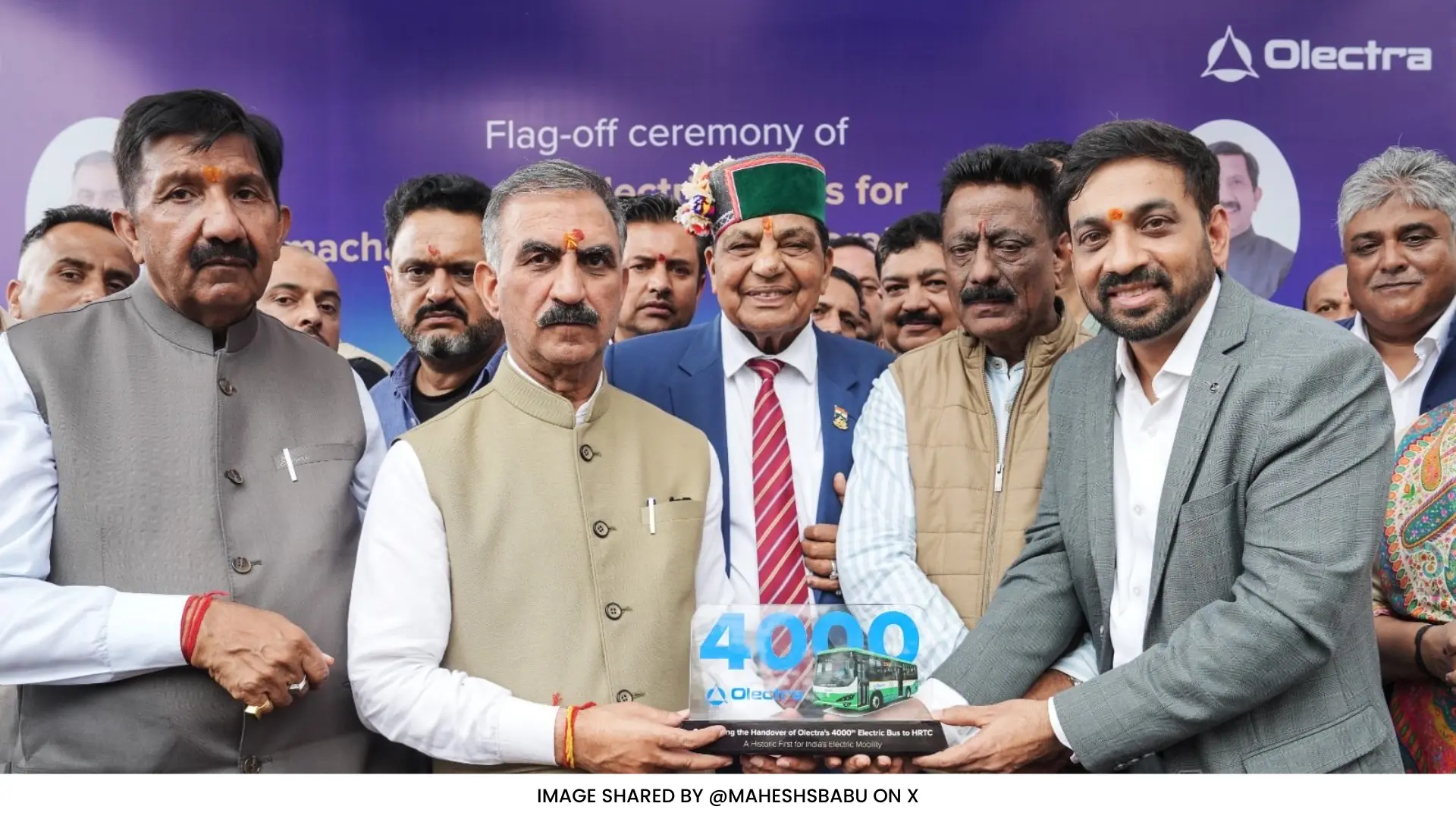
According to the company, its fleet has collectively travelled more than 730 million kilometres, avoiding over 6.5 lakh tonnes of carbon dioxide emissions. The 4,000th bus was delivered to the Government of Himachal Pradesh, along with 297 additional electric buses for the Himachal Road Transport Corporation (HRTC).
Calling the achievement "a defining milestone for India's electric mobility industry", Managing Director Mahesh Babu said the deployment reflects growing confidence in zero-emission public transport across India.
Key Numbers
| Metric | Figure |
|---|---|
| Electric buses deployed | 4,000+ (first in India) |
| Fleet distance covered* | 730+ million km |
| CO₂ emissions avoided* | 6.5+ lakh tonnes |
| Current executable order book | 8,500+ vehicles |
| Q3 FY26 revenue | ₹663.6 crore (+29% YoY) |
| Headquarters | Hyderabad, Telangana |
*Distance travelled and CO₂ savings are based on company estimates.
Why the Milestone Matters
Crossing the 4,000-bus mark is significant because it reflects buses that have been deployed and are operating on Indian roads, rather than announced manufacturing capacity, order wins or tender allocations.
That distinction matters. Manufacturers frequently announce large order books, but converting those orders into buses that operate reliably over several years requires sustained manufacturing capability, service support and operational execution. By that measure, Olectra has deployed more electric buses on Indian roads than any other manufacturer in India to date.
Competition Is Intensifying
While Olectra remains India's largest cumulative electric bus deployer, the competitive landscape has shifted rapidly over the past two years.
VAHAN registration trends and recent government procurements indicate that manufacturers such as Switch Mobility, PMI Electro Mobility and JBM Auto have strengthened their presence in the market, reflecting a far more competitive environment than when Olectra established its early lead.
The trend highlights an important distinction. A manufacturer can remain the country's largest fleet operator because of years of steady deployments while competitors capture a greater share of new registrations and government contracts. Olectra's 4,000-bus milestone reflects sustained execution over time, but future leadership will increasingly depend on success in upcoming tenders and large-scale deployments.
Government Procurement Is Reshaping the Market
The changing competitive landscape became evident during the PM E-DRIVE tender for 10,900 electric buses, finalised in December 2025.
Olectra secured 1,785 buses, while PMI Electro Mobility received the largest allocation with 5,210 buses, followed by EKA Mobility with 3,485 buses. The allocations underscored the government's preference for distributing large orders across multiple manufacturers rather than concentrating them with a handful of established suppliers.
Despite heightened competition, Olectra continues to have one of the industry's largest pending order pipelines. Its order book peaked at 9,439 vehicles during Q3 FY26 before declining as deliveries progressed. The company currently reports an executable backlog of more than 8,500 vehicles, providing revenue visibility over the coming years.
The GCC Model Is Changing the Market
Much of India's electric bus market now operates under the Gross Cost Contract (GCC) model, under which manufacturers or operators are responsible for supplying, maintaining and operating buses while state transport undertakings pay on a per-kilometre basis.
The shift has changed the basis of competition. Success now depends not only on manufacturing capacity but also on financing strength, fleet uptime and long-term operational performance. As procurement increasingly favours lifecycle performance over one-time deliveries, manufacturers with proven operational capabilities are expected to have an advantage.
Demand Is Rising, But Capacity Is Rising Faster
Government programmes such as PM e-Bus Sewa and PM E-DRIVE are expected to accelerate electric bus adoption over the remainder of the decade.
According to Mordor Intelligence, India's electric bus market is projected to grow from around US$1.23 billion in 2026 to US$5.53 billion by 2031, although estimates vary across research firms depending on methodology and market scope.
At the same time, India's leading manufacturers, including Olectra, PMI Electro Mobility, Switch Mobility, JBM Auto and Tata Motors, have announced annual production capacity exceeding 40,000 electric buses, significantly higher than current yearly demand. Whether procurement keeps pace with manufacturing expansion will be one of the defining questions for the industry over the next few years.
Outlook
The 4,000-bus milestone marks an important achievement for Olectra and reflects years of execution across multiple state transport projects.
For Olectra, however, the milestone marks the end of one phase of growth. The next phase will be defined by its ability to convert operational experience into fresh orders under programmes such as PM e-Bus Sewa and PM E-DRIVE, as India's electric bus market enters a far more competitive era.
To comment and participate in discussion Click Here
Recent Articles
Trending Articles
Kerala Makes EVs More Affordable: Revised Road Tax Structure to Accelerate Adoption
India Car Sales by Fuel Type — March 2026: EV Share Hits New High, CNG Surges, Petrol Loses Ground
No Fire Safety Certificate Will Be Declined Over EV Chargers, Says Haryana Fire Department
Haryana Releases Draft Fire Safety Guidelines for EV Charging