
India’s Powertrain Reset: Petrol Is Losing Share, but There Is No Single Winner
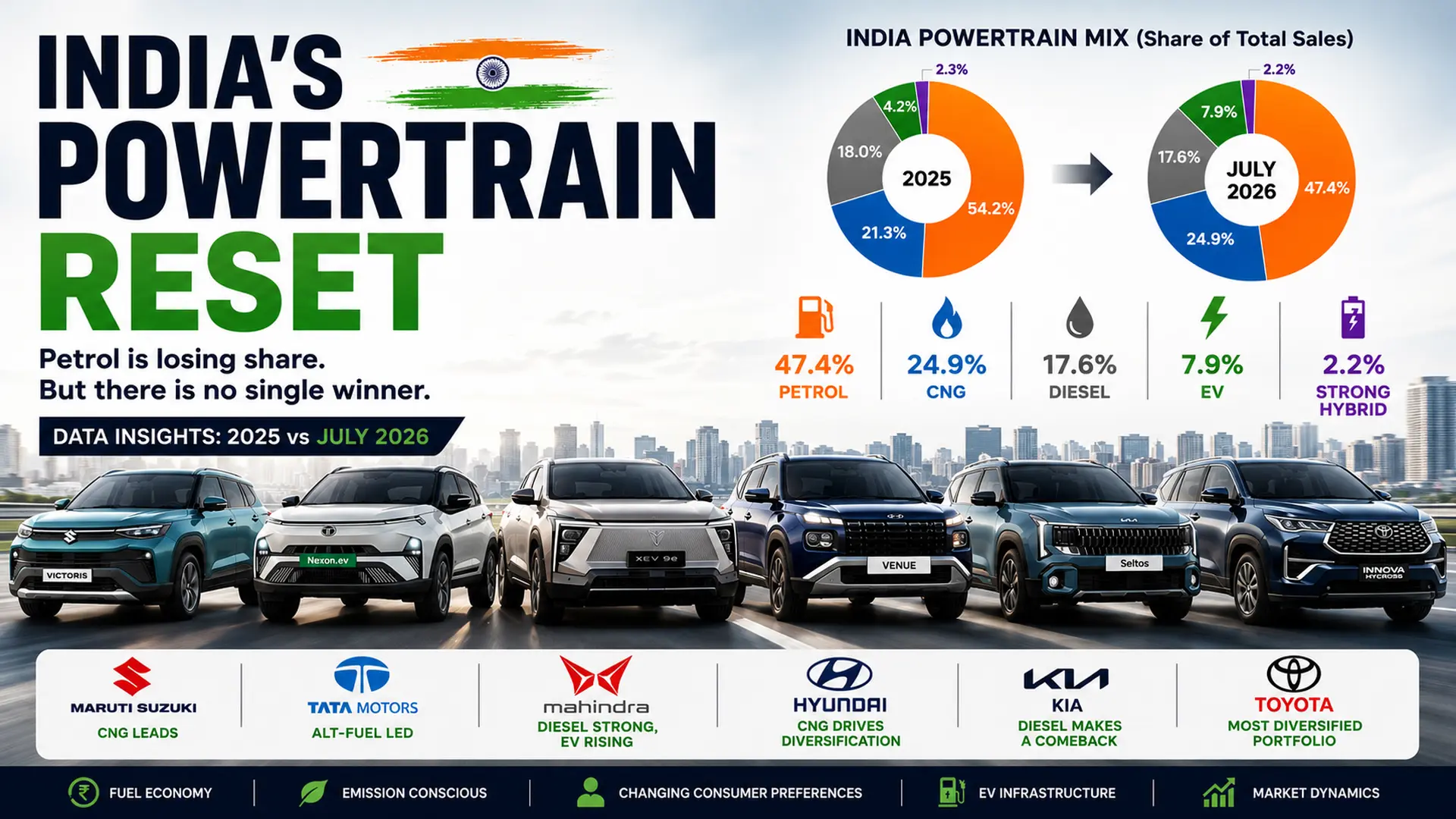
“India’s Powertrain Reset” comparing India’s 2025 and July 2026 car powertrain mix. Petrol share falls from 54.2% to 47.4%, while CNG rises to 24.9%, EVs to 7.9%, diesel to 17.6%, and strong hybrids remain at 2.2%. Latest models from Maruti Suzuki, Tata, Mahindra, Hyundai, Kia, and Toyota are shown, highlighting that India’s shift away from petrol has no single winner.


Category:
Tag:
- India Auto Market
- Powertrain Trends
India’s passenger-vehicle market is undergoing a quiet but significant powertrain shift.
To understand whether concerns around E20 petrol, fuel economics and geopolitical uncertainty are influencing buyer behaviour, we compared the average monthly sales mix in 2025 with the powertrain mix recorded in July 2026.
The headline is clear: petrol is losing ground.
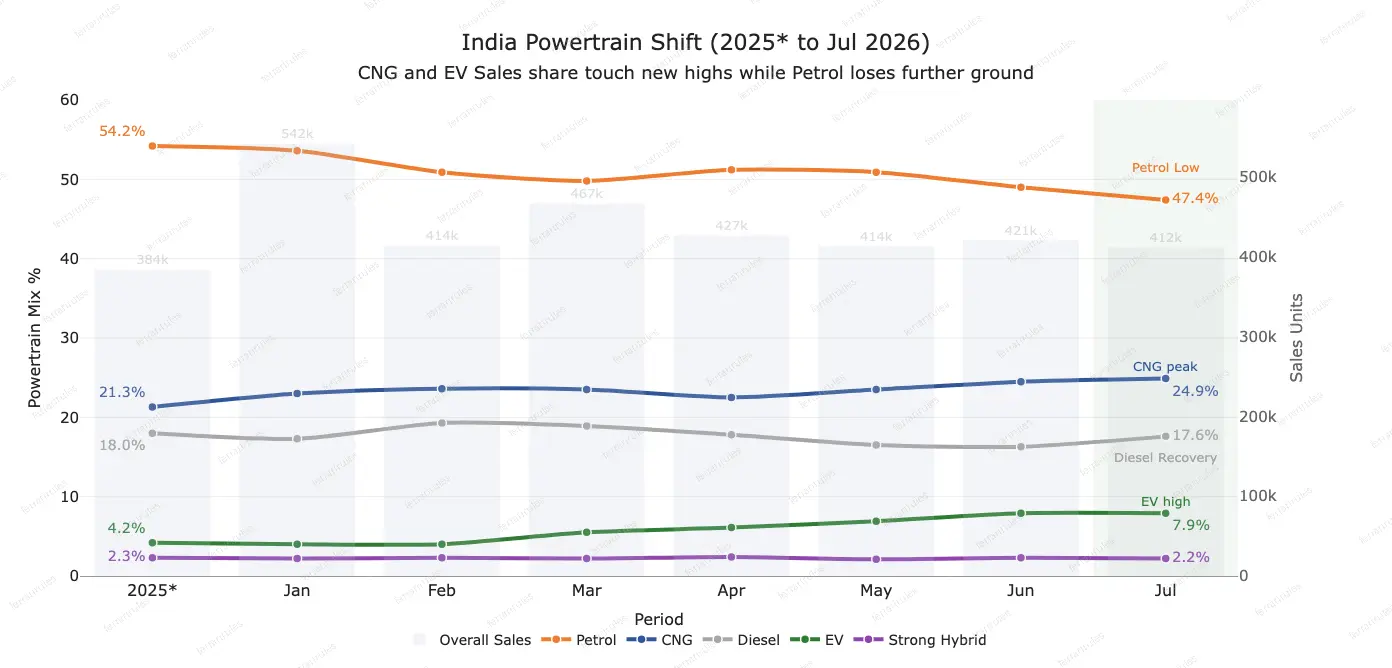
Its share has fallen from 54.2% in 2025 to 47.4% in July 2026. Meanwhile:
???? CNG reached 25%
????️ Diesel recovered to 17.6%
⚡ EVs climbed to 8%
But this is not a simple petrol-to-EV transition.
Different manufacturers are moving in very different directions. For some, CNG is the growth engine. For others, diesel remains resilient. And only a few are seeing EVs materially reshape their sales mix.
Maruti Suzuki: CNG is the real alternative-fuel story
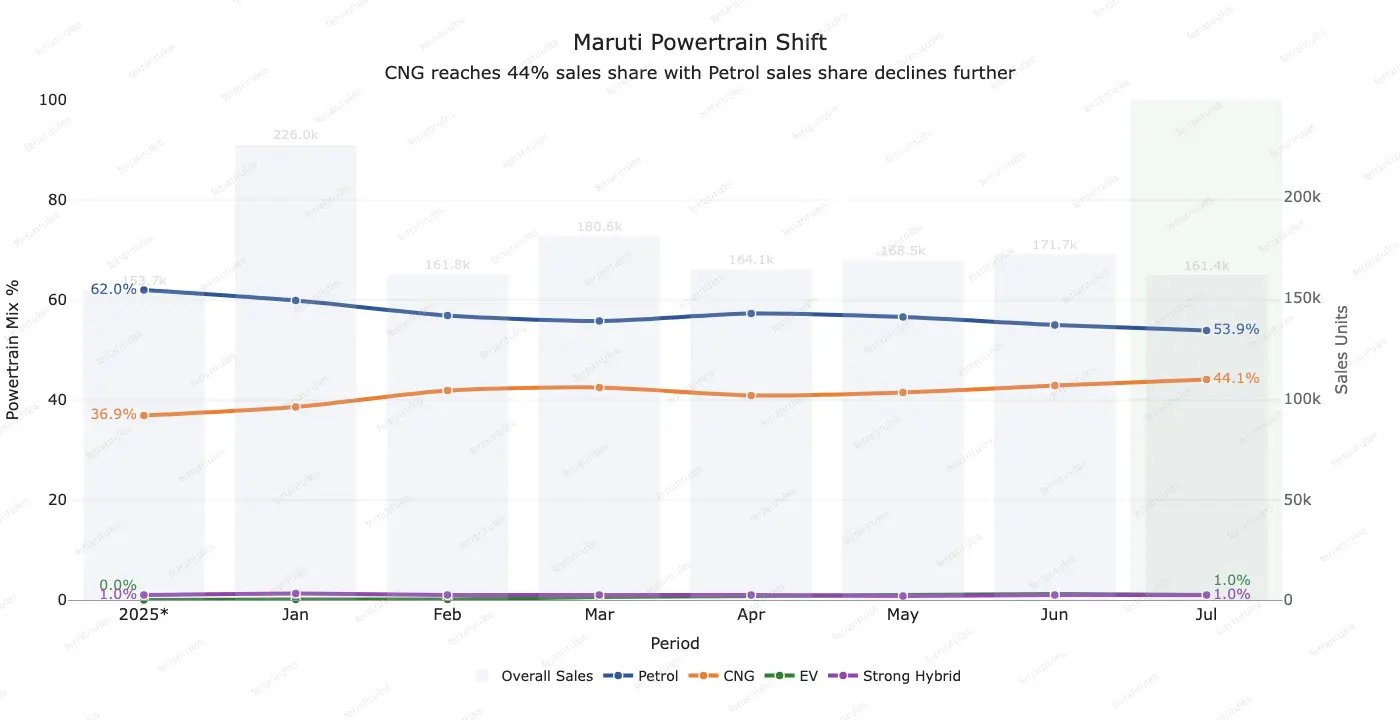
Maruti Suzuki’s biggest alternative-fuel story is not electric—it is CNG.
CNG now contributes 44.1% of Maruti’s sales, up from 36.9% in 2025. Petrol’s share has fallen to 53.9%.
The volume shift is equally striking.
In 2025, Maruti sold an average of approximately:
⛽ 95,000 petrol cars per month
???? 57,000 CNG cars per month
By July 2026, petrol volumes had declined to around 87,000 units, while CNG had risen to approximately 71,000 units.
Nearly one in every two Maruti cars sold is now CNG.
For India’s largest mass-market manufacturer, the transition away from petrol is therefore being led by affordability and lower running costs—not electrification.
Tata Motors: Alternative fuels cross the halfway mark
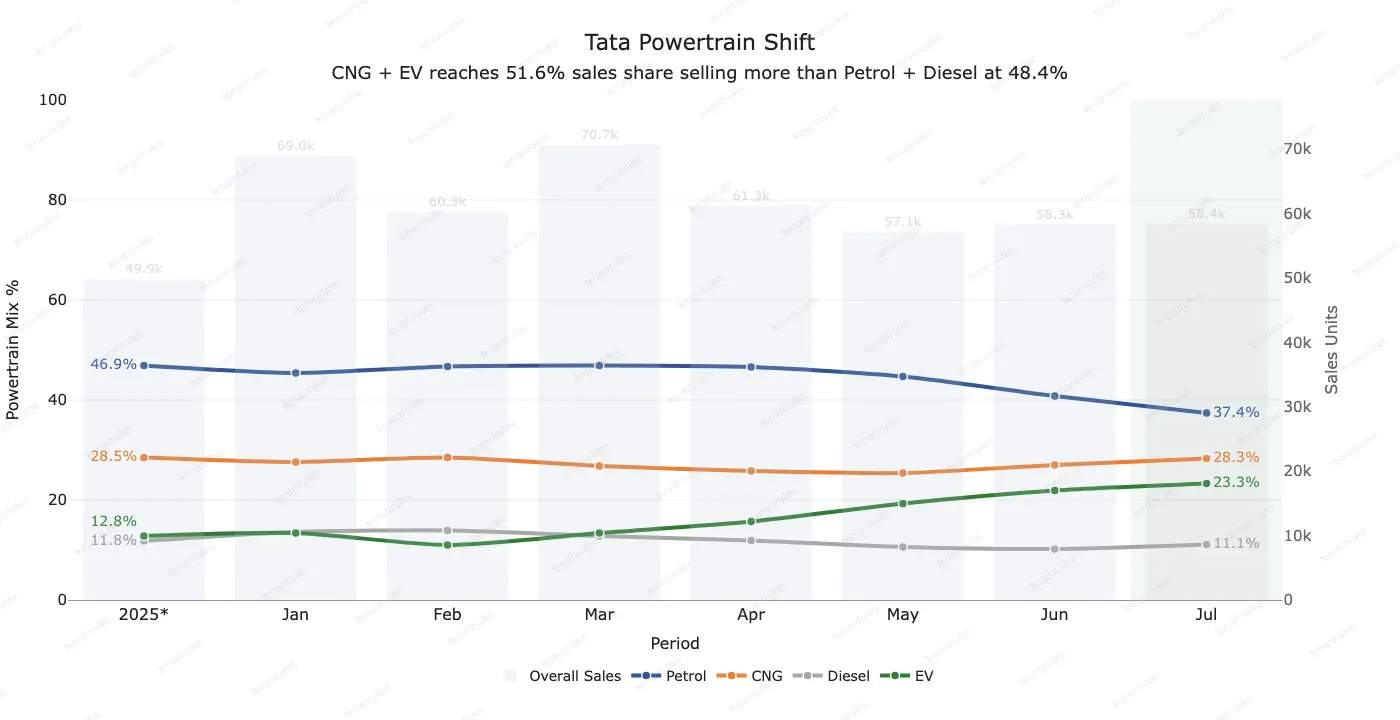
Tata Motors has crossed an important powertrain milestone.
CNG and EVs together now account for 51.6% of its sales, overtaking petrol and diesel, which together contribute 48.4%.
The July 2026 mix stands at:
⛽ Petrol: 37.4%
???? CNG: 28.3%
⚡ EV: 23.3%
????️ Diesel: 11.1%
In 2025, Tata averaged around 29,000 petrol and diesel vehicles per month, compared with approximately 21,000 CNG and electric vehicles.
By July 2026, the equation had flipped:
⛽ Petrol + Diesel: 28,000 units
???? CNG + EV: 30,000 units
Tata is now the clearest example of an Indian manufacturer whose portfolio has become genuinely alternative-fuel-led.
Mahindra: A diesel giant builds an electric second pillar
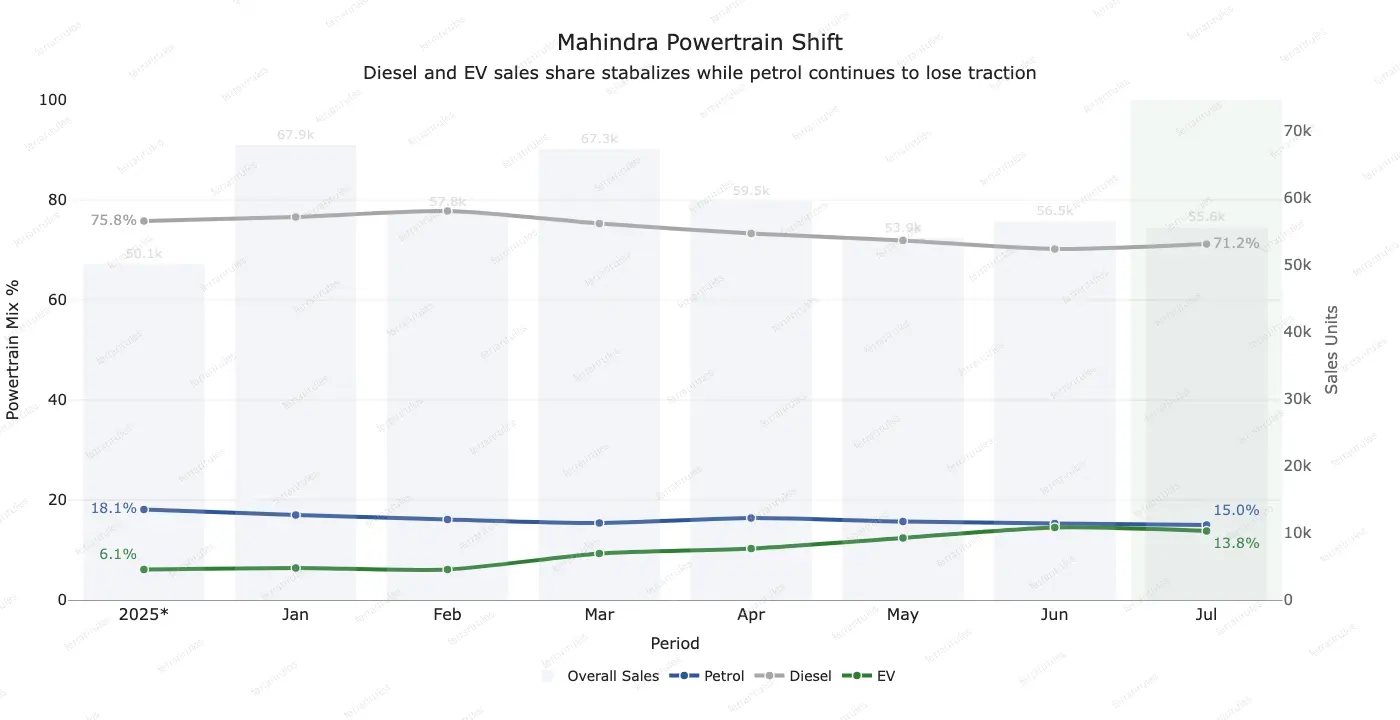
Mahindra remains overwhelmingly dependent on diesel, but EVs are beginning to reshape its sales mix.
Its July 2026 powertrain split is:
????️ Diesel: 71.2%
⛽ Petrol: 15.0%
⚡ EV: 13.8%
Diesel remains the foundation of Mahindra’s SUV portfolio, but EV volumes have more than doubled—from an average of roughly 3,000 units per month in 2025 to around 7,700 units in July 2026.
Petrol, meanwhile, slipped from a monthly average of approximately 9,000 units to 8,300 units.
Mahindra is not moving away from diesel overnight. Instead, it is building an electric second pillar alongside its traditional strength.
That makes its transition structurally different from Tata’s. Tata is becoming alternative-fuel-led, while Mahindra remains diesel-led but increasingly electrified.
Hyundai: CNG is driving diversification
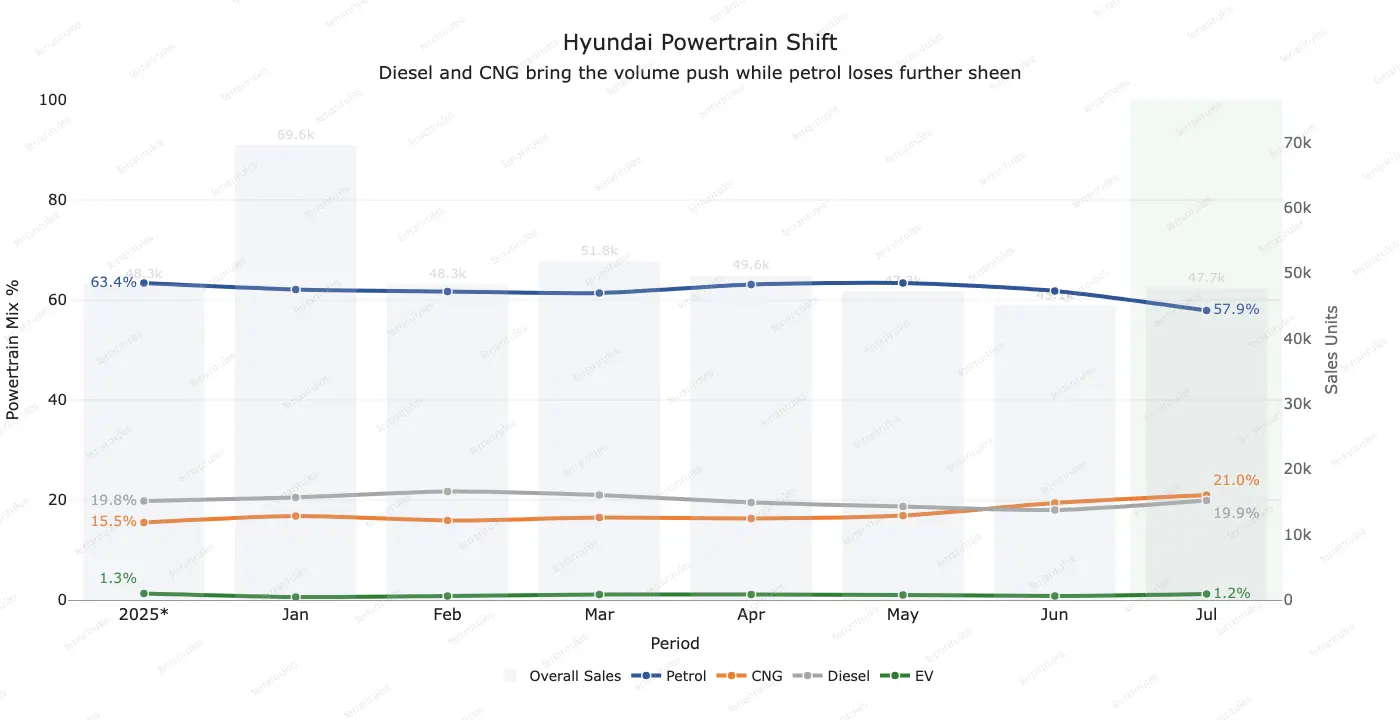
Hyundai’s petrol dominance is gradually weakening, but its diversification story is not yet being driven by EVs.
The volume movement tells the story:
⛽ Petrol declined from a monthly average of 30,000 units in 2025 to 27,600 units in July 2026
???? CNG climbed from approximately 7,500 units to 10,000 units
????️ Diesel remained stable at around 9,500 units
⚡ EV volumes stayed largely flat at approximately 500 units
For Hyundai, the immediate change is the rise of CNG, supported by the continued resilience of diesel.
EVs remain strategically important, but they are not yet large enough to materially alter Hyundai’s overall sales mix.
Kia: Diesel makes a comeback
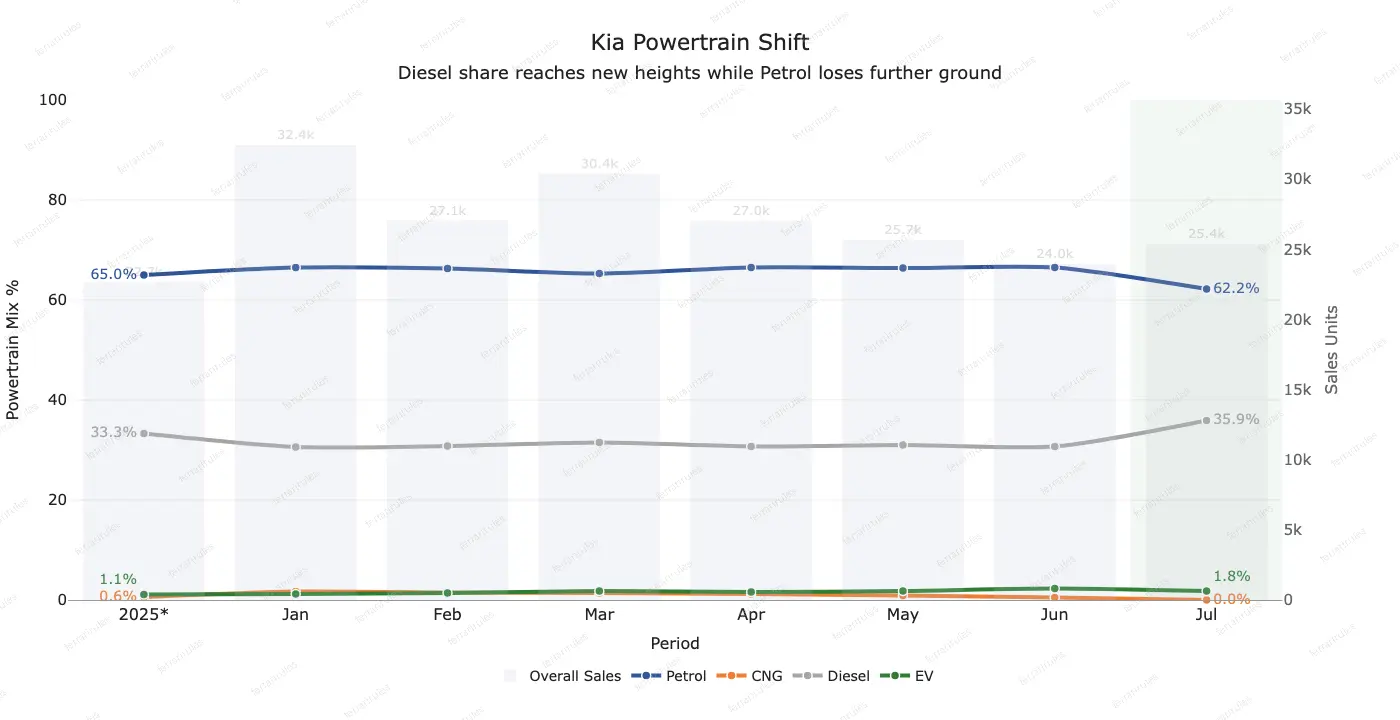
Kia is moving differently from several other mass-market manufacturers.
Diesel’s share has climbed to 35.9%, while petrol has fallen to 62.2%. EVs account for only 1.8%, while CNG is effectively absent from the portfolio.
This means Kia’s diversification is happening almost entirely within conventional internal-combustion powertrains.
While Maruti and Hyundai are gaining CNG buyers, and Tata and Mahindra are seeing greater EV participation, Kia is becoming more diesel-heavy.
That underlines an important point: diesel is not disappearing uniformly from the Indian market. In SUV-led portfolios, it can still remain highly relevant.
Toyota: India’s most diversified powertrain mix
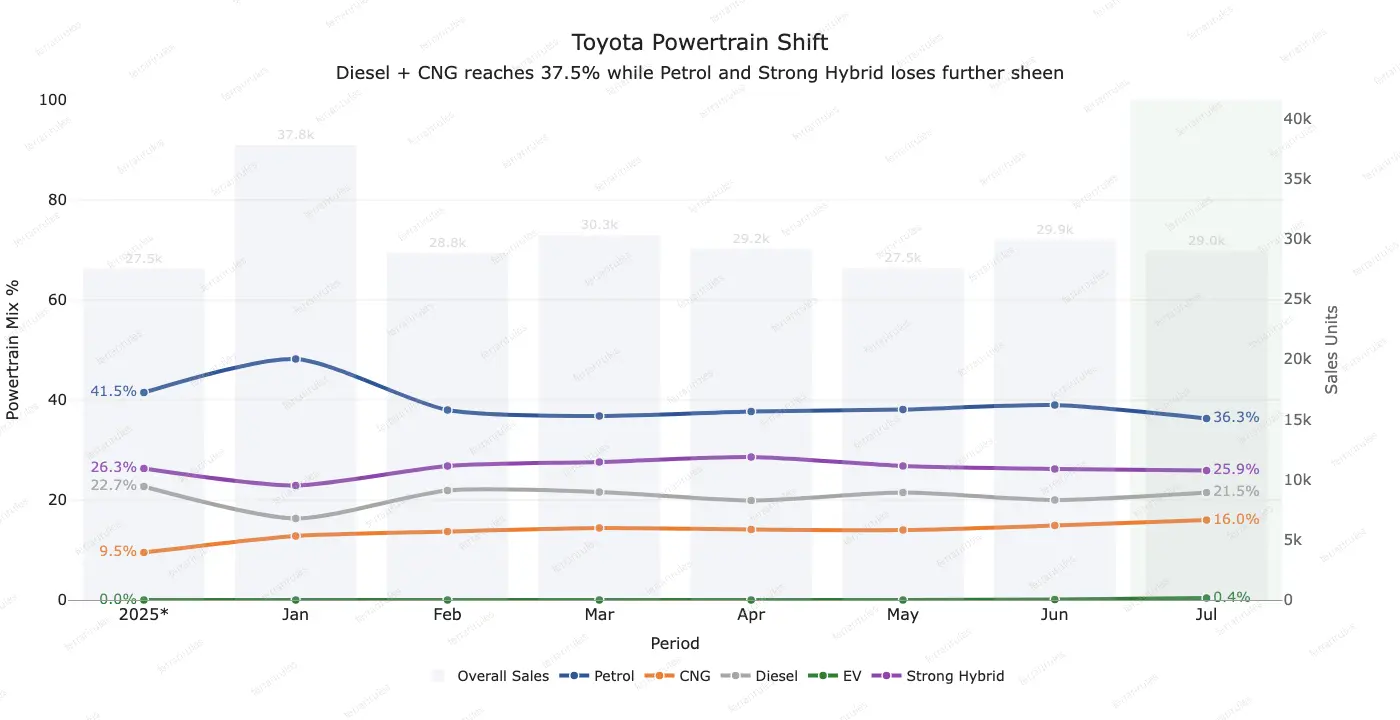
Toyota has one of the most balanced powertrain portfolios in the market.
Its July 2026 mix stands at:
⛽ Petrol: 36.3%
???? Strong hybrid: 25.9%
????️ Diesel: 21.5%
???? CNG: 16.0%
Toyota is commonly associated with hybrids, but diesel and CNG together now contribute 37.5% of its sales—more than the strong-hybrid share.
That does not mean hybrids are losing relevance. Instead, it shows that Toyota’s Indian strategy is increasingly multi-powertrain.
The company is serving different customers with petrol, diesel, CNG and strong-hybrid options rather than betting on one dominant technology.
There is no single Indian powertrain transition
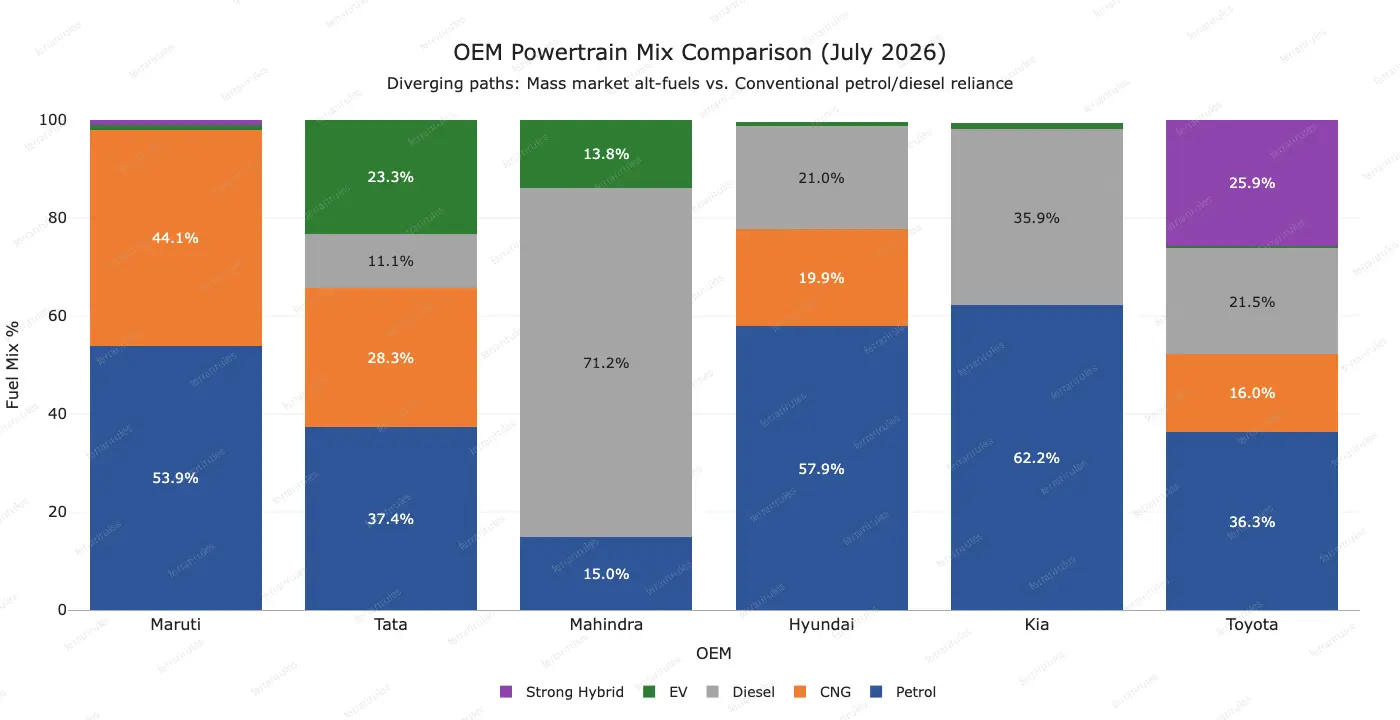
India’s automotive transition is not following a straight line from petrol to electric.
It is splitting into several parallel shifts:
???? Maruti and Hyundai: Petrol to CNG
⚡ Tata: Petrol and diesel to CNG and EV
????️⚡ Mahindra: Diesel remains dominant, with EVs emerging
????️ Kia: Petrol to diesel
???? Toyota: A diversified petrol, hybrid, diesel and CNG portfolio
This fragmentation reflects the realities of the Indian market.
Purchase price, running costs, charging access, fuel availability, resale expectations, driving distance and vehicle segment all influence the choice of powertrain.
A small hatchback buyer may find CNG more practical than an EV. An SUV buyer may continue to prefer diesel. An urban buyer with home charging may choose electric. A customer seeking efficiency without charging dependence may opt for a strong hybrid.
The bigger takeaway
Petrol’s decline is real, but no single technology has replaced it.
CNG is currently delivering the largest mass-market disruption. Diesel remains resilient in SUV-heavy portfolios. EVs are becoming meaningful for Tata and Mahindra, but remain marginal for several other major manufacturers. Strong hybrids have established a presence, though they are still concentrated within a limited number of brands and models.
India is therefore not moving toward one powertrain future.
It is moving toward a multi-powertrain market, where each manufacturer is building around its existing strengths, product portfolio and customer base.
The next phase will not simply be about which fuel wins.
It will be about which manufacturer can offer the right powertrain, at the right price, for the right customer.
To comment and participate in discussion Click Here
Recent Articles
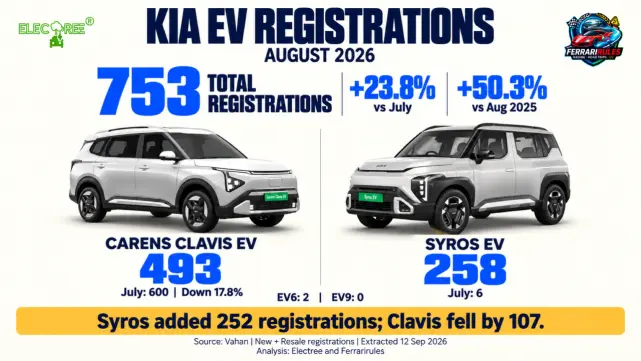
Kia EV Registrations Rise 24% in August as Syros Offsets Clavis Decline
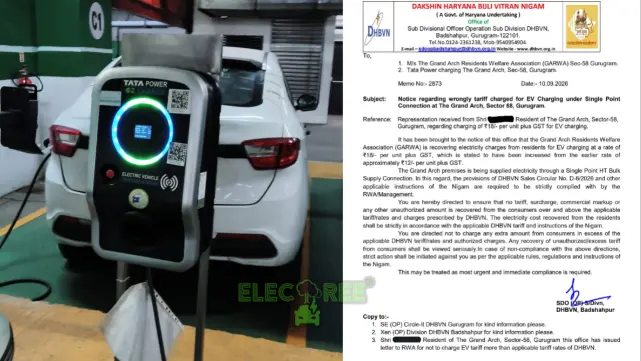
DISCOM Issues Notice to Gurugram RWA for Overcharging EV Users

Hyundai EV Sales August 2026: Creta Electric Rebounds, but Year-to-Date Sales Fall

Omega Seiki Mobility Begins Development of Accessible EV for Persons with Disabilities
Trending Articles
Kerala Makes EVs More Affordable: Revised Road Tax Structure to Accelerate Adoption
India Car Sales by Fuel Type — March 2026: EV Share Hits New High, CNG Surges, Petrol Loses Ground
No Fire Safety Certificate Will Be Declined Over EV Chargers, Says Haryana Fire Department
Haryana Releases Draft Fire Safety Guidelines for EV Charging