
India’s Large Hatchback Market Is Growing—But Buyers Aren’t Upgrading the Same Way
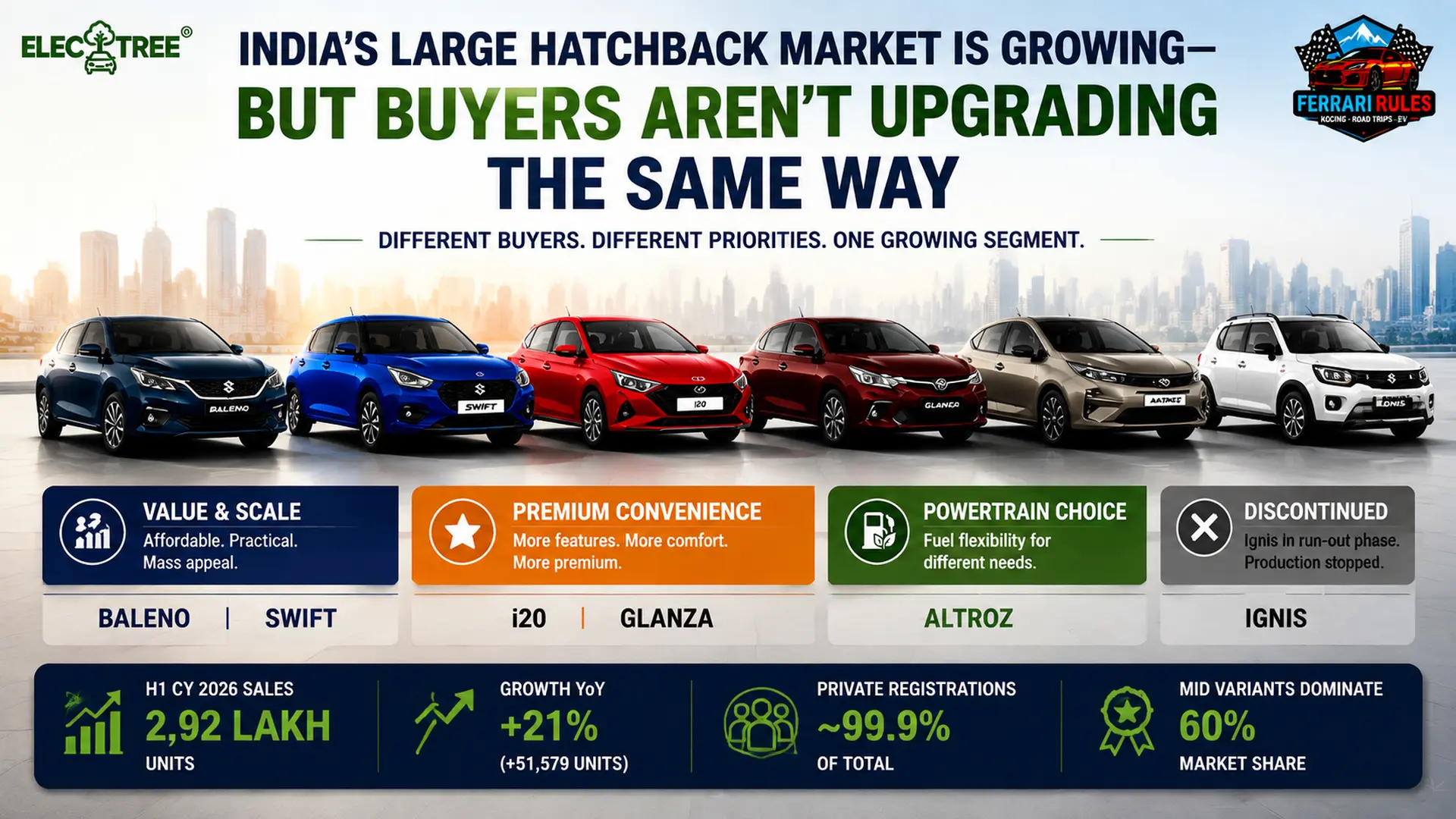
India’s large hatchback market grew 21% in H1 2026, led by Baleno’s rise, shifting buyer preferences, and diverse choices across value, premium features, automatics, and fuel options.


Category:
Tag:
- Hatchback Sales India
- Large Hatchback Market
- Premium Hatchbacks India
India’s large hatchback market is doing something that often gets overlooked in the SUV-heavy conversation. It is growing.
Sales increased from 2.41 lakh units in H1 2025 to 2.92 lakh units in H1 2026, a rise of 21%. That means the segment added more than 51,500 units in just one year. But the more interesting story lies beneath that growth.
Large-hatchback buyers are not all moving in the same direction. Some prioritise value, some convenience, some premium features, and others fuel flexibility. The segment is becoming more differentiated.
Large Hatchbacks Accelerate 21%
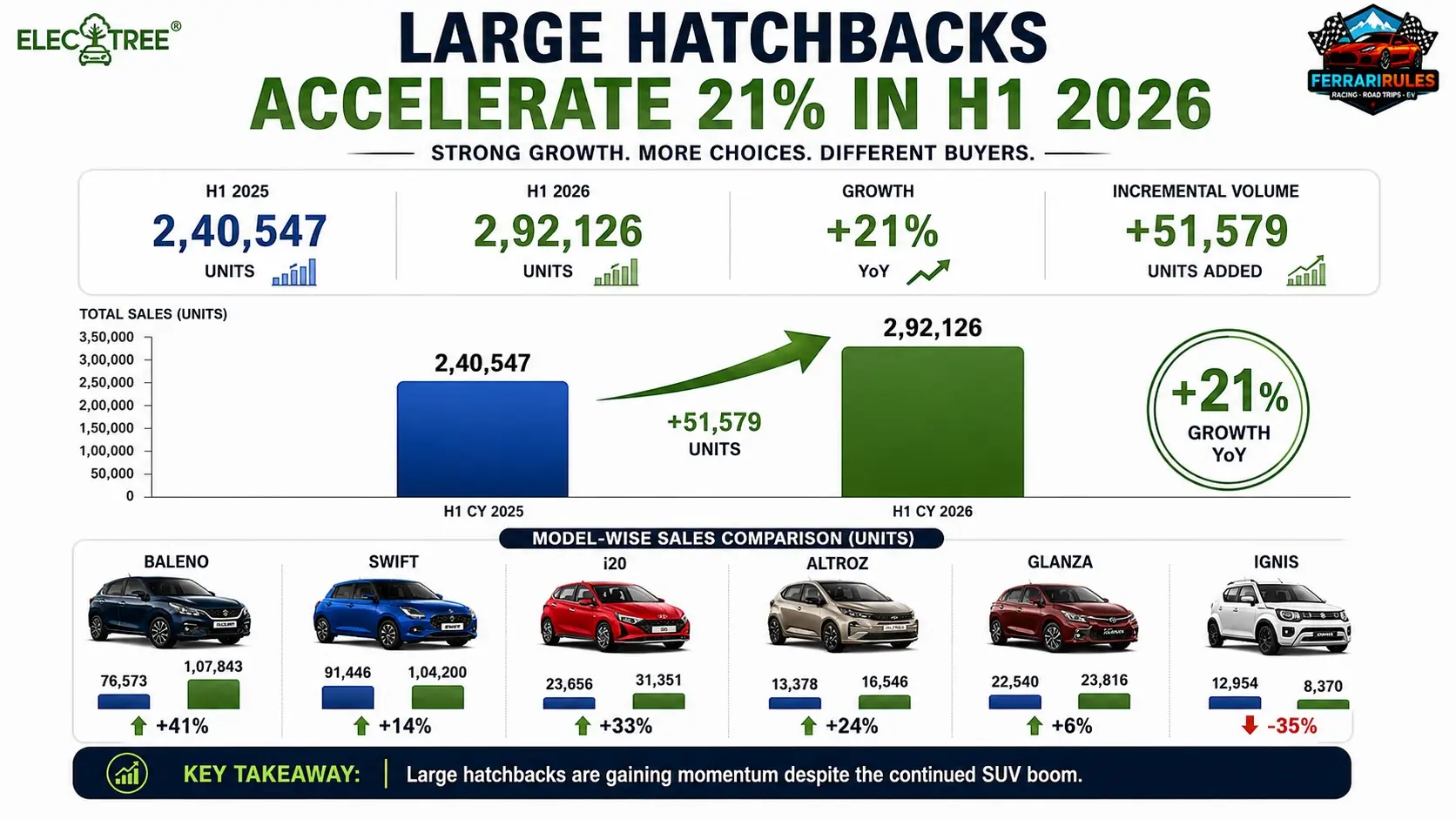
Large-hatchback registrations increased from 2,40,547 units in H1 2025 to 2,92,126 units in H1 2026.
That represents:
- +21% growth
- +51,579 incremental units
This is significant because it is happening even as SUVs continue to capture a larger share of India’s passenger-vehicle market.
The hatchback may no longer be the default body style it once was, but buyers who still want one appear increasingly willing to move towards larger, better-equipped models.
Large hatchbacks are gaining momentum despite the continued SUV boom.
Baleno Moves Ahead of Swift
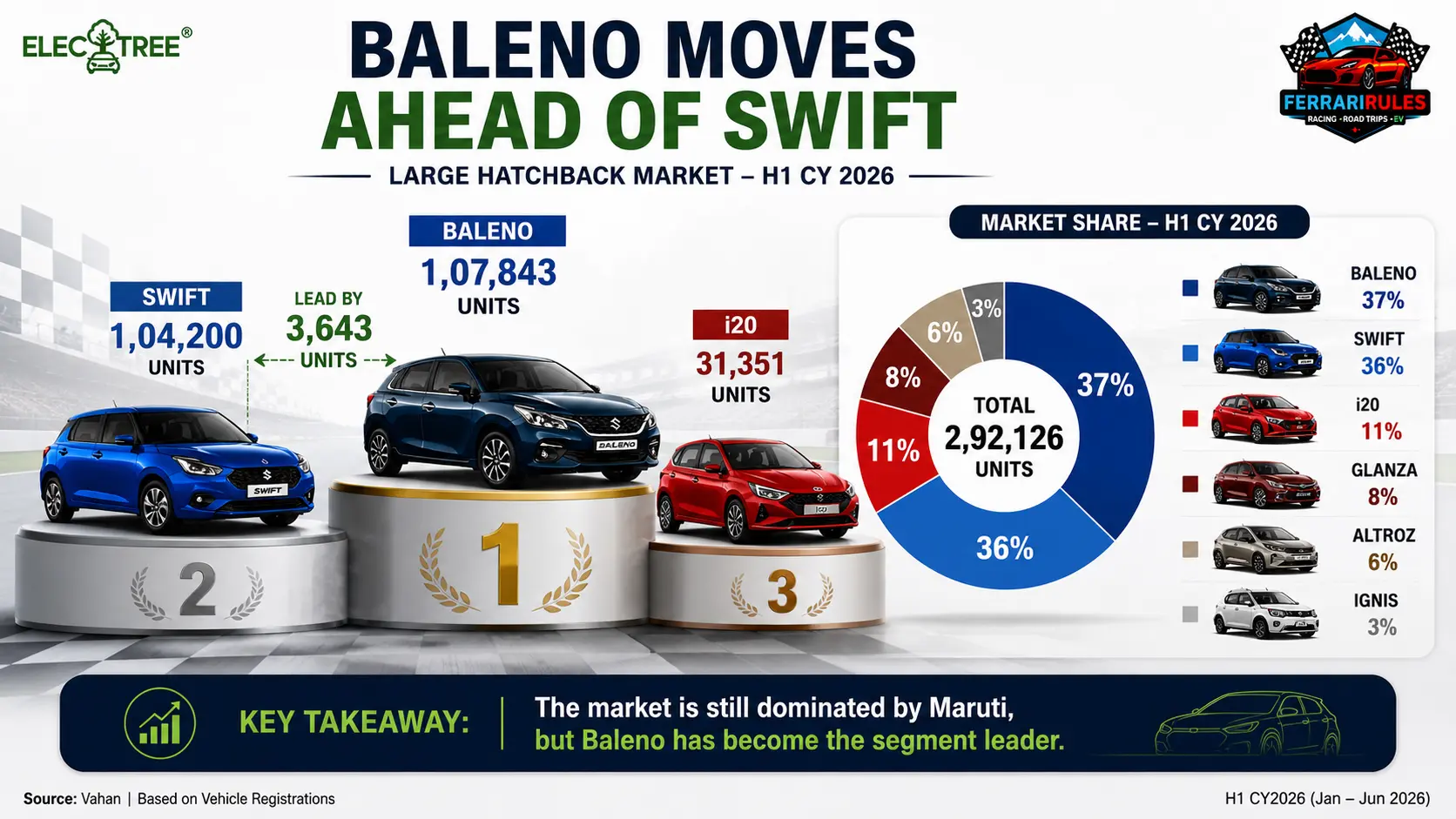
The fight at the top has become extremely close.
In H1 2026:
- Baleno: 1,07,843 units — 37% share
- Swift: 1,04,200 units — 36% share
- i20: 31,351 units — 11% share
- Glanza: 23,816 units — 8% share
- Altroz: 16,546 units — 6% share
- Ignis: 8,370 units — 3% share
Baleno finished just 3,643 units ahead of Swift.
Together, the two Maruti models account for nearly three-fourths of the market, underlining just how dominant Maruti remains in this segment. But the leadership position has changed.
Baleno has moved ahead of Swift to become India’s largest-selling large hatchback.
Baleno Is Also Growing the Fastest
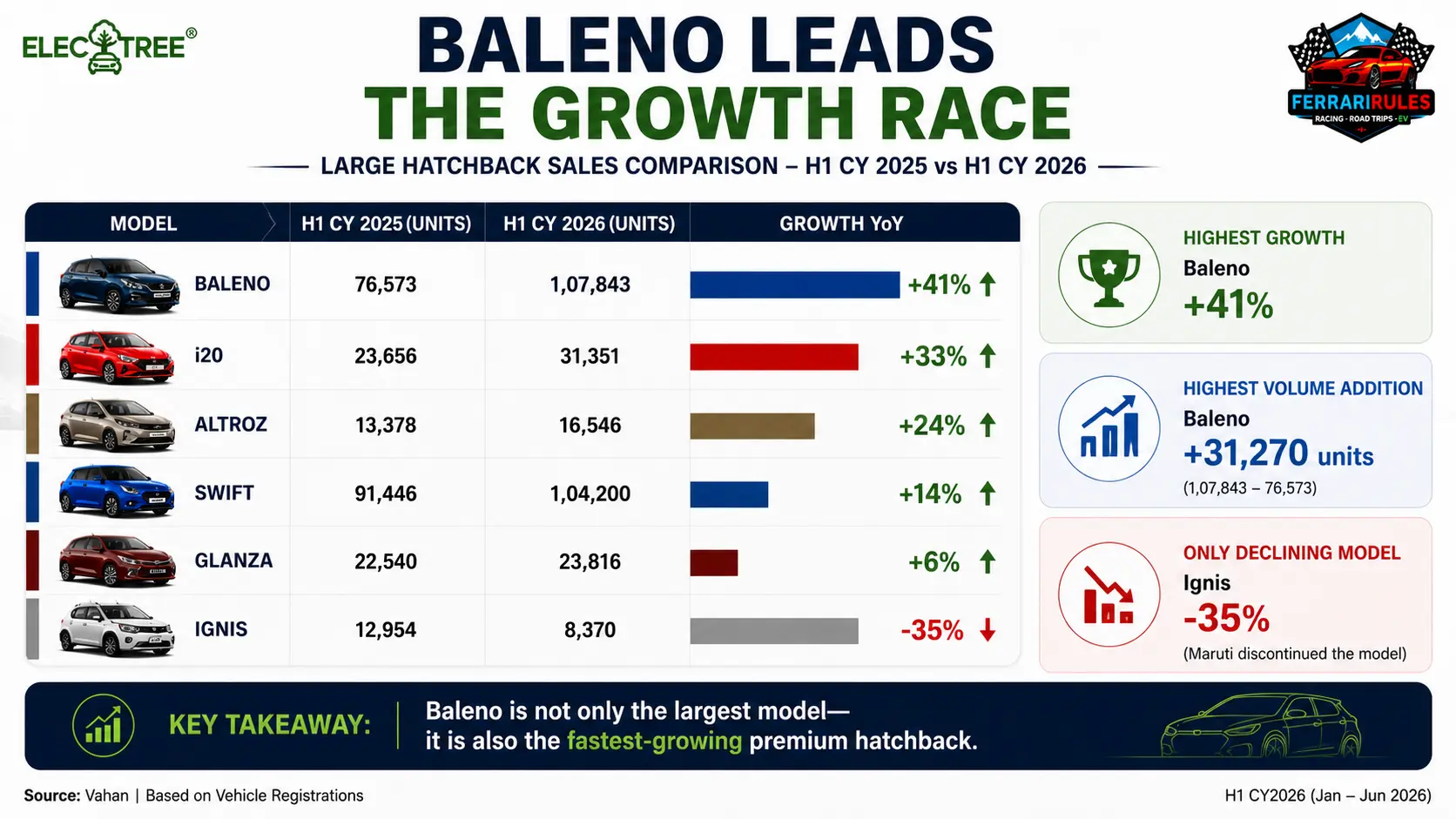
Baleno’s leadership is not just a consequence of scale.
It is also the fastest-growing major model in the segment.
H1 2026 vs H1 2025:
- Baleno: +41%
- i20: +33%
- Altroz: +24%
- Swift: +14%
- Glanza: +6%
- Ignis: -35%
Baleno added 31,270 units, the highest incremental volume of any model.
The i20 also recorded a strong 33% increase, while Altroz grew 24%.
Ignis was the only model to decline sharply, reflecting its run-out phase after discontinuation.
So Baleno now has two important distinctions:
It is both the largest and the fastest-growing large hatchback.
Manual Still Dominates—But Not Everywhere
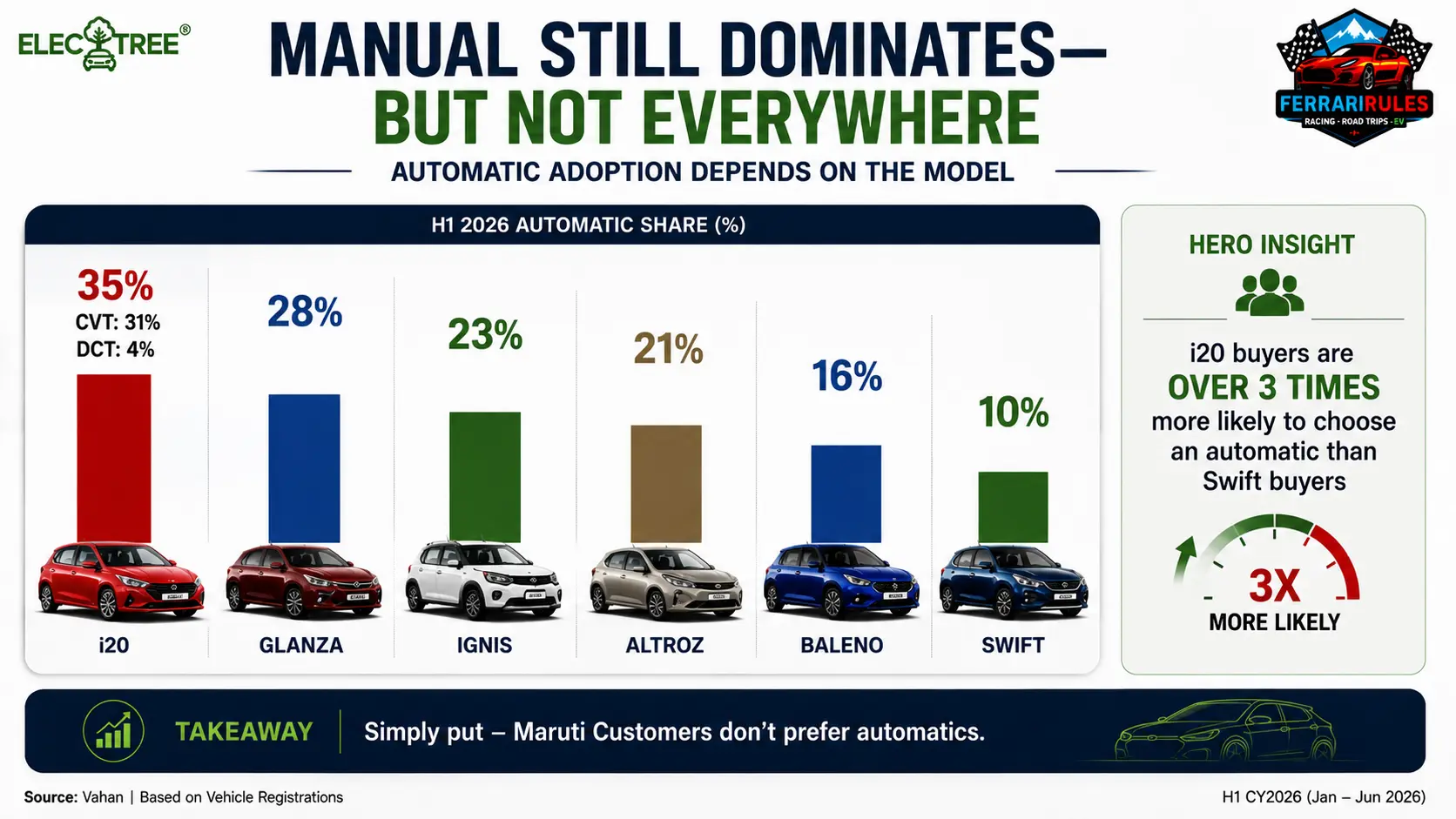
Automatic adoption varies dramatically by model.
In H1 2026:
- i20: 35% automatic
- Glanza: 28%
- Ignis: 23%
- Altroz: 21%
- Baleno: 16%
- Swift: 10%
The i20 is the clear outlier.
Its automatic share includes:
- CVT: 31%
- DCT: 4%
An i20 buyer is more than three times as likely to choose an automatic as a Swift buyer. That says a lot about customer positioning.
Hyundai buyers appear more willing to pay for convenience, while Maruti’s high-volume customers remain significantly more manual-oriented.
Simply put: Maruti customers still overwhelmingly prefer manuals.
One Segment, Six Different Fuel Stories
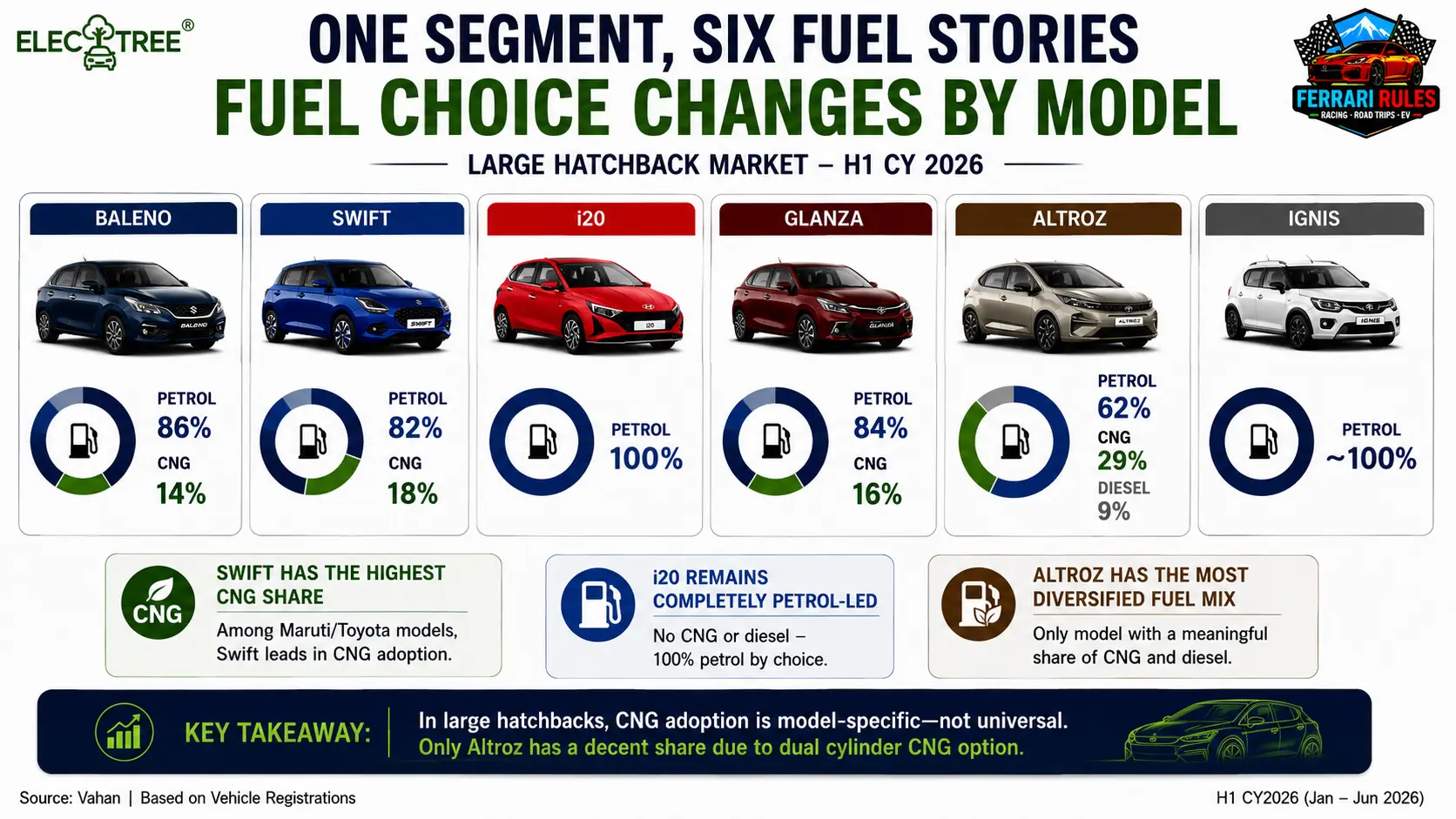
Fuel preference also differs sharply across models.
Baleno
- Petrol: 86%
- CNG: 14%
Swift
- Petrol: 82%
- CNG: 18%
i20
- Petrol: 100%
Glanza
- Petrol: 84%
- CNG: 16%
Altroz
- Petrol: 62%
- CNG: 29%
- Diesel: 9%
Ignis
- Petrol: ~100%
The standout here is Altroz. It is the only model with meaningful demand across petrol, CNG and diesel. Its 29% CNG share is considerably higher than its rivals, helped by Tata’s dual-cylinder CNG packaging that preserves more usable boot space.
Swift has the highest CNG share among the Maruti/Toyota models at 18%, while the i20 remains entirely petrol-led. Unlike small hatchbacks, where CNG adoption is widespread, large-hatchback CNG demand remains model-specific rather than universal.
Mid Variants Define the Market
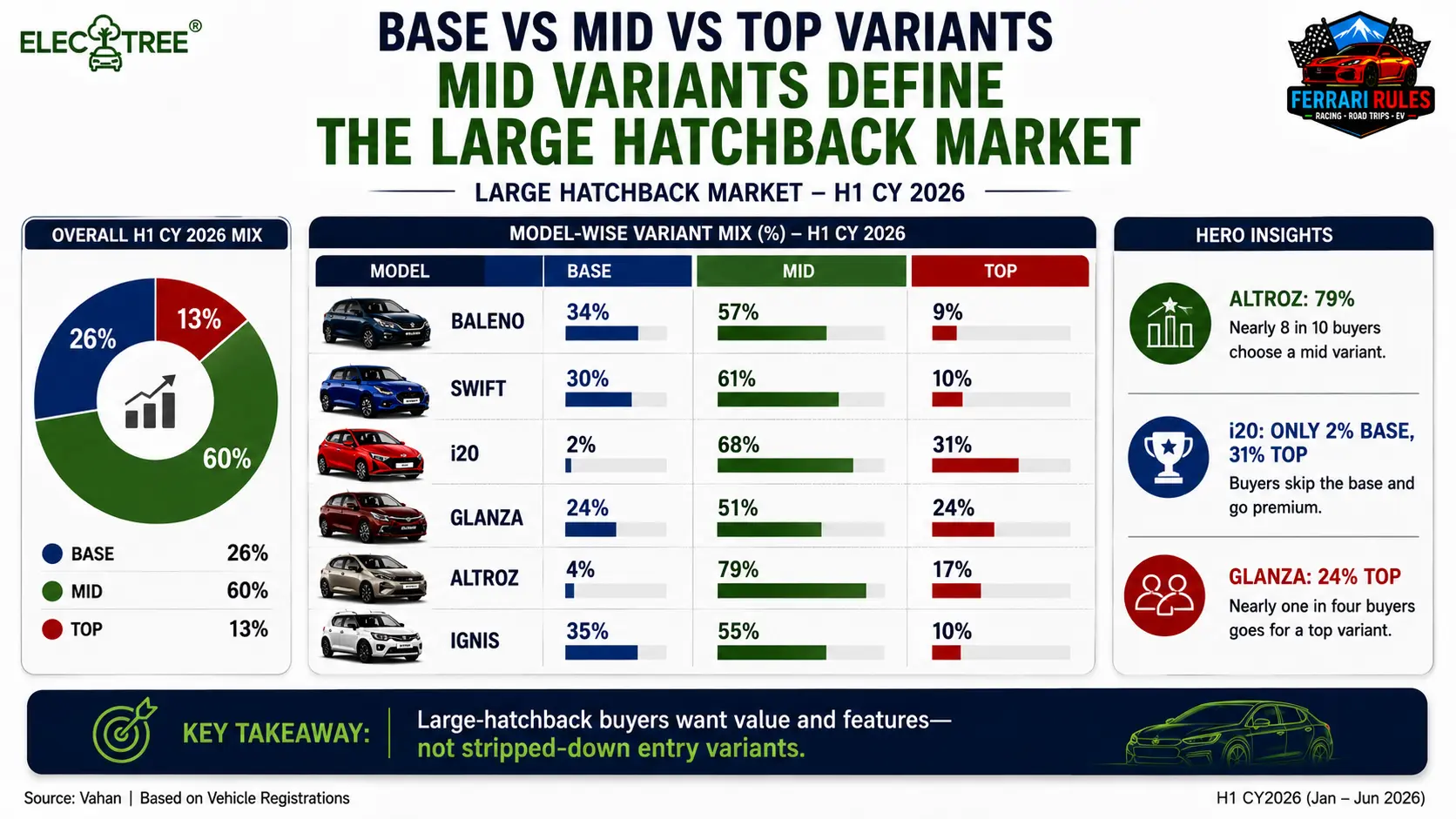
The idea that hatchback buyers simply choose the cheapest available version does not hold up here either.
Across the segment:
- Base variants: 26%
- Mid variants: 60%
- Top variants: 13%
Model-level behaviour is even more revealing. Altroz stands out with 79% of buyers choosing mid variants.
The i20 tells an even stronger premiumisation story: Only 2% of buyers choose base variants, while 31% choose top variants.
Glanza is also notable, with nearly one in four buyers choosing a top-spec version.
The large-hatchback buyer clearly wants value—but value increasingly means features for the money, not simply the lowest possible price.
Not Every Buyer Is Upgrading the Same Way
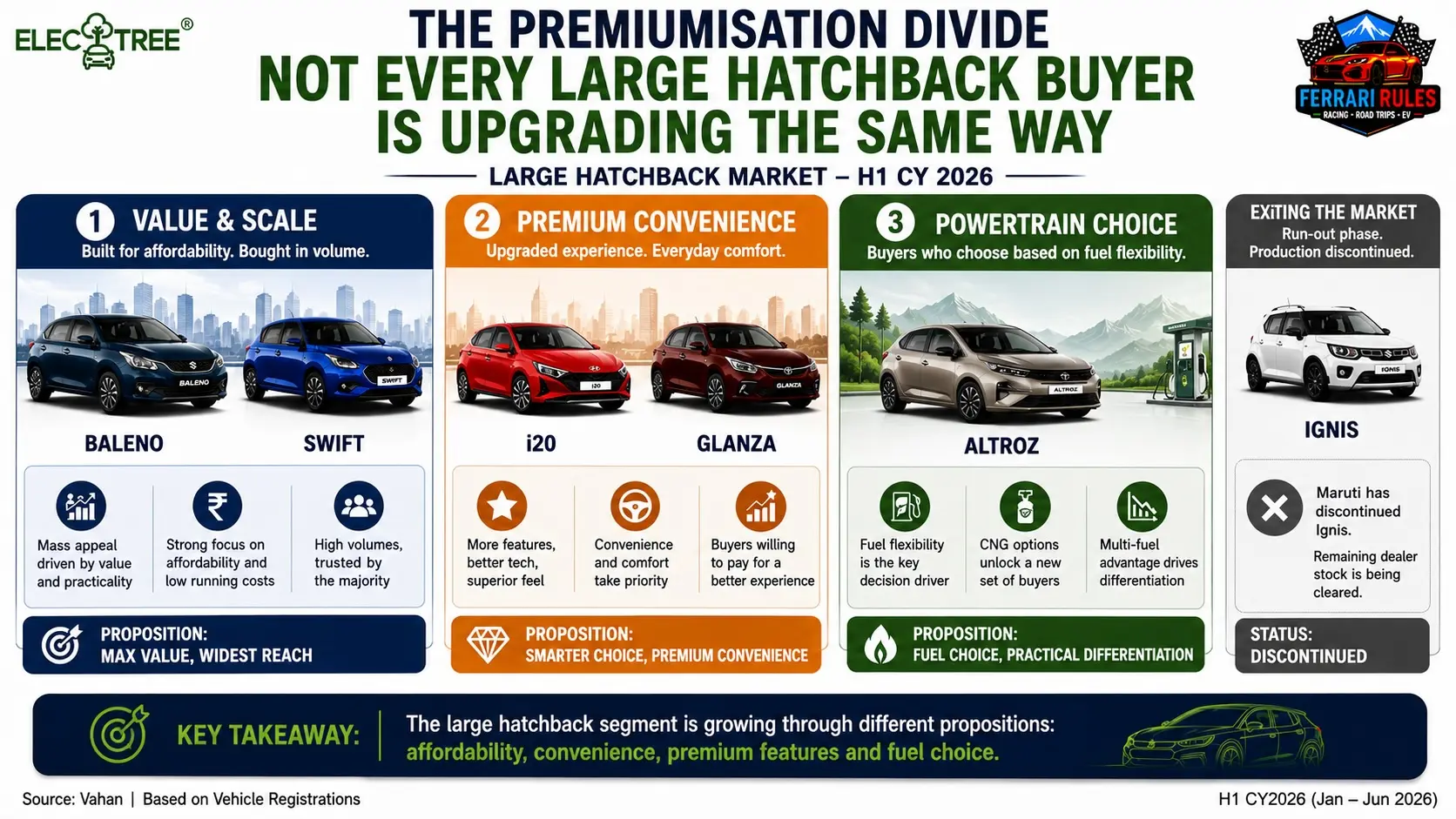
The data suggests three very different buyer groups.
Value & Scale — Baleno and Swift
These are the volume machines.
Their strength comes from:
- Affordability
- Running costs
- Wide reach
- Familiar ownership
- Strong resale
They represent premiumisation without moving too far away from mass-market pricing.
Premium Convenience — i20 and Glanza
These buyers place greater emphasis on:
- Features
- Automatic transmissions
- Comfort
- Cabin experience
- Higher-spec variants
The i20 is the clearest example, with high automatic adoption and an extremely low base-variant share.
Powertrain Choice — Altroz
Altroz differentiates itself differently.
Its proposition revolves around fuel flexibility:
- Petrol
- CNG
- Diesel
It gives buyers more powertrain choice than any other model in the segment.
Ignis now sits outside this competitive framework as a discontinued model in its run-out phase.
The larger point is simple:
Premiumisation does not mean the same thing to every buyer.
Large Hatchbacks Are Almost Entirely Private Cars
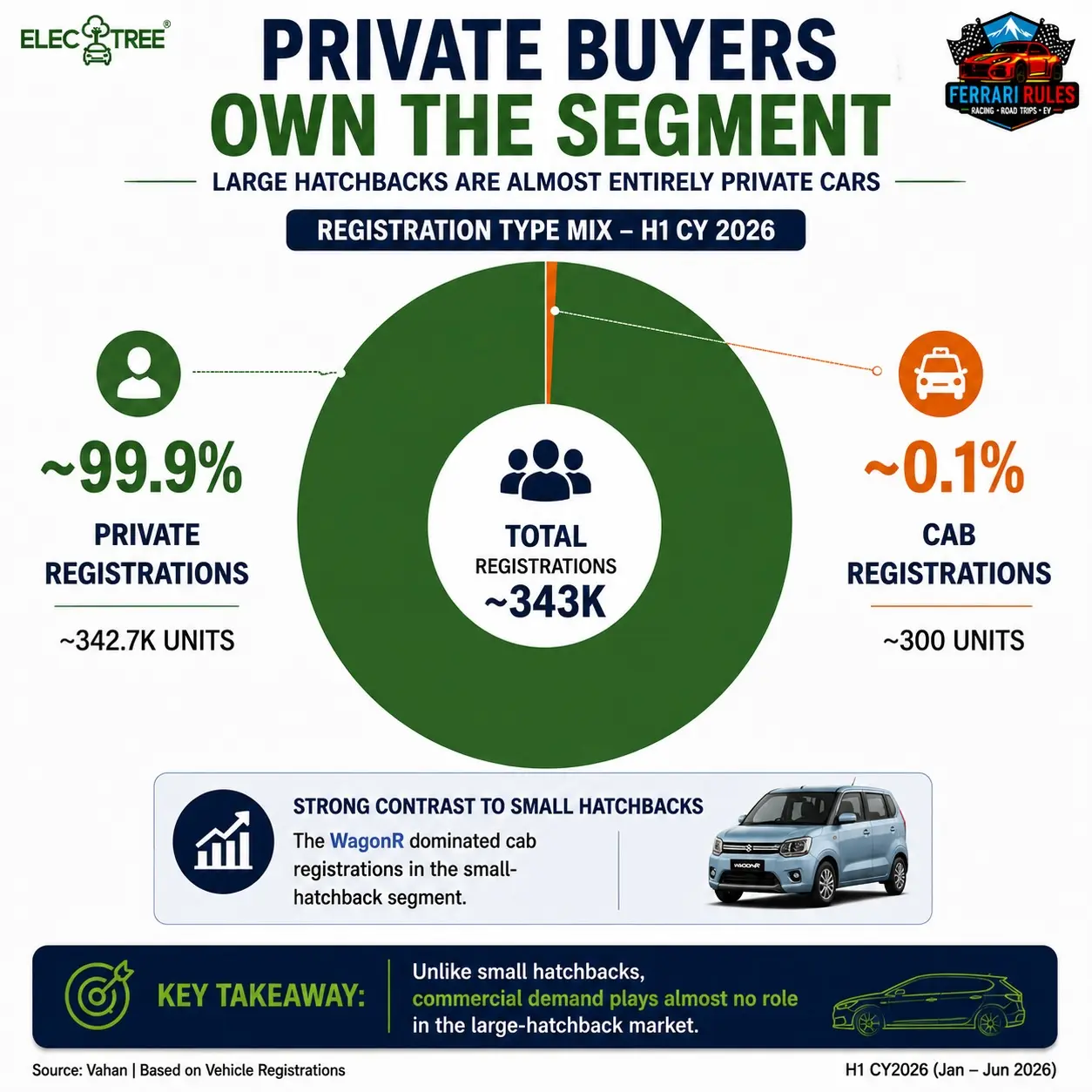
There is also a striking difference between large and small hatchbacks.
Nearly 99.9% of large-hatchback registrations are private, with cab registrations accounting for only around 0.1%.
That is almost the exact opposite of the WagonR story in the small-hatchback segment, where commercial registrations form an important part of demand.
Large hatchbacks are overwhelmingly bought as personal cars.
That reinforces their role as:
- Family cars
- Urban commuters
- Second cars
- Premium alternatives to entry SUVs
Commercial demand plays almost no role here.
Conclusion
India’s large-hatchback market grew 21% in H1 2026, adding more than 51,000 units year on year.
Baleno has moved ahead of Swift and is also the fastest-growing model. The i20 attracts a much more premium, automatic-oriented buyer. Altroz differentiates itself through multiple powertrains. Mid variants dominate across the market, while commercial demand is almost nonexistent.
The segment is growing—but not because every buyer wants the same thing.
Large-hatchback customers are upgrading in different ways: through value, convenience, features, and fuel choice.
And that may be exactly why the segment continues to remain relevant in an SUV-dominated market.
To comment and participate in discussion Click Here
Recent Articles
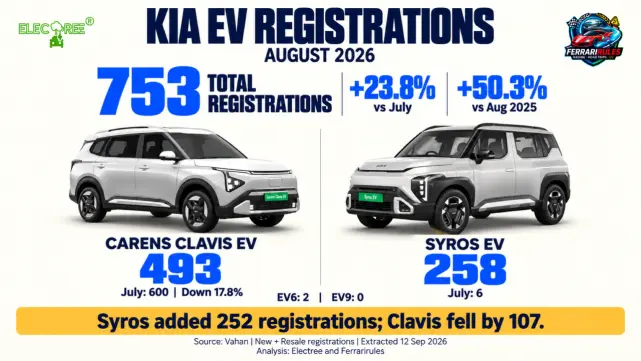
Kia EV Registrations Rise 24% in August as Syros Offsets Clavis Decline
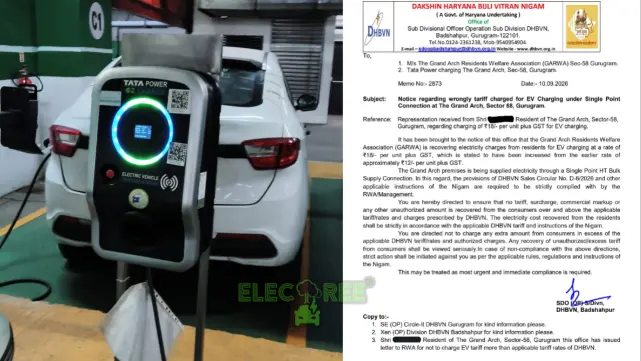
DISCOM Issues Notice to Gurugram RWA for Overcharging EV Users

Hyundai EV Sales August 2026: Creta Electric Rebounds, but Year-to-Date Sales Fall

Omega Seiki Mobility Begins Development of Accessible EV for Persons with Disabilities
Trending Articles
Kerala Makes EVs More Affordable: Revised Road Tax Structure to Accelerate Adoption

India Car Sales by Fuel Type — March 2026: EV Share Hits New High, CNG Surges, Petrol Loses Ground
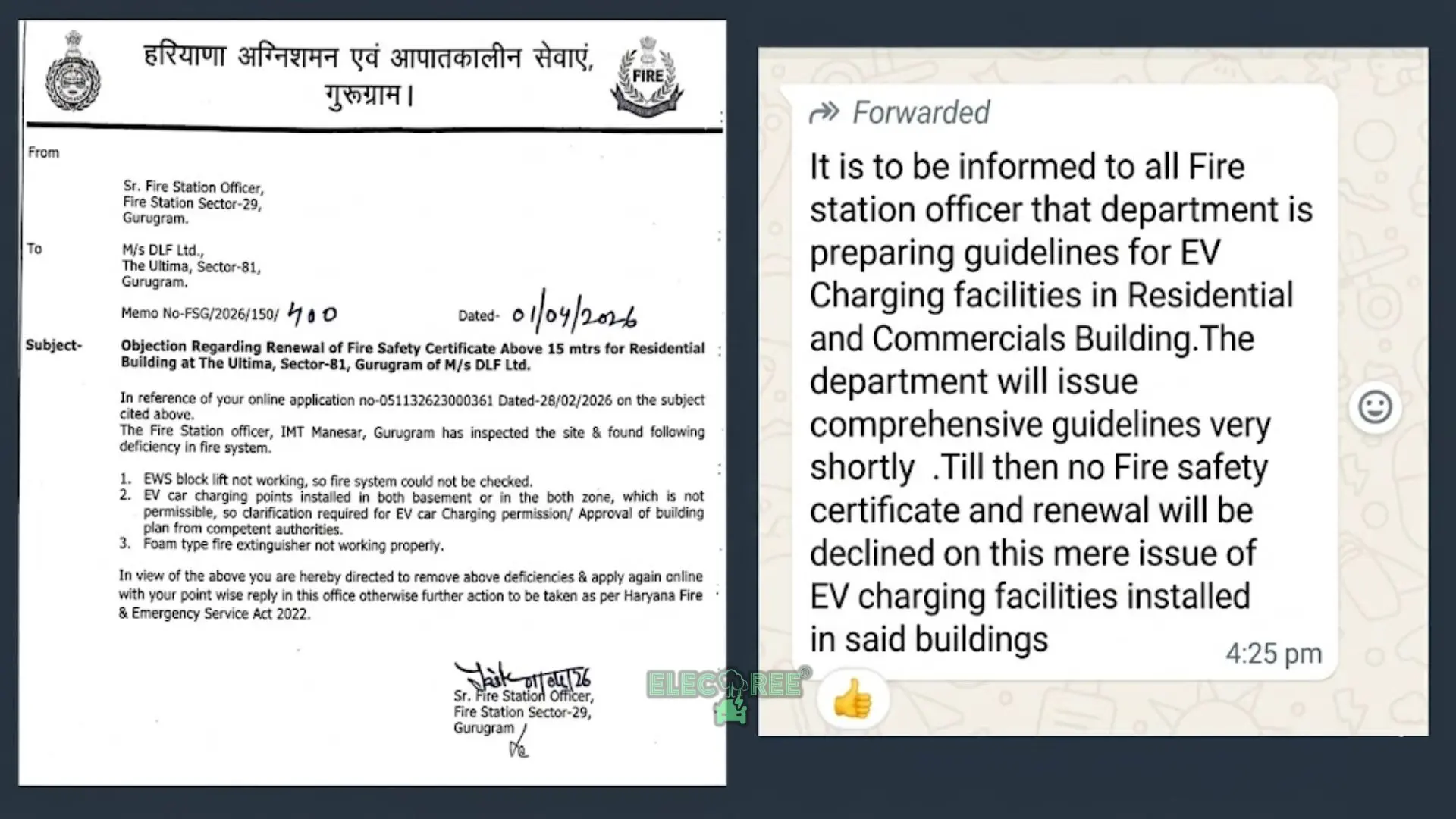
No Fire Safety Certificate Will Be Declined Over EV Chargers, Says Haryana Fire Department

Haryana Releases Draft Fire Safety Guidelines for EV Charging