India’s EV Transition Is Moving at Different Speeds: What NITI Aayog’s IEMI 2025 Shows
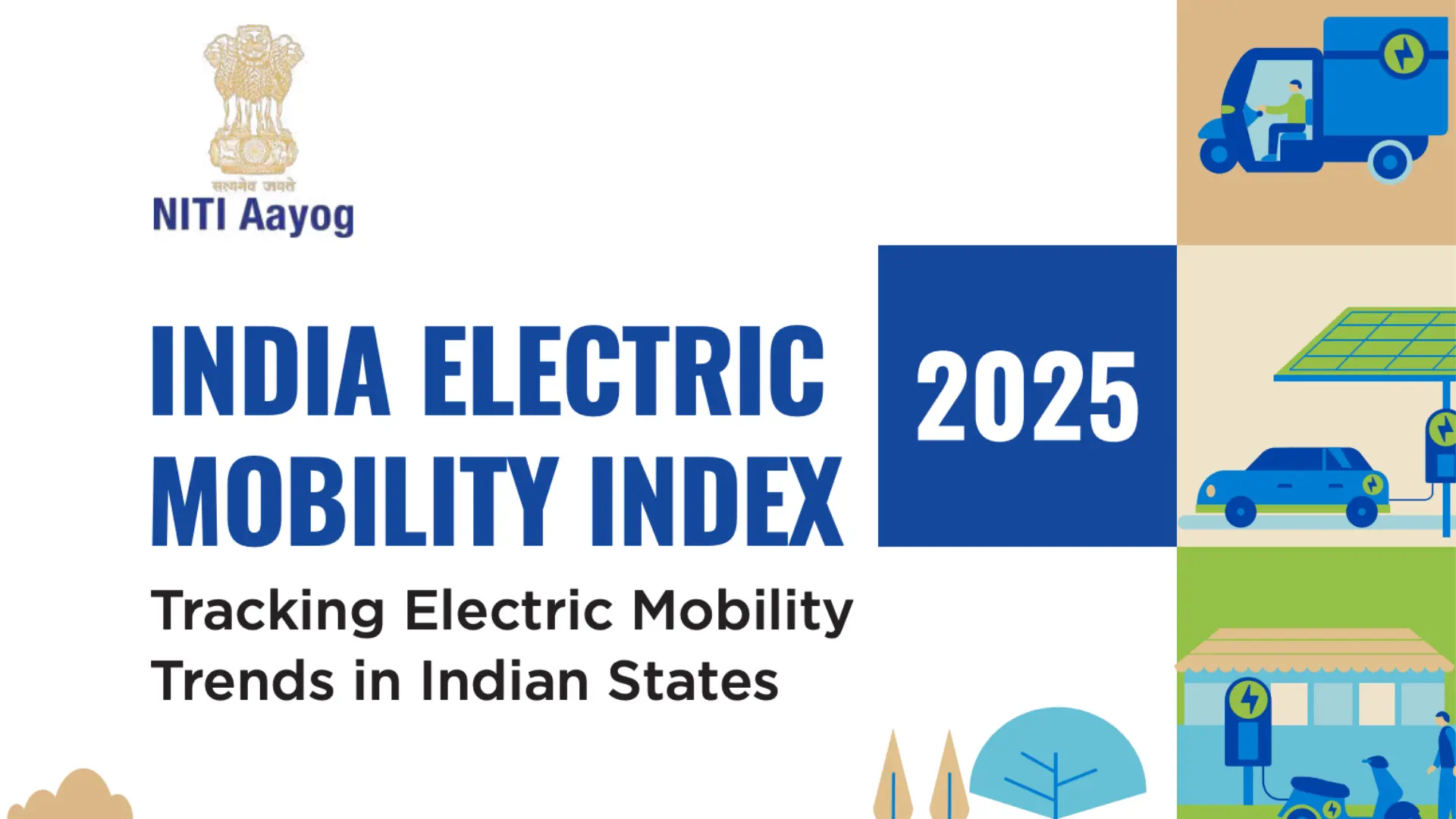
NITI Aayog’s India Electric Mobility Index 2025 shows that India’s EV transition is progressing at different speeds across states, with significant differences in adoption, charging readiness and innovation.


Category:
Tag:
- NITI Aayog
- IEMI 2025
India’s electric mobility story is no longer simply about how many electric vehicles are being sold.
The next phase will depend on whether states can build the supporting ecosystem around them: charging infrastructure, effective policies, commercial fleet adoption, research and innovation, and the systems needed to make electric mobility work at scale.
The India Electric Mobility Index (IEMI) 2025, released by NITI Aayog on September 16, offers a state-level view of that transition. Developed by NITI Aayog in partnership with WRI India, the second edition assesses all 28 states and eight Union Territories across three areas: transport electrification, charging infrastructure and EV research and innovation.
Rather than treating EV progress as a single number, the index looks at the different pieces that make up an electric mobility ecosystem.
What the IEMI Measures
The index has three themes, covering 16 indicators in total. The indicators are divided between outcomes, which measure observed progress, and enablers, which capture the policies and conditions supporting that progress.
| Theme | Share of overall score | What it examines |
|---|---|---|
| Transport Electrification Progress | 50% | Private and commercial EV adoption, policies, incentives and other transition measures |
| Charging Infrastructure Readiness | 30% | Charger availability, charging infrastructure initiatives and related support |
| EV Research and Innovation Status | 20% | Research, innovation and the wider EV technology ecosystem |
The scores are expressed on a scale of 0 to 100. For the overall index, jurisdictions are classified as Top Performers, Frontrunners, Emerging Performers and Aspirants based on their scores.
For IEMI 2025, NITI Aayog also changed the assessment structure by creating separate peer groups for Large States, Union Territories and City States, and Hilly and Northeastern States. This was intended to make comparisons more context-sensitive.
Delhi Leads the Overall Index
Delhi recorded the highest overall IEMI score at 84, followed by Maharashtra at 78, Karnataka at 73, Chandigarh at 71 and Goa at 65.
These figures represent the overall composite score across the index's three themes, rather than EV sales or registrations alone.
| Position | State/UT | IEMI 2025 score |
|---|---|---|
| 1 | Delhi | 84 |
| 2 | Maharashtra | 78 |
| 3 | Karnataka | 73 |
| 4 | Chandigarh | 71 |
| 5 | Goa | 65 |
Among the Large States, Maharashtra and Karnataka were the two jurisdictions in the Top Performer category on the overall index.
But the overall ranking only tells part of the story. Looking at the three individual themes reveals why states can perform very differently across different parts of the EV ecosystem.
EV Adoption and Infrastructure Do Not Always Move Together
Delhi and Chandigarh led the Transport Electrification Progress theme, scoring 77 and 75 respectively. Maharashtra led among the Large States with a score of 68.
The theme does not measure EV sales alone. It incorporates private and commercial EV adoption alongside governance initiatives, purchase incentives, transition initiatives, operational support and fuel-price parity.
The picture changes when charging infrastructure is considered separately.
Karnataka scored 97 in Charging Infrastructure Readiness, followed by Maharashtra and Haryana at 91 each. Tamil Nadu scored 73.
The contrast between individual states is particularly revealing. Haryana recorded a 91 in charging infrastructure readiness but 19 in transport electrification progress. Uttar Pradesh, meanwhile, scored 58 in transport electrification progress and 36 in charging infrastructure readiness.
The numbers underline a simple point: EV adoption and charging readiness are connected, but they are not the same measure of progress.
Research and Innovation Remains Another Story
The third pillar looks at the ecosystem supporting future EV development rather than current adoption alone.
Maharashtra recorded the highest score among Large States in EV Research and Innovation Status, at 85. Karnataka scored 82 and Tamil Nadu 77. Haryana, Telangana and Madhya Pradesh were also classified as Top Performers under this theme.
This dimension matters as India's electric mobility industry develops beyond vehicle sales. Battery technology, components, charging systems, software, testing and specialised skills will all influence how much of the EV value chain can develop within the country.
The report's state-level assessment therefore provides a broader picture than a conventional vehicle-registration ranking.
Madhya Pradesh Records the Biggest Rise
The index also captures changes in relative performance between editions.
Madhya Pradesh moved from 23rd in IEMI 2024 to seventh in IEMI 2025, with its score rising from 31 to 59. NITI Aayog identifies it as the jurisdiction with the largest improvement in ranking.
Goa also moved up 10 positions, reaching fifth overall, while Puducherry climbed 10 positions to 17th.
Ladakh, on the other hand, dropped 12 positions. The report notes that this was primarily associated with changes to the methodology used for assessing charging infrastructure, rather than being interpreted simply as a deterioration in its electric mobility performance.
This is an important distinction when reading the index: a change in ranking does not automatically mean that a state's underlying performance improved or deteriorated by the same extent.
States Are Taking Different Routes to Electrification
The state profiles in the report also show that there is no single model for building an EV ecosystem.
Karnataka, for example, has built on its early EV policy framework while introducing measures around charging infrastructure and related implementation mechanisms. Maharashtra combines its large automotive base with EV-focused policy measures and a sizeable start-up ecosystem. Tamil Nadu is using its established automotive industry while also focusing on EV skills and servicing. Madhya Pradesh has designated five cities as EV Model Cities.
These approaches reflect differences in industrial capacity, geography, fiscal resources and existing transport systems.
NITI Aayog itself notes that such differences are important when interpreting state-level performance, rather than treating them as a problem with the index.
India's EV Market Has Moved Beyond the Early Adoption Phase
The broader numbers also show how quickly India's electric mobility market has changed.
According to the IEMI 2025 report, EV penetration reached 8.25% in 2025-26, compared with around 0.5% in 2018. More than 8.7 million EVs were on Indian roads, while close to 2.5 million EVs were registered during 2025-26.
The report therefore comes at a point when India's EV discussion is shifting from whether electric mobility will grow to what infrastructure and ecosystem will be required to support that growth.
The government is also increasingly looking at charging reliability and distribution rather than simply the number of chargers installed. At the launch of the index, NITI Aayog highlighted the need for charging infrastructure to be spatially well-distributed and reliable, alongside greater public-transport electrification and investment in research and innovation.
What the IEMI Means for India's EV Transition
The most useful takeaway from the IEMI 2025 is that India's electric mobility transition is not progressing uniformly.
One state may have stronger EV adoption. Another may have a more developed charging network. A third may have a stronger research and manufacturing ecosystem.
Looking at only one of these indicators can therefore give an incomplete picture.
For India's next phase of electric mobility, the challenge is to bring these different elements closer together: vehicles, charging infrastructure, policy, manufacturing, research and consumer adoption.
That also makes state-level policy increasingly important. NITI Aayog says 26 of India's 36 states and Union Territories have notified EV policies, while the IEMI's median score increased from 36 to 40 and the highest score rose from 77 to 84 compared with the previous edition.
For an industry moving towards a broader new-energy mobility landscape, the significance of the IEMI goes beyond the ranking table. It provides a snapshot of where India's states stand today and, more importantly, shows which parts of the ecosystem still need to develop alongside EV adoption.
The transition is underway. The next question is how evenly and effectively the supporting ecosystem can grow with it.
To comment and participate in discussion Click Here
Trending Articles