River Indie Registrations Rise 274% in October as River Crosses 100 Showrooms
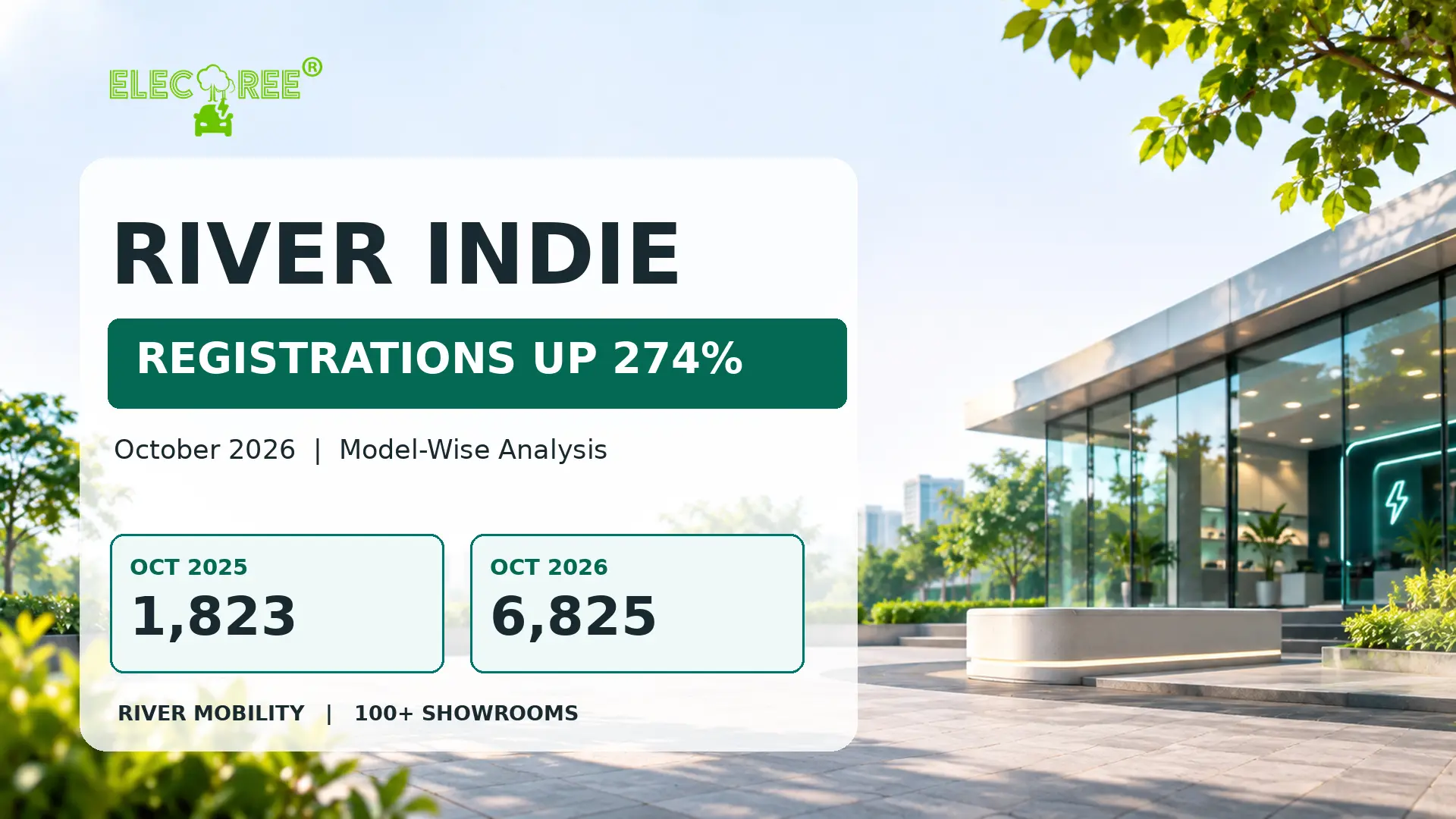
River Indie reached 6,825 mapped registrations in October 2026, up 274% year-on-year. River now has over 100 showrooms, raising questions about sustaining growth.


Category:
Tag:
- River Indie
- River Mobility
- October 2026 EV Registrations
- Electric Scooter Market
- EV Showroom Expansion
- EV Industry Analysis
River Indie recorded 6,825 mapped registrations in October 2026, compared with 1,823 in the same month last year. That is an increase of approximately 274% year-on-year, making October its strongest month in the reviewed 2026 model-wise figures.
At the manufacturer level, River Mobility recorded 6,850 October registrations, up from 5,656 in September. The distinction matters: the Indie accounts for nearly all identified River registrations, but the manufacturer and mapped model totals are not identical.
The growth coincides with another development. River crossed 100 showrooms across 65 cities and 12 states in late October. Yet a bigger retail footprint does not, by itself, explain why registrations are rising. The more interesting question is whether River can sustain its momentum while relying almost entirely on one scooter family.
| Registration measure | Oct 2025 | Sep 2026 | Oct 2026 | MoM | YoY |
|---|---|---|---|---|---|
| River Mobility (manufacturer) | 1,823 | 5,656 | 6,850 | +21.1% | +275.8% |
| River Indie (mapped model) | 1,823 | 5,650 | 6,825 | +20.8% | +274.4% |
Manufacturer and mapped model totals use different levels of the supplied registration datasets. A small number of manufacturer registrations are not assigned to a verified model. Figures are registrations, not factory dispatches.
River's October Was Its Strongest Month of 2026
River's manufacturer-level registrations increased 21.1% from September to October, adding 1,194 units in one month. The rise is notable because the company's progress has not been a straight line.
After registering 6,045 units in July, River slipped to 5,235 in August. It recovered to 5,656 in September before reaching 6,850 in October. This is a stronger signal than a single annual growth percentage: the company moved beyond its previous mid-year high after two more uneven months.
The longer comparison is also substantial. From January through October 2026, River recorded 45,695 manufacturer-level registrations, compared with 12,899 in the corresponding ten months of 2025. That represents growth of approximately 254%, although it began from a relatively small base.
Monthly registrations reflect vehicles recorded during each period. They do not, on their own, reveal dealership orders, customer waiting times, production utilisation or profitability.
Why a Single-Model Strategy Matters
River's registration story is effectively an Indie story. The reviewed October model mapping assigns 6,825 registrations to Indie, compared with a River manufacturer total of 6,850. Almost all of the identified volume therefore comes from one model family.
That gives the company a clear product identity. River markets the Indie as a utility-oriented scooter rather than a conventional family commuter. Its current specifications include a 4 kWh battery, 160 km certified IDC range, 14-inch wheels and 55 litres of combined lockable storage across the underseat area and glovebox.
Those features give buyers a particular reason to consider it, especially if carrying bags, work equipment or daily supplies matters more than minimalist styling. But the registration data does not show which feature motivated purchases or how many buyers use the scooter for business purposes.
Concentration creates a trade-off. One successful model can simplify the brand message and manufacturing focus, but it also leaves total volumes vulnerable if that model faces a demand, supply or service setback. River's expanding network may broaden its reach, but it has not yet diversified the retail product base shown in these figures.
More Than 100 Showrooms: Growth Opportunity and Service Test
At the end of October, River announced that it had crossed 100 showrooms, with a presence in 65 cities across 12 states. Ten outlets were added in one expansion push, and the company set out ambitions for 150 showrooms by the end of 2026 and more than 200 by March 2027.
For a young electric two-wheeler manufacturer, stores can play several roles: letting customers see and test a less familiar product, supporting deliveries and offering local service access. That last role matters because ownership confidence depends on more than the initial sale.
However, store openings late in October should not be credited as the cause of October's full-month registrations. The timing does not establish that link, and a showroom count does not tell us how many stores were operating throughout the period or how productive each location was.
River also raised $120 million in a Series C round announced in August 2026, with expansion plans spanning manufacturing, retail and future products. That gives the company more room to invest, but funding and planned capacity are not the same as demonstrated customer demand.
What River Needs to Prove Next
River is now large enough for its monthly registrations to matter in the wider electric scooter market, but it remains much smaller than the biggest established players. The company's next phase will be judged less by its growth percentage from last year and more by whether it can maintain a higher absolute registration base.
Three indicators will be worth watching: whether monthly registrations stay near or above October's level, whether new stores are matched by reliable servicing, and whether River's planned product expansion eventually reduces dependence on Indie.
For now, October shows genuine momentum. Indie registered 6,825 units, while River crossed 100 showrooms. The challenge is turning a strong single-model growth phase into a durable electric two-wheeler business.
Trending Articles
JSW MG Motor Hikes MG Hector Tomahawk EV Prices by ₹75,000 Just Months After Launch
Electric Scooter Battery Warranties Compared: What Do Ather, TVS, Bajaj and VIDA Actually Cover?
Top 4 Best Selling EVs in October 2026: Punch EV Leads Again
VIDA VX2 and Ather Grid: Which Chargers Work, and Why Charging Stops at 80%
Recent Articles