How Much Does It Really Cost to Charge an Electric Scooter at Home?
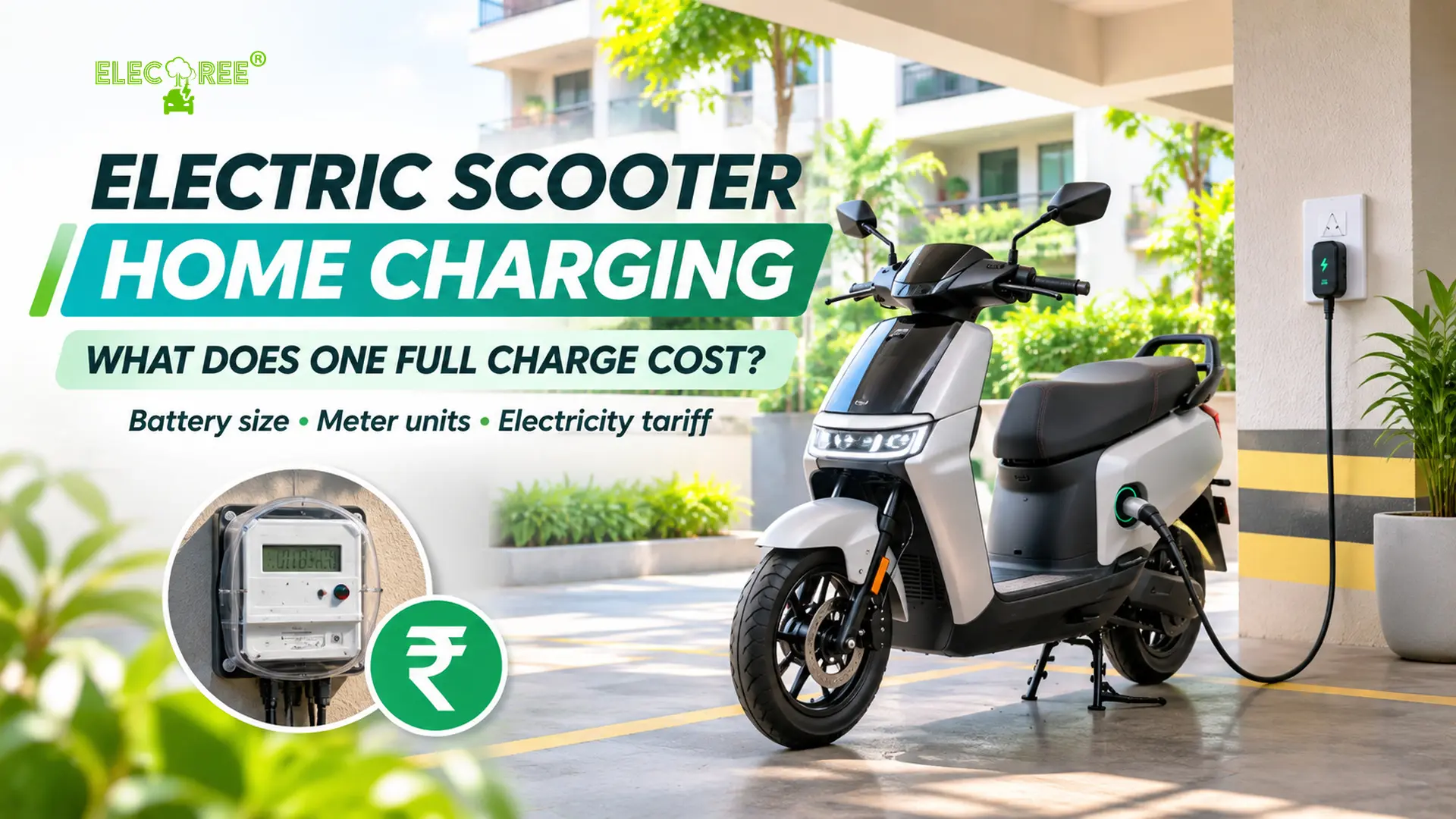
A home charge can cost a few tens of rupees, but battery size alone does not determine your bill. Here is how to calculate the real cost using meter units and your electricity tariff.


Category:
Tag:
- Electric Scooter Charging Cost
- Home EV Charging
- TVS iQube
- Electricity Tariff
- EV Running Cost
- Electric Scooter Ownership
Charging an electric scooter at home is usually inexpensive compared with buying petrol, but the exact electricity bill depends on more than the battery size printed in a brochure. The number that matters for your bill is the electricity drawn from the socket, measured in kilowatt-hours (kWh), or units.
For example, TVS says its iQube 3.5 kWh takes about 3.6 units of electricity for a full charge. At an illustrative electricity rate of ₹8 per unit, that works out to ₹28.80 in energy charges. A household paying ₹6 or ₹10 per additional unit would arrive at a different figure.
The same calculation works for any electric scooter, but it is important to separate published estimates from actual readings. Here are TVS's wall-electricity figures for three iQube battery versions, shown at three example electricity rates.
| Example scooter | Wall electricity (approx.) | ₹6 / unit | ₹8 / unit | ₹10 / unit |
|---|---|---|---|---|
| TVS iQube 2.3 kWh | ~2.3 units | ₹13.80 | ₹18.40 | ₹23.00 |
| TVS iQube 3.5 kWh | ~3.6 units | ₹21.60 | ₹28.80 | ₹36.00 |
| TVS iQube ST 5.3 kWh | ~5.4 units | ₹32.40 | ₹43.20 | ₹54.00 |
TVS-published approximate wall-energy estimates; cost calculations at illustrative electricity rates, not local tariff quotations. Actual charging consumption, taxes and bill components vary.
Battery Capacity Is Not the Same as Meter Consumption
A 3.5 kWh battery refers to the energy capacity associated with the pack, not necessarily the amount the electricity meter records during every full charge. The charger and battery-management system consume energy during charging, and the amount delivered can depend on battery temperature, charging conditions and the state of charge at the start.
That is why TVS's own full-charge electricity estimates are useful. The manufacturer lists approximately 2.3 units for the iQube 2.3 kWh, 3.6 units for the iQube 3.5 kWh and 5.4 units for the iQube ST 5.3 kWh. These are rounded manufacturer examples, not a measurement of every owner's charging session.
Other electric scooters have different battery capacities. Ather's Rizta has been offered with 2.9 kWh and 3.7 kWh packs, while VIDA has sold VX2 variants with batteries including 2.2 kWh and 3.4 kWh. Those specifications help explain the broad energy requirement, but they should not be converted directly into exact bill amounts without knowing electricity drawn from the wall for the specific configuration.
The Tariff Changes the Answer
Electricity bills are not calculated at one universal national rate. Home tariffs depend on the state, distribution company, monthly usage slab and sometimes time-of-day charges or other adjustments.
The rates in our table—₹6, ₹8 and ₹10 per unit—are illustrations, not quoted tariffs for any particular city. If charging the scooter pushes household consumption into a higher slab, the additional units may be billed differently from the household's average unit cost. Fixed charges, taxes and surcharges can also affect the final bill.
For a practical estimate, check the per-unit charges on the latest electricity bill and calculate the incremental cost of the additional units. That is more reliable than assuming a price mentioned in an advertisement applies to every buyer.
What About a Partial Charge?
Owners rarely ride down to zero and fully recharge every day. For budgeting, the useful number is the total electricity consumed over the month, not how often the charger was plugged in.
If you normally top up from 40% to 80%, each session generally uses less electricity than a near-empty-to-full charge. But several smaller top-ups can add up to roughly one full-charge equivalent over time. Actual consumption will vary with charging conditions and any additional overhead.
What Could a 30 km Daily Commute Cost?
Consider an illustrative rider covering 30 km per day, or 900 km over a 30-day month. Suppose their scooter delivers 100 km of real-world riding for every 3.6 units drawn from the wall, and their applicable electricity price is ₹8 per unit.
That would require about nine full-charge equivalents, consuming 32.4 units in the month. At ₹8 per unit, the charging energy would cost ₹259.20, or roughly 29 paise per kilometre.
This is not a measured range claim for the iQube or any other named scooter. If the same wall energy delivered only 75 km in real use, the monthly energy requirement for 900 km would rise to 43.2 units, costing ₹345.60 at the same tariff. The comparison shows why actual riding efficiency can matter as much as the nominal battery size.
How to Find Your Own Charging Cost
Start with the electricity rate applicable to the extra units you use. Next, find a trustworthy estimate of wall electricity consumed for a full charge, preferably from the manufacturer or a suitable energy meter installed and used safely. Then calculate:
Cost per charge = wall electricity consumed (units) × applicable price per unit.
To estimate cost per kilometre, divide the charging cost by the distance you actually cover on the energy used. For a monthly estimate, multiply your measured units per kilometre by expected kilometres, then by the applicable electricity tariff.
If measuring charging consumption separately, use suitable electrical equipment and follow the scooter manufacturer's instructions. Do not improvise with unsafe extension leads or incompatible chargers. TVS, for instance, specifies a compatible portable charger and a suitable domestic socket for the iQube.
The Cost That Is Easy to Miss
A low electricity bill does not represent the full cost of owning a scooter. Financing, insurance, tyres, servicing, potential battery-related expenses and any charging infrastructure installation should be considered separately. Battery-as-a-Service or swapping plans, where offered, can also introduce recurring fees unrelated to household meter units.
The practical takeaway is simple: look beyond the battery's kWh rating and measure the electricity you actually buy. A little attention to the tariff, wall consumption and real-world distance provides a far more useful charging-cost estimate than a single national price claim.
Trending Articles

JSW MG Motor Hikes MG Hector Tomahawk EV Prices by ₹75,000 Just Months After Launch

Electric Scooter Battery Warranties Compared: What Do Ather, TVS, Bajaj and VIDA Actually Cover?

Top 4 Best Selling EVs in October 2026: Punch EV Leads Again
VIDA VX2 and Ather Grid: Which Chargers Work, and Why Charging Stops at 80%
Recent Articles