Delhi’s EV Push: New Charging Facilities Added at Burari and Anand Vihar
Delhi has inaugurated new EV charging facilities at Burari and Anand Vihar alongside the expansion of its automated vehicle-testing network, supporting the city’s broader EV infrastructure push.



Category:
Tag:
- Delhi EV charging
Delhi has added new electric vehicle charging facilities at Burari and Anand Vihar, as the capital expands its EV infrastructure alongside its network of automated vehicle testing stations.
Delhi Chief Minister Rekha Gupta inaugurated the facilities on September 26. The announcement also marked the opening of the Burari Automated Testing Station (ATS), Delhi’s third such facility.
According to statements made at the inauguration, the three operational automated testing stations are expected to collectively handle around 2.5 lakh commercial vehicle fitness tests every year.
Burari ATS to Handle Around 1 Lakh Vehicles
The Burari ATS is expected to conduct fitness checks for around 1 lakh commercial vehicles annually.
It joins the existing automated testing facilities at Tehkhand and Nand Nagri, expanding Delhi’s capacity for automated vehicle fitness testing.
| Automated Testing Station | Status / Capacity |
|---|---|
| Burari | Around 1 lakh vehicles annually |
| Tehkhand | Operational |
| Nand Nagri | Operational |
| Jhuljhuli | Planned |
Delhi Health Minister Pankaj Kumar Singh said a fourth automated testing station at Jhuljhuli is expected to become operational within around one to one-and-a-half months.
Together, the three operational centres are expected to handle around 2.5 lakh commercial vehicle fitness tests each year.
EV Charging Added at Burari and Anand Vihar
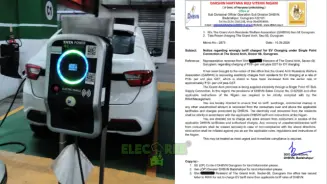
The EV-related development is the addition of charging facilities at the Burari and Anand Vihar testing station locations.
However, details such as the number of chargers, charging capacity, connector types, tariffs and operating hours have not been specified in the information released around the inauguration. These details will be important in determining how useful the facilities will be for EV owners.
The charging facilities form part of Delhi’s wider effort to increase access to EV infrastructure across the city.
Delhi Is Expanding Its Charging Network
The development comes against the backdrop of Delhi’s EV Policy 2026, which places greater emphasis on building and monitoring public charging and battery-swapping infrastructure.
Under the policy, Delhi Transco Limited, through the Power Department, is responsible for planning, deploying and monitoring public EV charging and battery-swapping stations across the National Capital Territory.
The policy also calls for performance standards covering aspects such as uptime and reliability of public charging infrastructure.
Delhi Chief Minister Rekha Gupta had earlier said that the city had around 9,000 charging points and was targeting nearly 32,000 by 2030.
The government has indicated that charging infrastructure will be expanded across locations including residential areas, offices, markets, parking facilities and other public spaces.
Anand Vihar Already Has EV Charging Infrastructure
The latest development adds to charging infrastructure that is already coming up around Anand Vihar.
Earlier this year, the National Capital Region Transport Corporation commissioned a fast EV charging facility at Anand Vihar on the Delhi-Meerut Namo Bharat corridor.
The facility has 10 high-voltage charging units rated at 480 kW each and can charge up to 10 vehicles simultaneously. NCRTC has also said that the facility includes charging provisions for heavy commercial EVs.
This facility is separate from the charging infrastructure inaugurated at the Anand Vihar testing station.
Why This Matters for EVs
Delhi’s latest move shows that EV charging is increasingly being incorporated into existing transport infrastructure rather than being developed only as standalone charging stations.
For a city seeking to increase electric vehicle adoption, the location of chargers is as important as the total number installed. Charging facilities at transport-related sites can add to the network available to EV users, although their actual impact will depend on factors such as accessibility, charger capacity, uptime and pricing.
The focus on reliability is particularly important. A larger number of installed chargers does not necessarily translate into a better charging experience if stations are unavailable or difficult to access when drivers need them.
Delhi's EV Infrastructure Push Continues
The Burari and Anand Vihar facilities add another layer to Delhi’s growing EV ecosystem, while the new Burari ATS expands the city’s automated vehicle-testing capacity.
For Delhi, the larger task now is to ensure that charging infrastructure grows alongside the electric vehicle fleet and remains accessible, operational and strategically distributed across the city.
With the government targeting a much larger charging network by 2030, the latest facilities are a small but relevant addition to the infrastructure being built to support Delhi’s transition towards electric mobility.
To comment and participate in discussion Click Here
Trending Articles