India Is Asking People to Switch to EVs. Here Is What Needs to Happen First.
With fuel prices rising and the government urging EV adoption, the gap between aspiration and affordability has never been clearer. ElecTree outlines what structural policy changes India actually needs.


Category:
Tag:
- EV Policy India
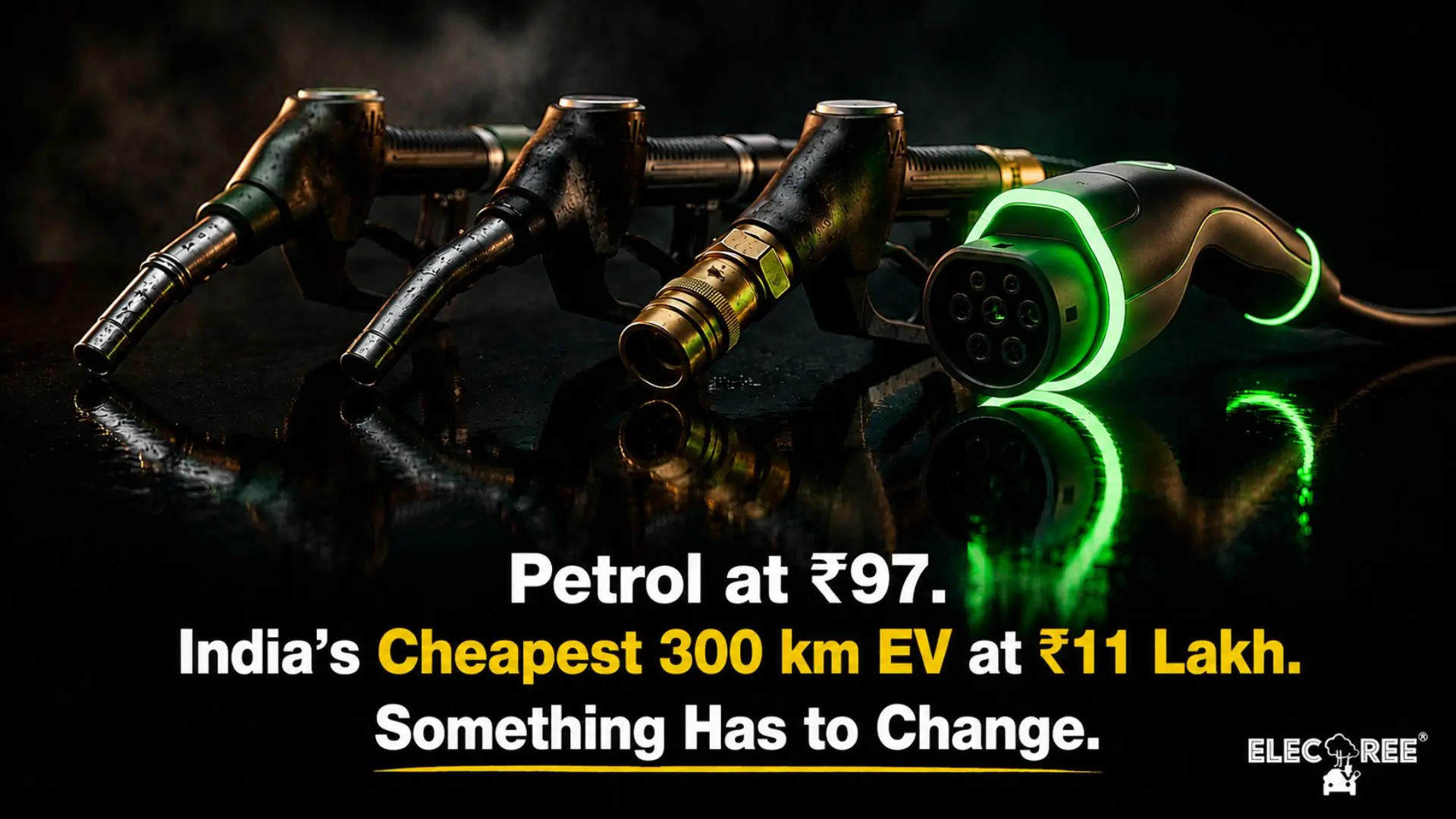
Petrol prices have been hiked by ₹3 per litre. CNG by ₹2. Petrol in Delhi now costs ₹97.77 per litre — in Kolkata it is ₹108.74. Prime Minister Narendra Modi has urged citizens to adopt electric vehicles and consider working from home to reduce fuel consumption. The intent behind that message is sound.
But intent and reality are two different things. India's cheapest four-wheeler EV with a genuine 300+ km range is the Tata Punch EV 40 kWh, starting at ₹10.89 lakh ex-showroom. The middle-income commuter who feels this fuel hike most sharply — running a petrol hatchback, paying EMIs, managing household costs — is nowhere near that price point. For that buyer, switching to an EV is not a choice. It is a financial impossibility.
Asking people to switch to EVs without addressing that gap is not a policy. It is a communication exercise.
How China Bridged the Gap
China did not arrive at affordable EVs through publicity. It spent twenty years building the conditions for them. Government subsidies beginning in 2009, a deliberately constructed domestic supply chain, vertical integration from raw materials to finished vehicles, and relentless pressure on cell manufacturing costs — by 2025 the BYD Seagull offered 305 km of range with a five-star safety rating at the equivalent of roughly ₹6.5 lakh. Profitably. BYD maintained over 20% gross profit margins through 2025 — higher than Tesla.
The foundation of that price advantage is battery cells. China manufactures them at scale, domestically. India imports nearly 100% of its lithium-ion cells — primarily from China — at a cost of $2.2 billion in FY2024-25, according to the Takshashila Institution. As long as that remains true, a ₹6-7 lakh Indian EV with meaningful range is not possible. The math simply does not work.
The ACC PLI Reality
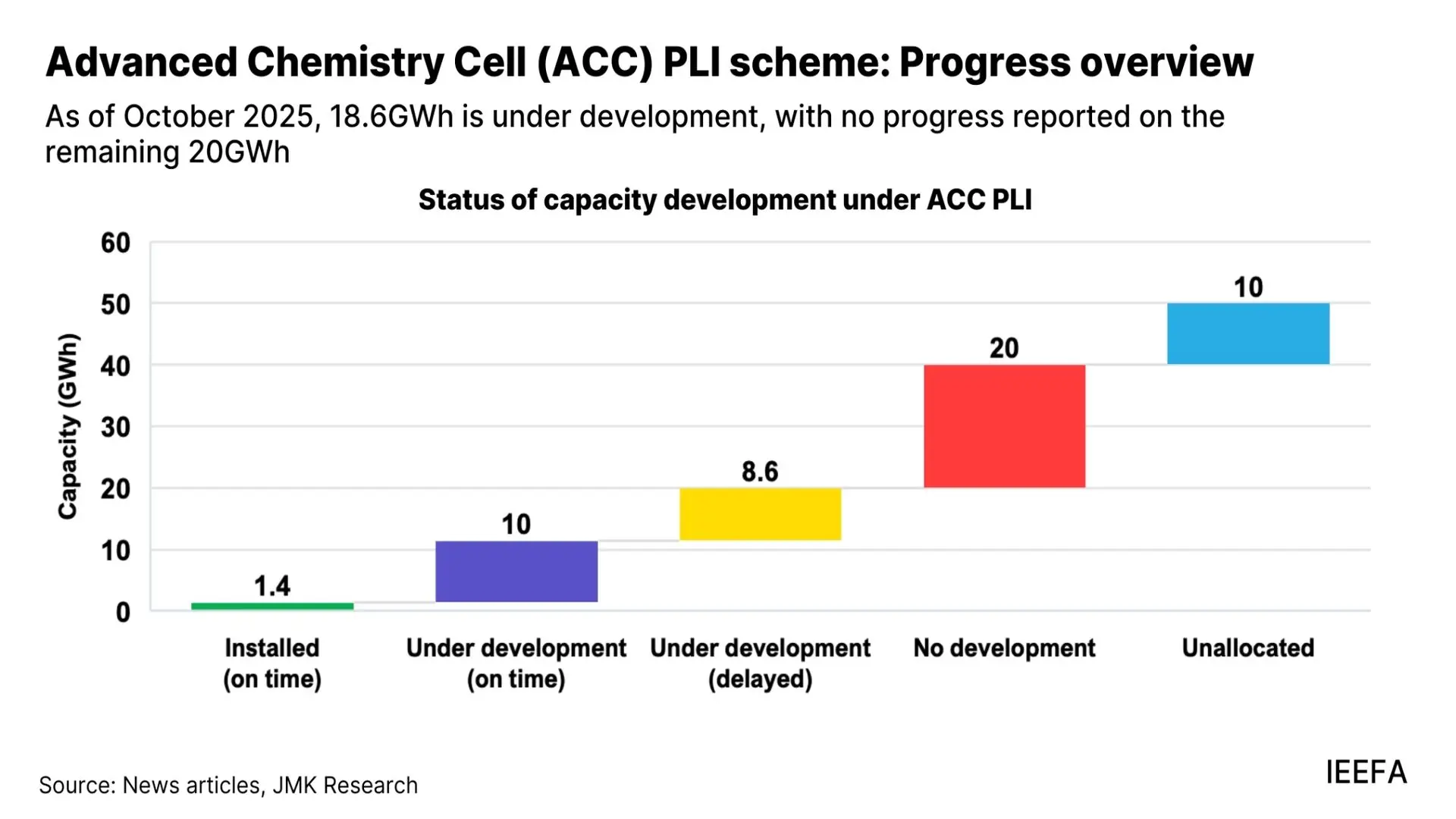
India recognized this problem early. The Advanced Chemistry Cell Production Linked Incentive scheme was launched in October 2021 with an outlay of ₹18,100 crore — targeting 50 GWh of domestic cell manufacturing capacity by 2025.
The result has been deeply disappointing. As of October 2025, only 1.4 GWh had been commissioned within the stipulated timeline — 2.8% of the target — entirely by Ola Electric. Against a job creation target of over 10 lakh, the scheme generated 1,118 jobs. One of the critical bottlenecks identified in the joint analysis by IEEFA and JMK Research was visa approval delays for Chinese technical specialists required for equipment installation.
That is a revealing detail. India needs Chinese technical expertise to build the very manufacturing capacity designed to reduce dependence on China — and the visa process is slowing it down.
What India Should Do
1. Calibrate the technology partnership policy for cell manufacturing
The ACC PLI's domestic value addition requirements are well-intentioned but have become a bottleneck. India should selectively allow technology transfer agreements and R&D partnerships with established cell manufacturers — easing visa approvals for technical specialists, reducing initial domestic value addition thresholds, and incentivizing joint R&D investment. This is not about giving away the industry. It is about using external expertise as a bridge while India builds its own capability — the same approach China used with foreign automotive joint ventures in the 1990s before indigenizing. Time-bound, structured, with clear milestones toward domestic self-sufficiency.
2. Prioritize critical mineral and rare earth mining
India has identified lithium reserves in Jammu and Kashmir and Karnataka. The National Critical Mineral Mission, launched in January 2025, is a step in the right direction. But intent needs to become extraction. Fast-tracked environmental clearances for strategically important mining projects, dedicated processing infrastructure, and international partnerships for refining technology would reduce India's raw material import dependency alongside cell manufacturing. Without domestic raw materials, even a domestic cell factory will remain partially import-dependent.
3. A national home charging framework — not just state-level drafts
When Gurugram's fire department began issuing notices to residential societies flagging basement EV chargers as non-permissible, it exposed a fundamental gap — India has no national guidelines for residential EV charging. ElecTree broke that story. Haryana subsequently released draft fire safety guidelines for EV charging stations on 29 April 2026 — a welcome step, but still state-level and still a draft.
For millions of apartment residents across India, the inability to install a home charger is a stronger deterrent than the vehicle price itself. A national law mandating EV-charging-ready infrastructure in all new residential buildings — with standardized safety norms, clear society-level permissions, and defined electrical specifications — would remove this friction permanently. State-level drafts are a start. A national mandate is what changes buyer behaviour.
4. Operational public charging, not just new stations
The government recently cleared ₹503 crore for 4,874 new public EV charging stations under PM E-Drive. The number is welcome. But as of 1 March 2026, India had 27,737 chargers installed over five years — and only 22,753 were operational. Roughly one in five was non-functional on any given day. However, Indian 4W EV users however report only 1 in 5 as functional in reality. New stations without mandatory uptime standards and maintenance accountability will replicate the same problem at greater scale. Hardware investment without operational standards is not infrastructure — it is inventory.
The Macro Case — Crude vs Batteries
There is a larger argument that goes beyond affordability. As ElecTree's stress test on India's energy import dependency showed in the context of the West Asia conflict — when Brent crude peaked at $126 per barrel during the Strait of Hormuz closure — India's crude import bill in FY25 was $137 billion at 88.2% import dependency.
Battery cell imports from China cost India $2.2 billion in the same year. The ratio is approximately 31:1.
But even that understates the true asymmetry. India's crude import burden is paid every year, permanently, for every ICE vehicle on its roads. A battery is paid for once — at the point of manufacture. Once an EV is on the road, it eliminates crude demand for its entire operational life with no recurring import cost. Shifting from crude dependency to battery dependency is not trading one problem for another. It is trading a permanent recurring liability for a finite, reducible one.
Every rupee invested in domestic cell manufacturing capacity today reduces both the vehicle price gap and the forex vulnerability simultaneously.
Publicity Is Not a Policy
The fuel price hike has created a moment of genuine public attention on energy costs. That attention will fade. What will not fade is the structural reality — that without affordable EVs, a national home charging framework, reliable public charging infrastructure, and domestic battery manufacturing, the government's EV adoption message has no foundation to stand on.
China's mass EV adoption was not built on awareness campaigns. It was built on two decades of manufacturing ecosystem development, supply chain investment, and price competition. India is at year four of a serious attempt. The next four years will determine whether this becomes a structural transition or a recurring announcement.
The fuel price hike is a signal. The government should respond with policy, not publicity.
Trending Articles