Hyundai India (2021–2025): The SUV Boom, the CNG Pivot, and the Missing EVs
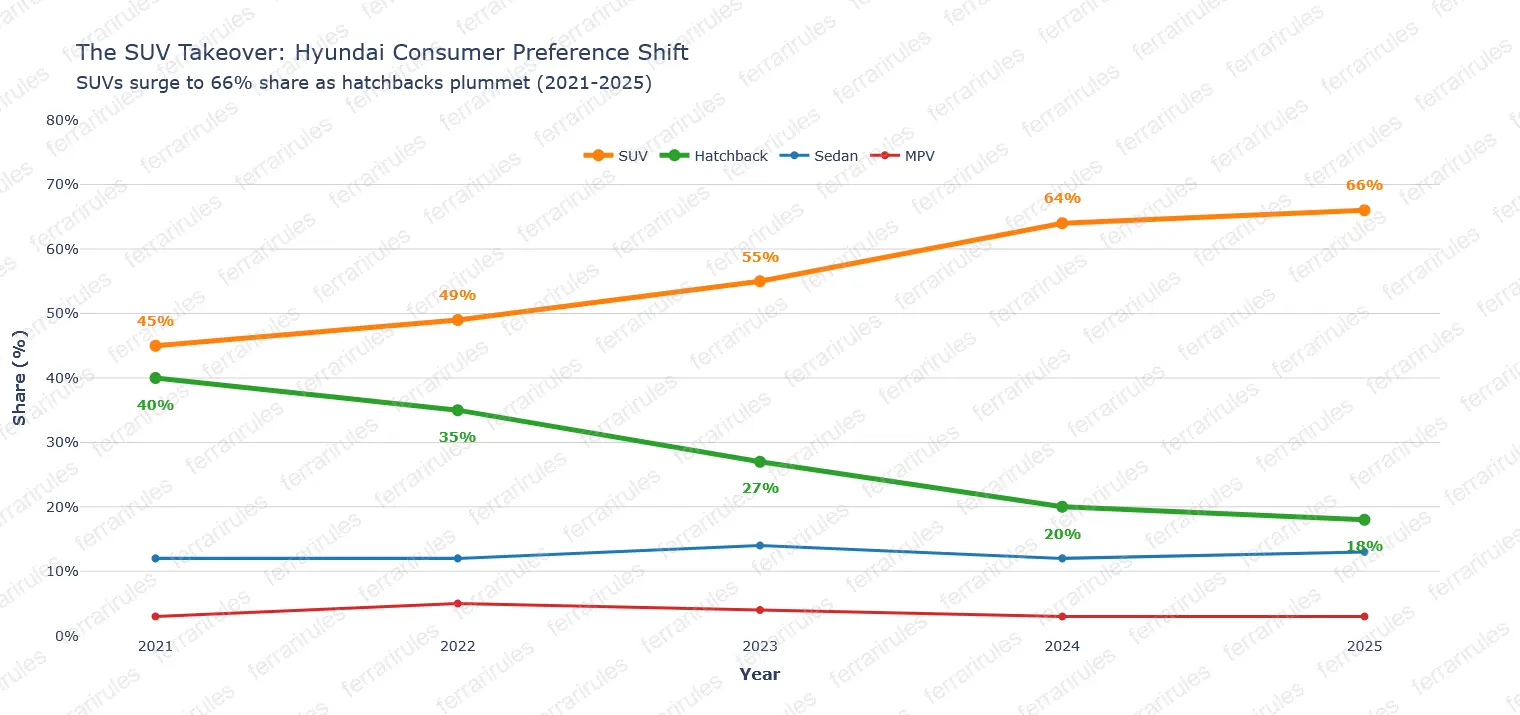
Hyundai Motor India’s 2021–2025 story is not just about steady sales growth, but about a deep portfolio shift toward SUVs and away from hatchbacks. SUVs expanded from 45% to 66% of Hyundai’s mix over the period, while hatchbacks fell from 40% to 18%, showing how strongly buyer preferences have changed. The broader takeaway is that Hyundai has protected volume through SUVs, CNG, and fleet demand, but risks losing ground if it does not rebuild momentum in newer growth areas


Category:
Tag:
- Hyundai Motor India
- Hyundai sales analysis
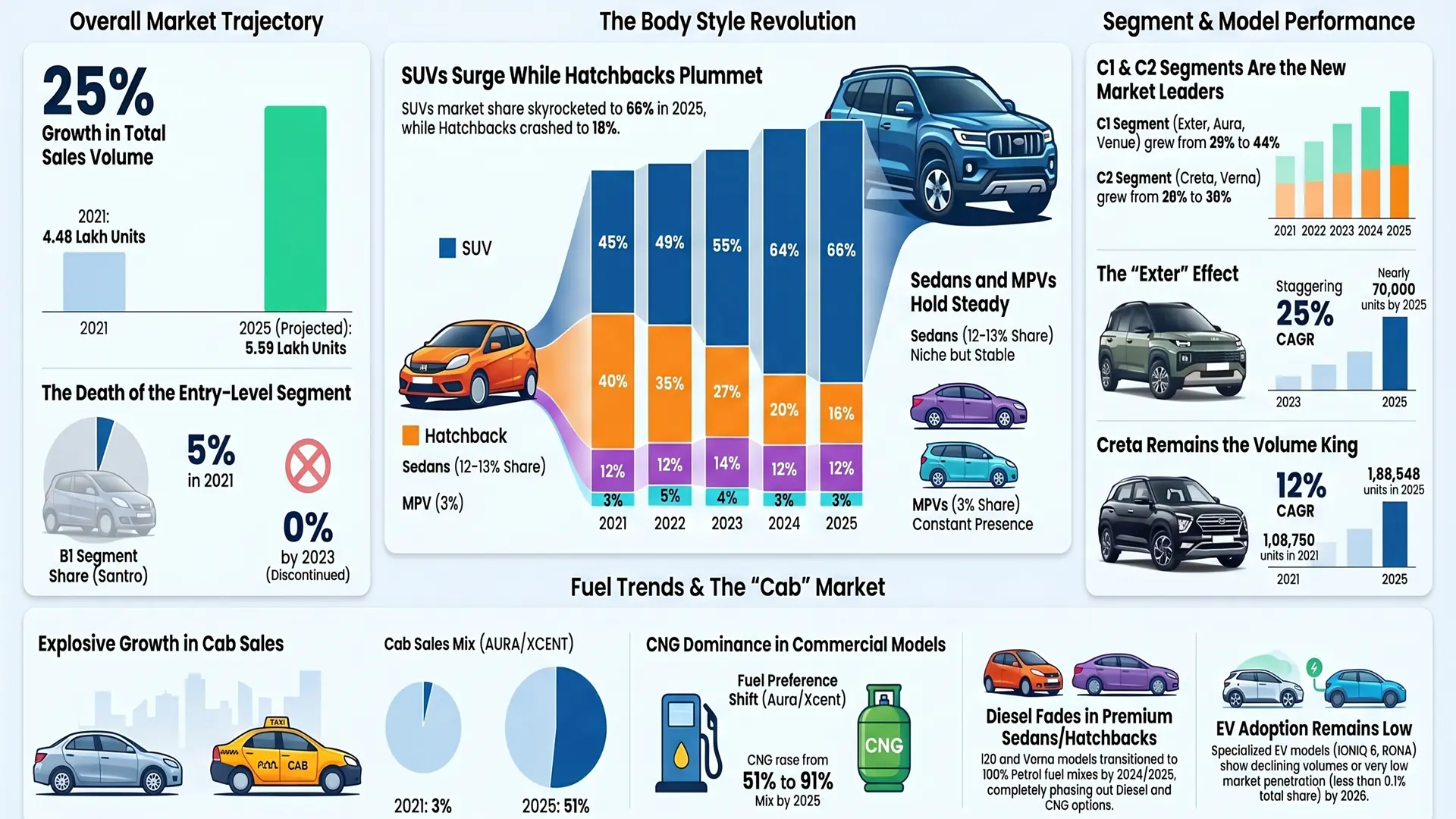
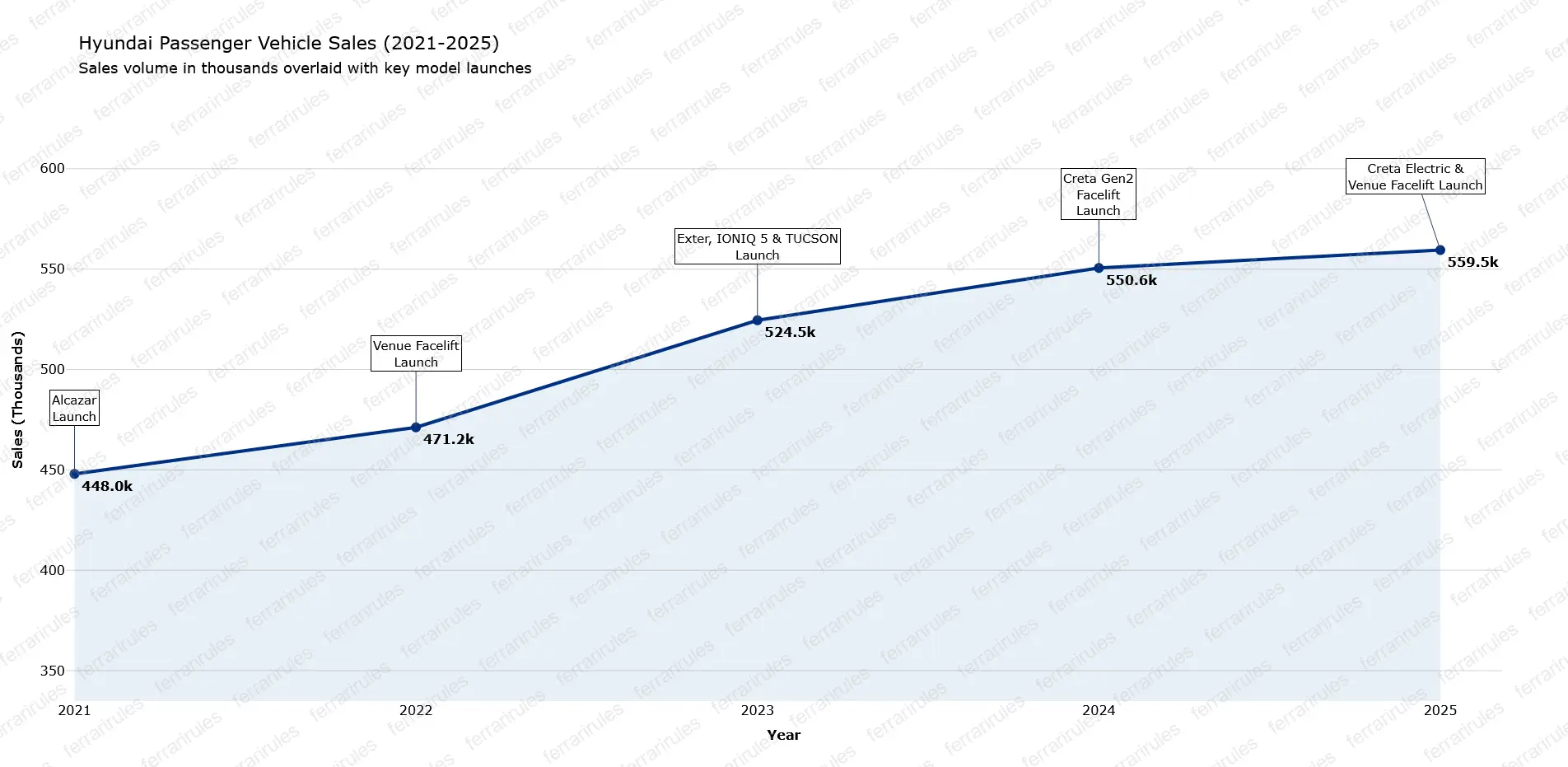
The 2021–2025 period marks a transformative era for Hyundai Motor India, characterized less by sheer volume growth and more by radical portfolio rationalization. While total sales grew from 4,48,075 to 5,59,485 units—representing a modest 5% Compound Annual Growth Rate (CAGR)—this surface-level stability masks a profound structural shift.
Over the last five years, Hyundai executed a complete exit from the entry-level hatchback (B1) and premium (D1) segments. Simultaneously, the automaker attempted to forge new volume pillars by introducing the Exter (sub-compact SUV) and Alcazar (MPV). Despite these additions, Hyundai’s overall growth trajectory has decelerated, causing the brand to fall behind Tata and Mahindra in the overall sales standings by 2025.
The SUV Hegemony: Deconstructing the Body Type Paradigm Shift
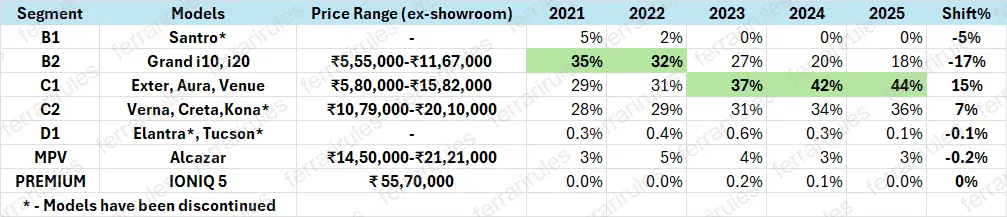
Data from these five years illustrates a stark polarization in consumer preferences and Hyundai's resulting production focus:
- The SUV Surge: SUVs have ascended from a 45% market share in 2021 to a dominant 66% in 2025. This 21-percentage-point expansion represents the absolute core of Hyundai's modern growth engine.
- The Hatchback Recession: Conversely, the once-dominant hatchback segment plummeted from 40% in 2021 to just 18% in 2025. Legacy nameplates like the Grand i10 and i20 are rapidly losing traction as consumers migrate toward higher-riding alternatives.
- Sedan and MPV Stability: Despite the market's SUV obsession, sedans maintained a resilient, albeit narrow, bandwidth (12% to 13%), driven almost entirely by the Aura cab sales. MPVs remained functionally flat at a 3% share.
Portfolio Performance: Winners and Strategic Phase-Outs
The Growth Engines
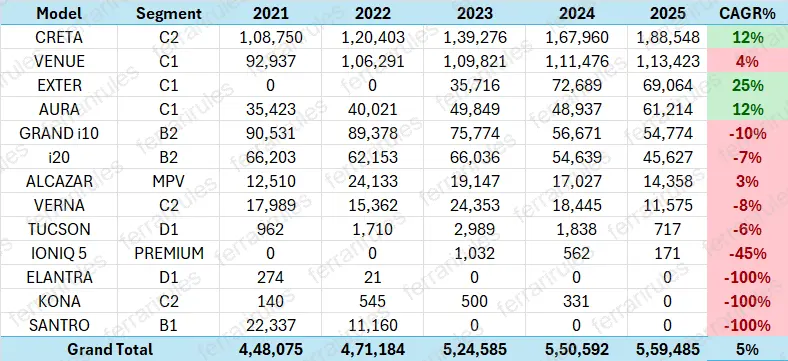
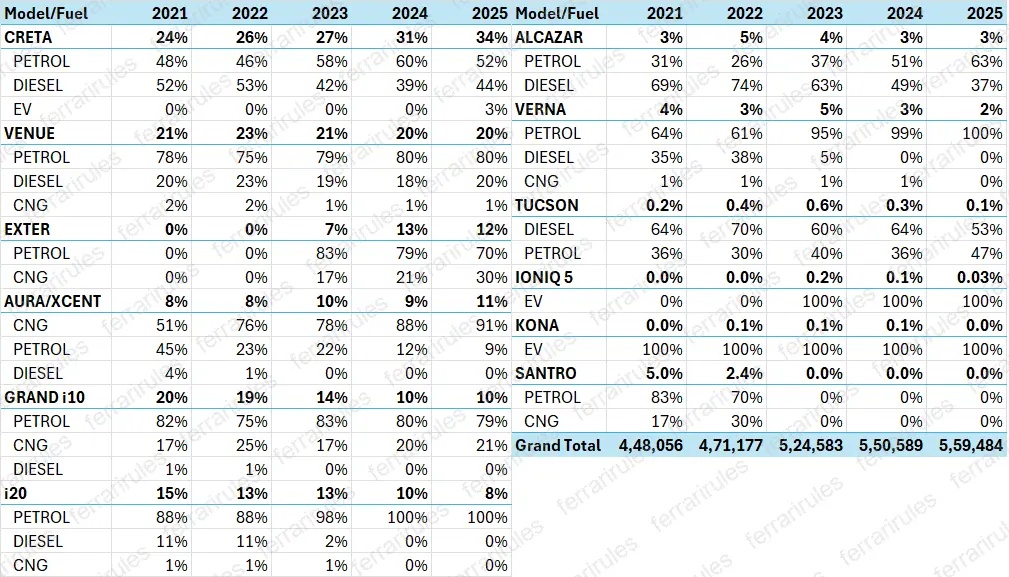
- Creta (12% CAGR): The undisputed flagship of the C2 segment, Creta volumes surged to 1,88,548 units in 2025. It is now the central pillar of Hyundai India, commanding a 34% share of total brand sales—up a massive 10% in five years.
- Exter (25% CAGR): A masterstroke in the C1 segment, the Exter provided a lucrative SUV alternative to the Grand i10, capturing 69,064 units in 2025. However, while it posted strong initial growth over 2023, its momentum between 2024 and 2025 has notably slowed.
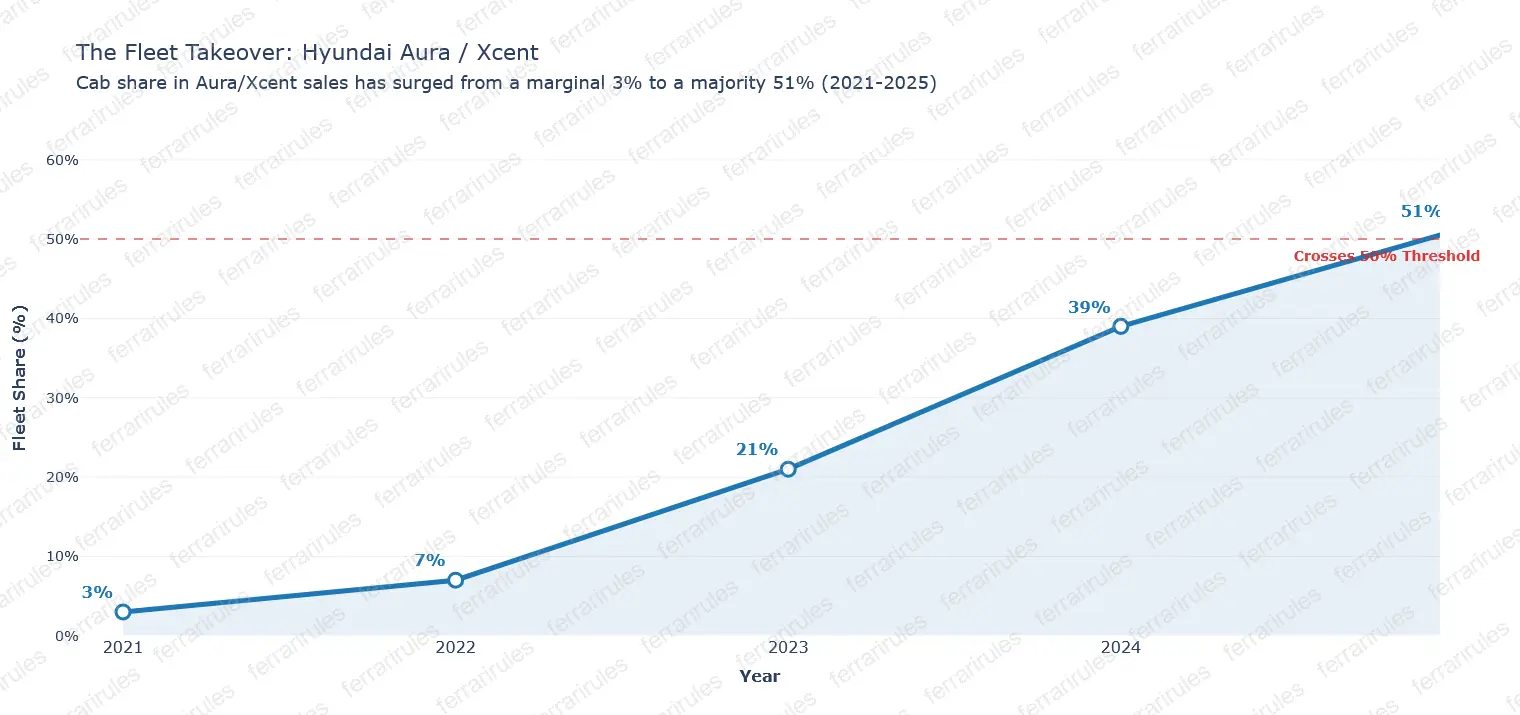
- Aura (12% CAGR): The Aura successfully carved out a high-volume niche by pivoting toward a "fleet-first" strategy. In 2025, an overwhelming 51% of Aura sales came from the commercial cab segment, sharing fleet dominance with Maruti's Dzire.
Declining Pillars and Asset Rationalization
- Grand i10 (-10% CAGR) & i20 (-7% CAGR): Both legacy hatchbacks have suffered severe declines. Together, they held a 35% sales share in 2021, which has now halved to 18% in 2025 as buyers migrate to the Exter and Venue. By contrast, competitors like Maruti Suzuki have managed to sustain growth in their B2 segments over the same period.
- Strategic Discontinuations: Hyundai executed a total withdrawal from the small hatchback (B1) segment by axing the Santro in 2022. The premium D1 segment was similarly abandoned, with the Elantra discontinued in 2021 and the Tucson quietly phased out in late 2025.
The Powertrain Pivot: Petrol Dominance, CNG Fleets, and EV Stagnation
Hyundai’s powertrain strategy has evolved into a heavily bifurcated approach: petrol for mass retail, and CNG for high-utility fleet segments.
- The Petrol Foundation: Petrol remains the primary powertrain, accounting for 80% of Venue sales. To streamline production amid evaporating diesel demand, both the i20 and Verna have been consolidated into 100% petrol portfolios.
- The CNG Surge: The Aura has undergone a near-total fuel transformation, with 91% of its 2025 volume powered by CNG—a shift inextricably linked to its 51% cab utilization rate. Similarly, the Exter has seen its CNG mix rise from 0% to a healthy 30%.
- Diesel’s Niche Resilience: While no longer a portfolio-wide staple, diesel remains highly resilient in the Creta (44% share) and Venue (20% share). However, Alcazar diesel sales share dropped sharply from 69% to 37%, indicating a shift toward petrol even in three-row SUVs.
- Squandering the Early-Mover EV Advantage: Despite an early entry into the Indian EV space, Hyundai's "wait-and-see" approach has resulted in a severe loss of momentum. The discontinuation of the Kona and the sharp regression of the Ioniq 5—which plummeted from 1,032 units in 2023 to just 171 units in 2025 (-45% CAGR)—highlights an inability to scale a premium EV narrative. Furthermore, the newly introduced Creta EV currently represents a negligible 3% of the Creta’s total 2025 volume.
P.S. - For models that don't have factory-fitted CNG option, the data reflects after-market CNG installation
Strategic Implications
While Hyundai has masterfully executed the ICE-to-CNG transition to secure short-term, high-margin profitability, its overall EV share has remained stagnant at 0.0%-0.2%. By prioritizing ICE SUVs and CNG-heavy fleet assets, the brand has left itself vulnerable in the burgeoning electric transition, where it now severely trails more aggressive competitors.
To reclaim its growth momentum and defend its market position against Tata and Mahindra, Hyundai must introduce compelling new nameplates and urgently address its conspicuous lack of EV scale.
Disclaimer: All charts have been created by the author with Vahan as the data source (without Telangana data). Digitally removing the ElecTree logo or any watermarks and repurposing the charts will amount to copyright infringement. Cite this article as a source and provide the link if sharing details on social media or a news publication.
Trending Articles