
India's Energy Import Dependency: A Stress Test — What the Iran War Tells Us About Crude, EVs, and Strategic Risk
A stress test on India's two energy import dependencies — crude oil and EV battery cells. Using FY25 government data and real price scenarios from the 2026 Iran war, the numbers reveal a structural asymmetry that has direct implications for India's energy security strategy.


Category:
Tag:
- Energy Security
- India EV Policy
- Stress Test
On February 28, 2026, the United States and Israel launched military strikes on Iran. Within days, Iran's Islamic Revolutionary Guard Corps closed the Strait of Hormuz — the narrow waterway between Iran and Oman through which nearly one-fifth of the world's daily oil supply flows. For 40 days, global energy markets went into shock. Brent crude, which was trading at $73 per barrel on February 27, surged past $100 per barrel by early March and peaked at nearly $126 per barrel on April 2, according to the U.S. Energy Information Administration's Short-Term Energy Outlook (EIA).
A fragile two-week ceasefire, brokered by Pakistan, was announced on April 7-8, 2026. As of writing, the Strait has seen only a trickle of traffic resume. Negotiations continue. Whether the ceasefire holds is uncertain — the United Nations described it as "shaky" and noted that early signs were mixed.
This article does not take a position on the war. It does something more useful: it applies a stress test.
What Is a Stress Test?
In banking, a stress test is not a prediction. It is a structured exercise that asks: if a specific adverse scenario occurs, what does it cost? Large retail banks run stress tests routinely — to understand what happens to their loan books if interest rates spike, if unemployment rises sharply, or if a sector collapses. The goal is not to forecast the future but to quantify the cost of being unprepared.
The author is an economist and former banker who has conducted stress tests for large retail financial institutions. The framework applied here borrows directly from that methodology — applied not to a loan book, but to India's energy import dependency.
The question this stress test asks is simple: if the Strait of Hormuz closes again, or closes for longer, what does it cost India? And how does that compare to India's other energy import dependency — the battery cells it imports from China to build electric vehicles?
The answer reveals a structural asymmetry that has direct implications for every policy decision India makes about its energy future.
India's Crude Oil Dependency — The Base
Before stress testing anything, we need a clean base. All figures here are from FY2024-25 — the most recent complete financial year — sourced from government data.
India imported 242.4 million metric tonnes of crude oil in FY25, up 4.2% from the previous year, according to the Petroleum Planning and Analysis Cell (PPAC), the official data arm of India's Ministry of Petroleum and Natural Gas. The total crude import bill for FY25 was $137 billion, up 2.7% from $133.4 billion in FY24. India's import dependency for crude oil stood at 88.2% — meaning India produces only about 12% of the crude it consumes domestically.
To put that in perspective: India's combined import bill for crude oil and petroleum products together reached $161 billion in FY25, also per PPAC. The crude figure of $137 billion is what this stress test focuses on, because EVs specifically displace crude demand — not refined petroleum products.
India imports crude from Russia, Iraq, Saudi Arabia, the UAE, and the United States, among others. A significant portion of these imports — particularly from Iraq, Saudi Arabia, and the UAE — transits through the Strait of Hormuz. This is the chokepoint that makes India structurally vulnerable to exactly the kind of disruption that just occurred.
Scenario 1: What Does $130 Per Barrel Cost India?
The Strait of Hormuz closed for 40 days in 2026. Brent crude averaged $103 per barrel in March 2026 and peaked at nearly $128 per barrel on April 2, per the EIA STEO. That was a 40-day closure. The stress test now asks: what if the next closure lasts longer, or the next geopolitical shock pushes crude to $130 per barrel on a sustained basis?
This is not an extreme assumption. The Federal Reserve Bank of Dallas published analysis showing that a Hormuz closure lasting three quarters could push WTI oil prices to $132 per barrel. Separately, a report by Nuvama — cited by the Times of Oman — estimated that crude could touch $110-150 per barrel if the Strait remained closed for four to eight weeks.
We use $130 per barrel as the primary stress scenario, with $150 per barrel referenced as the worst case.
How to calculate the impact:
ICRA, the credit rating agency, has quantified that every $10 per barrel increase in India's average crude price adds approximately $12-13 billion to India's net oil import bill and widens India's current account deficit (CAD) by approximately 0.3% of GDP.
India's FY25 average Indian basket crude price was approximately $75-80 per barrel, implied from the $137 billion import bill on 242.4 million metric tonnes of volume.
At $130 per barrel — a $55 increase over the FY25 base:
- Additional import burden: 5.5 × $12.5 billion = approximately $68-69 billion
- Total crude import bill: approximately $205-206 billion
- CAD widening: 5.5 × 0.3% = approximately 1.65% of GDP
At $150 per barrel — worst case, Nuvama scenario:
- Additional import burden: 7.5 × $12.5 billion = approximately $94 billion
- Total crude import bill: approximately $231 billion
- CAD widening: approximately 2.25% of GDP
To give these numbers human scale: India's total defence budget for FY26 was approximately $75 billion. A sustained $130/barrel crude price would cost India nearly as much in additional crude imports alone — every single year.
And the crucial word is every single year. As long as India runs 45 lakh ICE passenger vehicles annually — and hundreds of millions of ICE vehicles on its roads — this is a recurring, permanent burden. There is no end point. The crude meter never stops.
Now The Other Side: India's EV Battery Cell Dependency on China
India's electric passenger vehicle segment retailed 1,99,923 units in FY2025-26 — an 83.6% jump year-on-year, per FADA retail data. To build these EVs, Indian manufacturers import lithium-ion battery cells — primarily from China.
According to the Takshashila Institution, India's imports of lithium-ion cells from China in FY2024-25 amounted to $2.2 billion. China accounts for 94% of India's total lithium-ion battery imports, per GTAIC citing Ministry of Commerce data. India's top-selling EV manufacturer, Tata Motors, uses cells from Gotion and EVE Energy — both Chinese companies.
The Government of India acknowledged this dependency through PIB, launching the National Critical Mineral Mission in January 2025 specifically to address India's reliance on imported cells and materials.
This is a real dependency. It deserves to be stress tested honestly.
Scenario 2: What If China Restricts Battery Cell Supply to India?
China announced export controls on certain lithium-ion battery technologies in October-November 2025. However, as the Takshashila Institution noted, those controls only cover cells with energy density of 300 Wh/kg or above — which exempts mainstream EV cells used in Indian vehicles, which operate in the 100-280 Wh/kg range.
The stress scenario here goes further: China imposes broader supply restrictions — driven by trade tensions or strategic considerations — causing battery cell prices to spike significantly.
Current average battery cell prices in China are $84 per kWh, having fallen 13% in 2024 alone, per BloombergNEF. The global average is $108 per kWh, per the same source.
Scenario 2A — 50% price spike:
- Cell prices rise from $84/kWh to approximately $126/kWh
- India's annual battery cell import bill rises from $2.2 billion to approximately $3.3 billion
- Additional burden: approximately $1.1 billion
Scenario 2B — 100% price spike (worst case):
- Cell prices double from $84/kWh to approximately $168/kWh
- India's annual battery cell import bill rises to approximately $4.4 billion
- Additional burden: approximately $2.2 billion
These are significant numbers. But here is what makes them fundamentally different from the crude scenario.
The Asymmetry: Why These Two Dependencies Are Not the Same
This is the central finding of the stress test.
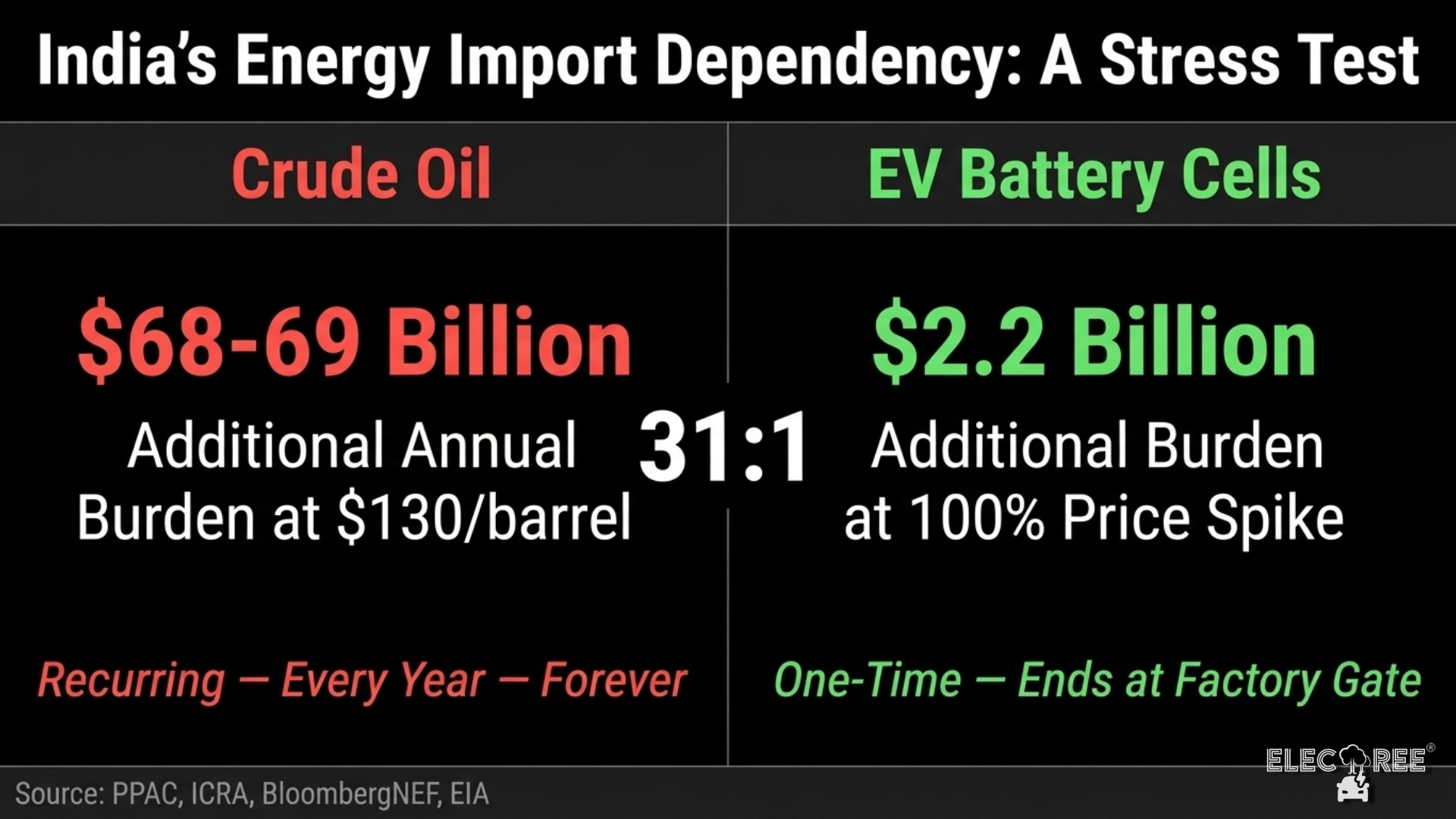
At $130 per barrel crude, India's additional annual import burden is approximately $68-69 billion. Even in the worst case battery cell scenario — prices doubling due to a China supply restriction — India's additional burden is approximately $2.2 billion.
That is a ratio of approximately 31:1.
But even that dramatically understates the true asymmetry. Here is why.
The crude burden of $68-69 billion is paid every year, forever, for as long as India runs ICE vehicles. It does not end. Every ICE car sold today creates a crude import liability that lasts 15-20 years. Multiply that across hundreds of millions of vehicles and the compounding effect is staggering.
The battery cell burden of $2.2 billion — even in the worst case — is paid once, at the point of manufacturing the vehicle. Once an EV rolls off the assembly line and is sold to a customer, that vehicle never needs crude oil for its entire operational life. The battery import dependency ends at the factory gate.
Think of it this way. When you build a house, you pay for bricks once. You do not keep importing bricks every time you want to live in the house. An EV's battery is the bricks. Crude oil is the rent. India currently pays rent — in the form of crude imports — on every ICE vehicle on its roads, every single day, with no end in sight.
The 31:1 ratio is therefore a point-in-time comparison at the moment of manufacture. Over the lifetime of the vehicles, the real ratio is far higher — and it only increases over time, because every EV already on India's roads continues to eliminate crude demand every year, with zero additional battery import burden. Even if India were to stop importing battery cells from China entirely tomorrow, every EV already sold would continue saving India crude import expenditure for the next decade or more.
What This Means for India's Strategic Choices
This stress test does not argue that EVs are without risk. The battery cell dependency on China is real and needs to be addressed — through the PLI scheme for domestic cell manufacturing, through supply chain diversification, and through India's National Critical Mineral Mission. These are legitimate policy imperatives.
But the stress test does reveal something important about the relative scale of these risks. India's crude import dependency is structurally infinite — it compounds with every ICE vehicle sold and every barrel consumed. India's battery cell import dependency is structurally finite — it ends at manufacture and can be progressively reduced through domestic production as India's gigafactory capacity scales up.
The Iran war just ran a live, unplanned stress test on India's energy supply chains. Crude hit $126/barrel. A 40-day closure pushed India toward a scenario that would have cost it approximately $15-20 billion in additional import burden for that period alone. The ceasefire is fragile. Negotiations continue. The strait may close again.
The question for India's policymakers — and for every Indian who buys a car — is not whether this risk is real. The Iran war just confirmed that it is. The question is what structural decisions today reduce India's exposure to the next shock.
The stress test says the answer lies in reducing the number of vehicles that depend on crude — one EV at a time.
Source note: All crude oil data sourced from Petroleum Planning and Analysis Cell (PPAC), Government of India. EV retail data from FADA. Battery cell import data from Takshashila Institution citing trade data. Crude price scenarios from Dallas Fed, EIA STEO, and Nuvama via Times of Oman. Battery price data from BloombergNEF and IEA Global EV Outlook 2025. ICRA multiplier from ICRA. Ceasefire status from UN News and Al Jazeera.
Trending Articles



Recent Articles
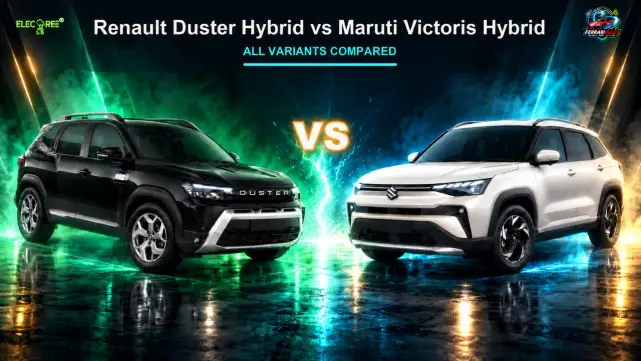
Renault Duster Hybrid vs Maruti Victoris Hybrid: All Variants Compared
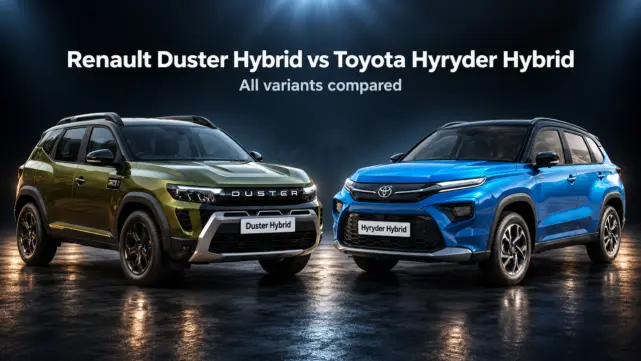
Duster Hybrid vs Hyryder Hybrid: Prices, Powertrain and Variants Compared
Top 5 Best Selling EVs This Year: Windsor Leads with Clear Margin

Renault Duster Hybrid vs Maruti Suzuki Grand Vitara Hybrid: Base, Mid, and Top Variant Comparison