
Delhi's EV Policy 2026: Everything You Need to Know
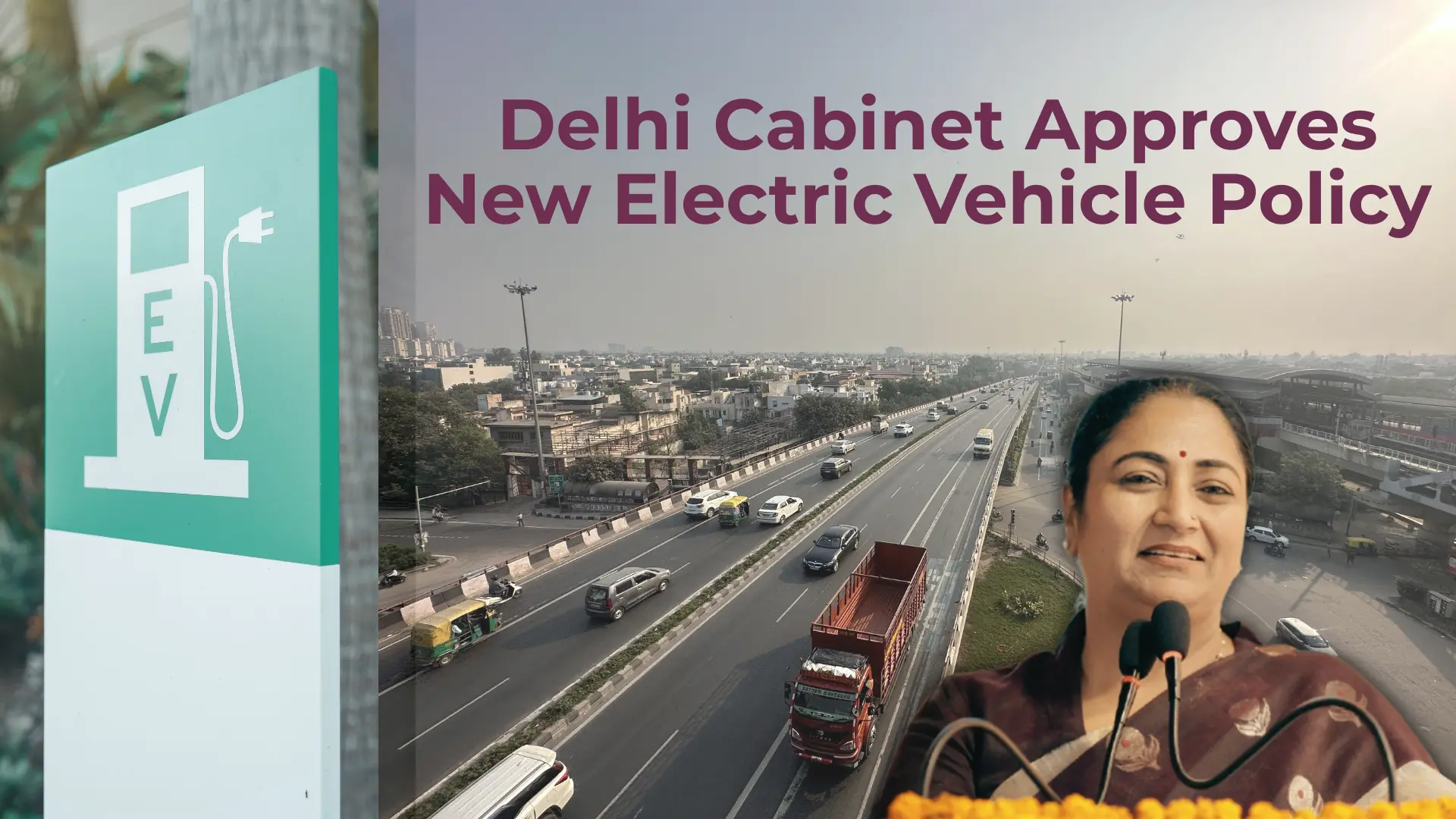
The Delhi Cabinet cleared its new Electric Vehicle Policy on June 29. It kicks in July 1, pending the Lieutenant Governor's approval and runs till March 31, 2030.


Category:
Tag:
- Delhi EV Policy 2026
- Electric Vehicle Policy
- EV Subsidy India
- Clean Mobility
- Zero Emission Vehicles
Delhi has a new electric vehicle policy. The Cabinet cleared it on June 29, and if the Lieutenant Governor approves it, it takes effect July 1 and runs till March 2030. Electric cars priced under ₹30 lakh get a full waiver on road tax and registration. Two-wheelers, three-wheelers, and small trucks get direct purchase subsidies. Owners of older polluting vehicles get up to ₹1 lakh to scrap and switch. The government puts the total value of the policy - incentives, infrastructure, and investment combined, at ₹15,000 crore over four years.
Why this policy exists
Delhi has a vehicular pollution problem that the government can no longer ignore. According to the Commission for Air Quality Management's report submitted to the Supreme Court in January 2026, vehicular emissions are the single largest contributor to Delhi's air pollution, accounting for 23% during winter months alone. Two-wheelers make up roughly 67% of all vehicles on Delhi's roads, and three-wheelers and commercial goods vehicles log disproportionately high daily distances. These are exactly the segments this policy targets.
The policy itself draws on Article 21 of the Constitution - the right to life, which courts have interpreted to include the right to clean air.
What buyers get
For electric cars priced up to ₹30 lakh (ex-showroom), there is a full 100% waiver on road tax and registration fees. Electric cars above ₹30 lakh get no exemption at all, the government has deliberately kept the benefit focused on the mass market.
For two-wheelers priced up to ₹2.25 lakh ex-factory, the purchase subsidy is structured to reward early buyers: ₹30,000 in the first year, ₹20,000 in the second, and ₹10,000 in the third. The subsidy tapers down to nudge people to switch sooner rather than later.
Auto-rickshaw buyers get ₹50,000 in year one, ₹40,000 in year two, and ₹30,000 in year three. For N1 electric goods vehicles - small trucks and delivery vehicles, the incentive is ₹1 lakh in year one, ₹75,000 in year two, and ₹50,000 in year three.
There are also scrappage incentives for anyone who scraps a BS-IV or older vehicle and switches to an EV: ₹1 lakh for cars (capped at the first one lakh applicants), ₹25,000 for three-wheelers, ₹10,000 for two-wheelers, and ₹50,000 for N1 trucks. The purchase of the new EV must happen within six months of receiving the scrappage certificate.
All incentives flow directly to buyers via Direct Benefit Transfer, no dealer intermediaries.
The phase-out timeline
From January 1, 2027, only electric three-wheelers will be registered in Delhi. From April 1, 2028, only electric two-wheelers. This is not a recommendation, it is a registration ban. The government is closing the door on new petrol and CNG vehicles in these segments on fixed calendar dates.
On hybrids: a clear, principled stance
The policy extends a 50% road tax exemption to strong hybrid vehicles, but that is where it stops. No purchase subsidy, no scrappage incentive, nothing else. The full suite of benefits is reserved exclusively for battery-operated vehicles as defined by the Central Motor Vehicles Rules: vehicles powered solely by an electric motor, with energy supplied entirely from an onboard traction battery.
This is the right call, and one we have long argued for. A hybrid, by design, still carries a petrol engine. It still burns fuel on most highway trips and in conditions where the battery depletes. Directing public subsidy toward a vehicle that retains fuel dependency does not serve Delhi's air quality goals, it just lowers the cost of a more efficient petrol car. The policy appears to agree. The real incentive architecture here belongs entirely to zero-emission vehicles.
Charging infrastructure
Delhi Transco Limited has been designated the nodal agency to plan and deploy public charging and battery swapping infrastructure across the city. The policy mandates a single-window clearance system for operators setting up charging stations, and requires every EV dealership to have at least one public charging station, with a minimum of three charger points for two- and three-wheelers and two for four-wheelers.
Battery recycling is also addressed: manufacturers will be held to Battery Waste Management Rules, and the Delhi Pollution Control Committee will facilitate battery collection centres under a public-private partnership model.
The bigger picture
Delhi's EV Policy 2026 is built differently from what came before. It combines shrinking financial carrots with hard regulatory deadlines. Subsidies step down annually, pushing early adoption. Registration bans give manufacturers and buyers a fixed horizon to plan around. And the infrastructure mandate puts obligation on vehicle makers, not just the government.
For the EV sector, this is significant. The policy signals that Delhi is no longer treating electric mobility as a niche choice, it is treating it as the only choice for new registrations in the city's highest-volume segments. That is a structural shift, and the market will have to respond accordingly.
Source: Delhi Electric Vehicle Policy 2026–2030 (Draft), Transport Department, Government of NCT of Delhi (F.No. JC/EV/TPT/2026/02/075819303/15517, dated April 11, 2026); Cabinet approval announced by Chief Minister Rekha Gupta, June 29, 2026.
To comment and participate in discussion Click Here
Trending Articles
Recent Articles

India Clears ₹1.86 Lakh Crore Green Energy Corridor Plan With ₹50,000 Crore for Battery Storage
Porsche Cayenne Electric Launched in India at ₹1.77 Crore: 642 Km Range, 400 kW Charging and More
Government's CAFE III Norms Give EVs a 3x Credit, PHEVs 2.5x
Creta Electric Owners Approach Hyundai - File Petition for Lifetime Battery Warranty