
Delhi EV Policy 2026: A Strong Start — But the Hybrid Concession Is a Strategic Mistake
Delhi's Draft EV Policy 2026-2030 is ambitious and largely well-designed — but one provision stands out as a strategic mistake. We break down the key changes and offers a frank assessment.


Category:
Tag:
- Delhi EV Policy
This is an opinion article. The factual summary of the policy is followed by ElecTree's editorial assessment. The Delhi Draft EV Policy 2026-2030 is currently open for public feedback until May 10, 2026. Readers who wish to share their views with the Delhi government can do so at evpolicy2026@gmail.com.
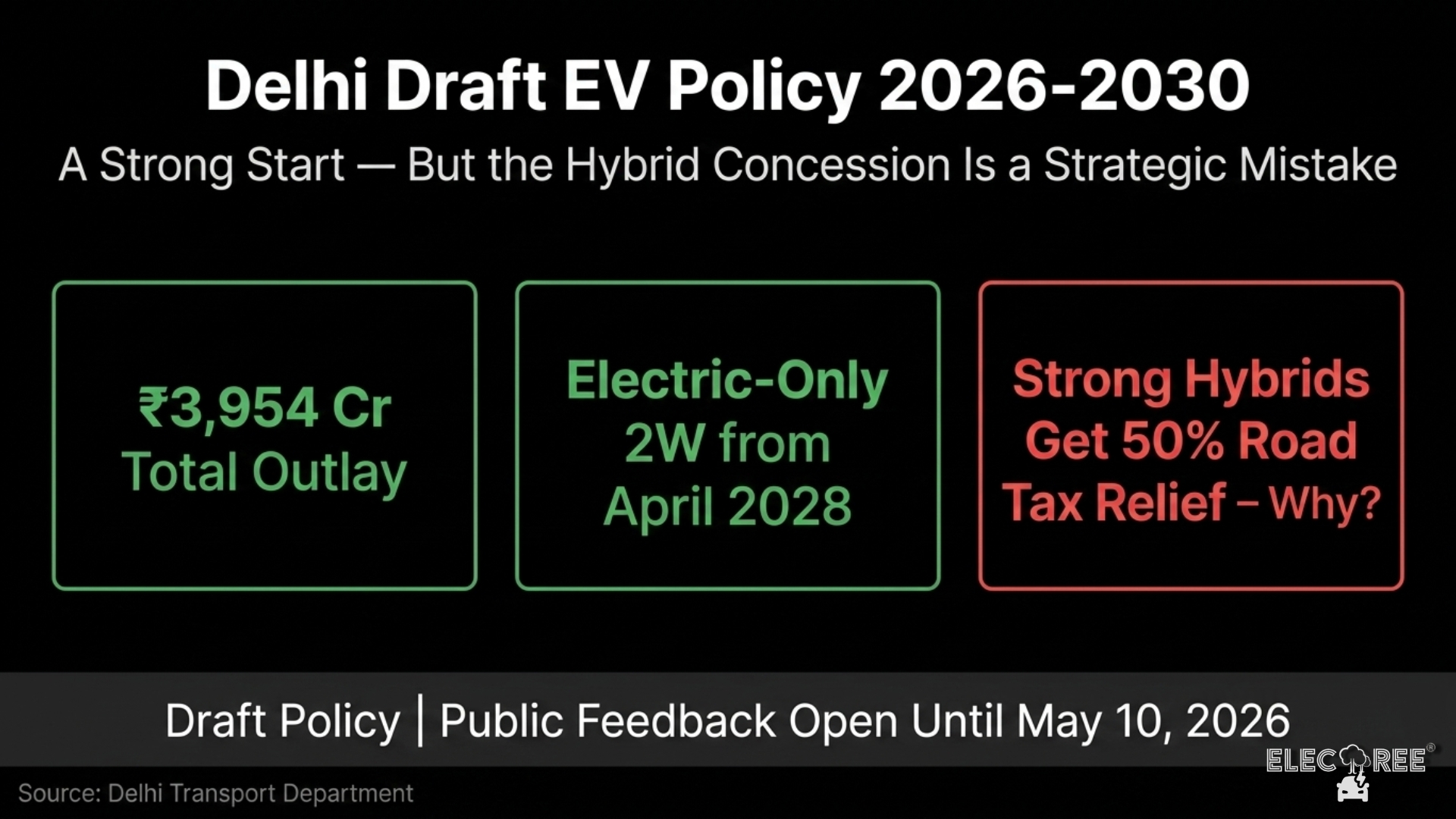
The Delhi government released the Draft Electric Vehicle Policy 2026-2030 on April 11, 2026. With a total outlay of ₹3,954.25 crore and a clear set of mandates, incentives, and timelines, it is the most comprehensive EV policy framework Delhi has proposed to date. The draft is open for public feedback for 30 days — until May 10, 2026 — before finalization.
Here is what the policy proposes, followed by my assessment.
What the Policy Proposes
Mandatory electrification timelines
The policy sets two hard deadlines. From January 1, 2027, only electric three-wheelers will be permitted for new registration in Delhi. From April 1, 2028, only electric two-wheelers will be permitted for new registration. These are not targets — they are registration bans on ICE vehicles in those segments.
For commercial operators, the transition is immediate. Fleet aggregators and delivery service providers — including Ola, Uber, Zomato, Swiggy, and similar platforms — cannot add new ICE two-wheelers or light goods vehicles (up to 3.5 tonnes) to their fleets from January 1, 2026. Existing BS6 two-wheelers in commercial use get until December 31, 2026.
Road tax and registration exemptions
All EVs registered in Delhi during the policy period will receive 100% exemption on road tax and registration fees — provided the vehicle is priced up to ₹30 lakh ex-showroom. EVs priced above ₹30 lakh will not be eligible.
Strong hybrid vehicles priced under ₹30 lakh will receive a 50% concession on road tax and registration fees. This is the first time Delhi has extended any road tax benefit to hybrids.
Purchase incentives
Incentives are time-bound and decline over three years to encourage early adoption:
For electric two-wheelers priced up to ₹2.25 lakh — Year 1: ₹10,000 per kWh, capped at ₹30,000 | Year 2: ₹6,600 per kWh, capped at ₹20,000 | Year 3: ₹3,300 per kWh, capped at ₹10,000.
For electric three-wheelers — Year 1: ₹50,000 | Year 2: ₹40,000 | Year 3: ₹30,000.
For electric light commercial vehicles (N1 category) — Year 1: ₹1,00,000 | Year 2: ₹75,000 | Year 3: ₹50,000.
Scrapping incentives
Owners who scrap a BS-IV or older Delhi-registered vehicle and purchase a new EV within six months will receive additional scrapping incentives — ₹10,000 for two-wheelers, ₹25,000 for three-wheelers, ₹1,00,000 for cars (first one lakh applicants, vehicle under ₹30 lakh), and ₹50,000 for goods vehicles.
Infrastructure
Delhi Transco Limited has been designated as the nodal agency for planning and implementing charging and battery swapping networks. A dedicated digital portal will be developed for approvals and monitoring. All OEMs operating in Delhi must install at least one public charging station at each dealership.
Government fleet and public transport
All new government-hired or owned vehicles will be electric from the date of policy notification. New Delhi Transport Corporation buses will be electric, with hydrogen as a future option. School buses must be 10% electric by Year 2, 20% by Year 3, and 30% by March 2030.
Budget allocation
Of the total ₹3,954.25 crore outlay — ₹1,236.25 crore is for purchase incentives, ₹1,718 crore for scrapping incentives, and ₹1,000 crore for charging infrastructure.
Author's Assessment
What the policy gets right
The ₹30 lakh ceiling for road tax exemption is well-calibrated for the current Indian 4W EV market. Contrary to what some may assume, this ceiling does not exclude mainstream EVs. The Mahindra BE 6 is priced from ₹18.90 to ₹26.90 lakh. The Hyundai Creta Electric tops out at ₹23.50 lakh. The MG ZS EV goes up to ₹23.50 lakh. The Tata Nexon EV, Tata Punch EV, and Tata Curvv EV all fall well within the ceiling. The policy correctly identifies where the mainstream 4W EV market actually sits and makes the incentive accessible to the vehicles that most buyers are actually buying.
The commercial fleet mandate — banning ICE additions to aggregator fleets from January 2026 — is the right call. Delivery two-wheelers clock far higher daily kilometres than private vehicles, meaning the emission reduction per vehicle converted is significantly higher.
The 2W mandate is the real story
Two-wheelers constitute approximately 67% of Delhi's total vehicle stock. Every serious analysis of Delhi's air pollution problem leads back to this segment. The mandatory electric-only 2W registration from April 2028 is the most consequential provision in the entire policy — more so than any of the 4W incentives. If this mandate holds through implementation, it will structurally alter Delhi's vehicular emission profile in a way that no amount of 4W EV subsidies ever could.
The hybrid concession is a strategic mistake
This is where the policy loses the plot — and it deserves to be said clearly.
A strong hybrid vehicle carries a battery of typically 1.1 to 2 kWh. For context, the Tata Punch EV carries a 40 kWh battery. A strong hybrid's battery is not a meaningful energy storage device — it is a recuperation aid that captures braking energy and uses it to reduce engine load marginally. The strong hybrid still runs on petrol or diesel for every single kilometre it travels. It cannot be plugged in. It cannot run on grid electricity. It will never reduce India's crude oil import bill by a single barrel.
Giving a strong hybrid 50% road tax relief — in the same policy framework as full EVs — creates a false equivalence that is not supported by the underlying physics or the strategic energy security imperative.
This matters beyond Delhi. India just lived through a 40-day Strait of Hormuz closure. Crude hit $126 per barrel. My own stress test analysis showed that at $130 per barrel, India's additional crude import burden is approximately $68-69 billion — every year, for as long as ICE vehicles run. A strong hybrid does nothing to change that structural dependency. It simply burns slightly less fuel while burning fuel indefinitely.
In this context, granting strong hybrids a policy benefit alongside full EVs sends the wrong signal to both manufacturers and buyers. It tells the market that a vehicle which remains permanently dependent on imported fuel is almost as desirable from a policy perspective as one that eliminates that dependency entirely.
The Delhi government should reconsider this provision. If the goal is to reward fuel efficiency, there are better mechanisms — lower road tax tiers based on fuel consumption ratings, for instance — that do not blur the fundamental distinction between a vehicle that needs crude oil forever and one that does not.
What You Can Do
The Delhi Draft EV Policy 2026-2030 is open for public feedback until May 10, 2026.
If you agree that the strong hybrid concession is misaligned with Delhi's stated goal of reducing vehicular pollution and India's strategic interest in reducing fuel import dependency — write to the Delhi government at evpolicy2026@gmail.com.
Citizen feedback on draft policies matters. This is the window to use it.
Trending Articles


Recent Articles
Renault Duster Hybrid vs Maruti Victoris Hybrid: All Variants Compared
Duster Hybrid vs Hyryder Hybrid: Prices, Powertrain and Variants Compared
Top 5 Best Selling EVs This Year: Windsor Leads with Clear Margin
Renault Duster Hybrid vs Maruti Suzuki Grand Vitara Hybrid: Base, Mid, and Top Variant Comparison