
India’s upcoming Battery Aadhaar system could allow EV owners to verify battery health, lifecycle history and replacement authenticity through a QR-based digital identity framework.

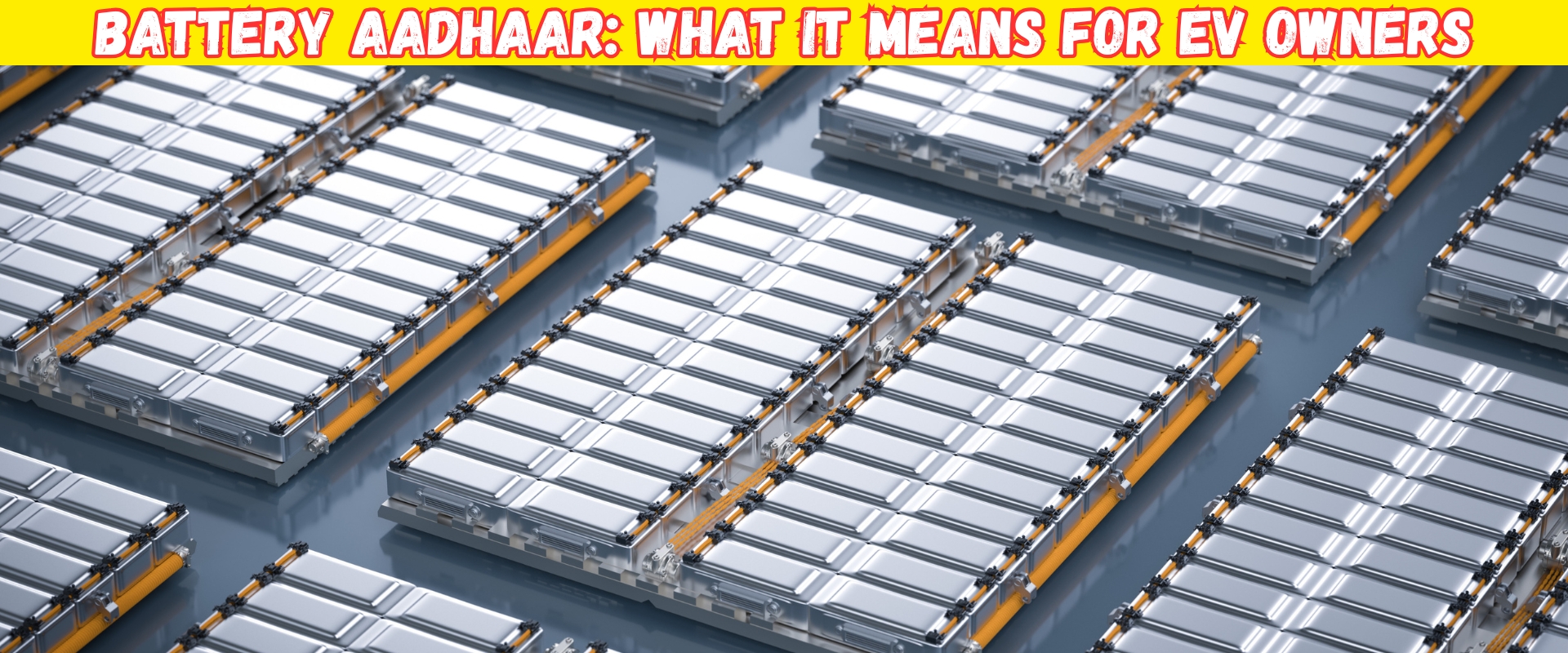
When most people buy an electric vehicle, they think about range, charging speed and running costs. Very few think about what happens if the battery needs to be replaced four or five years down the line.
That may soon change.
India is moving toward a unified “Battery Aadhaar” framework — a digital identity system that will assign every EV battery pack a unique 21-character number linked to a QR code. While the initiative is being discussed in regulatory and industry circles, its real impact may be felt most strongly by everyday EV owners.
Because for the first time, buyers could gain visibility into the full lifecycle of the most expensive component in their vehicle.
Consider a simple scenario.
An EV owner experiences battery degradation after several years of usage. The manufacturer approves a battery replacement under warranty. Today, the owner has little visibility into the replacement pack. Is it brand new? Is it refurbished? Has it been used before? What is its actual State of Health?
Under the proposed Battery Aadhaar system, that ambiguity may reduce significantly. Each battery pack would carry a unique Battery Pack Aadhaar Number (BPAN), tied to a digital record. Scanning the QR code could potentially reveal when the battery was manufactured, its chemistry, its original production batch, and dynamic data such as charge cycles, thermal history and State of Health. For the first time, battery replacements may become verifiable rather than trust-based. That shift alone could transform buyer confidence.
The framework is designed to do more than assign serial numbers. It aims to build lifecycle traceability — tracking a battery from manufacturing to deployment, through operational usage, and eventually to recycling or repurposing.
Dynamic parameters such as State of Health and usage cycles are expected to be part of this traceable data ecosystem. This is particularly important in a market where battery safety, resale value and warranty disputes have increasingly become discussion points.
Battery traceability can also support clearer root-cause analysis in case of thermal incidents. Instead of speculation, batch-level data and lifecycle documentation could provide clarity.
For used EV buyers, this may eventually mean being able to verify battery health before making a purchase — something that today often depends on dealership claims or third-party diagnostics.
As India aligns its framework with global battery passport standards — including those emerging in the European Union — ecosystem players have started signaling readiness.
Tata Technologies, in a recent communication, stated that its battery intelligence platform WATTSync is aligned with India’s upcoming Battery Aadhaar digital identity requirements as well as EU battery passport norms. The platform focuses on QR-based digital identity, lifecycle tracking and secure data integration.

While multiple stakeholders will ultimately participate in implementing Battery Aadhaar, the messaging suggests that digital infrastructure for traceability is already under development.
Battery Aadhaar could influence far more than compliance checklists. Manufacturers may benefit from stronger supply chain traceability and export readiness. Recyclers could gain structured data on battery origin and material composition, supporting India’s circular economy goals. Regulators would gain better oversight across the battery lifecycle.
But at the center of it all is the buyer.
In a market where EV adoption is accelerating, transparency becomes critical. If buyers know that a battery’s identity, health and lifecycle history are digitally documented and verifiable, trust in the product increases. And trust is often what drives long-term adoption.
India’s electric mobility journey has largely been defined by price battles, charging expansion and product launches. Battery Aadhaar introduces something more foundational — accountability and traceability. If implemented effectively, it may not grab headlines every day. But it could quietly become one of the most important structural reforms in India’s EV ecosystem.
Suhail Gulati
Suhail Gulati is the founder of ElecTree and an economist by training. He holds a Master's degree in Economics from the Delhi School of Economics and has worked in credit, retail banking, and financial stress testing at Barclays and American Express. He founded ElecTree in 2023 — building it into India's dedicated platform for 4-wheeler EV data, sales analysis, and original reporting. His work sits at the intersection of economic analysis and electric mobility — bringing a banker's rigour to a sector that deserves it.