Shell Unveils Triple 10 Challenge Concept Car: Redefining Efficiency in Electric Vehicles
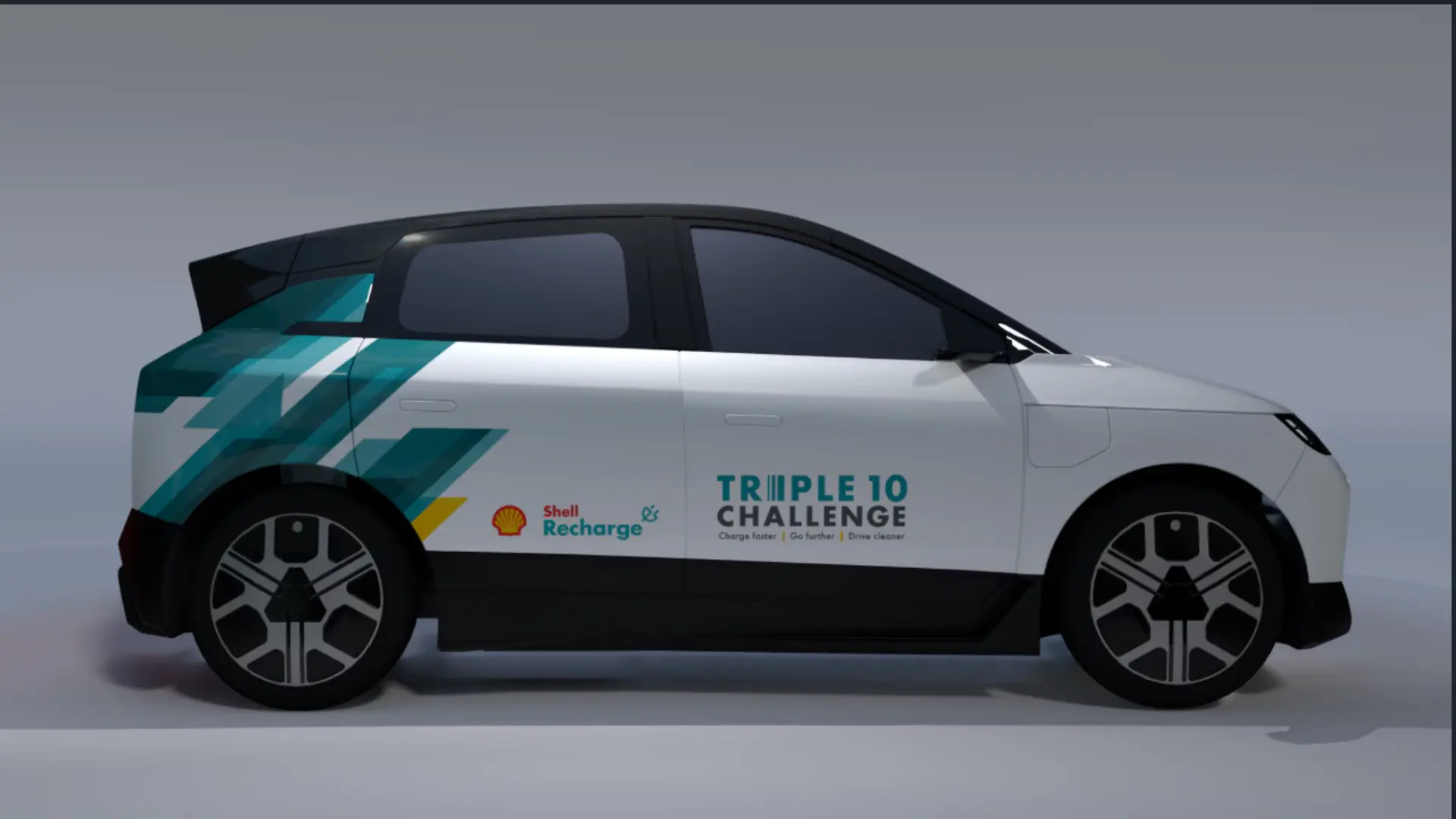
Shell has revealed the Triple 10 Challenge, a concept electric vehicle that aims to charge from 10-80% in under 10 minutes, deliver 10 km/kWh efficiency, and achieve a low 10-tonne lifecycle CO₂ footprint through advanced direct immersion cooling technology.


Category:
Tag:
- Shell Triple 10 Shell Concept Car EV Innovation Fast Charging EV Electric Vehicle Technology
Shell has introduced the Triple 10 Challenge, an innovative concept electric vehicle aimed at demonstrating how future mass-market EVs can become significantly more efficient without depending on increasingly larger and heavier batteries.
The concept sets three ambitious performance targets, which are collectively known as the “Triple 10”:
- Charge from 10% to 80% in under 10 minutes
- Achieve 10 km per kWh energy efficiency
- Maintain a lifecycle carbon footprint of around 10 tonnes CO₂e
Core Innovation: Advanced Thermal Management
The standout feature of the Triple 10 Challenge car is its revolutionary thermal management system. Instead of conventional water-glycol cooling with complex piping, Shell has used direct immersion cooling with its new Shell Recharge thermal fluid, a non-conductive dielectric liquid that directly surrounds the battery cells and powertrain components.
This simplified single-circuit cooling system reduces vehicle weight, simplifies battery pack design, and enables much faster charging while maintaining thermal stability.
Impressive Real-World Performance
According to Shell, the concept car has achieved:
- 10% to 80% charge in 9 minutes 54 seconds on a standard 175 kW DC charger, adding approximately 24 km of range per minute, nearly double the typical 13 km/minute seen in many current EVs.
- Overall efficiency of 10 km/kWh, which is around 30% better than many present-generation electric vehicles.
- An estimated lifecycle carbon footprint of just 10 tonnes CO₂e, roughly 50% lower than typical European EVs.
The more compact battery pack design is also expected to reduce battery pack costs by around 25% compared to traditional layouts.
Collaborative Development
Shell developed this concept in partnership with leading British engineering companies:
- RML Group - Responsible for the innovative battery pack architecture.
- Empel Systems - Developed the high-efficiency electric motors and drive units.
- HORIBA MIRA - Handled vehicle integration, testing, and extreme-condition validation.
Strategic Shift by Shell
Alongside the concept reveal, Shell announced the consolidation of all its electric mobility solutions - charging, thermal fluids, and battery-related offerings, under the unified Shell Recharge brand. The previous Shell EV-Plus brand has been retired.
Why This Concept Matters
The Triple 10 Challenge is not about Shell entering the car manufacturing business. It is a technology demonstrator intended to show automakers that smarter thermal management can solve some of the biggest challenges facing electric vehicles today - slow charging, heavy batteries, and high costs.
By proving these improvements are possible using technologies that exist today, Shell hopes to influence the design of future EVs, making them lighter, more affordable, faster to charge, and more sustainable overall.
For markets like India, where fast charging and high efficiency are critical for mass adoption, concepts like this could play an important role in shaping more practical and accessible electric vehicles in the coming years.
To comment and participate in discussion Click Here
Trending Articles